


TL;DR:
- Small businesses accept digital tips because they increase revenue and match customer payment habits. Implementing QR codes or payment links requires no extra hardware and simplifies tip tracking and compliance. Proper placement of prompts immediately after service boosts tips and builds customer loyalty.
Digital tipping is defined as the practice of collecting gratuity through mobile payments, QR codes, or payment links instead of physical cash. Small businesses accept digital tips because they directly increase tip income, reduce cash handling risks, and align with how customers already pay. Businesses adopting digital tip prompts see a 22% increase in average tips compared to cash-only operations. That number reflects a structural shift: customers who carry no cash still want to tip, and digital systems close that gap. For small business owners exploring the benefits of digital tipping, the case is straightforward and backed by real data.
Why small businesses accept digital tips and earn more
The core reason small businesses accept electronic tips is revenue. A 22% lift in average tip amounts is not a rounding error. It represents real income for service workers and real margin protection for business owners who operate on thin profits.
The mechanism is simple. Customers who intend to tip often skip it when they have no cash. A digital prompt at the right moment removes that barrier entirely. Timing tip prompts immediately after service completion increases tipping conversion rates. That means a coffee shop presenting a tip screen at checkout, or a salon texting a payment link right after an appointment, captures tips that would otherwise be lost.
The impact of digital tips on sales extends across many service categories:
- Coffee shops and cafes: Counter staff receive tips at checkout through tablet prompts, capturing gratuity from card and mobile pay customers who carry no cash.
- Hair salons and barbershops: Payment links sent via text after a service let clients tip at their own pace without awkward in-person moments.
- Car washes and auto detailers: QR codes posted at pickup points let customers tip the crew without hunting for dollar bills.
- Food delivery and catering: Digital tip options built into order confirmations capture gratuity before the customer closes the app.
- Freelancers and mobile service providers: A personalized tip link shared after a job is complete lets clients reward good work instantly.
Pro Tip: Place your digital tip prompt at two moments: right after service completion and again in your follow-up receipt or confirmation message. Double exposure significantly improves conversion without feeling pushy.
How does digital tipping improve customer loyalty?
Customer loyalty follows convenience. When paying is easy, customers return. Digital tipping fits directly into the payment habits most customers already use, including Apple Pay, Google Pay, and card tap payments.
The shift away from cash is not a preference. It is a behavioral reality. Customers who pay by card or phone have no physical cash to leave behind. A business that only accepts cash tips is invisible to a growing portion of its own customer base. Accepting electronic tips means every customer, regardless of how they pay, has a path to show appreciation.
Personalization deepens that connection. Staff profiles and preset tip percentages boost customer engagement and tipping rates by making the experience feel personal rather than transactional. When a customer sees a name and photo attached to a tip prompt, they are tipping a person, not a machine.
Here is how small businesses can build loyalty through their digital tipping setup:
- Display staff names and photos on tip screens or payment links so customers feel a direct connection to the person they are rewarding.
- Offer three preset tip amounts (for example, $2, $3, or $5 for a coffee order) so customers decide quickly without mental friction.
- Send a thank-you message after a tip is received. Platforms like Tipper allow businesses to respond with a personal note or short video, which turns a transaction into a relationship.
- Keep the interface clean and fast. A tip screen that takes more than two taps to complete loses customers mid-process.
Pro Tip: A thank-you video from the staff member who provided the service is one of the highest-converting follow-ups you can send. Customers who receive one are far more likely to tip again on their next visit.
What are the operational benefits of digital tipping?
Digital tipping does more than increase revenue. It reduces the administrative burden that comes with managing cash gratuity across a team.

Automated tracking and tax compliance
Digital tipping platforms automate tip distribution and minimize human error in tip reconciliation. For a small business owner managing payroll manually, this matters. Tip income must be reported accurately for tax purposes, and cash systems rely entirely on employee self-reporting. Automation removes that dependency and produces records that hold up to IRS scrutiny.
Reduced cash handling risk
Digital tipping reduces cash theft risks by limiting the amount of physical money on the premises. Less cash means fewer opportunities for miscounting, disputes between staff, or outright theft. For a small business with a tight team, that security improvement has real value.
Transparency for staff and owners
Tip transparency gives both customers and employees access to detailed tip reports. Staff can see exactly what they earned and when. Owners can verify distribution without relying on manual logs. That clarity reduces conflict and builds trust within the team.
The table below compares cash tip management against digital tip management across the operational factors that matter most to small businesses.
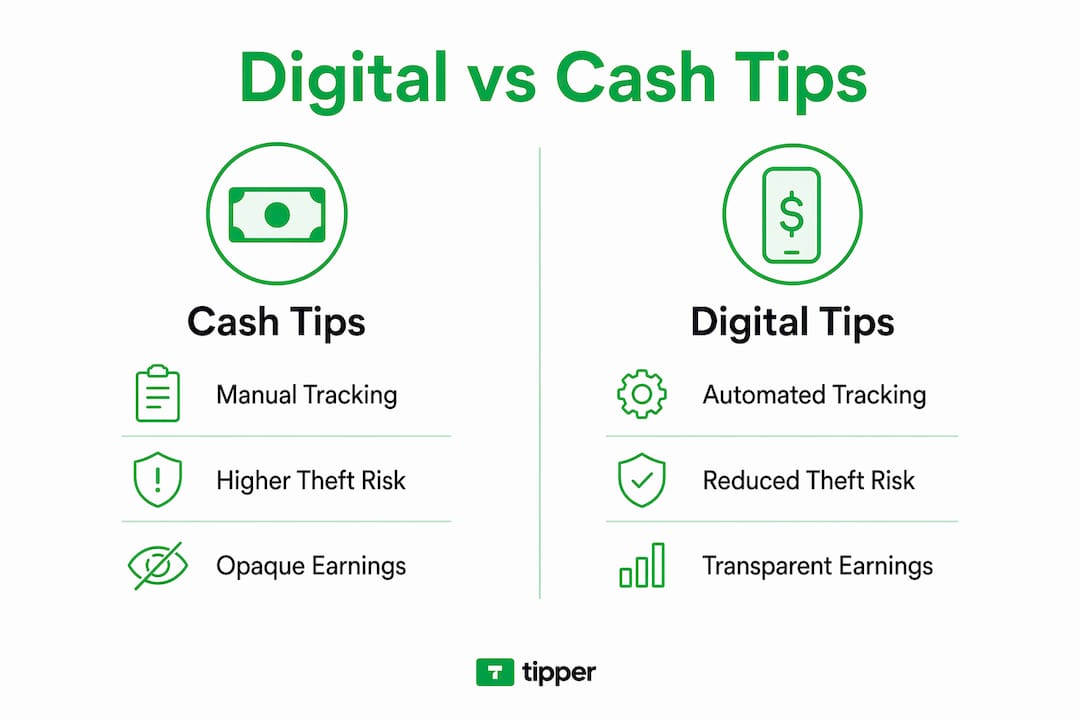
| Operational factor | Cash tip management | Digital tip management |
|---|---|---|
| Tip tracking accuracy | Manual, error-prone | Automated, real-time records |
| Tax compliance | Relies on self-reporting | Automated reporting built in |
| Security | Cash on premises, theft risk | No physical cash, reduced risk |
| Staff transparency | Informal, dispute-prone | Detailed reports for all parties |
| Customer reach | Cash carriers only | All payment types included |
How can small businesses start accepting digital tips?
The most common reason small business owners delay digital tipping adoption is a false belief that it requires expensive hardware or complex point-of-sale integration. QR codes and NFC enable instant tipping via digital wallets without requiring POS integration or app downloads. That changes the math entirely.
Small businesses can start digital tipping with simple tools like printed QR code cards, requiring minimal training and no expensive equipment. A QR code printed on a card stock and placed at a counter costs almost nothing. It works with any smartphone camera and connects directly to a payment link.
Practical setup steps for any small business:
- Generate a tip link or QR code through a platform like Tipper. No app download is required for the customer. They scan, choose an amount, and pay with Apple Pay or Google Pay in seconds.
- Place prompts at high-visibility touchpoints: the checkout counter, the service station, the table, the front door on exit, and the follow-up receipt email.
- Brief your staff in under 10 minutes. The conversation is simple: “We now accept tips by phone. If a customer asks how, show them the QR code.” No technical training needed.
- Use a cashless tipping setup guide to map out which customer touchpoints in your specific business will generate the most tip conversions.
- Test and adjust placement. A QR code at eye level on a counter outperforms one taped to the bottom of a receipt. Move prompts based on where customers naturally pause.
The businesses that see the fastest results are those that treat digital tipping as a customer experience feature, not a back-office tool. When the prompt feels natural and the payment takes seconds, customers follow through. Local businesses that have studied how digital tipping benefits their revenue consistently report that placement and timing matter more than the specific platform used.
Key Takeaways
Small businesses that accept digital tips increase average tip income, reduce cash handling risks, and build stronger customer loyalty by meeting customers where they already pay.
| Point | Details |
|---|---|
| Revenue lift is documented | Businesses using digital tip prompts see a 22% increase in average tips versus cash-only operations. |
| Timing drives conversion | Presenting a tip prompt immediately after service completion captures gratuity that would otherwise be lost. |
| No hardware required | QR codes and NFC tags enable digital tipping without POS upgrades or app downloads for customers. |
| Operations improve automatically | Automated tip tracking reduces payroll errors, improves tax compliance, and eliminates cash theft risk. |
| Loyalty follows convenience | Personalized tip interfaces with staff profiles and preset amounts increase customer engagement and repeat visits. |
The part most small business owners get wrong about digital tipping
Most small business owners I talk with frame digital tipping as a technology decision. They ask which platform to use, whether it integrates with their POS, and how much it costs. Those are the wrong first questions.
The real question is simpler: are your customers leaving without tipping because the option is not there? If you accept card payments and you do not have a digital tip option, the answer is almost certainly yes. The technology is the easy part. A QR code on a card costs nothing. Tipper lets customers tip through a personalized link using Apple Pay or Google Pay, with no account required on their end. The barrier to starting is lower than most owners realize.
What I find more interesting is the employee side of this equation. Staff morale in service businesses is directly tied to tip income. When tips increase by a meaningful amount and arrive consistently, turnover drops. That is a real operational benefit that rarely shows up in the marketing language around digital tipping, but it shows up clearly in the day-to-day experience of running a service business.
The one caution worth naming is tipping fatigue. Customers who feel prompted to tip at every interaction, including self-service kiosks and fast-food counters, are starting to push back. The solution is not to avoid digital tipping. It is to place prompts where they genuinely make sense and to keep the experience fast and pressure-free. A well-placed QR code that takes three seconds to use will never feel aggressive. A full-screen tip prompt that blocks the checkout screen might.
— Tipper
Tipper makes digital tipping simple for small businesses
Small business owners who want to start collecting digital tips do not need a complicated setup. Tipper gives you a personalized tip link that customers can use instantly with Apple Pay or Google Pay, no account required on their end.
You keep 100% of every tip. Tipper handles the payment processing, sends real-time notifications, and lets you respond to supporters with a personal thank-you note or video. Whether you run a salon, a food truck, or a freelance service, start collecting tips in minutes with no hardware and no technical setup. For businesses ready to go further, the QR code tipping guide covers exactly how to place prompts for maximum results.
FAQ
Why do small businesses accept digital tips instead of cash?
Digital tips capture gratuity from customers who carry no cash, which is a growing majority of card and mobile pay users. Businesses using digital tip prompts see a 22% increase in average tips compared to cash-only operations.
Do I need special equipment to accept digital tips?
No special equipment is required. QR codes and NFC tags enable instant tipping through digital wallets without POS integration or app downloads, making setup accessible for any small business.
How does digital tipping help with taxes and payroll?
Digital tipping platforms automate tip tracking and distribution, producing accurate records that support tax compliance and reduce manual payroll errors for small business owners.
Does digital tipping improve employee satisfaction?
Higher and more consistent tip income directly improves staff morale and reduces turnover in service businesses. Transparent tip reporting also eliminates disputes over distribution.
When is the best time to show a digital tip prompt?
The highest-converting moment is immediately after service completion. A follow-up prompt in a receipt email or confirmation message provides a second opportunity without feeling intrusive.




Leave A Comment