


TL;DR:
- Creators can accept tips without invoicing by using digital payment links or QR codes that support various payment methods. Proper recordkeeping and transparent labeling increase tip frequency while ensuring IRS compliance and tax reporting. Tipper simplifies instant, account-free tipping that aligns with legal and tax requirements.
Accepting tips without invoicing is defined as collecting voluntary, non-invoiced payments from clients or audiences through digital payment links, personalized tip pages, or contactless methods. This practice is fully legal for content creators and freelancers when tips are genuinely voluntary and properly reported to the IRS. The IRS treats voluntary tips as taxable income, and Form 1099-K applies when payment platforms process tips above reporting thresholds. Tipper is one platform built specifically for this workflow, letting creators receive real-time appreciation payments without generating a single invoice.
How to accept tips without invoicing: the best digital tools
The fastest way to collect non-invoiced tips is through a personalized payment link or QR code that sends money directly to your account. These tools remove the need for invoices entirely because the transaction is voluntary and initiated by the supporter, not requested by the creator.

Payment methods available for tip collection include credit and debit cards, Apple Pay, Google Pay, PayPal, and cryptocurrency wallets. Each method carries different setup requirements and tracking capabilities.
| Method | Setup effort | Payer account required | Tracking |
|---|---|---|---|
| Personalized tip link (e.g., Tipper) | Low | No | Built-in dashboard |
| Direct PayPal link | Low | Yes (payer) | Basic transaction log |
| Crypto wallet address | Medium | Yes (payer) | Manual or third-party |
| QR code on website or bio | Low | Depends on processor | Varies by processor |
Platforms that support no-account tipping settle funds directly to connected PayPal or crypto wallets with no intermediary balance. That means your supporter pays instantly and you receive the money without holding it in a platform wallet first.
One often-overlooked detail: the label you use on your tip page changes how often people actually tip. Dedicated “Tips” pages generate higher tip volume than pages labeled “Donations,” because “donation” carries a heavier psychological decision weight. Casual supporters tip more freely when the ask feels light.
Pro Tip: Offer 3–4 preset tip amounts rather than an open-ended field. Preset options reduce decision friction and increase conversion rates for micro-tips.
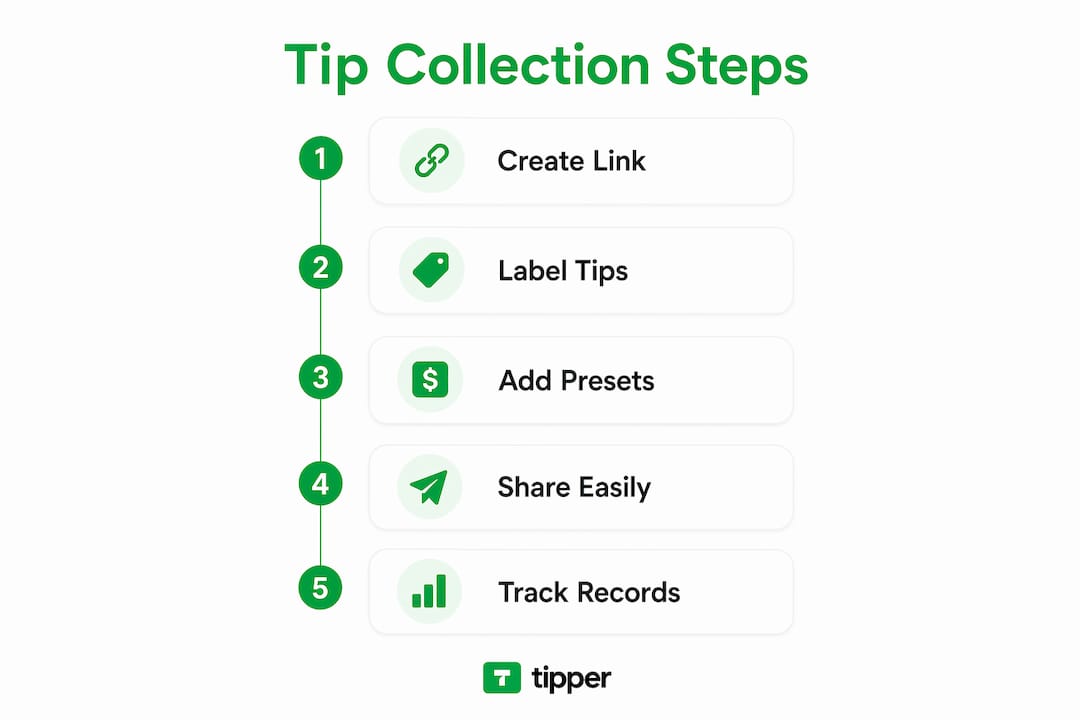
How to set up a simple tip collection system
Setting up a tip collection system takes less than 30 minutes when you use the right platform. The prerequisites are minimal: a payment account (PayPal, a bank account, or a crypto wallet) and a platform that generates a shareable link or QR code.
Here is a step-by-step setup process:
- Create an account on a tipping platform like Tipper or connect your existing PayPal account to a link generator.
- Set your tip page name. Use “Tips” or “Support [Your Name]” rather than “Donate.”
- Configure 3–4 preset tip amounts. Common starting points are $3, $5, $10, and $25.
- Add a short description explaining what the tips support (your content, your stream, your work).
- Copy your personalized link or download your QR code.
- Place the link in your social media bio, YouTube description, Linktree, or website footer.
- For livestreams, pin the link in chat or display the QR code on screen.
The table below compares three setup tiers based on creator needs:
| Setup tier | Time to launch | Best for | Key feature |
|---|---|---|---|
| Quick (link only) | Under 10 minutes | New creators | Shareable URL, no design needed |
| Mid (tip page) | 15–30 minutes | Active streamers | Preset amounts, branded page |
| Advanced (QR + web embed) | 30–60 minutes | Freelancers with websites | In-person and online tipping |
The most common setup mistake is using a generic payment link without labeling it as tips. Supporters who land on an unlabeled payment page often abandon the transaction because they are unsure what they are paying for. Clear labeling removes that hesitation.
Pro Tip: Always use an HTTPS link for your tip page. An insecure link signals risk to supporters and reduces trust before they even enter payment details. Check your contactless tip collection setup to confirm your link is secure.
Do you need to report tips received without invoices?
Yes. The IRS treats all voluntary tips as taxable income, regardless of whether an invoice was issued. This is the most misunderstood part of non-invoiced tipping for freelancers and creators.
Eligible creators may deduct up to $25,000 in qualified tip income for tax years 2025–2028, but only if tips are genuinely voluntary and reported on an information return such as Form 1099-K. That deduction phases out at incomes above $400,000 ($550,000 for married filing jointly). This is a meaningful tax benefit, but it requires clean records to claim.
IRS 2026 rules confirm that only voluntary tips where the customer fully controls the amount qualify for deductions. Automatic gratuities and mandatory charges are excluded. Anti-abuse rules now prevent reclassifying wages as tips to capture the deduction.
IRS 2026 regulations tighten this definition further. A tip must be entirely at the discretion of the supporter, with no employer influence over the amount. For creators, this means tips received through open tip pages qualify. Bundled “tip plus service” packages may not.
Here are the compliance essentials every creator should follow:
- Keep a digital ledger of every tip received, including the date, amount, and platform.
- Do not rely on platform transaction logs alone. Payment platforms are money-transfer logs, not tax receipts.
- Add a brief contemporaneous note for each tip explaining the business context (e.g., “tip received after livestream on March 14, 2026”).
- Track tips separately from client payments to avoid misclassification.
- Report all tip income on your annual return, even if you do not receive a Form 1099-K.
- Do not reclassify service fees as tips to claim the deduction. The IRS anti-abuse rules target exactly this.
The IRS $75 receipt rule applies to business expenses, not income, but the underlying principle carries over: a bank record plus a contemporaneous note is the minimum standard for audit defense in 2026. Apply that same discipline to your tip income records.
Common challenges when receiving tips without invoices
The biggest practical problem creators face is inconsistent recordkeeping. Tips arrive across multiple platforms at different times, and without a system, they become impossible to reconcile at tax time.
Digital ledgers are mandatory for freelancers who receive tips digitally, because payment platforms do not provide business-related documentation required for taxes. A spreadsheet updated weekly is the minimum. A dedicated accounting tool is better.
Common mistakes and how to fix them:
- Broken tip links: Test your tip link monthly. A misconfigured link is the top reason supporters abandon the tip flow. Redirect old links if you change platforms.
- No preset amounts: Open-ended fields reduce tip frequency. Add preset amounts to your tip page immediately if you have not already.
- Missing platform records: Download your transaction history from every payment platform at the end of each month. Do not wait until tax season.
- Mixing tip income with client payments: Use a separate bank account or at minimum a separate ledger column for tips. Mixing the two creates classification errors.
- Ignoring tip notifications: Set up email or push notifications for every tip received. This creates a real-time record and lets you send a thank-you promptly.
Technical payment failures are less common but do happen. If a supporter reports a failed payment, check whether your connected account is verified and whether the payment method is supported in their region. Most platforms surface these errors in a transaction log.
Pro Tip: Review your freelancer tipping workflow quarterly. Update preset amounts, refresh your tip page description, and reconcile your ledger against platform reports to catch discrepancies early.
Key Takeaways
Creators and freelancers can accept tips without invoicing legally and efficiently by using digital tip pages, preset payment options, and consistent recordkeeping that satisfies IRS requirements.
| Point | Details |
|---|---|
| Tips are taxable income | Report all voluntary tips on your annual return, even without a Form 1099-K. |
| Label matters | Use “Tips” not “Donations” on your payment page to increase tip frequency. |
| Preset amounts convert better | Offer 3–4 fixed tip options to reduce decision friction for supporters. |
| Platform logs are not enough | Add contemporaneous notes to every tip record for IRS audit defense. |
| Tipper removes the invoice step | Tipper lets creators receive tips instantly via Apple Pay, Google Pay, or card with no payer account required. |
Why frictionless tipping beats formal invoicing for creators
Formal invoicing creates a power imbalance that works against spontaneous appreciation. When a supporter wants to say “great work” with $5, a PDF invoice kills that impulse entirely. The moment you add a line item, a due date, and a payment reference number, you have turned a gift into a transaction.
What I have observed consistently is that the creators who earn the most from tips are not the ones with the largest audiences. They are the ones who make tipping feel effortless and natural. A well-placed tip link in a YouTube description or a QR code at the end of a livestream captures the exact moment when a supporter feels most generous.
The compliance side does not have to be complicated either. A weekly five-minute habit of logging tips in a spreadsheet satisfies IRS requirements and takes less time than generating a single invoice. The cashless tipping setup for small businesses and creators follows the same logic: keep it simple, keep it consistent.
The future of non-invoiced tipping points toward even lower friction. Apple Pay and Google Pay already let supporters tip in two taps. As biometric payments expand, that number will drop to one. Creators who build tipping into their content workflow now will have a structural advantage as payment technology catches up to audience behavior.
— Tipper
Tipper makes tip collection simple for creators
Tipper is built for creators and freelancers who want to accept tips instantly without generating invoices, chasing payments, or asking supporters to create accounts. Your personalized Tipper link works with Apple Pay, Google Pay, and all major cards, so supporters can tip in seconds from any device.
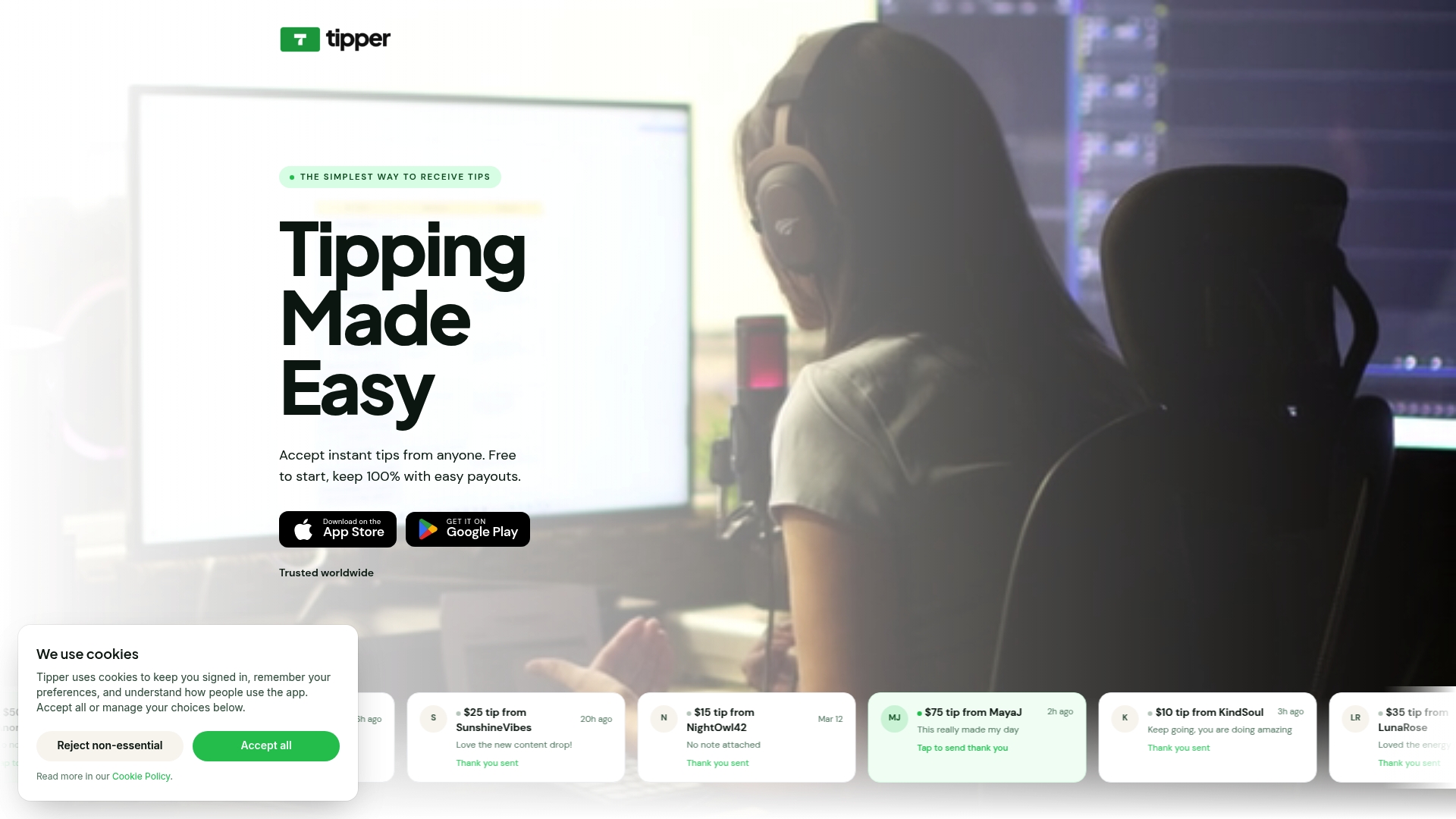
Tipper keeps 0% of your earnings. Every tip goes directly to you, with withdrawal options that fit your schedule. Your tip page is branded, shareable, and ready to embed in any bio, website, or livestream. Supporters can also leave a thank-you note or video message, which turns a one-time tip into a real connection. For creators who want a clean, compliant, and personal way to receive appreciation, Tipper is the direct path from audience to income.
FAQ
Do I have to report tips if I never send an invoice?
Yes. The IRS requires you to report all voluntary tip income regardless of whether an invoice was issued. Tips are taxable income in every case.
What is the difference between a tip and a donation for tax purposes?
Tips are voluntary payments for a service or content you provided and are taxable income. Donations to a qualified nonprofit are tax-deductible for the giver. For creators and freelancers, payments from supporters are tips, not donations.
Can I deduct tip income under the 2025 tax law?
Eligible individuals can deduct up to $25,000 in qualified tip income for tax years 2025–2028, provided tips are voluntary and reported on a qualifying information return. The deduction phases out above $400,000 in income.
How do I keep records of tips I receive without invoices?
Maintain a digital ledger with the date, amount, platform, and a brief note for each tip. Platform transaction logs alone do not satisfy IRS audit requirements, so contemporaneous notes are mandatory.
Does Tipper work without the supporter creating an account?
Yes. Tipper lets anyone send a tip using Apple Pay, Google Pay, or a card without creating an account. That removes the single biggest barrier to spontaneous tipping.




[…] How to Accept Tips Without Invoicing: A Creator’s Guide […]