

Cross-platform tipping is defined as a unified system that lets supporters send money to creators across multiple digital platforms and payment methods through a single underlying flow. Rather than forcing fans to use one app or one payment method, this model connects Discord, Telegram, Twitch, X, Bluesky, and other networks into one tipping experience. Projects like Just The Tips and Tippin’ Dots already demonstrate what this looks like in practice. For creators, freelancers, and influencers, understanding cross-platform tipping means understanding how to stop leaving money on the table every time a fan is on the wrong platform.
What does cross-platform tipping mean technically?
Cross-platform tipping is built on two layers: a set of platform adapters on the front end and a single payment or ledger monitoring system on the back end. The adapters handle how a tip request looks and feels inside Discord, Telegram, or Twitch. The back end handles where the money actually goes.
Just The Tips is the clearest public example of this architecture. It monitors wallet addresses on multiple blockchains simultaneously and posts thank-you messages through modular adapters tied to each platform. The bot itself never holds funds. That non-custodial design means the creator’s money moves directly from the tipper’s wallet to the creator’s address without passing through a middleman.

Tippin’ Dots takes a different angle. It maps decentralized identities (DIDs) to wallet addresses, so tipping works inside apps like Bluesky and Frequency without requiring the creator to set up a separate wallet for each network. Smart contracts handle the DID-to-wallet mapping lazily, meaning the connection is made only when a tip actually arrives. That design removes the friction of forcing every creator to configure crypto wallets before receiving their first tip.
On the payment side, systems like SimpleTip support Stripe Checkout, Apple Pay, Google Pay, PayPal, and regional options like M-Pesa. The specific methods available depend on the node operator’s configuration, but the point is that a single tipping component can serve supporters across card payments, mobile wallets, and crypto rails simultaneously.
Here is how the core technical pieces fit together:
- Platform adapters translate tip commands and notifications into the native language of each app (slash commands on Discord, chat triggers on Twitch, etc.)
- Multi-chain ledger observers watch multiple blockchains at once, so a tip sent on Solana and a tip sent on Arbitrum both register in the same system
- Payment rail integrations connect card networks, digital wallets, and crypto protocols into one unified flow
- DID integrations let creators use a single portable identity across federated or decentralized social networks
Pro Tip: If you are evaluating a cross-platform tipping tool, ask whether it is custodial or observational. Non-custodial systems like Just The Tips never hold your funds, which removes a significant layer of counterparty risk.
What are the benefits of cross-platform tipping for creators?
The core benefit of cross-platform tipping is freedom from platform lock-in. When your revenue depends on one platform’s tipping feature, you are one policy change away from losing that income stream. A unified system means your supporters can tip you from wherever they already spend time.
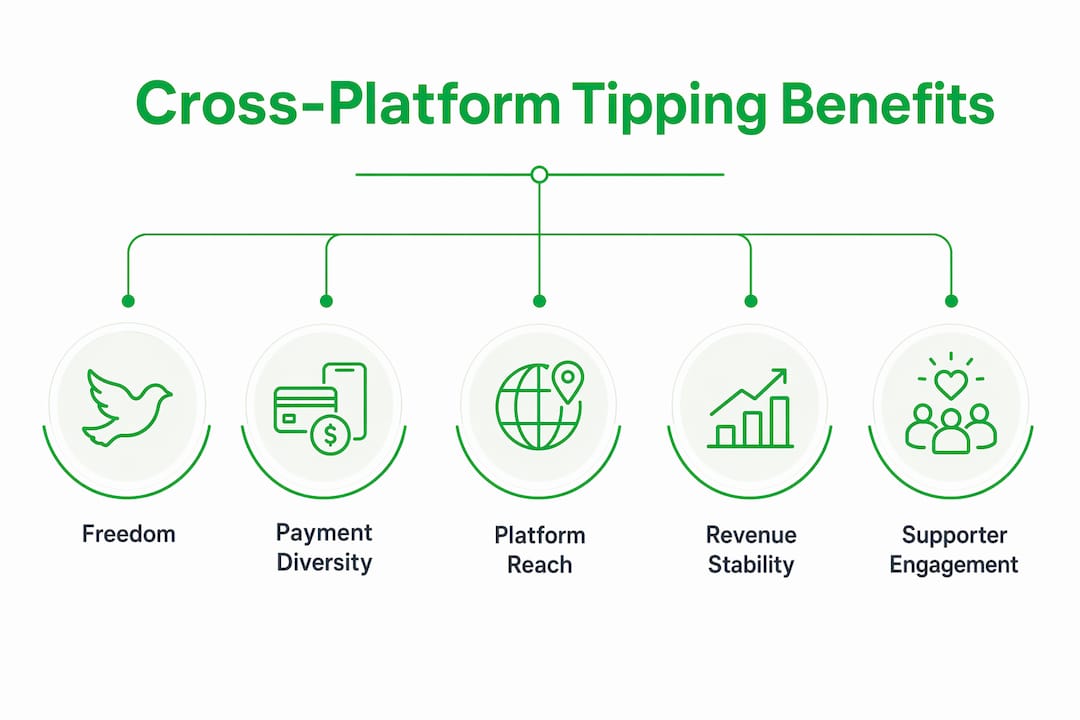
The creator tipping market now spans web apps, social media tools, digital wallets, crypto payments, and analytics tools. That breadth reflects how diverse creator audiences have become. A freelance illustrator might have fans on X, clients on LinkedIn, and a community on Discord. Expecting all of them to use the same payment method is unrealistic.
Specific advantages worth knowing:
- Higher tip volume through payment choice. Supporters tip more when they can use their preferred method. Offering Apple Pay, Google Pay, and PayPal alongside crypto removes the friction that kills impulse tips.
- Resilience through multi-chain redundancy. If one blockchain network is congested, monitoring multiple ledgers in parallel means tips on other chains still process normally.
- Reduced admin work through split payouts. Platform payment infrastructures support buyer-to-platform-to-seller routing, which automates the reconciliation work that would otherwise fall on the creator.
- Direct peer-to-peer support. Non-custodial systems remove intermediaries, so creators receive funds faster and without platform-imposed withdrawal delays.
- Engagement through personalized thank-yous. Thin platform adapters post thank-you messages in the same app where the tip originated, keeping the interaction native and personal.
The combination of payment diversity and platform reach is what separates cross-platform tipping from a simple tip jar. You are not just accepting more payment types. You are meeting your audience exactly where they are.
How does cross-platform tipping compare to traditional tipping models?
Traditional tipping is platform-specific. A Twitch Bits tip stays inside Twitch. A Ko-fi donation requires the supporter to visit Ko-fi. Each system has its own wallet, its own payout schedule, and its own fee structure. Cross-platform tipping collapses those silos.
The table below compares the main approaches:
| Feature | Traditional (Ko-fi, Patreon) | Cross-platform bot (Just The Tips) | Decentralized (Tippin’ Dots) | Link-based (SimpleTip, Tipper) |
|---|---|---|---|---|
| Platform coverage | Single platform | Multi-platform via adapters | Federated/decentralized networks | Any platform with a link |
| Custody model | Centralized (platform holds funds) | Non-custodial (observational) | Non-custodial (smart contract) | Varies by payment rail |
| Payment methods | Card, PayPal | Stablecoins (XRPL, Base, Solana) | Crypto via DID mapping | Card, Apple Pay, Google Pay, PayPal |
| Refund handling | Platform manages refunds | Transaction-level refund required | Smart contract logic | Partial refunds often not feasible |
| Setup complexity | Low | Medium | Medium to high | Low |
One detail that catches creators off guard is refund handling. When tips are bundled into a single payment transaction, refunding the tip portion alone is often not technically possible. The whole transaction or a defined partial amount must be refunded. This is not a flaw in cross-platform systems specifically. Card and wallet APIs treat the tip as a component of the principal transaction, not a separate charge. Knowing this upfront prevents disputes and support headaches later.
Pro Tip: Before going live with any tipping system, test a refund scenario end to end. Know whether your payment processor supports partial refunds or requires a full transaction reversal. Document your refund policy clearly for supporters.
How can creators implement cross-platform tipping effectively?
Getting cross-platform tipping working well is less about choosing the most technically advanced tool and more about matching the tool to where your audience actually lives. Here is a practical sequence:
- Map your platforms first. List every place you publish or engage: Discord server, Twitch channel, X profile, personal website, newsletter. Your tipping system needs to reach all of them, not just the biggest one.
- Choose a unified entry point. A single tipping URL or QR code that works everywhere is more effective than separate tip jars on each platform. Tools that generate a personal link let you share one address across your bio, stream overlay, and email signature.
- Match payment methods to your audience. Younger audiences on Twitch and Discord often prefer Apple Pay or Google Pay for speed. Crypto-native communities expect stablecoin options. International audiences may need regional methods like M-Pesa. SimpleTip’s multi-rail support shows how one component can cover all of these simultaneously.
- Set up platform-specific thank-you messages. A thank-you that appears in the same Discord channel where the tip was sent feels personal. A generic email confirmation does not. Use your platform adapter’s notification feature to keep acknowledgment native to each app.
- Plan your reconciliation process before you launch. Decide how you will track tips from different sources, how you will handle currency conversion if you accept crypto, and what your refund policy is. Tips embedded in payment transactions require transaction-level refund logic, so your policy needs to reflect that reality.
- Avoid over-engineering your setup. Starting with a simple link-based system and adding platform adapters as your audience grows is smarter than deploying a full multi-chain bot on day one. Complexity should follow audience demand, not precede it.
Pro Tip: Pin your tipping link in every community you run. Discord server descriptions, Twitch panels, and X bios are all high-visibility spots that supporters check before they decide to tip. Visibility directly drives tip volume.
What future trends are shaping cross-platform tipping?
The next wave of cross-platform tipping is being driven by decentralized social networks and portable identity systems. Several trends are worth watching closely.
- DID-based tipping at scale. Tippin’ Dots maps DIDs to wallets across Bluesky and Frequency today. As more social networks adopt decentralized identity standards, this model will extend to any platform that supports DIDs, making tipping truly portable across the entire open social web.
- Multi-chain stablecoin growth. Just The Tips already supports XRPL, Base, Arbitrum, and Solana. As stablecoin adoption grows, more creators will accept crypto tips without worrying about price volatility, and multi-chain monitoring will become a standard feature rather than a technical novelty.
- Federated tipping nodes. Federated node architectures let communities run their own tipping infrastructure while staying interoperable with other nodes. This gives creators and platform operators more control over payment rails and fee structures without sacrificing reach.
- Lower activation energy for supporters. The biggest barrier to tipping is not willingness. It is friction. Future systems will reduce the number of steps between “I want to tip this creator” and “the tip has arrived,” using saved payment methods, one-tap flows, and pre-authorized wallets.
- Split payout automation. As platform payment flows mature, automated split payouts will handle multi-party revenue sharing, making it easier for creators who collaborate or operate under a network to distribute tips fairly without manual reconciliation.
Key Takeaways
Cross-platform tipping works because it separates the payment flow from the platform experience, letting creators receive support from any app through any payment method without fragmentation.
| Point | Details |
|---|---|
| Core definition | Cross-platform tipping routes tips from multiple apps through a single unified payment flow. |
| Non-custodial advantage | Observational systems like Just The Tips never hold funds, removing counterparty risk for creators. |
| Payment diversity drives volume | Offering Apple Pay, Google Pay, PayPal, and crypto removes friction and increases tip conversion. |
| Refund complexity | Tips bundled into a single transaction often require full or partial transaction refunds, not isolated tip reversals. |
| Start simple, scale up | A single tipping link covering all platforms outperforms separate tip jars on each individual app. |
My take on cross-platform tipping as a monetization strategy
I have watched a lot of creators build tipping setups that are technically impressive but practically broken. They deploy a multi-chain bot, configure five platform adapters, and then wonder why their tip volume is low. The problem is almost never the technology. It is that supporters do not know the tipping option exists, or the payment method they prefer is not available.
The creators I have seen succeed with cross-platform tipping share one habit: they treat their tipping link like a product. They put it everywhere, they test it regularly, and they update their payment methods when their audience shifts. A freelance writer who moved her community from Twitter to Bluesky updated her tipping setup within a week. Her tip volume did not drop because her supporters never had to search for a new way to support her.
The decentralized identity angle is genuinely exciting for the long term. When your tipping identity is portable across every platform you use, you stop being dependent on any single network’s monetization policies. That is real creator independence. But you do not need DIDs or stablecoins to start. A single link that accepts Apple Pay and Google Pay, with a thank-you message that feels personal, will outperform a complex crypto setup that confuses your audience every time.
Build for your current audience first. Add complexity only when your supporters ask for it.
— Steve
Start accepting tips across every platform with Tipper
If you want to put cross-platform tipping into practice without building your own adapter stack, Tipper is worth a close look. Tipper gives you a personalized tipping link that works across every platform you use, from your Discord bio to your Twitch panel to your personal website. Supporters can tip instantly using Apple Pay, Google Pay, or a card without creating an account. You keep 100% of what you earn.

Tipper also lets supporters add a personal note or video with their tip, which turns a transaction into a genuine moment of connection. For creators who want to understand instant tip payments and get set up fast, Tipper removes every technical barrier between you and your first tip. Visit Tipper today and start accepting support from wherever your audience finds you.
FAQ
What does cross-platform tipping mean in simple terms?
Cross-platform tipping means a supporter can send a monetary tip to a creator from any platform they use, whether that is Discord, Twitch, or a personal website, through a single unified payment system. The creator receives the tip regardless of which app the supporter used to send it.
How does cross-platform tipping work without holding funds?
Non-custodial systems like Just The Tips act as observers, monitoring blockchain addresses for incoming payments and triggering thank-you notifications without ever controlling the funds. The money moves directly from the tipper’s wallet to the creator’s address.
Is cross-platform tipping safe for creators?
Cross-platform tipping is safe when the system is non-custodial and uses established payment rails like Stripe, Apple Pay, or Google Pay. The main risk is refund complexity, since tips bundled into a single transaction may require a full or partial transaction reversal rather than an isolated tip refund.
What payment methods do cross-platform tipping systems support?
Most cross-platform tipping services support credit and debit cards, Apple Pay, Google Pay, PayPal, and in some cases stablecoins on networks like Solana, Arbitrum, and XRPL. The available methods depend on the platform’s payment rail integrations and the node operator’s configuration.
Do creators need a crypto wallet to use cross-platform tipping?
Not always. Link-based systems like Tipper and SimpleTip work entirely through card and mobile wallet payments. Crypto-based systems like Tippin’ Dots use DID-to-wallet mapping, so creators can receive crypto tips without manually configuring a wallet for every platform they use.




[…] Cross-platform tipping strategies help creators manage multiple payment methods without overwhelming supporters with choices. […]
[…] cross-platform tipping data monthly to see which content type drives the most […]