

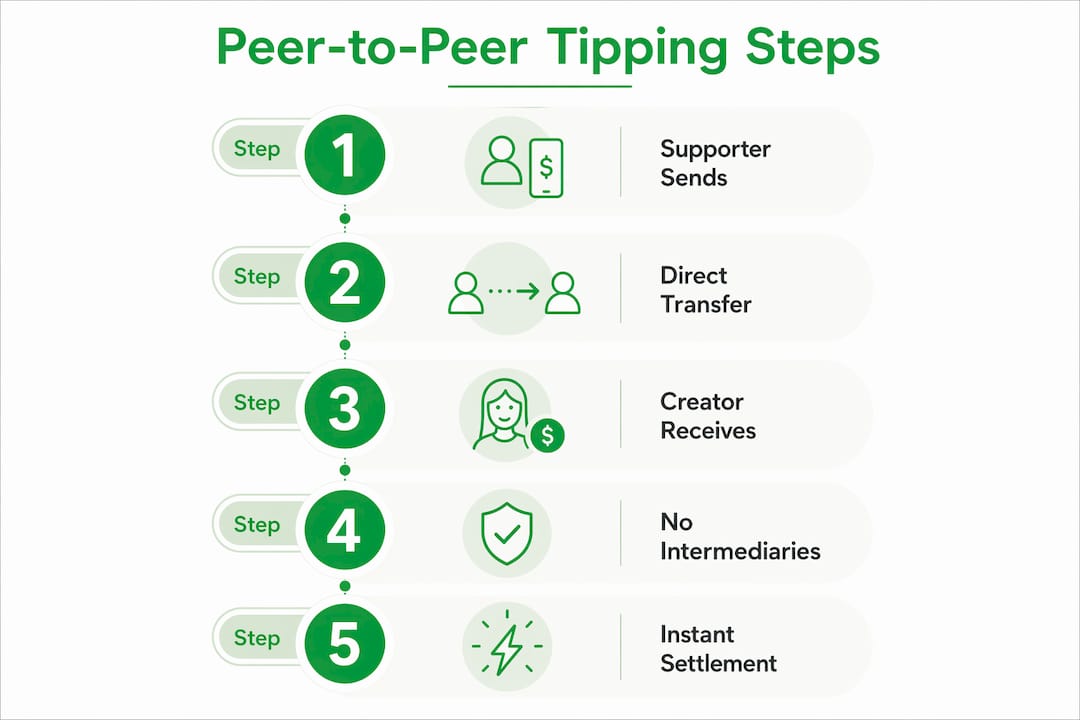
Peer-to-peer tipping is defined as a direct digital transfer of money from a supporter to a creator, with no bank, payment processor, or platform taking a cut in between. Known in the payments industry as P2P payments, this model has evolved from simple app-based transfers into a creator economy tool powered by blockchain networks, Lightning wallets, and platforms like Tipper. Standard P2P transfers are often free, while instant or card-funded tips carry fees of 1%–3.5%. That fee gap is exactly why creators are paying attention.
What is peer-to-peer tipping explained in simple terms?
Peer-to-peer tipping is the process of sending a digital tip directly to another person without routing it through a traditional financial intermediary. Think of it like handing someone cash, except the transaction happens in seconds across the internet. The sender uses a digital wallet or a platform link, enters an amount, and the creator receives the full value almost immediately.
The term “P2P payment” covers a broad category. Apps like Venmo and Cash App popularized the concept for splitting bills. The peer-to-peer tipping concept takes that same logic and applies it specifically to rewarding creators, freelancers, musicians, podcasters, and anyone producing content worth supporting. Platforms like Tipper make this even simpler by letting supporters send tips through a personalized link, with no account required on the sender’s side.
What separates tipping from a standard P2P payment is intent. A tip is voluntary, value-driven, and tied to appreciation rather than obligation. That distinction matters for how creators frame their monetization strategy.

How does peer-to-peer tipping work?
The mechanics behind P2P tipping follow a clear sequence, though the tools involved vary depending on whether you are using a blockchain-based system or a traditional app.
- The creator sets up a receiving method. This could be a Lightning Address (formatted like an email address), a wallet QR code, or a platform-generated link through a service like Tipper. Publishing a Lightning Address on a public profile is critical. Skipping this step causes bounced or errored tips.
- The supporter opens the tipping interface. On blockchain-based platforms like Nostr, this is a built-in “zap” button. On Tipper, it is a shareable link that opens a payment screen supporting Apple Pay or Google Pay.
- The transaction is initiated. The supporter selects or enters an amount. Preset tip amounts like 21, 100, 500, or 1,000 sats are common in Bitcoin-based systems. Setup for a creator typically takes 2–10 minutes.
- The payment clears. On the Lightning Network, this happens in seconds. On traditional P2P apps, bank-funded transfers take 1–3 business days, while instant transfers cost more.
- The creator is notified. Non-custodial tipping tools act as ledger observers on blockchain, monitoring incoming transactions and triggering instant notifications without ever holding private keys.
Non-custodial wallets and why they matter
Non-custodial wallets give creators full control over their funds. No third party holds the money on their behalf. This architecture also eliminates chargebacks, which are a persistent problem for creators using traditional payment processors. A tip sent is a tip received, with no reversal risk.
Pro Tip: If you are setting up a Lightning Address for the first time, use a wallet like Wallet of Satoshi or Alby. Both generate a Lightning Address automatically and take under five minutes to configure.
What are the benefits of peer-to-peer tipping over traditional methods?
The advantages of P2P tipping over traditional tipping systems are significant, especially for creators working at scale.
- Speed. Blockchain-based tips settle in seconds. Traditional bank transfers take 1–3 days. For a creator running a live stream, instant confirmation changes the experience entirely.
- Fee elimination. Feeless blockchain architectures mean the full tip amount reaches the creator. Traditional platforms often take 15%–30% of every transaction, making small tips economically pointless.
- No platform gatekeeping. Creators receive money directly. No platform can freeze, delay, or redirect funds. Decentralized payment rails give creators financial sovereignty that centralized platforms cannot offer.
- Micropayment viability. Sending $0.05 through a credit card processor is not economically viable once fees are applied. P2P tipping on the Lightning Network makes sub-cent tips real and meaningful.
- Better engagement signals. A tip, even a tiny one, represents a real resource commitment. That makes it a stronger signal of content quality than a free like or view.
“P2P tipping forces value exchange, where even tiny tips are votes with real resources, offering better content quality signals than free likes.” — Bitcoin Zaps Guide
The peer-to-peer tipping advantages extend beyond economics. Creators report that tipping audiences are more engaged, more loyal, and more likely to share content. When someone has put real money behind their appreciation, they have skin in the game.
What are the common pitfalls in peer-to-peer tipping?
P2P tipping is not without friction. Knowing the common failure points saves time and prevents lost tips.
- Setup errors. The most frequent problem is a missing or incorrectly formatted Lightning Address. Bounced tips from setup errors are common among beginners. The address must be publicly visible on the creator’s profile.
- Fee surprises. Instant transfers cost 1%–1.75%, and credit card-funded tips run 2%–3.5%. Creators and supporters who expect zero fees on every transaction will be caught off guard.
- Transaction limits. Many P2P apps cap daily or weekly transfer amounts. This matters for creators with high-volume audiences.
- Irreversibility. P2P payments are difficult to reverse, and consumer protections are weaker than with traditional bank disputes. Sending a tip to the wrong address is typically a permanent loss.
- Scam risk. Bad actors create fake creator profiles to collect tips. Only tip creators you can independently verify through their official channels.
Pro Tip: Before sending any tip, confirm the creator’s wallet address or tipping link matches what appears on their verified social profile. One extra check prevents irreversible mistakes.
The good news is that platforms designed specifically for tipping, like Tipper, reduce most of these risks by handling the technical layer for you. The creator shares a link, the supporter pays, and the funds transfer without either party needing to manage wallet configuration manually.
How are P2P tipping models transforming content monetization?
The shift from attention-based monetization to value-based monetization is the most significant structural change in the creator economy right now. P2P tipping is the mechanism making that shift possible.
The Value-for-Value model
The Value-for-Value (V4V) model replaces passive metrics like views and likes with active financial signals. V4V transforms engagement by treating every tip as a vote cast with real resources. A creator who receives 500 small tips learns far more about audience sentiment than one who collects 50,000 passive views.
Podcasters using apps like Fountain and Breez have adopted V4V as their primary monetization model. Listeners stream tiny Bitcoin payments per minute of audio consumed. The creator earns continuously, and the listener pays only for what they actually value.
Bitcoin zaps and social media integration
Bitcoin “zaps” are the most visible example of P2P tipping at scale. On Nostr, a decentralized social protocol, users send zaps directly from their social feed using a built-in wallet connection. The tip appears publicly on the post, creating a social proof layer that traditional likes cannot replicate.
Discord and Telegram bots now support non-custodial tipping inside community servers. A community member can tip a moderator or creator mid-conversation without leaving the platform. This integration turns every interaction into a potential monetization moment.
Traditional tipping vs. P2P tipping: a comparison
| Feature | Traditional tipping | P2P tipping |
|---|---|---|
| Settlement speed | 1–3 business days | Seconds |
| Platform fee | 15%–30% | 0%–3.5% |
| Minimum viable tip | $1+ (fees make less uneconomical) | Sub-cent possible |
| Chargeback risk | High | Low to none (non-custodial) |
| Creator control | Platform-dependent | Full ownership |
| Audience signal quality | Low (passive action) | High (real resource commitment) |
The table makes the economics clear. For creators earning from small, frequent tips, the difference between 0% and 30% in fees is the difference between a viable income and a symbolic gesture.
Setting up P2P tipping for content creators
Getting started with P2P tipping does not require deep technical knowledge. Here is the practical sequence:
- Choose a tipping platform. Tipper requires no wallet setup from the supporter’s side, which removes the biggest adoption barrier.
- Generate your tipping link or Lightning Address.
- Set preset tip amounts that match your audience’s typical spend.
- Share the link in your bio, video descriptions, and community posts.
- Respond to tips with personalized notes or short video messages to reinforce the connection.
The no-signup tipping model that Tipper uses is particularly effective for creators whose audiences are not crypto-native. Supporters pay with Apple Pay or Google Pay, and the creator receives the full amount.
Why P2P tipping is bigger than it looks
I have spent years watching monetization models come and go. Most of them shift value from creators to platforms. P2P tipping is the first model I have seen that genuinely reverses that dynamic.
The fee elimination argument is obvious once you run the numbers. A creator earning $10,000 per year through a platform taking 30% loses $3,000 to fees. The same earnings through a zero-fee P2P system stay whole. That is not a marginal improvement. That is a structural one.
What surprises me more is the engagement quality shift. Creators I have spoken with consistently report that tipping audiences behave differently. They comment more, share more, and return more often. When someone has put real money behind their support, they are invested in the creator’s success. That relationship is qualitatively different from a passive follower.
The “unstoppable money” concept matters too, though it gets less attention. A creator whose income flows through a centralized platform is always one policy change away from losing access. A creator whose income flows through non-custodial P2P channels owns that income stream completely. For creators in countries with unstable banking systems or restrictive platform policies, this is not theoretical. It is the difference between getting paid and not.
My advice for beginners: start simple. Use a platform like Tipper before you touch a Lightning wallet. Understand the user experience from both sides. Then, once you see the mechanics working, layer in more advanced tools like Lightning Addresses and V4V integrations.
— Steve
Start collecting tips with Tipper today
If you are a creator ready to put P2P tipping to work, Tipper is the fastest path from zero to earning. You get a personalized tipping link in minutes, supporters pay with Apple Pay or Google Pay without creating an account, and you keep 100% of every tip.

Tipper handles the technical layer so you can focus on your content. Whether you are a freelancer, podcaster, or social media creator, the platform gives you a direct line between your work and your audience’s appreciation. For creators exploring no-fee tipping systems or looking to understand instant tip payments in more depth, Tipper’s resources cover the full picture. Set up your tipping link and start earning today.
Key takeaways
Peer-to-peer tipping works because it removes intermediaries, eliminates fee drag, and gives creators full ownership of their income stream.
| Point | Details |
|---|---|
| Direct value transfer | P2P tipping sends money from supporter to creator with no platform taking a cut. |
| Fee structure matters | Instant and card-funded tips cost 1%–3.5%; bank-funded transfers are typically free but slower. |
| Setup accuracy is critical | A missing or incorrect Lightning Address causes bounced tips and lost earnings. |
| V4V signals beat passive metrics | Tips are real resource votes, giving creators stronger audience feedback than likes or views. |
| Non-custodial wallets protect creators | Ledger observer tools prevent chargebacks and keep private keys secure. |
FAQ
What is peer-to-peer tipping in simple terms?
Peer-to-peer tipping is a direct digital payment from a supporter to a creator, with no bank or platform intermediary involved. The creator receives the full amount, often within seconds.
How does peer-to-peer tipping work without an account?
Platforms like Tipper generate a shareable link that lets supporters pay using Apple Pay or Google Pay without registering. The creator receives the tip directly to their connected payment method.
Is peer-to-peer tipping safe?
P2P tipping is safe when you tip verified creators through official links. Transfers are difficult to reverse, so confirming the recipient’s identity before sending is the most important precaution.
What fees does peer-to-peer tipping involve?
Standard bank-funded P2P transfers are typically free, while instant transfers cost 1%–1.75% and credit card-funded tips run 2%–3.5%, depending on the platform.
What is the Value-for-Value model in P2P tipping?
Value-for-Value is a monetization model where audiences tip creators directly based on the value they receive, replacing passive metrics like views with real financial signals that reflect genuine audience engagement.




Leave A Comment