


Receipt-based tipping is a tipping process where customers add gratuity directly to an itemized receipt, either printed or digital, with suggested amounts and flexible options to customize the final tip. This method is now standard in restaurants, cafes, and service businesses across the United States, powered by point-of-sale systems like Toast POS. Understanding how receipt-based tipping works matters not just for diners, but for anyone exploring tip-based compensation, including freelancers, creators, and service providers looking to maximize financial support from their audience or clients.
What is receipt-based tipping and how does it work?
Receipt-based tipping, also called gratuity-on-receipt tipping, is defined as a system where suggested tip amounts appear directly on a customer’s itemized receipt, giving them a clear prompt and the option to add, adjust, or skip a tip before finalizing payment. The receipt typically displays two or three preset percentages alongside a blank line for a custom amount. This format removes ambiguity and speeds up the payment process for both customers and staff.
The mechanics are straightforward. When a customer finishes a transaction, the POS system generates a receipt that includes the subtotal, tax, and a dedicated tip section. Customers circle or write in a tip on paper receipts, or tap a tip button on digital or card-reader screens. The chosen amount is then captured and routed to the appropriate staff member or tip pool.

One detail most customers overlook is how the suggested percentages are calculated. Tip calculations can be set to run on the pre-tax subtotal or the post-tax total, and the difference is real. A 20% tip on a $50 pre-tax meal is $10.00. The same 20% on a $54.25 post-tax total is $10.85. Many customers mistakenly tip on after-tax amounts without realizing it, which is why experts recommend tipping on pre-tax subtotals for accuracy.
Here is what the receipt-based tipping process typically looks like from start to finish:
- The customer receives a printed or digital receipt showing the itemized order and subtotal.
- Suggested tip percentages (commonly 15%, 18%, and 20%) appear with pre-calculated dollar amounts.
- The customer selects a suggestion or writes in a custom amount on the tip line.
- For credit card payments, the customer signs or confirms the total including the tip.
- The POS system records the tip and assigns it to the relevant employee or tip pool.
Pro Tip: If you want to tip on the pre-tax amount, look at the subtotal line on your receipt rather than the total. Calculate your tip from that number to avoid unintentionally over-tipping due to post-tax calculation settings.
What is the difference between tips and gratuities on receipts?
The receipt tipping definition gets more nuanced when you separate voluntary tips from mandatory gratuities. A tip is a voluntary payment by the customer, added at their discretion after service. A gratuity, by contrast, is an automatic service charge that the business applies to the bill, most commonly for large parties of six or more, private events, or catered functions.
The distinction carries real financial and legal weight. Voluntary tips are generally considered the property of the employee and are subject to income tax reporting by the worker. Mandatory gratuities are treated as service charges by the IRS, meaning they count as business revenue first and are distributed to employees through payroll. This means gratuities are subject to payroll taxes and withholding in a way that standard tips are not.
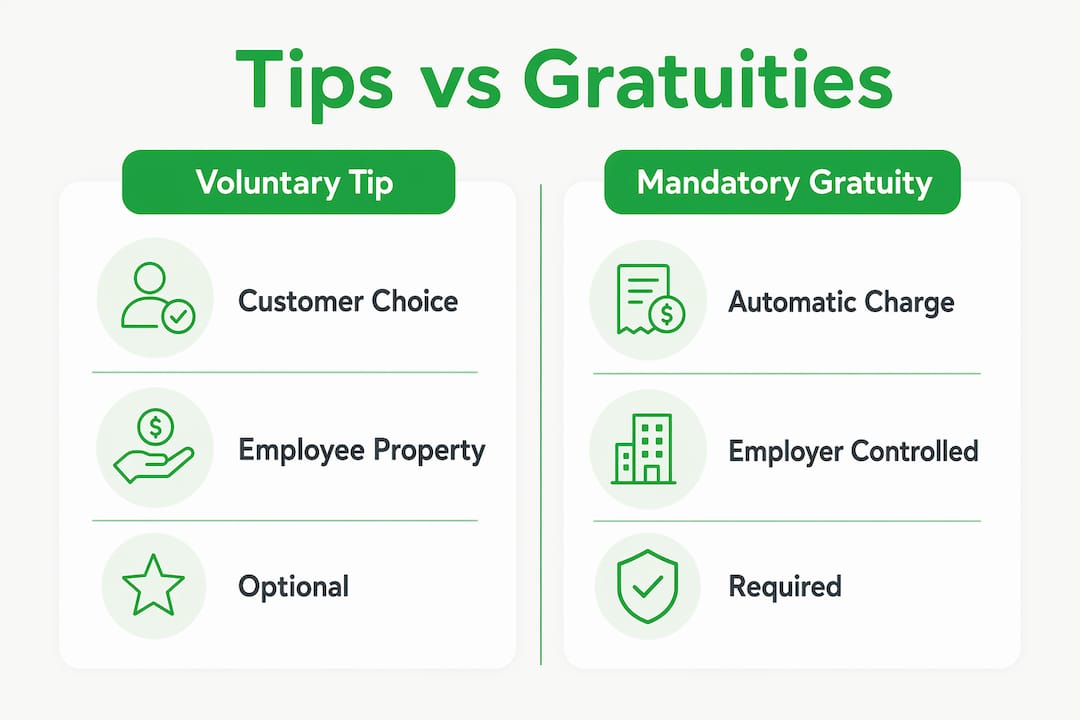
| Feature | Voluntary tip | Mandatory gratuity |
|---|---|---|
| Customer choice | Yes, fully optional | No, automatically added |
| Appears on receipt as | Tip line or blank field | Service charge line item |
| Tax treatment | Employee income, self-reported | Business revenue, payroll-taxed |
| Typical use case | Standard dining, individual service | Large parties, events, catering |
| Refundable by customer | Generally yes, with manager approval | Depends on business policy |
Customers are sometimes surprised to find a gratuity already added to their receipt, especially at busy restaurants during peak hours. Differentiating between voluntary tips and mandatory gratuities is important for managing customer expectations and avoiding the common mistake of double-tipping, where a customer adds a voluntary tip on top of an already-included service charge.
A few practical points worth knowing:
- Gratuities are always itemized separately on the receipt, usually labeled “service charge” or “auto-gratuity.”
- If you see both a gratuity line and a tip line on the same receipt, you are not required to fill in the tip line.
- Businesses must disclose automatic gratuity policies, either on the menu or verbally before the bill arrives.
What are the operational and technological benefits of receipt-based tipping?
Receipt-based tipping does more than simplify the customer experience. It creates a data trail that powers accurate payroll, fair tip distribution, and operational reporting. POS systems like Toast use receipt tip data for tip pooling and payroll integration, generating reports that break down each employee’s collected tips, pooling contributions, and net payout.
The operational advantages are significant for any business managing multiple staff members across shifts.
| Benefit | How it works in practice |
|---|---|
| Tip pooling accuracy | Receipt data assigns tips to specific transactions and employees automatically |
| Payroll integration | Tip totals feed directly into payroll software, reducing manual entry errors |
| Reconciliation reports | Managers review tip math per receipt to catch discrepancies before payroll runs |
| Approval workflows | Managers approve tip distributions before they are finalized and paid out |
| Audit trail | Every tip is tied to a specific receipt, transaction, and employee record |
One operational risk that many businesses underestimate is the connection between tip accuracy and time-tracking data. Accurate tip pooling requires correct time-entry data to assign tip eligibility. If an employee clocks in late or forgets to clock out, the system may miscalculate their share of pooled tips even when every receipt was processed correctly. This is a back-end problem that receipt-based tipping alone cannot solve.
Transparency is another major benefit. When dedicated tip lines and selectable percentages appear on receipts, customers know exactly what they are paying and why. This reduces disputes, builds trust, and gives service providers confidence that their earnings are being tracked and distributed fairly. For businesses using expense management software, integrating receipt tip data into broader financial reporting becomes straightforward.
Pro Tip: If you manage a tipped workforce, audit your time-entry records monthly alongside your tip reports. A single clock-in error can cascade into incorrect tip distributions across an entire shift.
How can receipt-based tipping enhance financial support for creators and service providers?
The logic behind receipt-based tips explained in a restaurant context translates directly to any service environment where compensation depends on voluntary contributions. Clear, easy tipping options increase the likelihood that customers will tip and tip generously. When the path to tipping is obvious and the suggested amounts are reasonable, friction disappears and revenue for service providers rises.
For creators and independent service providers, the principles are identical. A content creator who makes it easy for supporters to send a tip, with a clear prompt and a suggested amount, will consistently earn more than one who buries a donation link in a bio. The receipt-based model teaches a core lesson: visibility and simplicity drive tip volume.
Here is how those principles apply beyond the restaurant floor:
- Show suggested amounts. Whether on a receipt or a digital tip page, preset options like $2, $5, and $10 reduce decision fatigue and increase conversion.
- Make the tip line visible. Customers and supporters who have to search for a way to tip are less likely to follow through.
- Explain what the tip supports. A brief note on a receipt or a creator’s tip page connecting the tip to real work builds motivation to give.
- Offer multiple payment methods. Receipt-based systems that accept credit cards, Apple Pay, and Google Pay capture more tips than cash-only setups.
- Follow up with acknowledgment. A thank-you note or message after a tip reinforces the relationship and encourages repeat support.
Transparency and customer education on tipping calculations reduce confusion and improve trust between customers and service providers. For creators specifically, this means being upfront about how tips are used and what supporters are contributing to. That transparency is not just good ethics. It is good business.
Key takeaways
Receipt-based tipping works best when suggested amounts are visible, calculations are transparent, and tip data integrates directly with payroll or distribution systems.
| Point | Details |
|---|---|
| Core definition | Receipt-based tipping lets customers add gratuity directly on itemized receipts with suggested amounts. |
| Pre-tax vs. post-tax matters | Tip calculations based on post-tax totals produce higher amounts than pre-tax, which confuses many customers. |
| Tips vs. gratuities | Voluntary tips and mandatory gratuities differ in tax treatment, customer choice, and how they appear on receipts. |
| Operational accuracy | POS systems like Toast link receipt tip data to payroll and tip pooling, but only when time-entry records are correct. |
| Creator applications | The visibility and simplicity principles of receipt-based tipping apply directly to digital tip pages for creators and freelancers. |
Why receipt-based tipping is more complicated than it looks
I have spent years watching businesses roll out new POS systems with receipt-based tipping features, confident the technology will handle everything. It rarely does on its own. The most common failure point is not the receipt design or the suggested percentages. It is the gap between what the receipt captures and what actually reaches the employee’s paycheck.
The pre-tax versus post-tax debate is a perfect example of a small technical setting creating outsized confusion. I have seen customers genuinely upset after noticing their 20% tip produced a higher dollar amount than expected, not because they were cheated, but because the POS was calculating on the post-tax total. Businesses that do not communicate this clearly invite distrust, which is the opposite of what a good tipping system should do.
My honest advice to business owners: audit your receipt tip settings before your next busy season. Confirm whether your POS calculates suggested tips on the pre-tax or post-tax amount, and consider adding a single line of text to your receipt explaining the basis. For customers, always check the subtotal line before accepting a suggested tip percentage. The math is simple once you know where to look.
For creators and freelancers adapting these ideas to digital platforms, the lesson is even simpler. Make tipping obvious, make the amounts feel reasonable, and tell people what their support means. That combination outperforms any complicated monetization structure I have seen.
— Steve
How Tipper makes tipping simple for creators and service providers

Tipper is built for creators, freelancers, and service providers who want the same clarity and ease that receipt-based tipping brings to restaurants, applied to their own work. With Tipper, supporters send tips instantly through a personalized link using Apple Pay, Google Pay, or a credit card. No account required. No platform fees cutting into earnings. Creators keep 100% of every tip they receive.
Setting up a tip page on Tipper takes minutes, and the experience for supporters is as frictionless as tapping a button on a digital receipt. Tipper also supports thank-you messages via notes or video, giving creators a direct way to acknowledge support and build the kind of trust that keeps supporters coming back. If you are ready to put receipt-based tipping principles to work for your own income, Tipper is the place to start.
FAQ
What is the receipt tipping definition?
Receipt-based tipping is a system where customers add a gratuity directly on their itemized receipt, typically choosing from suggested tip percentages or writing in a custom amount. It is standard practice in U.S. restaurants and service businesses using POS systems like Toast.
How does pre-tax vs. post-tax affect my tip on a receipt?
When a POS calculates suggested tips on the post-tax total, the dollar amounts shown are higher than if calculated on the pre-tax subtotal. Experts recommend tipping on the pre-tax subtotal to keep tip percentages accurate.
What is the difference between a tip and a gratuity on a receipt?
A tip is voluntary and added by the customer at their discretion. A gratuity is an automatic service charge applied by the business, most often for large parties, and it is taxed differently under IRS rules.
Can receipt-based tipping work for creators and freelancers?
Yes. The core principles, visible suggested amounts, simple payment options, and transparent communication, apply directly to digital tip pages used by creators and freelancers. Platforms like Tipper replicate this model outside the restaurant context.
Why do some receipts show both a gratuity and a tip line?
Some receipts include an automatic gratuity as a service charge and still display a blank tip line. Customers are not required to fill in the tip line when a gratuity is already included. Checking the receipt carefully before signing prevents unintentional double-tipping.




Leave A Comment