


Tipping confuses almost everyone at some point. Is it required? Is it a fee? Does the worker actually keep it? With what is service-based tipping explained so differently across industries, platforms, and countries, the confusion is understandable. But the stakes are real. Misclassifying a mandatory service charge as a tip can trigger IRS penalties. Misunderstanding tipping etiquette can shortchange the people who served you well. Whether you run a restaurant, work as a freelancer, or just want to tip correctly, this guide cuts through the noise and gives you the full picture.
Table of Contents
- Key takeaways
- What service-based tipping really means
- The legal and tax framework you need to know
- Tip pooling and tip credits for businesses
- Customary tipping behavior across service industries
- Practical steps for businesses and individuals
- My take on where tipping culture is heading
- How Tipper fits into your tipping strategy
- FAQ
Key takeaways
| Point | Details |
|---|---|
| Tips are voluntary | A genuine tip is always the customer’s choice, never a mandated fee or automatic charge. |
| IRS rules hinge on discretion | POS systems must offer a zero tip option for tips to qualify under federal tax rules. |
| Tip pooling has strict limits | Managers and supervisors cannot legally participate in tip pools under federal law. |
| Tipping norms vary by context | Full-service restaurants expect 18 to 20 percent; counter service tipping is optional. |
| Technology changes the game | Digital tipping tools help businesses stay compliant and help workers capture more earnings. |
What service-based tipping really means
The service tipping definition that most people carry around is incomplete. Tipping is a voluntary, discretionary payment a customer makes to a service worker on top of the stated price, based on perceived service quality. That last part matters. Tips are voluntary payments distinguished from mandatory service charges, and that distinction has legal, tax, and social consequences.
Tipping exists partly to solve a classic economic problem. When you hire someone to serve you, you cannot fully monitor their effort. A tip creates a direct financial incentive for the worker to perform well, because their compensation is tied to your satisfaction. That is the economic logic. The social reality is messier.
Research from 2026 shows that tipping behavior splits into two core groups: “appreciators” who tip based on genuine satisfaction, and “conformists” who tip primarily because social norms make not tipping feel awkward. Both groups tip, but for different reasons. Understanding this distinction matters if you are a business owner trying to build a culture where great service actually drives earnings.
Here is what separates a tip from other forms of payment:
- Voluntary: The customer decides the amount and whether to pay at all.
- Performance-linked: The amount typically reflects perceived service quality.
- Non-negotiated: It is not part of the original price agreement.
- Directly benefiting the worker: Tips are meant for the person providing the service, not the business’s general revenue.
Pro Tip: If a charge appears automatically on your bill and you cannot reduce it to zero, it is almost certainly a mandatory service charge, not a tip, regardless of what the menu calls it.
The legal and tax framework you need to know
This is where understanding service tipping gets serious for businesses. The IRS draws a hard line between voluntary tips and mandatory service charges, and the consequences of getting it wrong are significant.
The IRS defines qualified tips as voluntary payments fully controlled by the customer, with the explicit right to reduce the amount to zero. Four criteria must all be met: the payment must be voluntary, the amount must be set by the customer, the payment cannot be the result of compulsion, and the customer must retain the right to pay nothing.
Automatic gratuities added to large party checks fail this test. So do mandatory service charges on hotel bills or delivery platforms. The Federal Register notes that automatic gratuities are generally not qualified tips because the customer has no real choice.
Here is why this matters operationally:
- POS system design: POS devices must offer a no-tip or zero option for tips to qualify under IRS rules. A slider that starts at 18 percent and only goes up does not meet the standard.
- Wage reporting: Tips must be reported on W-2 forms. Mandatory service charges are treated as regular wages, not tips, and are subject to different withholding rules.
- Tax deduction eligibility: Businesses can claim a tax deduction on employer payroll taxes paid on qualified tips. Misclassifying mandatory charges as tips to claim this deduction triggers IRS anti-abuse rules.
- Employee communication: Workers need to understand the difference too, because it affects how they report income and what protections apply to their earnings.
“Explaining service-based tipping requires separating voluntary tips, mandatory gratuities, and tip-credit mechanics to reduce confusion and promote compliance.” — Fisher Phillips
The practical takeaway: if your business adds any charge that customers cannot remove, call it a service charge. Do not call it a gratuity or tip. The label has legal weight.
Tip pooling and tip credits for businesses
Tip pooling and tip credits are two of the most misunderstood concepts in the service tipping space, and getting either one wrong can expose a business to serious liability.

A tip credit allows employers to pay tipped employees below the federal minimum wage of $7.25 per hour, as long as tips bring total compensation up to that level. The federal tip credit is $5.12 per hour, meaning an employer can pay as little as $2.13 per hour in direct wages. State rules vary widely, and some states do not allow tip credits at all.
| Feature | Traditional tip pool | Nontraditional tip pool |
|---|---|---|
| Who participates | Front-of-house tipped staff | Can include back-of-house workers |
| Manager/supervisor inclusion | Never allowed | Never allowed |
| Tip credit use | Employer may use tip credit | Employer cannot use tip credit |
| Common in | Restaurants, hotels | Modern hospitality concepts |
The rule that supervisors and managers cannot share tips is federal law, not a suggestion. A shift lead who exercises meaningful authority over scheduling or discipline is a supervisor for this purpose, even if their official title is “senior server.”
Tip pooling policies require regular audits to stay compliant, especially when staff roles change. A busser promoted to a lead role mid-season may suddenly become ineligible for the tip pool. Without an audit process, that slip goes unnoticed until a DOL investigation surfaces it.
Pro Tip: Document every role classification decision in writing and review tip pool eligibility whenever someone’s job responsibilities change, not just when their title changes.
Customary tipping behavior across service industries
Knowing the service gratuity explained above is one thing. Knowing what to actually tip in practice is another. Tipping norms vary significantly by industry, and the gap between what customers think is expected and what workers actually depend on can be wide.
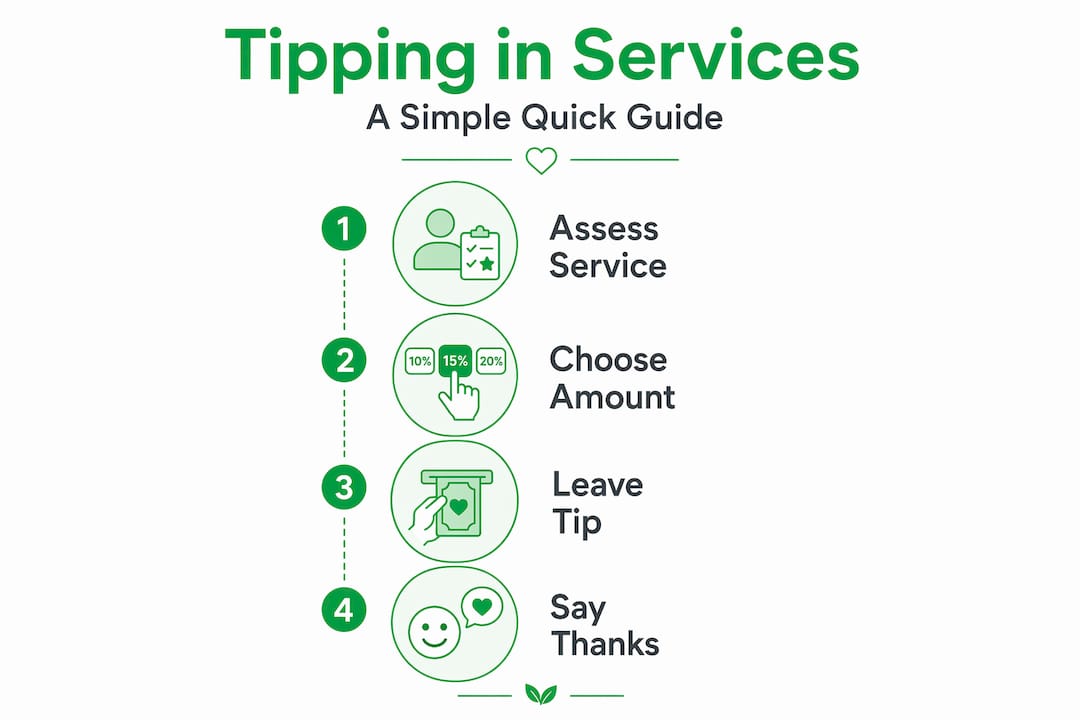
Full-service restaurant tips in the US average 18 to 19 percent, with 20 to 25 percent considered the standard for excellent service in 2026. Counter service and takeout tipping is genuinely optional, though digital tip prompts have normalized it in many settings.
Here is a practical breakdown of tipping expectations by service type:
- Full-service restaurants: 18 to 20 percent is the baseline; 25 percent for exceptional service.
- Bars: $1 to $2 per drink, or 20 percent of the total tab.
- Hotel housekeeping: $2 to $5 per night, left daily rather than at checkout.
- Rideshare and delivery: 15 to 20 percent is standard; workers often depend on it.
- Personal services (hair, nails, massage): 20 percent is the norm; these workers often rent their station and have no base salary.
- Counter service and coffee: Optional, but $1 on a complex order is appreciated.
One common misconception worth addressing: tipping on the pre-tax total versus the post-tax total. Most etiquette guidance and industry practice in the US treats the pre-tax subtotal as the base. The difference on a $60 meal is about $1.50 at 20 percent, but the principle matters.
Social pressure shapes tipping more than most people admit. Research confirms that many customers tip not because they feel the service warranted it, but because the social cost of not tipping feels too high. Businesses that understand this can design better tipping experiences rather than simply adding a tip prompt and hoping for the best.
Practical steps for businesses and individuals
Translating the theory of how service tipping works into daily practice requires a few deliberate choices, whether you are running a business or just trying to tip well.
For businesses, the priority is building a tipping system that is both legally sound and customer-friendly:
- Audit your POS setup. Confirm that your system offers a genuine zero tip option. This is not just good practice. It is a requirement for qualified tip status under IRS rules.
- Separate service charges from tips in all customer-facing materials. Menus, receipts, and digital checkouts should make the distinction clear.
- Train staff on the difference. Employees who understand the legal distinction between tips and service charges can communicate it to customers and report income correctly.
- Review tip pool eligibility quarterly. Ongoing audits protect you from inadvertently including ineligible employees after role changes.
- Use technology that tracks and reports tips automatically. Manual tip tracking creates errors and audit risk.
For individuals, the service-based tipping guide is simpler but still worth being intentional about. Tip on service quality, not just habit. Tip in cash when you can, since it reaches the worker directly and immediately. And do not assume a service charge on your bill means the worker was compensated fairly. Many mandatory service charges go to the business, not the staff.
Pro Tip: When dining in a group, calculate your tip individually before splitting the check. Group dynamics tend to drive tips down, and the server’s service quality does not change because your party was large.
My take on where tipping culture is heading
I have spent years watching tipping evolve from a simple social custom into a compliance minefield, and my honest view is that most businesses are still behind the curve.
The legal changes of the past few years, particularly the IRS’s tightened rules on qualified tips and POS requirements, have shifted tipping from a soft cultural practice into a hard compliance obligation. Businesses that treat it as the former are going to get caught out. The ones that build proper systems now will save themselves significant legal and reputational exposure later.
What I find most interesting is the employee morale dimension. Workers in tip-dependent roles know when a business is structuring its tipping system to benefit the house rather than them. Opaque service charge policies, tip pools that include ineligible supervisors, and POS designs that make zero-tipping feel socially unacceptable all erode trust. The businesses I have seen thrive long-term are the ones that treat tipping transparency as a retention tool, not just a compliance checkbox.
The future of tipping is digital, direct, and increasingly personalized. Platforms that let customers tip specific workers, add a note, or send a video message are changing the relationship between service quality and compensation in ways that traditional cash tipping never could. That is a genuine opportunity for workers and businesses willing to embrace it.
— Steve
How Tipper fits into your tipping strategy
If you are a freelancer, creator, or service professional trying to capture the appreciation your work deserves, the mechanics of service-based tipping matter beyond restaurants and hotels. Tipper is built for exactly this moment.

With Tipper’s tipping platform, anyone can send you a tip instantly through a personalized link, using Apple Pay or Google Pay, with no account required. You keep 100 percent of every tip. Supporters can attach a note or video message, making each transaction feel personal rather than transactional. For businesses managing multiple service professionals, Tipper removes the friction that typically prevents customers from tipping at all. No hidden fees, no complicated setup, and no mandatory minimums. Just direct, real-time appreciation that reaches the right person immediately.
FAQ
What is the service tipping definition?
Service-based tipping is a voluntary, discretionary payment a customer makes to a service worker beyond the stated price, based on perceived service quality. It is distinct from mandatory service charges, which the customer cannot reduce or remove.
Is service tipping necessary or legally required?
Tips are never legally required. They are voluntary by definition. Mandatory charges on a bill are service charges, not tips, regardless of what they are called.
How does the IRS distinguish tips from service charges?
The IRS requires that a qualified tip be fully voluntary, set by the customer, free from compulsion, and reducible to zero. Automatic gratuities added to bills do not meet this standard and are treated as wages.
Can managers participate in tip pools?
No. Federal law prohibits managers and supervisors from participating in tip pools. Violations can result in significant DOL penalties and back-pay liability for the business.
What percentage should I tip for good service?
For full-service restaurants, 20 percent is the current standard for good service, with 25 percent appropriate for exceptional experiences. Counter service tipping is optional but appreciated.




Leave A Comment