


TL;DR:
- The tip income business model involves customers voluntarily paying service providers or creators directly, outside fixed wages. It is taxable income, and creators must track and report all tips, with a legal deduction of up to $25,000 available through 2028. Digital tips are also taxable and require daily recordkeeping, but platforms like Tipper simplify collection and reporting efforts.
The tip income business model is a system where customers voluntarily pay service providers or creators directly, outside of any fixed wage or price, as a reward for quality work or content. This model operates across restaurants, salons, live streaming, and content creation. The IRS classifies all tips as taxable income, which means creators and workers must track and report every dollar received. The 2025 law introduced a deduction of up to $25,000 annually for qualified tip income, making this business model more financially attractive than ever. Tipper is one platform built specifically to help creators collect tips without friction, keeping 100% of earnings for themselves.
What is the tip income business model and how does it work?
The tip income business model is formally defined as a revenue structure where income comes from voluntary, discretionary payments made by customers or supporters directly to a worker or creator. Industry professionals often call this a “gratuity-based” or “voluntary payment” model. Both terms describe the same core mechanic: the customer decides the amount, and the provider receives it as supplemental or primary income.

This model differs from a subscription or product sale because no fixed price is set in advance. The customer pays what they feel the service or content is worth. That dynamic creates both opportunity and unpredictability. A restaurant server earns a base wage plus tips. A live streamer on a content platform earns tips from viewers who click a button during a broadcast. The mechanics differ, but the economic relationship is identical.
The IRS treats all tips as employee or self-employment income. All cash and non-cash tips are taxable regardless of how they are received. That includes cash left on a table, digital tips sent through an app, and gift cards given as gratuities.
Tax reporting rules every creator must know
The reporting threshold is clear: tips over $20 per month per employer must be reported to your employer by the 10th of the following month. Self-employed creators report tips directly on their tax return. That $20 threshold is not a tax-free allowance. It is simply the point at which formal reporting to an employer becomes mandatory.
The 2025 law, active through 2028, allows a deduction of up to $25,000 for qualified tip income. The phase-out begins at $150,000 MAGI for individuals and $300,000 for joint filers. That means most working creators and service workers qualify for the full deduction. The deduction reduces income tax only. Payroll taxes still apply to tip income, so the savings are real but not total.
Key tax facts for tip earners:
- All tips, cash or digital, count as taxable income from the moment you receive them.
- Report tips over $20 per month to your employer using IRS Form 4070.
- Self-employed creators report tip income on Schedule C or Schedule SE.
- The 2025 deduction covers up to $25,000 of qualified tip income through 2028.
- Payroll taxes (Social Security and Medicare) still apply even when the income tax deduction is claimed.
Pro Tip: Keep a daily tip log. The IRS recommends recording the date, amount, and source of every tip you receive. A simple spreadsheet or notes app works fine. Daily logging prevents gaps that trigger audits.
What business models use tips beyond traditional tipping?
Traditional tipping is not the only way to structure a tip-based business. Six alternative models exist for businesses that want to move beyond the standard tip credit system: inclusive tip pooling, service charges, revenue sharing, transparent hourly wages, hourly leadership pay, and increased base rates.
Each model solves a different problem. Tip pooling distributes gratuities across the whole team, which reduces wage gaps between front-of-house and back-of-house staff. Service charges replace voluntary tips with a mandatory fee set by the employer. That fee is employer-controlled income, not a tip, and it carries different tax accounting rules. Misclassifying a service charge as a tip is one of the most common errors that triggers an IRS audit.
| Model | How it works | Best for |
|---|---|---|
| Inclusive tip pooling | Tips collected and shared across all staff | Restaurants, cafes, team-based services |
| Service charges | Mandatory fee set by employer, not a tip | Hotels, large event venues |
| Revenue sharing | A percentage of total revenue distributed to staff | Salons, spas, boutique studios |
| Transparent hourly wages | Higher base pay replaces tip income entirely | Fast-casual dining, retail |
| Hourly leadership pay | Senior staff earn a premium hourly rate | Skilled trades, senior servers |
| Increased base rates | Wages rise to eliminate customer tipping | Tech-forward food service |
Many service employers are shifting toward higher base wages and away from tip credits. This trend improves wage stability for workers and reduces the tax complexity that comes with variable tip income. For creators, the equivalent shift is moving from pure tip income toward a hybrid model that combines tips with subscriptions or flat-rate services.
Traditional tipping also creates economic inefficiencies and wage disparities that push businesses toward these alternatives. Understanding which model fits your audience and service type is the first real decision in building a sustainable tip income strategy.
How do creators monetize content through digital tipping?
Digital tipping is the online equivalent of leaving cash on a table. A supporter clicks a button, enters an amount, and the payment goes directly to the creator. The creator receives the money in real time, with no intermediary holding funds for days. Platforms like Tipper make this possible through a personalized link that anyone can use without creating an account.
Digital tips are taxable income and must be recorded and reported exactly like cash tips. The common misconception that digital tips are “donations” and therefore tax-free is wrong and carries real compliance risk. The IRS does not distinguish between a $5 bill left on a counter and a $5 payment sent through Apple Pay or Google Pay.
The best practices for digital tip collection include:
- Use a dedicated platform that generates a transaction record for every tip received.
- Log each tip daily, including the date, amount, and payment method.
- Connect your tipping platform to accounting software so records stay current.
- Separate tip income from other revenue streams in your bookkeeping.
- Review your total tip income monthly to estimate quarterly tax payments.
Tipper supports Apple Pay and Google Pay, which means supporters can tip in seconds without entering card details manually. That low-friction experience directly increases the number of tips a creator receives. You can learn more about how digital tipping works and why it outperforms traditional cash collection for online creators.
Pro Tip: Add your Tipper link to every content platform you use: your YouTube description, Instagram bio, podcast show notes, and email newsletter footer. The more places your link appears, the more tips you collect without any extra effort.
Creators need to proactively track digital tips using dedicated systems to avoid compliance issues at tax time. Waiting until april to reconstruct months of tip records is the fastest way to make errors.
Practical steps to implement a tip income model as a creator
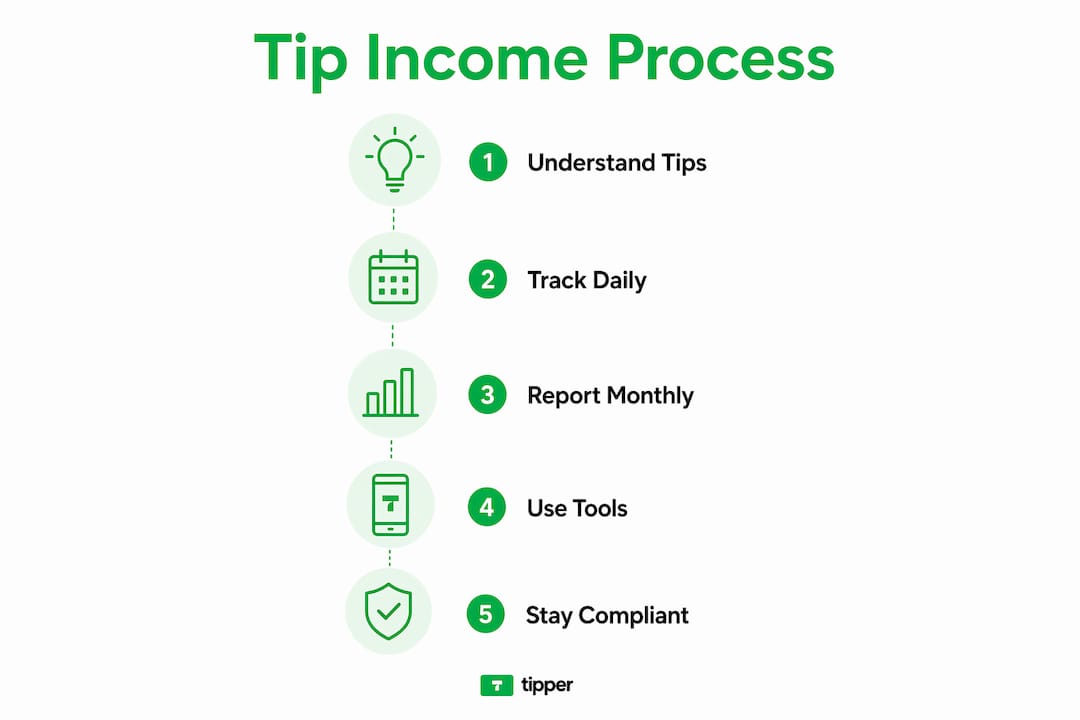
Setting up a tip income system takes less than an hour. The bigger challenge is maintaining compliance and growing tip volume over time. These steps cover both.
-
Choose a compliant tip collection platform. Select a tool that records every transaction automatically and supports major payment methods. Tipper generates a unique link that works with Apple Pay, Google Pay, and standard card payments. No supporter account is required, which removes the biggest barrier to tipping.
-
Set up daily recordkeeping from day one. Digital tip income requires daily tracking for accurate reporting. Use a spreadsheet, accounting software, or the export function in your tipping platform. Record the date, amount, and source for every tip.
-
Report tip income monthly. If you work for an employer, submit your tip total using IRS Form 4070 by the 10th of each month. If you are self-employed, add tip income to your quarterly estimated tax payments. Employers must also report all tip income they receive from workers and withhold appropriate payroll taxes.
-
Claim the 2025 tip income deduction. If your modified adjusted gross income falls below $150,000 as an individual, you qualify for the full $25,000 deduction on qualified tip income. Work with a tax professional to confirm your tips meet the IRS definition of “qualified” under the new law.
-
Communicate your tipping option clearly to your audience. Creators who explain why they accept tips and what the money supports consistently earn more than those who simply post a link. A short sentence in your content description or a 10-second mention in a video is enough.
-
Balance tip income with stable revenue. Tips are variable by nature. Pair your tip income strategy with at least one predictable revenue stream, such as a monthly membership or a flat-rate service offering. That combination protects your income during slow periods. You can explore cashless tipping setup options designed for small businesses and solo creators.
-
Review and adjust quarterly. Track which content or services generate the most tips. Double down on those formats. If a particular video or service type consistently earns tips, that is direct audience feedback about what they value most.
Key Takeaways
The tip income business model generates real, taxable income that requires daily tracking, monthly reporting, and proactive tax planning to maximize its benefits.
| Point | Details |
|---|---|
| Tips are always taxable | All cash and digital tips count as income; the $20 monthly threshold triggers employer reporting, not tax exemption. |
| 2025 deduction opportunity | Creators earning under $150,000 MAGI can deduct up to $25,000 in qualified tip income through 2028. |
| Six alternative models exist | Businesses can replace traditional tipping with pooling, service charges, revenue sharing, or higher base wages. |
| Digital tips need daily logging | Recording each digital tip on the day it arrives prevents compliance gaps and simplifies quarterly tax estimates. |
| Low friction drives more tips | Platforms that skip account creation and support Apple Pay or Google Pay consistently generate higher tip volume. |
Tipping has changed. Here’s what that means for creators.
Tipping used to be simple. You left cash, someone picked it up, and everyone moved on. The tax rules existed but enforcement was loose and the amounts were small. That era is over. Digital tipping has moved gratuities into a fully traceable, fully taxable system where every transaction leaves a record.
The 2025 tip income deduction is genuinely useful for working creators. But the new law also creates distortions between workers in tipped occupations and those doing similar work without the tip classification. A freelance writer who charges flat fees gets no deduction. A creator who earns the same income through tips might deduct up to $25,000. That gap will likely prompt more creators to restructure how they charge for their work.
My honest view: the creators who will benefit most from the tip income model are those who treat it like a real business system, not a passive bonus. That means daily recordkeeping, quarterly tax estimates, and a clear communication strategy with their audience. The tax savings are real, but only if you claim them correctly.
The shift away from tip credits in the restaurant industry also signals something broader. Voluntary tipping as a compensation system is under pressure from all sides: regulators, workers, and customers who are fatigued by tip prompts everywhere they go. Creators who build a hybrid model now, combining tips with subscriptions or flat-rate offers, will be better positioned when that pressure reaches the digital space.
— Tipper
Tipper makes collecting tip income simple
Creators who understand the tip income model still need a reliable way to collect payments. Tipper gives you a personalized link that supporters can use to send tips instantly, with no account required on their end.

Supporters pay through Apple Pay, Google Pay, or a standard card in seconds. You keep 100% of every tip you receive. Tipper also lets supporters send a thank-you note or video with their payment, which builds a stronger connection between you and your audience. Every transaction is recorded automatically, which makes monthly reporting straightforward. If you are ready to start collecting tips without the complexity of traditional platforms, Tipper is built for exactly that. You can also read about how businesses share tipping links to increase their tip volume from day one.
FAQ
What is the tip income business model?
The tip income business model is a revenue structure where customers make voluntary payments directly to a service provider or creator as a reward for their work. It operates alongside or instead of fixed wages and applies to both traditional service workers and digital content creators.
Are digital tips taxable income?
Yes. Digital tips are taxable income and must be reported exactly like cash tips. The IRS does not treat digital payments as donations, and failing to report them creates compliance risk.
How much of my tip income can I deduct in 2026?
The 2025 law allows a deduction of up to $25,000 on qualified tip income for individuals with a MAGI below $150,000. The deduction reduces income tax only; payroll taxes still apply to all tip income.
What is the difference between a tip and a service charge?
A tip is a voluntary payment made by the customer. A service charge is a mandatory fee set by the employer. Service charges are employer-controlled income and follow different tax rules. Misclassifying a service charge as a tip can trigger an IRS audit.
How often do I need to report my tips?
Employees must report tips over $20 per month to their employer by the 10th of the following month using IRS Form 4070. Self-employed creators include tip income in their quarterly estimated tax payments and annual tax return.




Leave A Comment