

TL;DR:
- Creators can build a sustainable financial feedback loop by allocating tips before spending and redirecting surplus to growth bottlenecks. Using frictionless collection methods like Tipper enables instant tips that reinforce habit formation, package value, and allow continuous reinvestment. Implementing disciplined allocation, tracking key metrics, and prioritizing operational hires ensure long-term compounding growth in creator income.
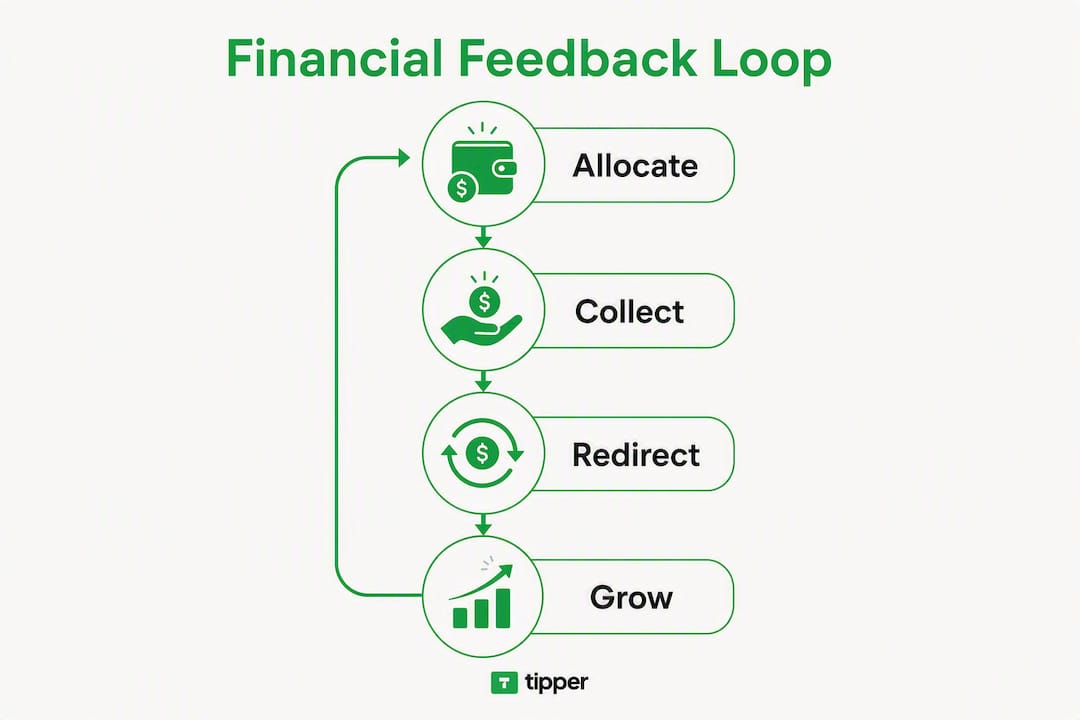
Yes, creators can build a financial feedback loop using instant tips — and the mechanism is simpler than most expect. Each tip becomes fuel: allocate it before you spend it, collect it through frictionless rails, then redirect any surplus to the one bottleneck holding your growth back. That three-part cycle (Allocate → Collect → Redirect) is what separates a sustainable tipping income from a transaction you restart from zero every month.
Pro Tip: Set up your allocation buckets before your first tip lands. Deciding where money goes after it arrives almost always means it disappears into expenses.
TL;DR — start today:
- Open a separate account and label it “Tax Reserve”
- Create a tipping link and add it to your bio or email signature
- Write down one bottleneck (gear, ads, an assistant) that your first surplus will fund
Table of Contents
- What Is a Financial Feedback Loop for Creators?
- Why Tipping-First Loops Compound Growth
- How to Set Up the Allocate → Collect → Redirect Loop
- Tactics to Collect Instant Tips Today
- How to Measure and Iterate the Loop
- Common Mistakes and Quick Fixes
- Your 30-Day Action Plan
- Key Takeaways
- The Mental Model That Actually Changes Things
- Tipper Makes the Collection Step Effortless
- FAQ
What Is a Financial Feedback Loop for Creators?
A financial feedback loop is the practice of treating every dollar of income as fuel that must have a destination before it lands. Without that discipline, most creators run what researchers call a transaction loop: they earn, spend, and restart each cycle from the same baseline. A flywheel routes profits back into the system so each cycle produces more output for the same effort.
The allocation rules that make this work are non-negotiable:
- Tax reserve first. Set aside a significant portion of every payment before touching the rest. This is a placeholder range, not tax advice; your actual rate depends on your filing status and state.
- Fixed owner pay. Pay yourself on a schedule, not whenever cash feels comfortable. Irregular draws are the fastest way to confuse business cash flow with personal spending.
- Operating expense cap. Define a ceiling for tools, subscriptions, and production costs before you scale. Uncapped opex is where loops die.
- Surplus to bottleneck. Whatever remains after the three buckets above funds the single constraint limiting your next growth cycle.
Allocation discipline changes behavior because it removes the decision from the moment of spending. When the rules are set in advance, surplus automatically flows to growth rather than lifestyle creep.
A financial feedback loop doesn’t require high income to start. It requires a change in how income is used.
Why Tipping-First Loops Compound Growth
Tipping changes the timing and visibility of value exchange. A subscription delays revenue; a tip arrives the moment a reader or viewer feels something. That immediacy gives you faster data on what content resonates and faster cash to act on it.

Three mechanisms explain why the loop compounds:
Packaging drives conversion more than content quality alone. Jahbari Taylor, a finance creator who built an agency after being laid off, observed that creators often mistake information as the product and neglect the delivery wrapper. If engagement is low, audit the delivery first before assuming the content is the problem.
Habit alignment multiplies tip frequency. Angela Zeng’s analysis of Substack’s growth engine shows that features like email delivery, free-to-paid previews, and member perks turn habitual reading into reliable revenue. Define the target behavior — weekly reader engagement, for example — then build rails that make that behavior easy and repeatable.
Reinvestment discipline raises the baseline. Terrence Porter frames this as a mindset shift: the goal is not to earn more, but to make each dollar work before the next one arrives. Loop management effort stays roughly constant; with evergreen content and systems in place, each unit of effort eventually produces compounding results.
Audience engagement forms a distinct feedback loop from revenue. Perceived-value tactics — member perks, paid previews, one-click payments — bridge engagement to steady tips and justify higher pricing over time.
How to Set Up the Allocate → Collect → Redirect Loop
Step 1: Allocate before you collect
| Bucket | Purpose | Example range |
|---|---|---|
| Tax reserve | Cover self-employment and income tax | — |
| Owner pay | Fixed draw on a set schedule | — |
| Operating expenses | Tools, software, production costs | — |
| Reinvestment | Fund the identified growth bottleneck | Remainder |
Open a separate bank account for each bucket or use a single account with labeled sub-accounts. Transfer funds on the day income arrives, not at month-end.
Step 2: Collect with frictionless rails
- Create a tipping link (more on Tipper below) and place it in your bio, email footer, and end-of-post CTA.
- Generate a QR code from the same link for printed materials, merch, or event signage.
- Enable Apple Pay and Google Pay so supporters tip in two taps with no account required.
- Add a short verbal CTA at the end of videos or streams: “If this helped, the tip link is in the description.”
- Test one CTA placement per week and track which channel drives the most conversions.
Step 3: Redirect surplus to the bottleneck
Once you have covered taxes, owner pay, and opex, the surplus has one job: fix the single constraint holding back your next growth cycle. That might be a paid ad test, a better microphone, or part-time coordination help.
Pro Tip: Your first hire should fix operational plumbing, not add creative capacity. An ops or coordination role stabilizes cash flow; a second content creator does not.
Tactics to Collect Instant Tips Today
Tipping links are the fastest rail to set up. Here is how each tactic works in practice:
- Link in bio: One URL, updated once, visible on every platform. Use a short, memorable slug.
- Email CTA: Place the link in your signature and in a one-line ask at the bottom of every newsletter issue.
- QR code: Print it on packaging, business cards, or a thank-you card tucked into physical orders.
- In-stream verbal CTA: Mention it at the natural pause point in a live stream, not at the very end when viewers have already left.
- Apple Pay / Google Pay flow: Supporters complete the tip without creating an account, which removes the single biggest friction point in digital tipping.
Tipper handles all of this from one dashboard. You get a customizable tip page, no-sender-account checkout, Apple Pay and Google Pay support, thank-you messages (text, photo, or video), and direct payouts. Creators keep 100% of their earnings; Tipper adds a small processing fee at checkout, visible to the sender. For a practical walkthrough of how real-time tips work, the mechanics are straightforward enough to set up in under 15 minutes.
How to Measure and Iterate the Loop
Track four metrics weekly. Nothing more, at least for the first 30 days.
| Metric | What it tells you | Target (starter) |
|---|---|---|
| Average tip size | Perceived value of your content | Trending up month over month |
| Conversion rate (visitors → tippers) | CTA and page effectiveness | Above 2% |
| Tip frequency per supporter | Habit formation | At least 1x per month |
| Retention of repeat tippers | Loop durability | — |
Run experiments in this order:
- State a hypothesis: “Adding a tip CTA to my email footer will increase weekly tips by at least one.”
- Run it for two weeks without changing anything else.
- Compare conversion rate before and after.
- Scale what works; kill what does not after a fixed sample.
Scale reinvestment when conversion rate holds above your target for four consecutive weeks. Hire when a specific operational task is consuming more than five hours per week of your time. Productize (turn a service into a repeatable offer) when you have at least three months of consistent tip data showing what your audience values most.
Common Mistakes and Quick Fixes
Skipping allocation. Fix: freeze all discretionary spending for one week, set up the four buckets, and transfer your next payment before doing anything else.
Broken delivery wrapper. If tips are flat despite traffic, audit your CTA placement before changing content. Move the link higher, simplify the ask, and test one change at a time.
Hiring for the wrong role. A creative hire during a revenue spike feels good but rarely fixes the bottleneck. Ops and coordination roles stabilize the loop first.
No measurement plan. Without the four metrics above, you cannot tell whether a change helped. Set up a simple spreadsheet before your next tip arrives.
Relying on one-time spikes. A viral post is not a loop. A loop is what you build so the next viral post starts from a higher baseline.
Loop health check:
- Are all four allocation buckets funded this month?
- Is your tipping link live and tested on mobile?
- Have you tracked conversion rate for at least two weeks?
- Did last month’s surplus go to the identified bottleneck?
Your 30-Day Action Plan
| Week | Actions | Estimated cost |
|---|---|---|
| Week 1 | Set up allocation buckets; create tipping link and QR code; add CTAs to top two channels | — |
| Week 2 | Run first tip promotion; A/B test two CTA placements; optional small paid boost | — |
| Week 3 | Review conversion data; iterate the weaker CTA; allocate first surplus to bottleneck experiment | Cost of bottleneck item |
| Week 4 | Measure four metrics; decide whether to scale reinvestment or bring in part-time ops help | — |
- Day 1: Open tax reserve account and set allocation percentages.
- Day 2: Create your Tipper link and test it on your phone.
- Day 3: Add the link to your bio, email footer, and one piece of content.
- Day 7: Check your first conversion data and note which channel drove it.
- Day 14: Run your first CTA experiment with a clear hypothesis.
- Day 21: Allocate any surplus to one bottleneck item.
- Day 30: Review all four metrics and set targets for month two.
Key Takeaways
A tipping-first financial feedback loop works because allocation rules force surplus into growth rather than expenses, and frictionless collection rails turn audience appreciation into repeatable, compounding revenue.
| Point | Details |
|---|---|
| Allocate before you collect | Set tax reserve, owner pay, and opex limits before your first tip arrives. |
| Delivery wrapper matters | Low tips often signal a broken CTA or placement, not weak content. |
| Four metrics are enough | Track average tip size, conversion rate, tip frequency, and retention weekly. |
| First hire fixes operations | Ops roles stabilize cash flow; creative hires come after the loop is proven. |
| Tipper as your collection rail | Tipper’s no-account checkout, Apple Pay support, and direct payouts make the Collect step frictionless from day one. |
The Mental Model That Actually Changes Things
The income-as-fuel frame is the one shift that makes everything else click. Most creators treat revenue as a reward to spend; the loop treats it as an input to program. That single reframe is what separates creators who compound from those who restart every month.
Disciplined allocation matters more than tip volume. A creator collecting $200 a month with clear buckets and a defined bottleneck will outpace one collecting $2,000 with no system. Test the loop at small scale, measure honestly, and let the data tell you where to reinvest. Tipper’s instant-payout and no-friction checkout make the collection mechanics easy to run, so your attention stays on the allocation and reinvestment decisions that actually move the needle.
Tipper Makes the Collection Step Effortless
Every tip you collect through Tipper lands in your account fast, with no barriers for your supporters. No account creation, no app download, no friction. Supporters pay with Apple Pay, Google Pay, or a card in two taps, and you receive a direct payout with 100% of your earnings intact.
Set up your customizable tip page in minutes, generate a QR code for any physical touchpoint, and send a personal thank-you note or video after every tip. Those small touches are what turn one-time tippers into repeat supporters — the retention side of your loop. The Allocate → Collect → Redirect checklist works best when the Collect step never breaks. Start your free Tipper link today and have your first tipping rail live before the end of the day.
FAQ
What is a financial feedback loop for creators?
It is a system where tip income is allocated to specific buckets (taxes, owner pay, opex, reinvestment) before spending, so surplus automatically funds the next growth bottleneck rather than disappearing into expenses.
How much income do I need to start a tipping loop?
None — the loop starts with allocation discipline, not a revenue threshold. Even a single tip can be allocated correctly and redirected to a bottleneck.
What metrics should I track for my tipping loop?
Track average tip size, conversion rate (visitors to tippers), tip frequency per supporter, and month-over-month retention of repeat tippers.
How does Tipper support a financial feedback loop?
Tipper provides the Collect step: a no-account-required checkout, Apple Pay and Google Pay support, customizable tip pages, thank-you messages, and direct payouts — so creators keep 100% of earnings and supporters face zero friction.
What should my first hire be when the loop proves out?
Hire for operations and coordination first. An ops role stabilizes cash flow and turns lumpy revenue into reliable business processes before you add creative capacity.




[…] Financial Feedback Loop for Creators: Build Your Engine […]