

Why tipping links are essential for creators
Tipping links give creators a direct revenue stream that requires no product, no paywall, and no brand deal. A supporter clicks a link, sends $5, and the creator gets paid. That simplicity is the whole point.
The benefits of tipping for creators go beyond the dollar amount. Creators who add an active tip jar to their monetization mix generate 8–15% more monthly income than those who rely solely on ads or affiliate links. For many creators with smaller audiences, this translates to supplemental income that can meaningfully support their work. Not a salary replacement, but real money that compounds as an audience grows.
What makes tipping links different from sponsorships or memberships is the absence of obligation. Supporters give because they want to, not because they signed up for something. That voluntary nature creates a different kind of relationship. When a fan tips, they’re signaling genuine appreciation, and that signal tends to strengthen the creator-audience bond more than a passive subscription ever could.
Here is what tipping links actually do for creators:
- Direct monetization without intermediaries, ad networks, or brand approvals
- Low barrier for supporters since no account creation or subscription is required
- Complementary income that stacks on top of memberships, sponsorships, and ad revenue
- Community signal that shows which fans are most engaged and invested
- Scalable support that grows naturally as audience size and loyalty increase
The importance of tipping links also shows up in how they deepen engagement. When a creator publicly acknowledges a tip, that moment of recognition encourages repeat giving and signals to the broader audience that tipping is welcome. Tipping is, at its core, a social act, and the platforms that understand this have built features specifically around that dynamic.
What are the best tipping platforms for creators in 2026?

The U.S. market has no shortage of options. The right platform depends on where your audience lives, how they prefer to pay, and how much friction you’re willing to accept. Here’s how the major players compare.

| Platform | Best for | Payment methods | Fees / earnings share | Engagement features | Ease of use |
|---|---|---|---|---|---|
| Show Love | Fan-driven tipping with engagement | Cards, digital wallets | Varies by plan | Custom tip amounts, multi-platform integration | Easy |
| Buy Me a Coffee | Flexible tipping + memberships | Cards, PayPal | 5% platform fee | Social sharing, membership tiers | Very easy |
| Tip Jar | One-time supporter contributions | Cards, multiple options | Varies | Simple link sharing | Easy |
| Twitter Tips | Twitter-native monetization | Cards, Cash App, Venmo, Patreon, Strike | No Twitter fee; processor fees apply | In-app tipping via profile | Easy |
| TikTok Tips | TikTok influencers, live streams | TikTok Coins | TikTok takes a cut | Real-time gifting during streams | Easy within TikTok |
| Zink | Quick, borderless tipping | Apple Pay, Google Pay | Low; instant payouts | Instant payment confirmation | Very easy |
| Linktree | Consolidating tips + links in one bio | Stripe, PayPal | Free tier available; Pro at $9/month | Customizable tip buttons | Easy |
| Tip Jar (Twitter Tips) | Twitter-integrated tipping | Cards, Venmo, Cash App | No Twitter fee | Direct social tipping via tweets | Easy |
| Clubhouse Payments | Live audio creators, podcasters | Cards | Clubhouse takes a cut | Native listener interaction | Easy within Clubhouse |
| Instagram Badges | Live-streaming creators | In-app purchase | Instagram takes a cut | Real-time badge visibility during Lives | Easy within Instagram |
| Patreon | Subscription-based community building | Cards, PayPal | 5–12% depending on plan | Tiered membership rewards, community posts | Moderate |
| Twitch Tips | Live streamers | Cards, PayPal, Bits | Bits: Twitch takes ~29%; direct tips vary | Viewer badges, interactive tools | Easy within Twitch |
| YouTube Super Chat / Tips | YouTubers monetizing live streams | Cards, Google Pay | YouTube takes 30% | Highlighted messages, pinned chats | Easy within YouTube |
A few things stand out when you look at this list as a whole. Platforms native to a specific app, like TikTok Tips, Instagram Badges, and YouTube Super Chat, are frictionless for audiences already on those platforms but lock you into that ecosystem. Standalone tools like Buy Me a Coffee, Zink, and Linktree work across platforms and give creators more control.
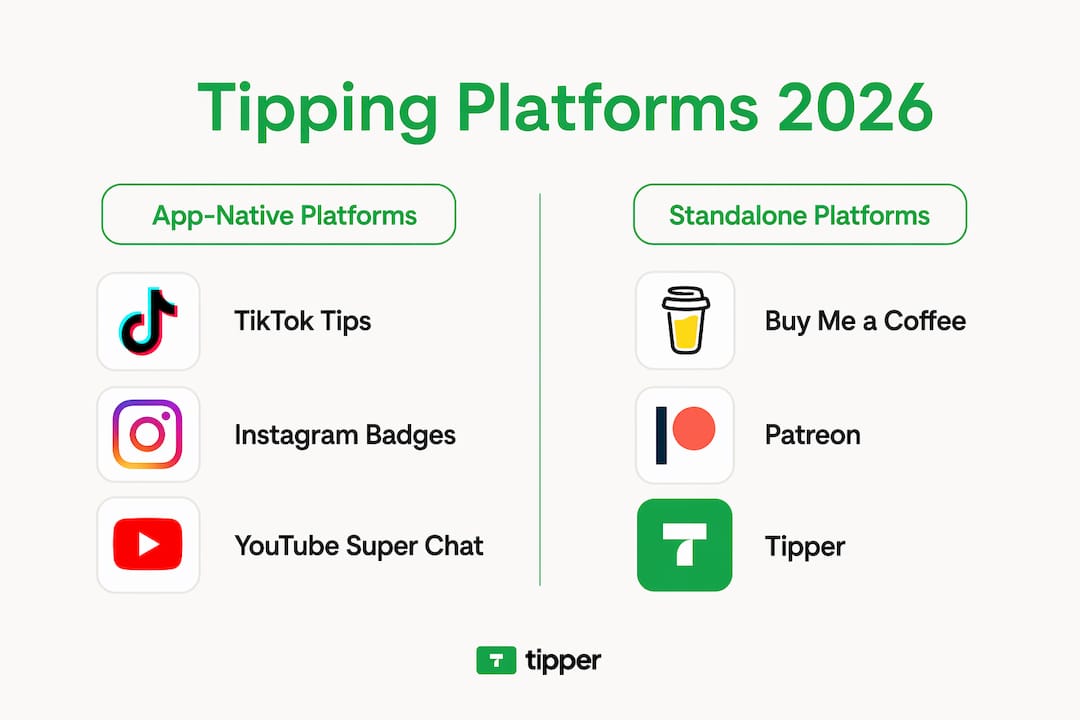
Buy Me a Coffee is the most popular standalone option for creators who want a clean, low-effort setup. The 5% fee is transparent, the UI is genuinely simple, and the social sharing features make it easy to promote. Patreon sits at the other end of the spectrum: more infrastructure, more community features, and a higher fee that only makes sense if you’re building a subscription layer on top of tipping.
YouTube Super Chat deserves a closer look. YouTube takes 30%, but for creators with active live streams, the engagement mechanics are hard to beat. Highlighted messages and pinned chats create a visible incentive for viewers to tip, and top streamers earn over $50,000 monthly from Super Chats alone. The 80/20 reality applies here too: roughly 80% of fan funding comes from the top 20% of tippers, so building relationships with your most engaged viewers matters more than chasing volume.
Twitch Tips works similarly for live streamers, with Bits adding a gamified layer that casual viewers find approachable. Clubhouse Payments and Instagram Badges are solid within their native apps but have limited utility outside them.
For creators who want a full platform comparison before committing, the fee structure and payout speed differences across these tools can meaningfully affect monthly take-home.
How do you integrate tipping links into your monetization strategy?
Choosing a platform is the easy part. Getting supporters to actually use it takes a bit more thought.
Start with your audience’s geography and payment habits. If most of your followers are in the U.S., platforms that support Apple Pay, Google Pay, Venmo, and Cash App will convert better than those requiring a credit card form. For creators with a significant European audience, the fee dynamics shift: Wero is the cheapest processor for micro-tips under €5 in Europe, while Stripe handles larger tips and international fans more cost-effectively. A hybrid setup captures both.
Placement matters more than most creators expect. A tip link buried at the bottom of a bio gets ignored. Put it in your top three links, directly under your primary call to action. The copy around the button determines whether people click. Phrases that imply reciprocity (“buy me a coffee so I can keep making this”) outperform generic “donate” language. Effective tip jar copy centers on reciprocity and a light tone, not obligation.
Promotion should be consistent but not aggressive. A monthly thank-you post naming recent tippers, a brief verbal mention at the end of a video, or a pinned comment on a popular post keeps the link visible without feeling like a hard sell. Fans who want to support you will find the link; your job is to make sure it’s easy to find.
Tipping links work best as part of a broader monetization mix, not as a standalone income source. They complement memberships by capturing supporters who want to give without committing to a subscription. They complement sponsorships by providing direct community revenue that doesn’t depend on brand relationships. And unlike both, they require no new content, no deliverables, and no negotiations.
Pro Tip: Test two or three different copy templates for your tip link over 30 days and track which one gets clicked most. Something as small as changing “support my work” to “buy me a coffee” can double conversion rates. Small copy changes compound over time.
What does research say about the psychology of tipping?
Tipping is not purely economic. Cornell researcher Michael Lynn, whose forthcoming book covers decades of tipping studies, describes tipping as “a complex social ritual shaped by psychology, social norms, economics and even national personality traits.” For creators, that framing is useful. It means your audience’s decision to tip is influenced by factors you can actually shape.
Research from Tel Aviv University identifies two main types of tippers: “appreciators,” who tip to genuinely reward quality, and “conformists,” who tip because social norms make it feel expected. Appreciators tend to tip above average; conformists match whatever the prevailing norm appears to be. Over time, appreciators pull conformists upward, which partly explains why U.S. tipping rates have risen significantly over recent decades.
For creators, this dynamic has a practical implication. When you publicly acknowledge tips and make tipping visible in your community, you create a social norm around it. Conformist supporters see that others tip and adjust their behavior accordingly. The creator who reads every Super Chat aloud and thanks the tipper by name isn’t just being polite; they’re actively building a tipping culture.
The income impact of acknowledgment is concrete. Creators who acknowledge every tip earn 2–4 times more revenue from fan funding than those who let messages pass unnoticed. Recognition is the single strongest driver of repeat tipping, and it costs nothing.
Tipping also doesn’t correlate strongly with content quality alone. Bill size, payment method, and group dynamics often matter more than the quality of the service or content itself. That means a creator with a mid-size but highly engaged audience can out-earn a larger creator who never acknowledges supporters.
Tipping creates direct-to-creator revenue independent of ads, sponsorships, or paid content, requiring no external partnerships or product creation.
What are the tax and legal rules for creators using tipping links?
Tips received by creators are taxable income in the United States. The IRS treats tips as ordinary income regardless of whether they come through YouTube Super Chat, Buy Me a Coffee, Patreon, or a standalone tipping link. If you receive tips through a third-party payment platform, that platform may issue a 1099-K form once your earnings cross the reporting threshold. Creators should track all tip income throughout the year, not just at tax time.
The Department of Labor addresses tipping primarily in the context of employees, but the core principle applies to self-employed creators: tips are compensation and must be reported. As a self-employed creator, you’ll also owe self-employment tax on net earnings, which covers Social Security and Medicare contributions.
A few practical points worth knowing. Platforms that process payments, including Stripe and PayPal, are required to report transactions to the IRS above certain thresholds. Keeping a separate business account for tip income simplifies bookkeeping and makes quarterly estimated tax payments easier to calculate. If you have international supporters, currency conversion doesn’t change your tax obligation; the dollar value at the time of receipt is what gets reported.
For creators with audiences in Europe, GDPR rules apply to any personal data collected during the payment process. Processors like Stripe handle most of this compliance automatically, but creators should review the privacy terms of any platform they use.
Tax rules change, and the specifics depend on your income level, state of residence, and business structure. Consulting a tax professional who works with self-employed creators is the most reliable way to stay compliant as your tip income grows.
Key Takeaways
Tipping links generate 8–15% more monthly income for creators who use them actively, and acknowledging every tip drives 2–4 times more repeat support than ignoring them.
| Point | Details |
|---|---|
| Tipping links add real income | Creators with active tip jars earn 8–15% more monthly income than those without one. |
| Acknowledgment multiplies revenue | Publicly thanking tippers by name drives 2–4 times more fan funding over time. |
| Platform choice depends on audience | Match your platform to where your audience pays: native tools for single-platform creators, standalone tools for cross-platform reach. |
| Tips are taxable in the U.S. | The IRS treats all tip income as ordinary income; track it year-round and report it on your return. |
| Tipper keeps 100% for creators | Tipper lets supporters tip instantly via Apple Pay or Google Pay with no account required, and creators keep every dollar. |
Tipper is worth a look before you commit to a platform
Most tipping platforms take a cut. Buy Me a Coffee charges 5%, YouTube keeps 30% of every Super Chat, and Patreon’s fees run 5–12% depending on your plan. Those percentages add up fast once your tip volume grows.
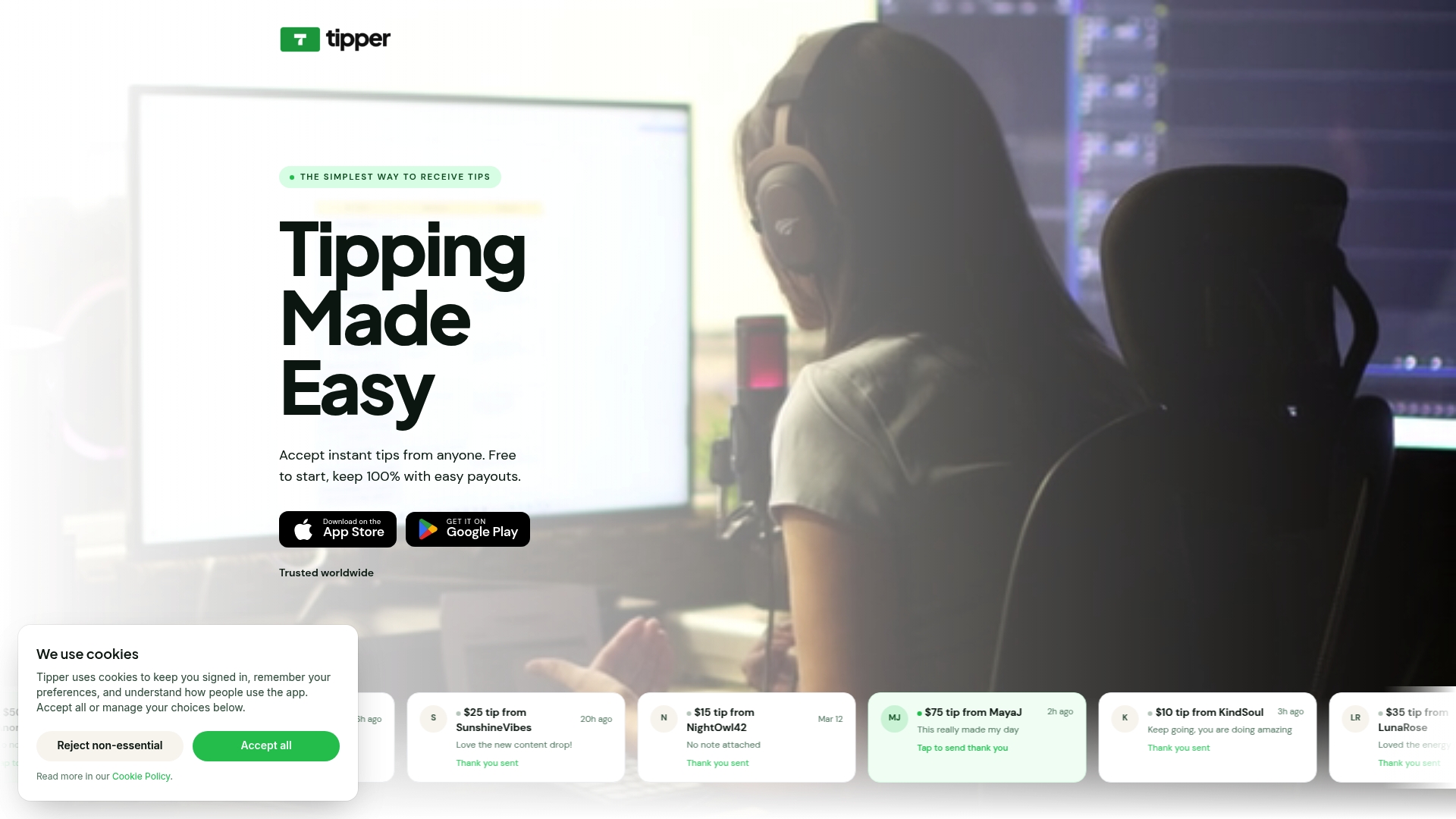
Tipper takes a different approach. Creators keep 100% of every tip, and supporters don’t need an account to send money. They pay with Apple Pay or Google Pay in seconds, which removes the biggest friction point in the tipping flow. Tipper also lets creators send a thank-you note or video back to the supporter, which reinforces the personal connection that drives repeat tipping. If you want a tipping setup that’s genuinely frictionless for both you and your audience, Tipper is worth setting up alongside whatever platform-native tools you already use.
FAQ
Should I tip a content creator?
Tipping a creator is entirely voluntary, but it’s one of the most direct ways to support someone whose work you value. Unlike subscriptions, a tip carries no ongoing commitment and goes straight to the creator.
Does Linktree have a tip jar?
Yes. Linktree supports tipping through integrations with Stripe and PayPal, letting creators add a customizable tip button to their bio link page.
Why do so many creators ask for tips?
Tipping links give creators direct income that doesn’t depend on ad revenue, brand deals, or platform algorithms. For most creators, tips are supplemental income that helps sustain their work without requiring new products or partnerships.
Is a 10% tip considered low for a creator?
In the context of digital creator tipping, there’s no fixed percentage norm the way there is in restaurants. Any voluntary contribution is appreciated; what matters more is the acknowledgment the creator gives in return, which research shows is the strongest driver of repeat support.
How do tipping links affect creator income over time?
Creators who actively promote their tip links and acknowledge supporters consistently tend to see income grow as their audience scales. The 8–15% income boost from an active tip jar compounds as follower counts and engagement rates rise.




[…] Why Creators Need Tipping Links: A 2025 Guide […]
[…] Tipper blog: Why creators need tipping links — the business case for adding a tip link to your content revenue mix. […]
[…] card network on essentially the same timeline as any instant card transaction. This is the category tipping links fall into, and it’s built specifically to remove the multi-day gap between appreciation and […]
[…] add-ons. Tipper treats every tip as a real, professional transaction, not a digital tip jar, and positions the experience accordingly. Visit the Tipper landing page to see the setup flow […]
[…] Why Creators Need Tipping Links: A 2025 Guide […]
[…] the flow on the creator’s own page, backed by Apple Pay and Google Pay, mirrors what helps creators build sustainable tipping revenue instead of one-off donations that never repeat. The tools that win here aren’t the ones with the […]
[…] which turns a one-off tip into something closer to a real connection. If you want to see how a personalized tipping link works in practice, or you’re a creator ready to set one up for your own audience, visit […]
[…] readers who want a deeper walkthrough, our guide on why creators need tipping links covers the conversion logic in more detail, and our digital tipping platforms comparison breaks […]
[…] pattern lines up with how Tipper’s own guidance on tipping links frames the decision: tipping and wishlisting solve different problems, so running both in parallel […]
[…] cover the reasoning in more depth in why creators need tipping links and the mechanics in how tipping links work for creators in […]