

Payment immediacy means a creator can access money they’ve earned within seconds or minutes of it being sent, rather than waiting through a billing cycle or platform hold. It’s the difference between a fan tapping “send” on a tip and that money actually landing somewhere you can spend it, versus watching a pending balance sit for weeks.
For creators, immediacy isn’t a nice-to-have feature buried in a payments settings menu. It changes how you run your business day to day.
- Cashflow stability: money arrives when you need it, not on someone else’s schedule
- Reinvestment speed: you can buy gear, hire an editor, or boost a post the same day a tip or payout hits
- Retention: creators who get paid fast stick around on a platform longer than those stuck waiting
- Negotiation leverage: payout speed becomes a bargaining chip with brands and platforms
- Financial resilience: irregular income becomes easier to manage when at least part of it is predictable in timing
Standards bodies like the Bank for International Settlements define fast payment systems by their ability to complete a transaction almost instantly, any time of day. Infrastructure like FedNow in the US and tools like Tipper are built specifically to close the gap between “you earned it” and “you can use it.”
Key Takeaways
Payment immediacy works because it converts unpredictable creator income into something closer to real-time cashflow, which directly reduces churn and financial fragility.
| Point | Details |
|---|---|
| Immediacy has a clear definition | It means usable funds within seconds to minutes, not just a fast-sounding label on a contract. |
| Speed drives retention | Platforms paying within seven days see roughly half the churn of those on 30-day cycles. |
| NET-30 and instant are different promises | Billing terms control when payment is due; payout rails control how fast it moves once released. |
| Fees usually land on someone | Instant transfers often carry around a 1% fee, so confirm upfront who absorbs it. |
| Tipper removes the delay entirely for tips | Tipping links let supporters pay instantly via Apple Pay or Google Pay with no account and no invoicing cycle. |
Table of Contents
- Why Payment Speed Changes Creator Economics
- What “Instant,” “Same Day,” and NET-30 Actually Mean
- How Platforms and Fintechs Actually Deliver Instant Money
- The Payout Methods You’ll Actually See
- What Faster Payments Actually Cost You
- How to Get Paid Faster, Starting This Week
- Real Examples of Immediacy in Practice
- Why “Instant” Doesn’t Always Mean the Same Thing
- An Operator’s View on Why Speed Should Be the Default
- Get Paid the Moment Someone Wants to Support You
- Sources
- FAQ
Why Payment Speed Changes Creator Economics
Most creators don’t have one steady paycheck. You’ve got ad revenue landing on one schedule, brand deals on another, tips arriving whenever a fan feels generous, and platform payouts trickling in on their own cycle. That patchwork income is manageable when at least some of it moves fast. It becomes a real problem when everything is delayed at once.
More than a third of the US labor force now identifies as independent workers, and BLS research on social media influencers points to payment speed as a central financial concern for that group. When your income doesn’t arrive on a fixed date, the timing of each individual payment matters more, not less.
The retention data backs this up. Platforms that pay creators within seven days of approval see churn rates roughly half of what platforms see when they stick to 30-day cycles, according to industry analysis on creator retention. Creators who wait 30 or more days for a payment are far more likely to simply stop taking new assignments from that platform or brand. Slow pay doesn’t just annoy people. It pushes them elsewhere.
Faster access to earnings has knock-on effects that compound over time:
- You can pay a video editor or virtual assistant the same week instead of floating them on your own credit
- You can reinvest in equipment or ad spend while a trend is still relevant, not three weeks after it’s cooled
- You gain something to point to when a brand tries to lock you into 60 or 90-day net terms
Pro Tip: Treat payout speed as a line item in every negotiation, the same way you’d negotiate usage rights or exclusivity. Ask brands directly: “What’s your payment timeline, and is there a faster option for a small fee reduction?” Many will say yes because cash held longer costs them something too.
What “Instant,” “Same Day,” and NET-30 Actually Mean
Contract language around payment timing is inconsistent, and that inconsistency costs creators money and stress. Here’s what each common label actually promises in practice.
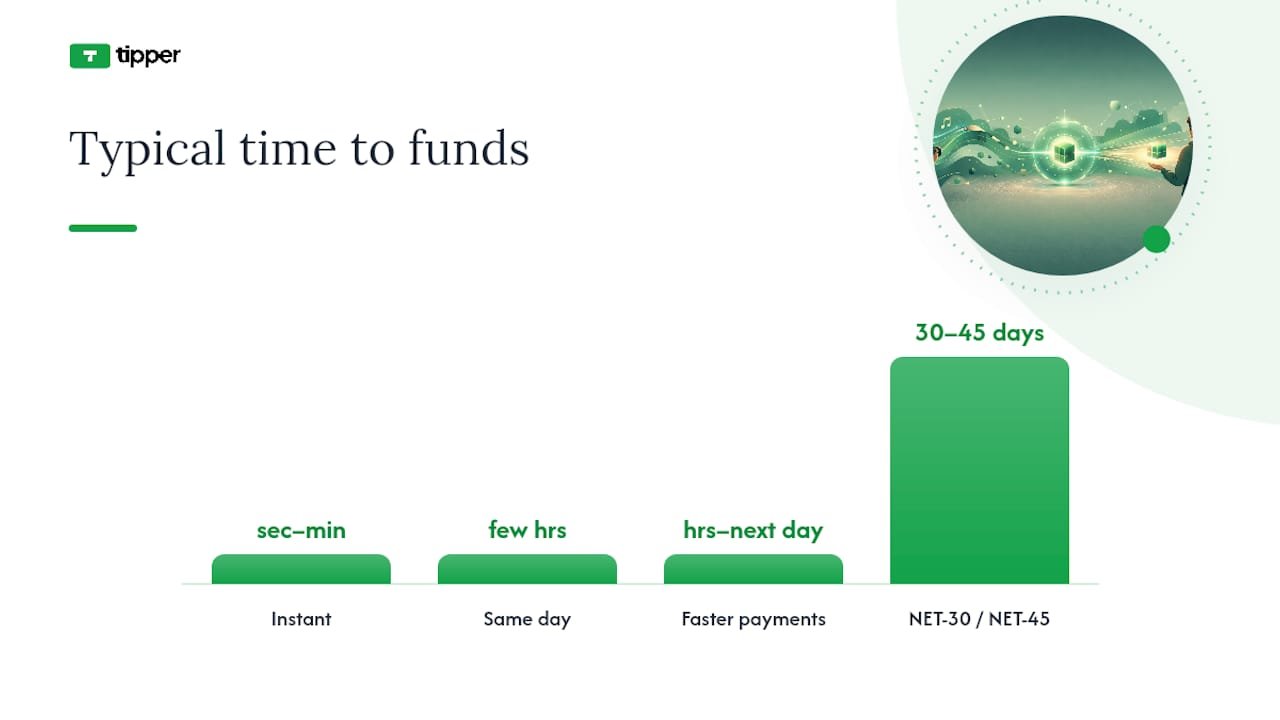
“Instant” should mean funds are usable within seconds to a couple of minutes. “Same day” usually means hours, not seconds, funds clear before the bank’s daily cutoff but you might wait until evening. “Faster payments” is a broader category that can mean anywhere from a few hours to next business day. “NET-30” or “NET-45” refers to billing terms, not payout speed. It’s a promise about when an invoice becomes due, and it says nothing about how fast the money moves once it’s released.
That last distinction trips up a lot of creators. NET-30 is a business term. Instant bank push or card push is a technical rail. A brand can offer NET-30 billing and then, once the 30 days are up, still pay you through a slow wire that takes three more business days. The label and the rail are separate promises.
| Label | Typical time to funds | Common delivery rail |
|---|---|---|
| Instant | Seconds to a few minutes | Card push, instant bank rails, platform wallet with instant unlock |
| Same day | A few hours, same business day | Same-day ACH, some bank transfers |
| Faster payments | Hours to next business day | Faster Payments-style rails, some card networks |
| NET-30 / NET-45 | 30 to 45 days before payment is even released | Standard ACH or check once released |
Eligibility gates matter here too. Instant options often require a debit card (not a prepaid card), a bank account in a supported country, or a verified account past a certain age or transaction history. A creator in one country might get instant card push while someone in another region on the same platform gets stuck with standard ACH, purely because of what rails their bank supports.
How Platforms and Fintechs Actually Deliver Instant Money
Behind every “instant payout” button is a specific piece of financial plumbing, and it’s worth knowing roughly how it works so you can judge whether a platform’s promise is real or just marketing.
The most common rails are:
- Card push (debit push): funds route directly to your debit card’s network rather than sitting in a bank queue, often landing in minutes
- Instant bank rails: systems like FedNow in the US, or comparable real-time rails elsewhere, move money bank-to-bank around the clock
- Platform wallets: money lands in an in-app balance instantly, but you still have to transfer it out to your bank, which may or may not be instant itself
- Fronting or advance services: a company like Lumanu advances a creator their expected payment before the underlying brand or platform funds have actually settled, essentially floating the cash and taking on the collection risk itself
There are two commercial patterns worth separating. One is native instant rails, where the money genuinely moves in real time because the underlying payment infrastructure supports it. The other is fronting, where a fintech pays you first out of its own balance sheet and then collects from the actual payer later. Both feel identical from a creator’s side, instant money, but they carry very different risk profiles for the company providing it.
Mastercard has invested heavily here through Mastercard Move, a network of partnerships designed to give platforms and gig workers faster, more transparent access to what they’ve earned. Mastercard’s own reporting notes that platforms adopting these faster rails see measurably better user experience and retention, echoing the churn data seen elsewhere in the creator economy.
Substack, for its part, has built subscription payouts around Stripe’s instant payout infrastructure, letting writers pull earned revenue out closer to the moment it’s collected instead of waiting for a monthly batch. Whatever platform or fintech you’re evaluating, always check the fine print on eligibility. Country restrictions, minimum balances, and card type requirements can quietly turn an “instant” feature into something that only works for a fraction of users.
The Payout Methods You’ll Actually See
Contracts and platform dashboards use a handful of recurring payout methods, and each comes with its own timing, fee structure, and friction level.
ACH / direct deposit. The default for most platform payouts in the US. Funds typically take one to three business days. Usually free to the creator, though the platform may absorb a small processing cost.
Card push / instant debit payouts. Money lands on a linked debit card, often within minutes.
Platform wallets. Common on marketplaces and creator platforms. The balance updates instantly, but moving it to an actual bank account may still take the standard ACH timeline unless the platform offers an instant cash-out option, often for a fee.
PayPal and similar wallets. Fast for peer transfers, slower and costlier for currency conversion or business withdrawals. Instant transfer to a linked card is usually available for a small percentage fee.
Tipping links and one-tap pay (Apple Pay, Google Pay). These skip the invoice-and-wait cycle entirely. A supporter taps once, no account required on their end, and the money moves through the underlying card network on essentially the same timeline as any instant card transaction. This is the category tipping links fall into, and it’s built specifically to remove the multi-day gap between appreciation and access.

Wire transfers. Reserved for larger one-off payments, often international. Slow (one to five business days) and expensive, with fees frequently in the $15 to $50 range depending on the bank and currency.
Pro Tip: Set your default payout destination to a real debit card, not a prepaid or virtual card, since many instant-payout systems reject non-standard cards outright. Check this in your platform settings before you need the money urgently, not after.
What Faster Payments Actually Cost You
Speed isn’t free. Somebody in the chain, you, the platform, or the brand, absorbs the cost of moving money faster than the default rails allow, and it’s worth knowing who that is before you assume instant is always the better deal.
The direct cost drivers include instant-payout fees charged by the processor (commonly a percentage of the transfer amount), debit card network fees, currency conversion spreads on cross-border payments, and the margin a platform builds in if it’s fronting funds ahead of its own collection.
There are operational risks too, and they cut in the platform’s direction more than the creator’s, but they still shape what gets offered to you:
- Chargeback exposure: if a brand payment gets reversed after a creator has already been paid instantly, someone eats that loss
- Reconciliation complexity: instant rails moving money in real time make bookkeeping harder to audit than batch payments
- KYC/AML friction: instant payout products usually require tighter identity verification upfront, which can delay your first payout even while later ones are instant
- Liquidity exposure: fronting services are taking on real financial risk every time they pay a creator before collecting from the actual source, which is why they charge for it
Who typically pays the fee depends on the platform. Some brands absorb an instant-payout surcharge as a cost of doing business with top creators. Others pass it straight to you. When you’re negotiating a deal, ask directly which side of that fee you’re on, and use it as a bargaining point, particularly if you’re a repeat contributor with leverage. On the compliance side, remember that faster money is still taxable money. University of Bath research on influencer income flags how easy it is to mismanage reporting when payments arrive through unconventional channels like platform credits or in-kind arrangements. Instant cash doesn’t remove that obligation.
How to Get Paid Faster, Starting This Week
You don’t need to wait for platforms to fix this industry-wide. There’s a lot you can control directly.
- Ask for a partial upfront payment. Even 25% to 50% before deliverables are due protects you against a slow final settlement and signals you take your business seriously.
- Add an accelerated payout clause to contracts. Specify a release trigger, “payment due within 5 business days of content approval,” rather than a vague monthly cycle.
- Set up instant-ready payout destinations before you need them. A verified debit card or bank account that supports instant rails should be configured before your next deal closes, not scrambled together after.
- Use tipping links for direct supporter payments. These bypass invoicing entirely and let fans pay you the moment they decide to, with platform tools built for exactly this.
- Document deliverables against payment milestones. The Library of Congress guide to influencer marketing costs is a useful reference for structuring what you deliver against what triggers payment.
- Push for a hybrid payout policy if a platform offers one. Many platforms now offer gated instant payout lanes for eligible creators while keeping NET-30 as the default, according to platform payout strategy guidance. Ask if you qualify.
Pro Tip: Here’s a contract clause you can adapt directly: “Payment shall be released within 3 business days of content approval via [instant bank transfer / card push], with approval defined as written sign-off or 5 business days of no feedback, whichever comes first.” That single clause removes the two biggest sources of payment delay, ambiguous approval windows and vague release timing.
Real Examples of Immediacy in Practice
Substack and instant payouts. Substack writers rely on Stripe’s instant payout infrastructure to pull subscription revenue closer to the moment it’s collected, rather than waiting for a fixed monthly disbursement, cutting the lag between a subscriber signing up and the writer seeing that money.
ShearShare and Mastercard Move. ShearShare, a marketplace connecting hair stylists with booth space, integrated Mastercard Move to give its workers faster access to earnings, a model Mastercard highlights as evidence that gig and creator-adjacent platforms see real retention gains when they shorten payout timelines.
The residuals benchmark. Fast Company’s reporting points out that SAG-AFTRA actors typically see residual payments within 30 to 60 days of a project airing, while creators on many brand deals wait 90 to 180 days for comparable campaign payments. That gap is the clearest evidence that the creator economy’s payment norms lag behind other entertainment sectors, not because the technology can’t move faster, but because the industry hasn’t standardized around doing so.
Retention data across platforms. The pattern holds everywhere it’s been measured: platforms that pay within a week retain creators at roughly double the rate of platforms running 30-day cycles, reinforcing that speed isn’t a cosmetic feature, it’s a business lever.
Why “Instant” Doesn’t Always Mean the Same Thing
The word “instant” gets used loosely, but the plumbing behind it varies by country and system, and understanding the difference helps explain why some payments genuinely land in seconds while others just feel fast.
The BIS distinguishes between coupled real-time settlement, where the interbank settlement and the money landing in your account happen at essentially the same moment, and decoupled deferred settlement, where banks settle with each other later in batches, but the payee still sees funds available almost immediately because the system guarantees it.
Sweden’s Swish runs on real-time settlement. India’s IMPS is near-instant. The UK’s Faster Payments system settles between banks on a deferred, net basis, yet still makes funds available to the recipient within seconds, because the underlying scheme guarantees payee availability regardless of when the banks square up behind the scenes.
The message flow generally looks like this: payer initiates → payment service provider validates and sends the message → the settlement layer either clears in real time or queues for batch settlement → the payee’s account shows available funds, often before the interbank settlement is even finished.
For creators, what matters is payee availability, not what’s happening between banks behind the scenes. A primer on instant versus faster payments makes this distinction clear: the label “instant” is really a promise about when you can spend the money, not a description of the bank’s internal settlement mechanics. When a platform tells you a payout is instant, the honest follow-up question is: instant to my account, or instant somewhere in the pipeline that I still can’t touch yet?
An Operator’s View on Why Speed Should Be the Default
Creators have spent years being treated like unsecured lenders to platforms and brands, fronting content, time, and production costs, then waiting months to see a return. That framing has held up mostly because the technology for faster settlement wasn’t widely accessible until recently. It is now, and the industry’s slow adoption of it looks increasingly like inertia rather than necessity.
The strongest argument for immediacy isn’t convenience, it’s fairness paired with financial reality. A creator managing irregular income from five different sources needs predictability more than the average salaried employee, not less. Every week a payment sits delayed for no operational reason is a week that creator is absorbing risk that belongs, functionally, to the platform or brand holding the money.
That said, immediacy has real limits. Fronting services carry genuine liquidity risk, and native instant rails only work where the underlying banking infrastructure supports them. Nobody should promise instant payouts everywhere and mean it. The realistic goal is a system where instant is the default wherever the rails allow it, and creators are told plainly, upfront, when it isn’t available yet. Tools built specifically around tipping links and one-tap payments, Tipper’s approach among them, are a practical step toward that default, because they remove the invoicing and approval delay entirely from at least one income stream.
Get Paid the Moment Someone Wants to Support You
Tipper closes the gap this entire article has been describing: the space between a supporter deciding to pay you and the money actually reaching you. A fan taps your personalized link, pays with Apple Pay, Google Pay, or a card, and never needs to create an account. No invoice, no NET-30 clause, no waiting on a brand’s finance department to process a batch.
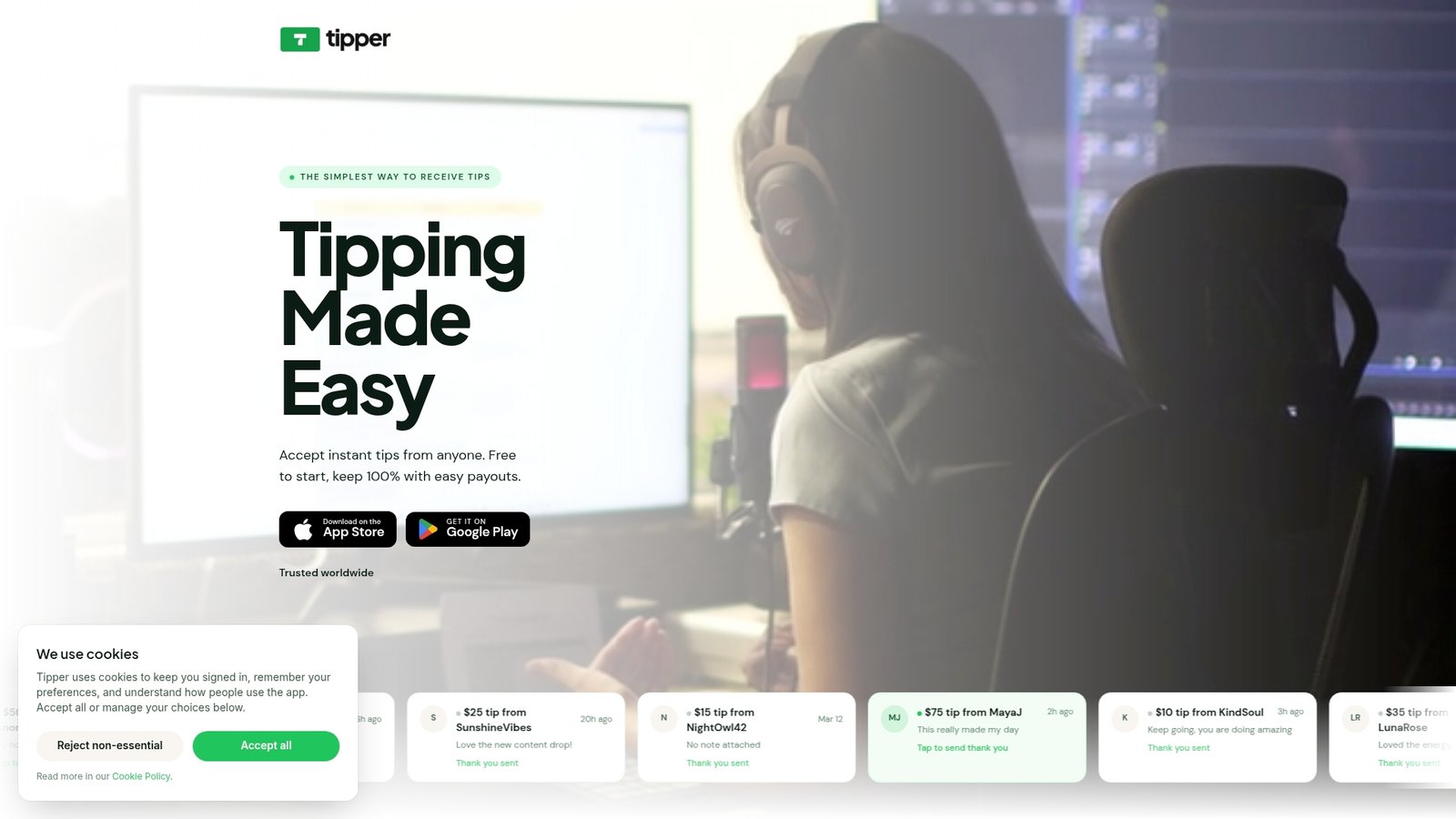
That structure matters because it puts you outside the delayed-payment problems this article covers in detail. There’s no fronting service taking a cut for advancing your money, and no billing cycle to negotiate around, because Tipper isn’t collecting on your behalf and holding funds. You can also add a thank you message, text, photo, or video, so supporters get something personal back in the same moment they’ve just made your day a little easier. If you want a payment flow built around immediacy from the ground up rather than retrofitted onto slower rails, Tipper and see how it feels to get paid the moment someone decides you’re worth supporting.
Sources
For readers who want to dig into the mechanics and industry context behind this article, these sources cover the technical, commercial, and labor-market angles in more depth.
- BIS quarterly review: instant payments and settlement models
- Payday on demand: how fast payouts are crucial for creators and gig workers — Mastercard
FAQ
How do influencers accept payments?
Influencers typically accept payment through ACH direct deposit, card push transfers, platform wallets like PayPal, brand invoicing on NET-30 terms, and direct tipping links using Apple Pay or Google Pay for one-tap fan payments.
What are the four types of payment methods creators use?
The four most common categories are bank transfers (ACH or wire), card-based push payments, platform-native wallets, and one-tap digital wallet links such as Apple Pay or Google Pay tipping pages.
How long does payment initiation take?
Instant rails move money in seconds to a few minutes, same-day options clear within business hours, faster payment systems typically take hours to next business day, and standard NET-30 terms mean payment isn’t even released for 30 days after invoicing.
How do social media payments work?
Social media payments generally route through a platform’s built-in monetization tools, a brand’s invoicing cycle for sponsored content, or direct supporter payments via tipping links, with speed depending entirely on which payout rail the platform or brand uses behind the scenes.
Does Tipper require supporters to have an account?
No. Tipper lets supporters pay through a personalized link or QR code using Apple Pay, Google Pay, or a card, with no account required on the sender’s side.




Leave A Comment