

Income transparency for creators means deliberately choosing what financial information to share, with whom, and in what format, whether that’s a public rate range, a sponsor campaign report, or aggregated tip metrics. The short verdict: transparency helps when it reduces information gaps that cost you deals or audience trust, and it hurts when it exposes details that anchor negotiations downward or invite harassment.
Four elements define the concept in practice:
- Public ranges vs. exact amounts — sharing “$3,000–$8,000 per integration” rather than a specific contract figure
- Rate cards — a document or page that lists your services, deliverables, and fee ranges for brand partners
- Campaign performance summaries — post-campaign reports showing CTR, conversion, or reach delivered to a sponsor
- Aggregated support metrics — tip totals, subscriber counts, or monthly supporter figures shared publicly without revealing individual transactions
The core distinction: income transparency for creators is not about posting your bank balance. It’s about making your professional value legible to the people who pay for it.
Table of Contents
- What does income transparency mean for creators, exactly?
- Why transparency pays off for creators and brands
- What are the real risks of disclosing your income?
- How to practice income transparency without exposing yourself
- How transparency shapes earnings and pay equity in the creator economy
- What the research and experts say about creator pay transparency
- Key Takeaways
- The transparency line worth drawing
- Tipper gives creators a privacy-respecting way to show audience support
- Useful sources for going deeper
- FAQ
What does income transparency mean for creators, exactly?
Creator income disclosure takes several concrete forms. Understanding which one fits your situation is the first practical decision.
| Form | Purpose | Audience | Privacy boundary |
|---|---|---|---|
| Public income post | Build audience trust, attract brand interest | Followers, media | Ranges or gross totals only |
| Rate card | Speed up brand negotiations | Brands, agencies | Published minimums; exact terms stay private |
| Campaign outcome report | Prove ROI, secure repeat deals | Sponsors | Aggregated KPIs; no raw contract amounts |
| Tip/subscriber metrics | Show audience support depth | Followers, potential sponsors | Totals only; no individual payer data |
| Private NDA disclosure | Share full financials under confidentiality | Vetted brand partners | Fully private; legally protected |
Public income posts are the most visible form. Creators share monthly or annual revenue figures, sometimes broken down by source (brand deals, ad revenue, tips, courses). The risk is that raw numbers without context mislead both audiences and brands.
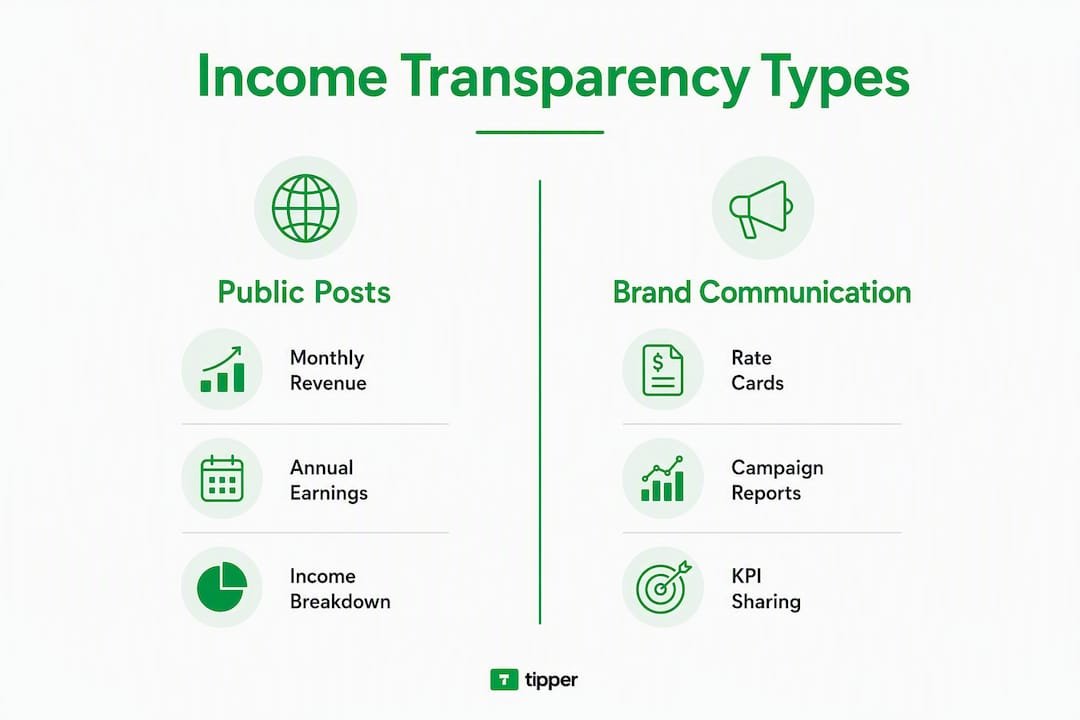
Rate cards sit closer to the B2B end. Publishing a rate card or fee range tells brands what you charge without locking you into a single number. Creator pay transparency is an operational practice that speeds deals and reduces disputes; it’s not a legal requirement.
Campaign outcome reports are arguably the most underused format. A one-page summary showing impressions delivered, link clicks, and conversion rate gives a sponsor exactly what they need to approve a renewal, without you revealing what a competitor paid.
A practical alternative to raw financials: publish 3–5 KPIs at a regular cadence, the way a public company releases quarterly highlights. Returning viewer rate, average watch time, and sponsor CTR tell a coherent story without exposing your contracts.
Why transparency pays off for creators and brands
The business case for income transparency is cleaner than most creators expect.
For brands, a creator who publishes rate ranges or sends a structured campaign report cuts the back-and-forth that kills deal velocity. When your value is legible, a brand’s legal and finance teams can approve a deal faster. Repeat sponsorships follow naturally because the sponsor already has documented proof of ROI.
“Legibility beats raw numbers. Sponsors want a small set of clear signals — KPIs and milestone reports. Creators who adopt light, consistent reporting reduce negotiation friction and build trust over time.” — Overly
For audiences, clear disclosure of paid partnerships increases trust in your recommendations. When followers know you’re being paid and can see the terms of that relationship at a high level, your organic endorsements carry more weight, not less. The benefits of tip-based revenue models extend this logic: when supporters can see aggregated tip figures, they understand they’re directly funding your work, which strengthens the relationship.
Benchmarking is a quieter benefit. When creators in a niche share rate ranges, the whole market gets smarter. A mid-tier creator who discovers that peers charge twice what they do can correct that gap without a lengthy negotiation education.

What are the real risks of disclosing your income?
The downsides are real and worth planning around before you post anything.
Psychological and social risks. A large-scale natural experiment by economist Ricardo Perez-Truglia found that public income disclosure raised the life-satisfaction gap between higher- and lower-earning people by 21–29%. For creators, this plays out as comparison anxiety in both directions: followers who earn less may disengage, and peers who earn more may become competitive rather than collaborative.
Commercial anchoring. Publishing an exact rate gives brands a ceiling to negotiate down from. Once a number is public, you’ve handed the other side a reference point they’ll use against you. Ranges protect you; exact figures often don’t.
Privacy and security. Sharing income details publicly can attract unwanted attention, including scammers, aggressive solicitations, and in some cases targeted harassment. This risk scales with audience size.

FTC disclosure confusion. Pay transparency (what you charge brands) is legally distinct from FTC endorsement disclosure (telling your audience a post is sponsored under 16 CFR Part 255). Conflating the two in your communications creates compliance risk. Keep them separate in how you talk about each.
Pro Tip: Set your transparency boundary before you publish anything. A simple rule: publish ranges and aggregated KPIs publicly, share exact rates only under NDA with vetted partners, and never post individual transaction data. Write that rule down and apply it consistently.
Three concrete mitigation steps:
- Publish ranges, not exact contract amounts, in any public-facing content.
- Use aggregated numbers (monthly totals, supporter counts) rather than per-deal figures.
- For brand-sensitive details, require a mutual NDA before sharing specifics.
How to practice income transparency without exposing yourself
A repeatable process matters more than a one-time disclosure decision.
- Define your goal first. Are you building audience trust, attracting brand deals, or both? Public KPI reports serve audiences. Rate cards serve brands. A campaign outcome report serves sponsors. Pick the format that matches the goal.
- Prepare clean numbers. Track gross revenue, platform fees, withdrawal costs, and taxes separately. Tools like CreatorCalc and Earnly show the full money chain from gross to take-home, so your disclosures use meaningful figures rather than inflated gross totals.
- Normalize gross vs. net. Never publish gross as if it’s take-home. A $10,000 brand deal after platform fees, taxes, and production costs might net $5,500. Misrepresenting this misleads your audience and sets unrealistic expectations for peers.
- Redact sensitive clauses. If you share a campaign report, remove exclusivity windows, kill fees, and any terms your contract requires you to keep confidential.
- Choose frequency and channel. A quarterly KPI post on your main platform is enough for audience transparency. Brand-facing rate cards can live on a media kit page or be sent on request.
- Pair numbers with narrative. A raw figure without context invites misinterpretation. A short sentence explaining what drove a result (“CTR was 4.2% on this integration because the product matched my audience’s existing behavior”) turns a number into a story a sponsor can act on.
Template: public rate-range paragraph
“Brand integrations on this channel start at $X,000 for a dedicated mention and scale based on exclusivity, usage rights, and campaign duration. I share post-campaign performance reports with all partners.”
Template: sponsor campaign summary
Campaign: [Brand], [Month]. Deliverable: 60-second integration. Impressions: [X]. Link clicks: [X]. Conversion rate: [X%]. Notes: [brief context].
Template: brand-facing rate-range email
“My standard fee range for a single dedicated integration is $X,000–$Y,000 depending on usage rights and exclusivity. Happy to share a full media kit with recent campaign performance on request.”
Pro Tip: For public-facing reports, lead with engagement quality metrics, returning viewer rate, CTR, and conversion, rather than raw dollar figures. These signals tell a sponsor more about your audience’s behavior than a revenue number does, and they don’t expose your contract terms.
For creators exploring how real-time tips work, tip-based income is one of the cleanest formats to report publicly: total tips received, number of supporters, and average tip amount are all meaningful without revealing any private deal.
How transparency shapes earnings and pay equity in the creator economy
Income transparency affects the market, not just individual deals.
When creators publish rate ranges, those ranges become informal benchmarks. A brand that has seen dozens of rate cards from creators in a niche develops a realistic sense of market rates. That’s good for creators who were undercharging and bad for those who were overcharging based on information asymmetry. Bloomberg has reported on pay disparities among influencers, particularly affecting Black creators who were paid less than peers with comparable audiences. Shared rate information is one of the few tools that can correct that gap from the creator side.
| Level | Effect of transparency |
|---|---|
| Individual negotiation | Rate cards set a floor; ranges protect leverage; exact figures can anchor down |
| Market-level fairness | Shared benchmarks reduce pay gaps and expose systematic underpayment |
| Attention concentration | Public income posts can concentrate brand interest toward already-visible creators |
| Equity risk | Misframed comparisons can widen gaps if context (niche, audience size) is stripped out |
The risk of attention concentration is underappreciated. When a creator publicly reports high earnings, brands take notice, but so does the algorithm. Visibility compounds. Creators who are already large benefit most from public income posts; smaller creators may find that the same disclosure attracts scrutiny without the corresponding deal flow. Publishing ranges rather than totals, and framing them in terms of deliverables rather than personal income, reduces this effect.
What the research and experts say about creator pay transparency
The evidence base here is thin but pointed.
Ricardo Perez-Truglia’s 2020 study in the American Economic Review used a natural experiment in Norway, where income tax records became publicly searchable, to measure the effect on well-being. The result: public income disclosure raised the life-satisfaction gap between higher- and lower-earning individuals by 21–29%. The mechanism is social comparison. For creators, this is a direct warning against posting raw income figures without context.
Alexandra Niki of the Creators Network frames transparency-first branding as accountability rather than oversharing. The distinction matters: disclose your commercial relationships, your creative process, and what you stand for professionally. Keep your personal finances private. That framing turns transparency from a vulnerability into a positioning tool.
On the operational side, the practitioner consensus aligns around three principles:
- Legibility over volume. A small set of consistent KPIs builds more trust than a data dump.
- Gross-to-net tracking. Tools like CreatorCalc exist specifically because creators routinely conflate gross revenue with take-home pay, a mistake that produces misleading disclosures.
- B2B vs. consumer disclosure. Rate transparency with brands is a business practice. FTC endorsement disclosure to audiences is a legal obligation. They serve different purposes and should be communicated separately.
Key Takeaways
Income transparency for creators works best when it’s strategic: publish ranges and KPIs, not raw contracts, and keep B2B rate disclosure separate from FTC-required audience disclosures.
| Point | Details |
|---|---|
| Publish ranges, not exacts | Rate ranges protect negotiation leverage while still making your value legible to brands. |
| Track gross to net | Use tools like CreatorCalc or Earnly to report meaningful take-home figures, not inflated gross totals. |
| Separate B2B and audience disclosure | Rate cards for brands and FTC endorsement disclosures for audiences serve different purposes; keep them distinct. |
| Transparency carries psychological risk | Perez-Truglia’s research found public income disclosure widened the life-satisfaction gap by 21–29%; use aggregated KPIs to reduce comparison harm. |
| Tipper supports privacy-first transparency | Tipper lets creators share aggregated tip metrics publicly while keeping individual transaction and contract data private. |
The transparency line worth drawing
The creators who handle this best aren’t the ones who post everything or the ones who post nothing. They’re the ones who decided in advance what transparency is actually for.
Transparency as accountability means your audience knows you’re paid when you’re paid, knows roughly what kind of work you take on, and can see that your recommendations aren’t purely transactional. That’s a professional standard, not a confession. Sharing a rate range with a brand partner isn’t vulnerability; it’s efficiency. A campaign report isn’t exposure; it’s proof of work.
What it doesn’t mean: posting your tax return, revealing what a specific brand paid you, or competing with peers on income figures. Those disclosures serve comparison, not accountability. And as the research shows, comparison at scale tends to make people less satisfied, not more informed.
The transparency policy worth building is the one you can explain in one sentence to a brand and one sentence to your audience, without those two sentences contradicting each other.
Tipper gives creators a privacy-respecting way to show audience support
Creators who want transparent, audience-facing monetization without posting private contract details have a direct option: tip-based income through Tipper.

Tipper lets you share aggregated tip metrics publicly, total tips received, number of supporters, monthly totals, without exposing any individual transaction or brand contract. Supporters send tips instantly via Apple Pay, Google Pay, or card through your personalized link, no account required on their end. You keep 100% of what you earn, with a small processing fee added at checkout. That means the numbers you share publicly are clean and meaningful, not inflated by platform cuts you haven’t accounted for.
For creators building a tip-based income model, Tipper’s aggregated metrics give you something concrete to show your audience (“this channel is supported by X people tipping each month”) without the risks that come with posting raw brand deal figures. Set up your Tipper page at tipper.app and start collecting direct support today.
Useful sources for going deeper
- Ricardo Perez-Truglia, “The Effects of Income Transparency on Well-Being” (AER, 2020) — the foundational study on psychological effects of public income disclosure; essential reading before you post any income figures publicly.
- NBER Working Paper 25622 — the working paper version of the Perez-Truglia study, freely accessible.
- Tipper: Tip Income Business Model Guide — covers how tip-based revenue works and how to incorporate it into a transparent income strategy.
- Best Creator Tools for US Creators: 2026 Guide — tool roundup covering analytics and payment tools that support transparent reporting.
FAQ
What does income transparency mean for creators?
Income transparency for creators means deliberately disclosing financial information, such as rate ranges, campaign performance metrics, or aggregated tip totals, to build trust with audiences or reduce friction in brand negotiations. It’s a strategic choice, not a legal requirement.
Is salary transparency good or bad for creators?
It depends on what you disclose and how. Publishing rate ranges and KPIs tends to improve deal velocity and audience trust. Posting exact contract figures can anchor negotiations downward and invite comparison anxiety, a risk supported by Perez-Truglia’s research showing public income disclosure widened the life-satisfaction gap by 21–29%.
What is transparency in influencer marketing?
In influencer marketing, transparency covers two distinct obligations: FTC-required disclosure of paid partnerships to audiences (a legal requirement under 16 CFR Part 255), and voluntary rate transparency with brand partners (a business practice that speeds deal-making). Keep these two separate in your communications.
Should creators publish exact rates or ranges?
Ranges are almost always the better choice. They make your value legible to brands without giving a single anchor point to negotiate against, and they protect your privacy while still signaling your market position.
How do creators report income without exposing private details?
Use aggregated metrics, monthly tip totals, supporter counts, campaign CTR, and returning viewer rates, rather than raw contract figures. Tools like CreatorCalc and Earnly help you track gross-to-net so any figure you share reflects actual take-home, not inflated gross revenue.




[…] Income Transparency for Creators: What It Really Means […]
[…] Income Transparency for Creators: What It Really Means […]