

TL;DR:
- Building a successful supporter community depends on a small, committed audience, not size. Focus on defining a clear promise, personal onboarding, consistent rituals, and early monetization once engagement stabilizes. Prioritizing member bonds over raw numbers creates more sustainable growth and higher retention.
The fastest path to sustainable influence is not a bigger audience. It is a smaller, more committed one. Pick one owned platform as your community’s home, write a single-sentence member promise, recruit your first 10 founding members personally, run weekly rituals plus one flagship monthly event, formalize your top contributors as ambassadors, then introduce low-friction tipping once attendance is consistent.
The short version:
- Pick a home. Choose Discord, Circle, Patreon, or Substack based on whether you want free community, paid membership, or gated content.
- Write one promise. Define exactly what members get and why they should show up every week.
- Activate your first 10. Personal invites, founding-member status, and a welcome call beat any automated funnel.
- Run weekly rituals. AMAs, challenges, and member spotlights keep the space alive between big events.
- Introduce tipping early. Low-friction tools like Tipper let supporters show appreciation the moment they feel it.
- Track contributor rate first. Percentage of members who post, comment, or attend tells you more than total member count.
Community-built influencer campaigns drive 5x more user-generated content and 3x higher customer retention than traditional influencer campaigns run without a community layer (InfluenceFlow). That gap exists because community members are not passive consumers. They are invested participants who have opted into something with a name, a purpose, and a recurring schedule.
Table of Contents
- How do you choose the right platform for your community?
- What should your community promise its members?
- How do you onboard your first 10, 30, and 100 active members?
- What recurring formats keep your community active week after week?
- When and how should you introduce monetization?
- Which tools handle tipping and supporter payments well?
- How do you keep your community safe as it grows?
- What metrics actually tell you if your community is healthy?
- What mistakes do influencers and brands most often make?
- Your week-by-week 90-day launch plan
- Key Takeaways
- Why depth beats breadth: a community flywheel view
- Tipper makes tipping inside your community frictionless
- Useful sources
- FAQ
How do you choose the right platform for your community?
The platform decision shapes everything downstream: how you moderate, how you monetize, and how much friction new members face. There is no universally correct answer, but there is a correct answer for your specific use case.
| Platform | Best for | Pricing shape | Setup ease | Engagement features | Monetization support |
|---|---|---|---|---|---|
| Discord | Free or freemium communities; gaming, tech, creator niches | Free; Nitro boosts optional | Moderate (channel structure takes planning) | Threads, voice/video, reactions, roles, bots | Limited native; integrate Patreon or Tipper |
| Circle | Paid or hybrid membership communities | — | High (purpose-built for community) | Spaces, events, DMs, rich media, courses | Native payments, subscriptions, gated spaces |
| Patreon | Paid membership with tiered content access | 8–12% platform fee on earnings | High | Posts, polls, early access, Discord integration | Native; tiers, one-time payments |
| Substack | Newsletter-first with community add-on (Notes, Chat) | Free; 10% fee on paid subscriptions | Very high | Threads, comments, Notes feed | Native paid subscriptions |
| Discovery and top-of-funnel; not a primary home | Free | Very high | Stories, Lives, Broadcast Channels | Badges, subscriptions (limited) | |
| Telegram | Lightweight, high-volume messaging communities | Free | Very high | Channels, groups, bots, polls | Limited native; external tools needed |
The hybrid approach most creators underuse: use Instagram or TikTok for discovery, then funnel engaged followers into an owned home on Discord or Circle. Social platforms are rented land. Your Discord server or Circle space is owned infrastructure where you control the member list, the data, and the rules.
A few operational specifics worth knowing before you commit:
- Discord works best when you set up roles from day one (Founding Member, Active Contributor, Moderator) and use a bot like MEE6 or Carl-bot to automate welcome messages and role assignments.
- Circle is the cleaner choice if you plan to charge for access from the start. Its native payment flow removes the need for a third-party integration.
- Patreon makes sense when your primary value is exclusive content (videos, posts, early access) rather than peer-to-peer conversation.
- Substack is worth considering if your community is built around ideas and writing, and your members are readers first.
Pro Tip: Before you set up channels or spaces, capture email addresses. Even if your community lives on Discord, a connected email list means you own the relationship regardless of what any platform decides to change.
What should your community promise its members?
Most communities fail at the promise stage, not the platform stage. They attract members with vague language (“join my community!”) and then wonder why no one shows up after the first week. The fix is one sentence written before you send a single invite.
A member promise answers three questions at once: who this is for, what they get, and how often. A workable template: “[Community name] is for [specific member type] who want [specific outcome] — we meet [cadence] to [specific activity].”
For example: “Creator Lab is for independent video creators who want to grow their first 10,000 subscribers — we meet every Tuesday for peer feedback and every first Friday for a guest AMA.”
That sentence does more work than a paragraph of marketing copy. It tells a prospective member immediately whether they belong, what they will do there, and how much time it requires.
Membership model options:
- Free community. Low barrier to entry; best for building initial momentum and UGC. Revenue comes later through tipping, sponsorships, or upsells.
- Freemium. A free tier for discovery and a paid tier for premium access (live sessions, direct feedback, early content). Works well on Discord + Patreon or Circle.
- Paid from day one. Signals serious commitment from members and filters for quality. Harder to fill initially but produces higher engagement per member.
- Founding member model. Offer a discounted or lifetime rate to the first 20–50 members in exchange for active participation and feedback. Creates urgency and loyalty simultaneously.
Pro Tip: Write your member promise on a sticky note and put it somewhere visible. Every content decision, moderation call, and monetization choice should pass the test: does this serve the person described in that sentence?
How do you onboard your first 10, 30, and 100 active members?
The onboarding sequence is where most communities bleed members. Someone joins, sees an empty server or a sparse feed, and never comes back. The antidote is a staged activation plan that treats the first 10 members as co-founders, not customers.
The first 10: personal and intentional
Do not post a public link and wait. Go to your existing audience, identify the 10–15 people who comment most, share most, or message you directly, and invite them personally. A message under 100 words works better than a long pitch.

These first 10 get a founding-member role, a welcome call (30 minutes, group or 1:1), and a direct line to you. Their feedback shapes the community before it opens to anyone else.
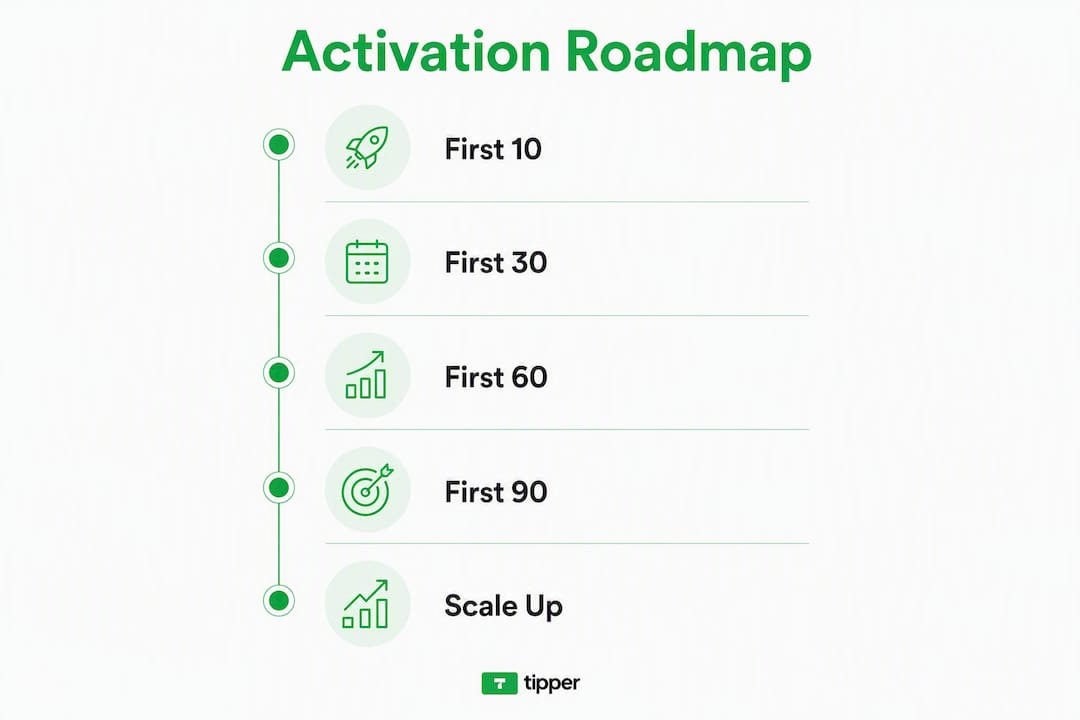
The 30/60/90-day activation roadmap
| Milestone | Timeframe | Priority actions | Success indicator |
|---|---|---|---|
| First 10 active members | Days 1–14 | Personal invites, founding call, first pinned post, first AMA | 8 of 10 post or comment within 7 days |
| First 30 active members | Days 15–45 | Open soft launch, first weekly ritual, peer intro thread | 40% of members attend or engage weekly |
| First 100 active members | Days 30–90 | Public launch, first challenge or event, first moderator recruited | 30% contributor rate; 3+ peer-to-peer threads per week |
Community-built campaigns drive 5x more user-generated content and 3x higher customer retention than traditional influencer campaigns (InfluenceFlow).
Staged growth that prioritizes participation over raw size is the consistent recommendation from practitioners who have built communities past the 1,000-member mark. The reason is simple: a community of 30 people where 25 are active is healthier than one with 300 members where 10 show up.
For outreach beyond your existing audience, shortlist 5–10 hyper-relevant creators or potential members, engage meaningfully with their content for several days, then send a short personalized message under 120 words. Reference something specific they said or created. Mass outreach produces mass indifference.
Welcome flow checklist (automate where possible):
- Immediate welcome DM with the community promise and a single first action (“introduce yourself in #introductions”).
- Day 3 nudge: link to the most useful resource or pinned post.
- Day 7 check-in: personal message asking what they want to see more of.
- Day 14: invite to the first live event or AMA.
What recurring formats keep your community active week after week?
A community without a calendar is a chat room. The formats below are proven to drive return visits and, more importantly, member-to-member interaction rather than just member-to-creator interaction.
Weekly formats:
- Weekly AMA (Ask Me Anything). A 30–45 minute live or async thread where you answer member questions. Works on Discord voice, Circle events, or a Substack thread. The key is consistency: same day, same time, every week.
- Peer review or feedback thread. Members share work (a draft, a video, a pitch) and give structured feedback. Drives peer bonding faster than almost any other format.
- Curated prompt. A single question posted Monday morning (“What’s one thing you’re working on this week?”). Low effort for you, high participation when the culture is set.
- Member spotlight. Feature one member’s work or story each week. Takes 10 minutes to write and makes that member a vocal advocate for the community.
Monthly formats:
- Flagship live event. A guest interview, workshop, or panel. This is the event members invite friends to. Keep it under 60 minutes and record it for members who can’t attend live.
- Community challenge. A 7–14 day challenge with a specific output (post daily, hit a goal, complete a project). Challenges generate UGC and create shared experience.
- Office hours. Sponsoring ongoing, value-driven sessions inside the owned community solves the cold-start problem and keeps influencers present as facilitators rather than one-off guests.
Cadence by community size:
- Under 30 members: one weekly ritual plus one monthly event. Keep it simple.
- 30–100 members: two weekly touchpoints (AMA + prompt or spotlight) plus one monthly flagship.
- 100+ members: delegate weekly rituals to moderators; you focus on monthly flagship and quarterly deep-dives.
Pro Tip: Schedule your first six weeks of content before you launch. An empty calendar is the fastest way to kill momentum. Members who show up to nothing twice do not come back a third time.

When and how should you introduce monetization?
The timing of monetization matters as much as the structure. Introduce paid options too early and you signal that the community is a sales channel. Wait too long and you train members to expect everything for free.
The right signal to watch is consistent attendance. When the same group of members shows up to your weekly ritual three weeks in a row, they have demonstrated that the community delivers value. That is the moment to introduce a paid option.
Suggested tier structure:
- Free tier. Access to the community, weekly prompts, and peer threads. No paywall on the culture.
- Supporter tier ($5–$15/month). Early access to content, a monthly exclusive Q&A, and a supporter badge. This is the easiest yes for an engaged free member.
- Pro or founding tier ($25–$50/month). Direct feedback sessions, co-creation opportunities, or a private channel. Reserved for your most committed members.
Non-monetary rewards keep free members engaged and signal that participation itself has value. Badges for posting streaks, moderator nominations for top contributors, and public recognition in member spotlights cost nothing and drive behavior.
The 80/20 rule for community content: 80% of what you post should be educational, entertaining, or community-building. No more than 20% should reference paid options or products. Members who feel sold to constantly leave quietly.
Pro Tip: When you launch a paid tier, frame it as a way for members to “go deeper” rather than as an upgrade. Language like “for members who want more direct access” converts better than “premium plan.”
Budget expectations for early-stage communities vary. Nano- and micro-influencer partnerships have typical cost ranges, with additional platform costs; expect a few months before community investment returns measurable revenue.
Which tools handle tipping and supporter payments well?
When evaluating a tipping or supporter payment tool, four criteria matter: how easy it is for a supporter to send a tip (friction), which payment methods are supported, how quickly creators receive payouts, and whether the tool respects supporter privacy.
What to look for:
- No account required for the person sending the tip.
- Apple Pay and Google Pay support (these reduce checkout abandonment significantly).
- Customizable tip pages so the experience matches your brand.
- Thank-you message capability (text, photo, or video) to close the loop with supporters.
- Transparent fee structure so you know exactly what you keep.
Tipper in a community monetization stack
Tipper is built specifically for this use case. Supporters send a tip through your personalized Tipper link or QR code with no account required on their end, using Apple Pay, Google Pay, or a card. You keep 100% of the tip amount (a small payment processing fee is added at checkout for the sender). After a tip arrives, you can send a thank-you note or video directly through the platform, which turns a one-time transaction into a relationship moment.
For community builders, the integration points are straightforward. Place your Tipper link in your Discord bio, your Circle profile, your Substack footer, and your event recap posts. Add a QR code to any in-person or live-stream event. When you run a member spotlight, include a line inviting the community to tip the featured member directly.
Tip acknowledgment builds community bonds in a way that automated payment receipts do not. A short video thank-you from a creator after a tip is the kind of personal touch that turns a supporter into an evangelist.
For a broader look at how real-time supporter contribution tools fit into a community stack, the options range from tipping links to live-stream badges to subscription tiers. Tipper sits at the low-friction end of that spectrum, which makes it the right first step before you build out a full tier structure.
Pro Tip: Add your Tipper link to your welcome message on day one. A supporter who tips in the first week is significantly more likely to stay active at 90 days than one who never has.
How do you keep your community safe as it grows?
Rules and moderation are not bureaucracy. They are the infrastructure that lets members trust the space enough to be vulnerable, share work, and disagree productively. Without them, the loudest voices set the culture by default, and that culture is rarely the one you intended.
Sample community rules (adapt to your voice):
- Be specific and constructive. Vague criticism helps no one.
- No self-promotion outside designated channels.
- Treat every member’s work with the respect you want for your own.
- Disagreement is welcome; personal attacks are not.
- What’s shared in the community stays in the community.
Lightweight escalation flow:
- First offense: private DM from a moderator, no public callout.
- Second offense: formal warning with the specific rule cited.
- Third offense: temporary mute or removal from the space, depending on severity.
The path from member to moderator to ambassador is one of the most underused retention tools available. A member who earns a moderator role is invested in the community’s success in a way that no paid subscription can replicate. Give moderators a clear checklist: welcome new members within 24 hours, flag rule violations, surface great content to the creator, and run one weekly ritual independently.
Formalizing superfans with roles, badges, or certifications produces reliable evangelists who recruit peers and increase referral rates without ongoing ad spend. The ambassador tier sits above moderator: these are members who actively recruit, create content about the community, and represent it in public spaces.
Pro Tip: Write your moderation SOPs before you need them. A moderator who has to improvise a response to a conflict will almost always make it worse. A one-page doc covering the three most common scenarios is enough to start.
What metrics actually tell you if your community is healthy?
Total member count is the least useful number you can track. A community of 200 members where 180 are inactive is not a community. It is a mailing list with a Discord server attached.
The metrics that matter:
- Monthly active members (MAM). Members who post, comment, react, or attend at least once in 30 days. This is your primary health indicator.
- Contributor rate. Percentage of MAM who create original content (posts, threads, shared work) rather than only consuming. Aim for 20–30% in a healthy early-stage community.
- Retention at 30/60/90 days. What percentage of members who joined are still active at each interval? A 60-day retention rate above 40% is a strong signal for a new community.
- Event attendance rate. Number of members who attend live events divided by total MAM. Above 25% is excellent for a community under 100 members.
- UGC volume. Number of member-created posts or threads per week. Track the trend, not the absolute number.
- Referral rate. How many new members were invited by existing members? This signals whether the community is generating organic word-of-mouth.
Measure participation and contributor rates before worrying about absolute size. Early community health shows up in repeat attendance and peer-to-peer interactions, not in the total member count on your dashboard.
Simple weekly tracking template
Prioritize in order: MAM first, contributor rate second, retention at 30 days third. Revenue metrics (tips, subscriptions) become meaningful only after contributor rate is above 15%.
What mistakes do influencers and brands most often make?
The failure modes are predictable, which means they are also preventable.
| Mistake | Quick fix |
|---|---|
| Creator-centered community (members bond with you, not each other) | Introduce peer-to-peer formats (feedback threads, challenges) in week one |
| No onboarding flow | Build a 3-message automated welcome sequence before launch |
| Over-selling in the community | Apply the 80/20 rule: 80% value, 20% promotion, maximum |
| Poor or absent moderation | Write rules and an escalation doc before the first public invite |
| Chasing vanity metrics (total members, follower count) | Track contributor rate and 30-day retention instead |
| Launching too broadly too fast | Start with 10 founding members; resist the urge to go public immediately |
The deepest failure mode is one that looks like success: a community where the audience bonds with the creator instead of each other. When the creator goes quiet for two weeks, the community dies. The fix is to move members into peer-to-peer interaction early and position yourself as a facilitator, not the permanent hub.
Red-flag checklist (check monthly):
- Fewer than 15% of members have posted in the last 30 days.
- The same 3–5 people are generating all the content.
- Event attendance has dropped two months in a row.
- New member invites from existing members have stopped.
- The last three member messages were complaints or questions, not contributions.
Pro Tip: If your contributor rate drops below 10%, run a “community health” AMA before you change anything else. Ask members directly what they want more of. The answers are almost always surprising and almost always actionable.
Your week-by-week 90-day launch plan
This is the sequence. Follow it in order.
Weeks 0–2: Foundation
- Write your one-sentence member promise.
- Choose your primary platform and set up the basic structure (channels, spaces, or sections).
- Configure your welcome automation (bot or manual sequence).
- Set up your Tipper link and place it in your profile.
- Identify your first 10 founding members from your existing audience.
- Send 10 personal invites (under 100 words each).
- Host a founding-member welcome call.
Weeks 3–4: First activation
8. Run your first weekly ritual (AMA or peer feedback thread).
9. Post your first member spotlight.
10. Collect founding-member feedback on what to add or change.
11. Milestone check: 8 of 10 founding members active.
Weeks 5–6: Soft launch
12. Open the community to a second wave (20 more targeted invites or a soft public link).
13. Run your first monthly flagship event (guest interview or workshop).
14. Introduce your first paid tier or tipping option with a brief, low-pressure announcement.
15. Milestone check: 30 active members, 40% weekly engagement rate.
Weeks 7–9: Momentum
16. Recruit your first moderator from the founding member group.
17. Launch your first community challenge (7–14 days).
18. Begin tracking UGC volume and referral rate weekly.
19. Run a focus group or feedback thread to refine the community promise.
Weeks 10–12: Scale
20. Open public launch or expand invite radius.
21. Formalize your first ambassador (badge, role, public recognition).
22. Review 30/60-day retention data and adjust onboarding if retention is below 40%.
23. Milestone check: 100 active members, 20%+ contributor rate, first recurring revenue from tips or subscriptions.
When to pivot: if event attendance drops below 15% or contributor rate falls below 10% at week 6, pause new member acquisition and run a feedback session before going wider. Growth on top of a broken foundation makes the problem harder to fix, not easier.
Key Takeaways
A supporter community built on depth over reach consistently outperforms follower-count strategies on retention, UGC, and sustainable revenue.
| Point | Details |
|---|---|
| Community-led campaigns drive 5x more user-generated content and 3x higher retention | Personal invites to 10 founding members produce higher 90-day retention than any public launch. |
| Contributor rate is the key metric | Track the percentage of members who create content weekly; aim for 20–30% in the first 90 days. |
| Rituals beat one-off events | A consistent weekly AMA or peer thread drives more return visits than a single large launch event. |
| Monetize after consistent attendance | Introduce tipping or paid tiers once the same members show up three weeks in a row. |
| Tipper for low-friction tipping | Tipper’s no-account-required tip link, Apple Pay/Google Pay support, and thank-you messages fit directly into community onboarding and event flows. |
Why depth beats breadth: a community flywheel view
The conventional advice for influencers is to grow the number. More followers, more reach, more impressions. It is the wrong objective for anyone who wants to build something that lasts.
The community flywheel model reframes the influencer’s role entirely. Instead of acting as a billboard that broadcasts to a passive audience, an influencer becomes a gravity node: the initial source of energy that pulls the right people into an owned space, then gradually steps back as members generate their own momentum. The flywheel spins because members create content for each other, recruit peers, and develop a shared identity that exists independently of any single creator.
The practical implication is counterintuitive. The most important thing you can do in the first 90 days is not to grow the community. It is to manufacture the conditions under which members bond with each other. Peer feedback threads, challenges with shared outputs, and member spotlights all serve that goal. Once peer-to-peer interaction is the norm, the community becomes self-sustaining in a way that a creator-centered audience never can be.
Formalizing superfans accelerates this flywheel. A member who earns an ambassador badge or a moderator role is not just retained. They become a recruiter, a content creator, and a proof point for every prospective member who evaluates whether the community is worth joining. That is the referral engine that replaces paid acquisition.
Start small. Design rituals before you design growth. Formalize your superfans before you hit 100 members. The communities that scale past 1,000 active members almost always did those three things in that order.
Tipper makes tipping inside your community frictionless
Every community has members who want to show appreciation the moment they feel it. A great AMA answer, a member spotlight that resonated, a piece of advice that changed how someone works. The gap between that impulse and a completed tip is where most platforms lose the transaction.
Tipper closes that gap. Your personalized Tipper link or QR code goes into your Discord bio, your Circle profile, your Substack footer, and your event recap posts. Supporters tip instantly using Apple Pay, Google Pay, or a card, with no account required on their end. You keep 100% of the tip amount (a small payment processing fee is added at checkout). After the tip arrives, you send a thank-you note or video directly through the platform, turning a payment into a personal moment.
For community builders running their first 90-day plan, Tipper fits naturally into the welcome flow (day one: “here’s my Tipper link if you want to support the community”), into event recaps (“if today’s session was useful, a tip means a lot”), and into member spotlights (“you can tip [Member Name] directly here”). It is the lowest-friction monetization step available, which makes it the right first move before you build out a full subscription tier.
Set up your Tipper page in under five minutes and place the link in your community profile today.
Useful sources
- Building Customer Communities with Influencers 2026 (InfluenceFlow) — Practitioner guide covering UGC uplift data, influencer tiers, and budget benchmarks for community-led campaigns.
- Billboards to Builders: How Influencers Fit Into Your Community Flywheel Strategy (Tribe Pit) — Explains the flywheel model and the influencer-as-facilitator role; essential for the perspective section.
- Niche Community Building: 0 to 1,000 True Fans (mean.ceo) — Staged growth framework (10 → 30 → 100) with participation-first metrics.
- Start a Community From Scratch (Mighty Networks) — Step-by-step launch blueprint covering purpose, ideal member, platform, and founding-member recruitment.
- Listening to Your Supporters: How to Build a Community of Trust (Givecloud) — Covers trust-building through active listening and structured feedback loops.
- How to Contact Social Media Influencers (JoinBrands) — Practical outreach guidance including the short, personalized message framework.
- The 1 Engine (Tribe Pit) — Deep dive on manufacturing superfans and formalizing ambassador programs for referral growth.
- How to Engage with Influencers and Measure Their Impact (Harvard Business School Online) — Foundational overview of influencer marketing mechanics and measurement from an academic source.
FAQ
How do you build a supporter community as an influencer?
Pick one owned platform (Discord, Circle, or Patreon), write a single-sentence member promise, then personally invite 10 founding members before any public launch. Run a consistent weekly ritual from day one and track contributor rate, not total member count, as your primary health metric.
What are the main types of influencers for community building?
Nano-influencers (1K–10K followers) and micro-influencers (10K–100K) are the most effective for community initiatives because their engagement rates and audience trust are higher than those of larger creators. Macro and mega influencers work better for broad awareness campaigns than for building tight, participatory communities.
How do you find and recruit influencers to collaborate with?
Shortlist 5–10 creators who are genuinely relevant to your niche, engage meaningfully with their content for several days, then send a personalized outreach message under 120 words that references specific work they have done. Mass pitching produces low response rates; specificity and prior engagement are what move the needle.
Do you need an LLC to run a paid creator community?
Not to start, but once you are collecting subscription fees or tips regularly, consulting a business attorney or accountant about the right entity structure for your situation is worth doing. Many U.S. creators operate as sole proprietors initially and form an LLC once revenue is consistent.
What are the four R’s of influencer marketing?
The four R’s commonly referenced in influencer marketing are Reach, Relevance, Resonance, and Return. For community building specifically, Resonance (how deeply the influencer’s content connects with an audience) and Relevance (how closely their niche matches yours) matter far more than Reach alone.




Leave A Comment