


The micropayment content model charges small, per-item fees for individual pieces of digital content. Think $0.10 for a single article, $0.25 for a video, or a $1 tip after a live stream. Use it when you need flexible, pay-per-use monetization that captures revenue from people who will never subscribe.
Common fits include:
- Single articles or blog posts behind a pay-per-view gate
- Individual videos or audio episodes
- Tips and appreciation payments for creators
- In-game items or virtual goods
- Pay-per-message or micro-service billing
- IoT device usage billed by the transaction
The model works best alongside subscriptions and tipping, not instead of them. It converts the occasional visitor who won’t commit to a monthly plan, and it lets you price content at its actual value rather than bundling everything into one flat fee.
Key Takeaways
The micro-payment content model works when you aggregate transactions to control fees, minimize checkout friction with wallet-based payments, and treat micropayments as a complement to subscriptions rather than a replacement.
| Point | Details |
|---|---|
| Define itemized pricing first | Pick one content item and a price between $0.10 and $2.00 before building any infrastructure. |
| Aggregation controls fee math | Stored-value or server-side aggregation is necessary for sub-$1 transactions to remain profitable. |
| Wallet support lifts conversion | Apple Pay and Google Pay eliminate card-entry friction and typically improve mobile conversion. |
| Measure conversion per view | Track pay-prompt views vs. completed payments for two weeks before scaling or changing infrastructure. |
| Tipper for instant pilots | Tipper’s pay link and QR code let creators test micropayment demand with no code and no sender account required. |
Table of Contents
- What does the micro-payment content model actually mean?
- Why did early micropayment systems fail?
- How do micropayments actually get processed?
- What business models use micropayments, and where do they fit?
- Why transaction costs are the core constraint
- What technology and payment rails should you integrate?
- Which providers should you evaluate?
- When does the micropayment model actually make sense?
- A practical implementation checklist with KPIs
- Where micropayments fit in a creator’s content strategy
- Tipper makes the pay-link step immediate
- Sources
- FAQ
What does the micro-payment content model actually mean?
A few terms appear constantly in this space, and vendors don’t always agree on definitions. Here’s what each one means in practice.
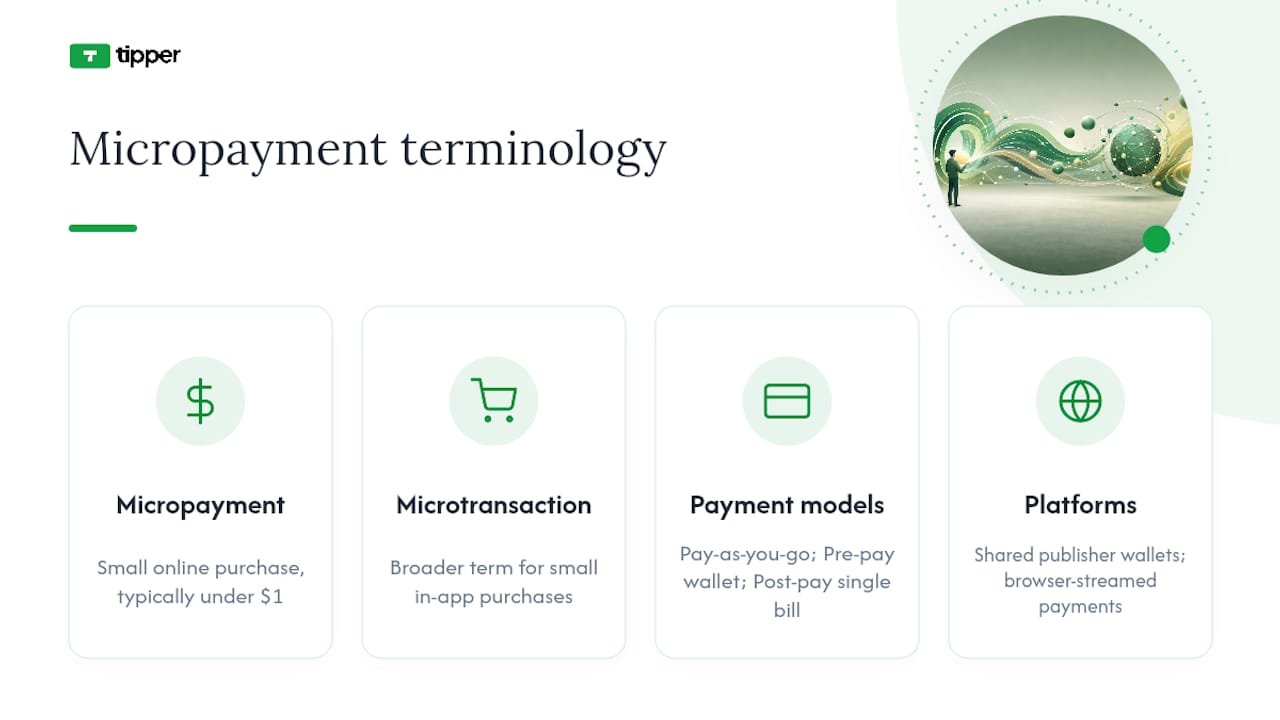
Micropayment refers to a small online transaction, typically under $1, though some providers draw the line at $10. Investopedia defines micropayments as small-value online transactions used for content, tips, and in-game purchases, with the “micro” floor shifting as infrastructure improves.
Microtransaction is the broader commercial term, often used in gaming and app stores. It covers any small in-app purchase, whether $0.01 or $4.99, and is the label most mobile platforms prefer.
Pay-as-you-go means the buyer pays only for what they consume, one item at a time, with no pre-loaded balance.
Pre-pay (stored value) means the buyer loads a wallet balance upfront, then spends from it. Each purchase draws down the balance without triggering a new card transaction.
Post-pay (aggregation billing) means purchases accumulate in a running tab and settle in a single charge at a threshold or billing cycle, similar to how a phone carrier bills data overages.
Collaborative models pool infrastructure across multiple publishers or platforms so that a single wallet or account works across properties, spreading fixed costs across a larger transaction base.
Web monetization / Interledger refers to a browser-level protocol concept that streams tiny payments from a visitor’s wallet to a publisher in real time, without a checkout step. The W3C has explored this space, though no universal standard has achieved wide adoption.
Why did early micropayment systems fail?
The idea is older than most people realize. Researchers and payment engineers were proposing micropayment schemes in the mid-1990s, well before anyone had a smartphone.
Early academic proposals included Millicent, PayWord, MicroMint, and lottery-based variants. Ronald Rivest and colleagues proposed aggregation schemes specifically designed to bundle small values into fewer bank settlements, cutting processing overhead. The Rivest aggregation paper shows how the math works: if you can batch 1,000 $0.01 payments into a single $10 settlement, the fixed cost per transaction drops by three orders of magnitude.
The W3C ran micropayment markup experiments in the early 2000s, trying to embed payment capabilities directly into web protocols. None of it stuck.
Why did these efforts fail? Three reasons, consistently:
- Transaction fees: Card-network fixed fees made sub-dollar payments economically absurd. A $0.30 fixed fee on a $0.10 payment means you lose money on every sale.
- Front-end friction: Every system required registration, account creation, or software installation before a buyer could pay. Most visitors left.
- No shared rails: Each scheme built its own wallet, its own network, its own merchant relationships. Without interoperability, neither side of the market reached critical mass.
The ECB analysis of micropayment adoption barriers identifies these same friction points as the primary reasons earlier systems didn’t scale. What’s changed since then: digital wallets like Apple Pay and Google Pay have eliminated registration friction for millions of users, instant payment rails have reduced settlement latency, and mobile-first behavior has normalized small in-app purchases at scale.
How do micropayments actually get processed?
Three core mechanisms handle the math of moving tiny amounts of money without destroying the margin.
Immediate micro-transaction
The buyer pays at the moment of purchase. A card or wallet is charged directly. This is the simplest architecture but the most expensive per transaction, because every payment triggers card-network fees. It only makes sense when the ticket price is high enough to absorb a fixed fee, or when the payment rail (like a stored-value wallet) bypasses card networks entirely.
Stored-value aggregation
The buyer loads a balance into a wallet. Each micro-purchase debits the wallet internally, with no new card transaction. The card network only sees the initial top-up. This is how most in-game currency systems work: you buy 1,000 coins for $9.99, then spend coins on items. The merchant’s processing cost is one card transaction, regardless of how many items the buyer purchases.
Server-side aggregation with delayed settlement
Purchases accumulate server-side until they hit a threshold or billing cycle. Then one charge covers everything. The buyer experiences frictionless access; the merchant batches settlement. This is the post-pay model, and it requires the merchant to carry credit risk between purchase and settlement.
In all three cases, the processing flow runs roughly the same way: the payer’s wallet or card authorizes the payment, the processor routes it to the merchant account, and the platform pays out to the creator or publisher on a schedule. Tokenization handles card data so the merchant never stores raw PAN data, which reduces PCI scope significantly.
Pro Tip: Use stored-value or server-side aggregation whenever your average transaction is under $1. Triggering a card-network transaction for every $0.10 purchase will consume your margin before you reach meaningful volume. Load the wallet once; spend from it freely.
What business models use micropayments, and where do they fit?
Pay identifies three main commercial structures. A fourth, the collaborative model, applies specifically to multi-publisher environments.
| Model | User friction | Settlement complexity | Merchant risk |
|---|---|---|---|
| Pay-as-you-go | High (pay each time) | Low | Low |
| Pre-pay (stored value) | Low after top-up | Medium | Medium (float) |
| Post-pay (aggregation) | Very low | High | High (credit risk) |
| Collaborative / consortium | Low (shared wallet) | High | Shared |
Use cases map to models fairly naturally:
- Content-on-demand (single articles, videos, audio): pre-pay or post-pay work best. The buyer loads a balance or runs a tab; access is instant.
- Tipping: pay-as-you-go is fine here because the buyer chooses the amount and the moment. Friction is acceptable when the act is voluntary appreciation.
- In-game purchases: stored-value is the industry standard. Virtual currency decouples the purchase decision from the card transaction.
- Pay-per-message or micro-services: post-pay aggregation, billed at end of period.
- IoT device billing: post-pay or collaborative, often with real-time metering and periodic settlement.
The MDPI study on consumer readiness for microtransactions found that consumers in a sampled population were receptive across several digital-content categories, which supports running small pilot experiments to test demand before committing to a full integration.
Why transaction costs are the core constraint
The math is unforgiving at small ticket sizes. A standard card transaction carries a fixed fee (often around $0.30) plus a percentage of the transaction value. You cannot build a business on that arithmetic.
The practical thresholds involve smaller microtransactions requiring aggregation or wallet-based processing to be viable, while higher-value transactions may use direct processing with better margins.
The ECB notes that regulatory and scheme rules can impose practical lower limits on electronic payments, so technical feasibility isn’t the only constraint. Some payment schemes decline transactions below certain cent thresholds entirely.
PayPal Micropayments offers a fee structure intended for small transactions, providing an option with lower fees compared to standard PayPal merchant accounts. This makes it more viable for sub-$5 payments than a standard merchant account, though it still requires enough volume to justify the integration.
Fee aggregation improves the picture significantly. If a stored-value wallet processes 100 purchases of $0.10 each from a single top-up of $10, the merchant pays one card-network fee on the $10 load, not 100 fees on 100 transactions. Net take rate improves by roughly an order of magnitude.
Breakeven framing: before launching, calculate your net take rate after fees at your expected average transaction value and volume.
What technology and payment rails should you integrate?
The right integration path depends on your transaction volume, your audience’s device behavior, and how much engineering time you can spend.
- Start with a pay link or payment button. Stripe, PayPal, and similar providers offer hosted payment pages that require no backend code. This is the fastest way to test whether your audience will pay per item at all.
- Add wallet support early. Apple Pay and Google Pay reduce friction dramatically for mobile users. One-tap payment eliminates the card-entry step that kills conversion on small purchases.
- Implement server-side aggregation once volume justifies it. This requires a backend, a database for tracking balances or tabs, and webhook handling for payment events. Don’t build this first.
- Configure payout flows. Decide how often creators or merchants receive payouts (daily, weekly, on-demand) and what minimum threshold triggers a payout. Stripe Connect and PayPal Payouts both handle this at scale.
- Handle chargebacks and fraud. Micropayments attract low-value fraud. Set velocity limits (max transactions per user per hour), require email or phone verification for stored-value top-ups, and monitor for unusual patterns.
Trade-offs to weigh:
- PCI scope: hosted pay links keep card data off your servers entirely. SDKs and direct API integrations require more compliance work.
- Reconciliation: aggregated billing creates complex reconciliation. Every item in a tab needs a record so disputes can be resolved.
- User friction vs. control: hosted pages are fast to launch but limit customization. SDKs give full control at the cost of integration time.
Payment integration strategy is also a payments consulting question worth getting right before you build, especially if you’re handling stored-value balances that carry regulatory implications in some states.
Pro Tip: *Prototype with a pay link first. Measure conversion for two weeks.
Which providers should you evaluate?
A short list of real options, each with a distinct profile:
- Stripe: Best for developer-led integrations. Stripe’s micropayments guidance recommends aggregation and wallet-based flows for low-ticket items. Strong SDK, excellent documentation, and Stripe Connect handles creator payouts natively. Not the cheapest per-transaction option for very small amounts.
- PayPal Micropayments: Offers a dedicated fee structure for small transactions, with a lower fixed fee than standard PayPal rates. TechCrunch covered PayPal’s 2010 micropayments launch as a signal of commercial interest in the model. Still relevant for publishers with existing PayPal audiences.
- Dropp: A newer micropayment platform built specifically for sub-dollar transactions, using a stored-value model to avoid per-transaction card fees. Worth evaluating if your average ticket is under $0.50.
- Web Monetization / Interledger: A browser-level protocol concept that streams tiny payments in real time. Still experimental; no mainstream browser has shipped native support. Worth watching, not yet worth building on.
- Tipping platforms (including Tipper): For creators whose primary use case is appreciation payments rather than gated content, a digital tip jar tool is often the fastest path to live micropayments. No stored-value complexity, no aggregation logic, just a link that pays.
When evaluating any provider, check: fixed fee per transaction, percentage fee, minimum payout threshold, payout frequency, chargeback policy, and whether they support Apple Pay and Google Pay natively.
When does the micropayment model actually make sense?
Not every content business should run micropayments. Here’s a practical decision frame.
Good signals for micropayments:
- Your content has clear per-item value (a single research report, a tutorial, a live session recording)
- You have a meaningful audience that visits occasionally but won’t subscribe
- Your average ticket can support fees after aggregation ($0.25 or above, or you’re using a wallet rail)
- You have the technical capacity to integrate a pay link or SDK
- You can aggregate transactions to reduce per-transaction costs
Red flags:
- Very low traffic volume (under a few thousand monthly visitors makes conversion math brutal)
- High chargeback risk (digital goods with no physical delivery are chargeback-prone)
- Regulatory constraints on stored-value balances in your jurisdiction
- Content that’s genuinely better suited to a subscription (recurring, high-volume, habitual consumption)
Compared to subscriptions, micropayments have lower commitment friction but also lower revenue predictability. A subscriber pays every month whether they consume or not; a micropayment buyer pays only when they show up. The tip-based revenue model sits between the two: voluntary, per-interaction, and often higher per-event than a prorated subscription day.
Paywalls and micropayments can coexist. A metered paywall (free for the first three articles, then pay per article) is a micropayment model with a free trial built in.
A practical implementation checklist with KPIs
This sequence keeps risk low and learning fast.
- Define your itemized pricing. Pick one piece of content. Set a price between $0.10 and $2.00. Don’t optimize the price yet; just pick something defensible.
- Prototype a pay link. Use Stripe Payment Links, PayPal, or a tipping platform. Get a live URL in under a day. No backend required.
- Measure conversion per view for two weeks. Track how many people who see the pay prompt actually complete a payment. Even 1% is a signal worth building on.
- Add wallet flows. Enable Apple Pay and Google Pay on your payment page. Conversion typically improves for mobile users when card entry is eliminated.
- Implement aggregation once volume justifies it. If you’re processing more than a few hundred transactions per month, stored-value or server-side aggregation will materially improve your net take rate.
- Configure payouts and reconciliation. Set a payout schedule, document every transaction, and build a basic dispute-resolution process before you scale.
Key KPIs to track:
- Conversion per view (pay prompts seen vs. payments completed)
- Average transaction value (AOV)
- Payout latency (time from transaction to creator payout)
- Net take rate (revenue after all fees, as a percentage of gross)
- Retention lift (do micropayment buyers return more often than non-payers?)
Research supports keeping friction as low as possible at every step. The MDPI consumer readiness study found receptiveness across digital-content categories, but receptiveness doesn’t survive a clunky checkout. The ECB’s analysis reinforces that front-end friction is a primary adoption barrier, not just fee math.
Pro Tip: Run your first micropayment experiment on your highest-traffic piece of content, not your newest one. You need enough views to get a statistically meaningful conversion signal within two weeks. Low-traffic content takes months to generate useful data.
Where micropayments fit in a creator’s content strategy
The creators who get the most from micropayments treat them as a third revenue layer, not a replacement for anything. Subscriptions cover the core audience. Ads or sponsorships cover the casual visitor. Micropayments and tips capture the middle: people who value specific content enough to pay once but not enough to subscribe.
Practically, this means tagging a subset of your content as pay-per-item, placing the pay prompt immediately after a preview (not at the end of the full piece), and following up with a thank-you message that nudges toward a subscription. The payment link placement matters more than most creators expect. A prompt buried at the bottom of a post converts far worse than one placed at the natural decision point.
Small-scale experiments limit downside. Start with one piece of content, one price point, and one payment method. If conversion is flat after two weeks, change the price or the content before changing the infrastructure. The risk of a failed micropayment experiment is low; the risk of over-building before validating demand is real.
Tipper makes the pay-link step immediate
Creators who want to test the pay-link stage of the implementation checklist without writing any code have a direct option in Tipper. A personalized Tipper link or QR code maps exactly to the “prototype a pay link” step: it’s live in minutes, supports Apple Pay and Google Pay natively, and requires no account from the person sending a tip.

Where Stripe and PayPal require developer setup and merchant account configuration, Tipper is built specifically for the creator-to-supporter flow. Senders pay with one tap. Creators receive instant tips with customizable pages, thank-you messages (text, photo, or video), and direct payouts.
If you’re at step one of the checklist and want a live payment link today, start with Tipper and validate demand before committing to a more complex integration.
Sources
- A big future for small payments? Micropayments and their impact on the payment ecosystem
- What Are Micropayments? Exploring Their Fintech Applications
- What Are Micropayments? How Do They Work? 2026 Info
FAQ
What is a micro-payment plan?
A micro-payment plan charges buyers a small fee, typically under $1, for each individual piece of digital content they access, rather than a flat subscription. It’s a pay-per-item model that works alongside subscriptions and tipping.
How does a micro-payment gateway work?
A micro-payment gateway processes small transactions by routing payments through a stored-value wallet or aggregation system, batching multiple purchases into fewer card-network transactions to keep per-transaction fees from exceeding the payment value.
Are micropayments worth implementing?
Micropayments are worth testing when your average ticket is $0.25 or above, you have enough traffic to generate a meaningful conversion signal, and you can use aggregation or wallet-based rails to control fees. Below those thresholds, subscriptions or tip-based models often produce better margins with less complexity.
What are the main types of micropayment models?
The three main arrangements are pay-as-you-go (pay per item, no pre-loaded balance), pre-pay stored value (load a wallet, spend from it), and post-pay aggregation (purchases accumulate and settle in a single charge). Collaborative models pool infrastructure across multiple publishers to spread fixed costs.
Can creators use micropayments without a developer?
Yes. Pay-link tools and tipping platforms like Tipper let creators accept small payments via a personalized link or QR code, with Apple Pay and Google Pay support, and no code or sender account required. This covers the first stage of any micropayment pilot.




Leave A Comment