


Real-time payments give freelancers immediate access to funds the moment a transaction clears, cutting out the multi-day settlement delays that make cash flow unpredictable. That single shift, from waiting to having, changes how you budget, which gigs you take, and how much time you spend chasing invoices.
Here is the short version of how real-time payments benefit freelancers:
- Cash flow on demand. Funds land in seconds, not days, so you can pay bills, buy supplies, or take on new work without waiting for a batch to settle.
- Fewer disputes and less reconciliation. Payment finality and instant confirmation mean both you and your client know the transfer succeeded, reducing follow-up emails and back-office guesswork.
- Faster access to tips and shift pay. Gig workers and creators can receive earnings immediately after finishing work, whether that’s a shift, a session, or a tip through a payment link.
The U.S. infrastructure making this possible includes the Federal Reserve’s FedNow Service, the Clearing House RTP network, same-day ACH, push-to-card transfers, and digital wallets like Apple Pay. Payment providers like Stripe sit on top of these rails to give freelancers practical access. According to PYMNTS and Ingo Payments survey data, freelancers are notably more likely than average consumers to choose instant payments when offered, and a large majority would select instant pay if it were available.
Key Takeaways
| Point | Details |
|---|---|
| Instant access to funds | RTP and FedNow settle in seconds, 24/7, so you never wait days for a transfer to clear. |
| Less admin overhead | Payment finality and instant confirmation cut follow-up emails and reconciliation time significantly. |
| Freelancers value speed | Survey data shows 84% of freelancers would choose instant pay if available, and many will pay a fee for it. |
| Test before you scale | Run a small test transaction on any new instant payout tool to confirm actual speed and record the timestamp. |
| Tipper for instant tips | Tipper’s personalized tip links support Apple Pay, Google Pay, and cards, with no sender account required and direct payouts to you. |
Table of Contents
- Where do freelancers actually use real-time payments?
- How fast payments help freelancers beyond just speed
- How real-time payments actually deliver funds in the U.S.
- Fees, speed trade-offs, and practical limits
- What to watch out for: fraud, reversals, and tax implications
- How to start accepting real-time payments as a freelancer
- Which tools can freelancers use for instant payouts right now?
- When real-time payments aren’t the right choice
- What instant pay actually feels like in practice
- Tipper makes instant tipping simple for freelancers
- Sources
- FAQ
Where do freelancers actually use real-time payments?
Real-time payment rails map cleanly onto the irregular, project-based nature of freelance work. The use cases below are where the speed advantage shows up most clearly in practice.
Instant tips after a service. A photographer wrapping up a wedding reception can share a Tipper link or QR code on the spot. Guests pay via Apple Pay with no account required, and the photographer sees the funds immediately. The Clearing House RTP network explicitly lists instant merchant settlement as a supported use case, and tip-style payments fit that pattern exactly.

Shift-based and on-demand pay. Delivery drivers, rideshare workers, and hourly gig workers often finish a shift and want access to earnings that same evening. Push-to-card transfers and platform-level instant payout features make this possible, with funds hitting a debit card in minutes rather than waiting for the next ACH batch. The Clearing House documents payroll-at-end-of-shift as a core RTP use case.

Immediate invoice payouts. A consultant who sends a $2,000 invoice can request payment via an RTP-enabled payment link. When the client pays, the funds settle irrevocably in seconds rather than the two to five business days a standard ACH transfer takes. Stripe’s real-time payments explainer notes that faster settlement helps freelancers and microbusinesses access and move money quickly, reducing the risk that a late payment disrupts rent or operating costs.
Reimbursements and expense refunds. A freelance event producer who fronts costs for supplies can receive a reimbursement the same day via same-day ACH or an RTP push, rather than waiting a week for a check.
Marketplace escrow releases. Some project-based platforms hold funds in escrow until work is approved. RTP-enabled release means the money moves the moment the client clicks “approve,” not the next business day.
- Instant tips: digital wallets (Apple Pay, Google Pay), payment links
- Shift pay: push-to-card, platform payout features
- Invoice payouts: RTP network, same-day ACH, payment links
- Reimbursements: same-day ACH, push-to-card
- Escrow releases: RTP network, platform-level instant transfer
Pro Tip: For gig economy tipping specifically, a dedicated tipping workflow that lets clients pay without creating an account removes the biggest friction point between finishing a job and getting paid for it.
How fast payments help freelancers beyond just speed
Speed is the headline, but the deeper benefits of instant payments show up in how you run your business day to day.
Cash flow without the guessing game. When you know funds land in seconds, you can schedule bill payments, buy materials, and accept last-minute gigs without holding a mental buffer for “when will that transfer clear?” A Federal Reserve business payments study found that 92% of businesses using instant payments cited improved cash flow as a primary benefit, and the same dynamic applies directly to solo operators and freelancers.
Less time chasing and reconciling. With standard ACH, you send an invoice, wait, check your bank, wonder if it cleared, and sometimes send a follow-up. With RTP, you get a confirmation within seconds of the transfer completing. Bank of America’s analysis frames this as precision and transparency, not just speed: originators and recipients both know the status immediately, which cuts exceptions and back-office rework. For a freelancer, that means fewer “did you get my payment?” emails from clients and fewer hours spent matching deposits to invoices.
Better planning and budgeting. RTP’s 24/7 availability means a client can pay you at 11 PM on a Sunday and you have access to those funds before Monday morning. That timing precision, documented by J.P. Morgan’s payments research, lets you plan bill payments and cash reserves with much more accuracy than batch-settled systems allow.
Willingness to take more work. This one is underappreciated. When you know you’ll be paid immediately after finishing a job, you’re more likely to accept short-notice gigs, work with newer clients, or take on smaller projects that wouldn’t be worth the invoicing overhead otherwise. Survey data from PYMNTS and Ingo Payments found that many freelancers report instant payments reduce financial strain, and that willingness to pay a fee for instant disbursements is higher among freelancers than among the general population.
Pro Tip: Open a dedicated business checking account just for incoming instant payments. When funds arrive, you can see your “available to spend” balance at a glance without mentally subtracting pending transfers. Pair it with real-time bookkeeping to keep your records current automatically.
How real-time payments actually deliver funds in the U.S.
Understanding the rails helps you know what to ask for and what to expect when a payment is described as “instant.”
The main U.S. rails and methods
FedNow. Launched by the Federal Reserve in 2023, FedNow is a central-bank-backed instant settlement service available to participating U.S. financial institutions. When your bank and your client’s bank both participate, a FedNow transfer settles in seconds, around the clock, every day of the year.
The Clearing House RTP network. The private-sector counterpart to FedNow, the RTP network has been operating since 2017. It supports request-for-payment messaging, which lets you send a payment request directly to a client’s bank app, and the client can approve it with a tap.
Push-to-card. A debit card-based instant transfer where a payer “pushes” funds to your Visa or Mastercard debit card. Common in gig platform payouts and marketplace disbursements. Funds typically arrive within 30 minutes, though many transfers complete in under a minute.
Same-day ACH. Not truly real-time, but meaningfully faster than standard ACH. Funds settle within the same business day through up to three daily settlement windows. No 24/7 availability, but it covers a wide range of transaction sizes and is broadly supported.
Digital wallets (Apple Pay, Google Pay). Wallets move money through underlying card or bank rails. Apple Pay and Google Pay can facilitate instant peer-to-peer transfers when linked to eligible accounts, and they’re the most frictionless option for clients who want to tip or pay on a mobile device.
Settlement and finality at a glance
| Rail / Method | Typical speed | Availability | Reversibility |
|---|---|---|---|
| FedNow | Seconds | 24/7/365 | Final / irrevocable |
| The Clearing House RTP | Seconds | 24/7/365 | Final / irrevocable |
| Push-to-card | Under 30 minutes | 24/7 (most networks) | Limited; card network rules apply |
| Same-day ACH | Same business day | Business hours only | Reversible within window |
| Digital wallets | Seconds to minutes | 24/7 | Varies by underlying rail |
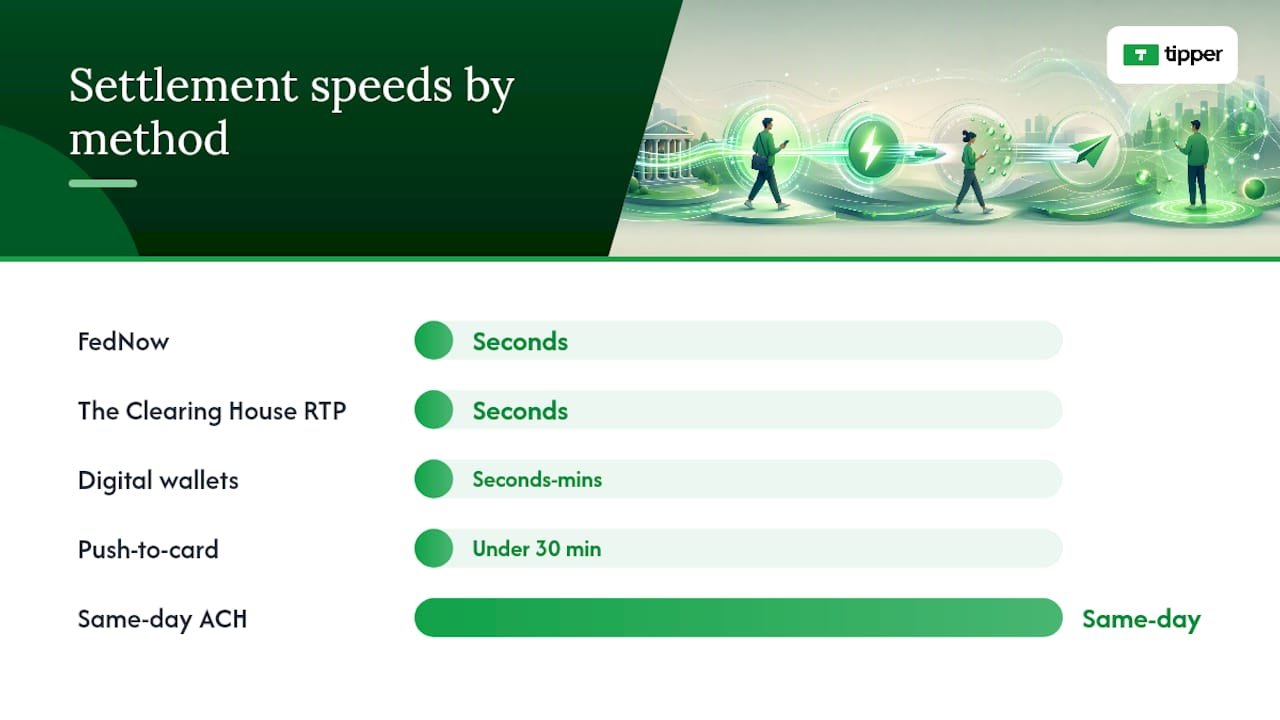
One practical note: RTP and FedNow transfers carry richer payment data using the ISO 20022 messaging standard. That means a transfer can include invoice numbers, reference codes, and remittance details alongside the funds, which makes reconciliation faster and reduces the chance of mismatched records.
Fees, speed trade-offs, and practical limits
Real-time payment advantages come with a cost structure that differs from standard ACH, and knowing the shape of those costs helps you decide when instant pay is worth it.
Standard ACH is typically free or close to it for the sender, and same-day ACH adds a small per-transaction fee on the sending side. RTP and FedNow transfers often carry a flat fee per transaction, though the exact amount depends on your bank or payment provider.
Platforms and employers sometimes pass instant-payout fees to the recipient. A gig platform might offer “instant” payout for a fee deducted from your earnings, while standard payout is free but takes one to two business days. Survey data from PYMNTS and Ingo Payments shows that many freelancers are willing to pay that fee, particularly when cash flow is tight or when the work is high-value.
There are also per-transaction caps to be aware of. The Clearing House RTP network supports transactions up to high limits, but individual banks often set lower thresholds. FedNow transaction limits vary by participating institution. For most freelance invoices, these caps are not a practical constraint, but for large project payments, it’s worth confirming your bank’s specific limit before promising a client an instant transfer.
| Dimension | Same-day ACH | RTP / FedNow | Push-to-card |
|---|---|---|---|
| Speed | Same business day | Seconds | Under 30 minutes |
| Typical fee structure | Small flat fee (sender) | Flat fee per transaction | Percentage of amount |
| Reversibility | Reversible within window | Final / irrevocable | Limited |
| Availability | Business hours | 24/7/365 | 24/7 (most networks) |
What to watch out for: fraud, reversals, and tax implications
The finality that makes RTP valuable is also the property that creates the most risk. Once an RTP or FedNow transfer settles, it cannot be recalled the way a standard ACH can. That means if you send money to the wrong account, or if a fraudster tricks you into sending funds, recovery depends on the recipient’s cooperation, not a bank reversal.
Fraud patterns to know. Social engineering is the most common attack vector. A scammer poses as a client, sends a fake payment confirmation, and asks you to ship goods or start work before the funds actually arrive. Always verify payment in your bank account directly, not from a screenshot or email. For new clients paying via RTP, wait for the confirmation in your own banking app before delivering work.
Finality vs. platform-level holds. Even though the underlying rail settles instantly, the platform sitting on top may impose its own hold period for fraud review. A marketplace might show a payment as “pending” for 24 hours before releasing it to your balance. That is a platform policy, not a rail limitation, and it varies by provider.
Chargebacks and disputes. RTP transfers themselves are not chargeable in the same way a credit card transaction is. But if a client pays via a card-funded wallet or a card-based push, the card network’s dispute rules still apply. Know which rail your payment actually traveled before assuming it’s fully final.
Tax and record-keeping. Instant tips, shift pay, and invoice payouts via RTP are all taxable income, regardless of how fast they arrive. The speed of settlement does not change your reporting obligations. For each instant receipt, record the timestamp, the payer’s name or ID, the amount, and the invoice or job reference. That metadata is exactly what you need at tax time, and RTP’s richer payment messaging often includes it automatically if you’re using a platform that passes it through.
A simple rule: treat every instant receipt the same way you’d treat a check. Log it the day it arrives, tag it to a project, and set aside your estimated tax percentage immediately.
How to start accepting real-time payments as a freelancer
Getting set up to receive instant payments takes a few deliberate steps, but none of them are complicated.
-
Decide which instant method fits your work. If you do project-based work with direct clients, an RTP-enabled payment link or request-for-payment flow is the cleanest option. If you work through a gig platform, check whether it offers instant or same-day payout and what the fee is. For tips and appreciation payments, a wallet-enabled tip link is the fastest path.
-
Open a dedicated receiving account. A separate business checking account for incoming instant payments keeps your cash flow visible and your bookkeeping clean. Many online banks support FedNow or RTP receiving without extra setup. Gig worker instant pay guidance consistently points to account separation as the single most practical workflow change.
-
Update your payment terms. Add a line to your contracts and invoices specifying your preferred payment method and any fee for instant processing. Something like: “Payment via RTP or same-day ACH preferred. A 1.5% instant-processing fee applies to push-to-card payouts.” That sets expectations before the invoice arrives.
-
Test with a small transaction. Before relying on instant pay for a large invoice, send yourself a $1 test transfer or ask a trusted client to run a small payment through the new flow. Confirm the funds appear in your account within the expected window and that the payment data (reference, amount, timestamp) is correct.
-
Integrate payment links or request-for-payment flows. A payment link lets clients pay with one tap, without logging into a portal or entering your bank details manually. For tips specifically, a personalized link that supports Apple Pay or Google Pay removes every barrier between finishing a job and getting paid for it.
Documents and settings to prepare: bank routing and account numbers for instant rails, your EIN or SSN for tax reporting, a refund and dispute policy, and invoice metadata fields (job ID, date, client name).
Pro Tip: When you phrase your payment terms, be specific about the rail: “Please pay via Zelle, RTP, or same-day ACH to [account details]” is clearer than “please pay electronically.” Specificity reduces the chance a client defaults to a paper check. For a full freelancer tipping workflow, including how to set up your first tip link, the step-by-step guide covers the setup in detail.
Which tools can freelancers use for instant payouts right now?
The practical options fall into a few categories, each suited to a different type of freelance work.
Payment link and checkout tools. Stripe supports real-time payment methods and push-to-card payouts, making it a solid option for freelancers who invoice directly. You can create a payment link, share it with a client, and receive funds via the client’s preferred method. Stripe’s documentation covers which rails are available in the U.S. and what the fee structure looks like for each.
Push-to-card payout services. Several platforms let employers and marketplaces push earnings directly to a worker’s debit card. If you work through a marketplace, check whether it supports instant payout and what the per-transfer fee is. For evaluating payout terms and cadence, understanding when funds are released and under what conditions matters as much as the speed claim.
Digital-wallet-first flows. Apple Pay and Google Pay work best when the payer is on a mobile device and wants to complete a transaction in seconds. For in-person services, a QR code that opens a wallet-enabled payment page is the fastest possible experience for both parties.
Marketplace payout features. Many gig platforms now offer instant or same-day payout as a toggle in your earnings dashboard. The fee is usually deducted from your balance rather than charged separately, so read the fine print before assuming the “instant” option is free.
Tipper for instant tips. For creators and freelancers who receive tips, Tipper offers a personalized tip link and QR code that clients can use without creating an account. Apple Pay, Google Pay, and card payments are all supported. Payouts go directly to the creator, and the sender experience takes seconds. It fits the instant payment tools category that works best for service workers, photographers, musicians, and anyone whose clients want to show appreciation on the spot.
Checklist for evaluating any instant payout tool:
- Payout speed (seconds vs. hours vs. next business day)
- Fee structure (flat vs. percentage, who pays)
- Reconciliation data included with each transfer
- API or payment link support for your workflow
- Refund and hold policy
- Privacy handling for sender and recipient data
Pro Tip: Run a $1 test payout through any new tool before using it for real income. Record the exact time the funds appeared in your account. If the tool claims “instant” but funds take 20 minutes, that is useful information for setting client expectations and for your own cash-flow planning.
When real-time payments aren’t the right choice
Instant pay is not always the best option, and knowing when to skip it saves you fees and complexity.
- Recurring retainers with trusted clients. If a client pays the same amount on the first of every month, a standard ACH setup is simpler and free. The predictability of a retainer already solves the cash-flow problem that RTP is designed to address.
- High-value transactions that exceed rail caps. If your bank’s RTP limit is lower than your invoice amount, you’ll need to split the payment or use a wire. Wires are slower to set up but handle large amounts without the per-transaction cap constraints of some RTP implementations.
- Disputed or conditional work. If there’s any chance a client will contest the work, an irrevocable RTP transfer puts you in a harder position than a reversible ACH. For new client relationships or milestone-based projects, consider keeping standard ACH until trust is established.
- When clients won’t absorb the fee. If a client refuses to pay an instant-processing fee and you don’t want to absorb it yourself, the math may not work. A 1.5% fee on a $500 invoice is $7.50, which is manageable. On a $50 invoice, it starts to feel disproportionate.
- High-volume small payouts. If you receive dozens of small instant transfers daily, the per-transaction fees add up and the bookkeeping becomes more complex than a daily batch settlement. Scheduled same-day ACH or invoice acceleration services may be a cleaner fit.
For situations where instant pay isn’t ideal, same-day ACH covers most of the speed gap at lower cost, and invoice factoring or acceleration services can bridge cash-flow gaps on larger invoices without requiring the client to change their payment behavior.
What instant pay actually feels like in practice
Finishing a project and seeing the payment land before you’ve closed your laptop changes something about how you think about your work. The financial anxiety that comes with waiting, checking your bank twice a day, wondering if the client forgot, simply isn’t there. You know the job is done and the money is there, so you can move on to the next thing. Budgeting becomes more concrete too: instead of estimating when funds might arrive, you’re working with real numbers. The one adjustment worth noting is administrative. Instant receipts still need to be logged, tagged to a project, and set aside for taxes, so keeping a separate account and a simple tracking habit makes the whole system work cleanly.
Tipper makes instant tipping simple for freelancers
Freelancers who rely on tips, whether photographers, musicians, coaches, or content creators, often lose those payments to friction. A client wants to tip but doesn’t have cash, doesn’t want to create an account, or doesn’t know where to send money. Tipper removes every one of those barriers.

With Tipper, you get a personalized tip link and QR code that your clients can use in seconds. Apple Pay, Google Pay, and card payments are all supported, and senders never need to sign up for anything. Payouts go directly to you, and you keep your earnings. You can add a thank-you message, a photo, or a short video to make the experience personal. Privacy is built in: senders share only what they choose, and your payout details stay private.
If you finish a job and want to get paid for it right now, create your Tipper page and share the link with your next client. Setup takes minutes, and the first tip can arrive before you’ve packed up your gear.
Sources
- Real-Time Payments Explained | Stripe
- Instant payments: Understanding RTP® and FedNow® Service | J.P. Morgan
- 2024 Business Payments Study | Federal Reserve / Payments Improvement
This article is general information, not a substitute for advice from a qualified financial advisor. Consult a qualified financial professional about your own circumstances before acting on anything here.
FAQ
Which payment method is best for freelancers?
The best method depends on your workflow. For direct client invoices, an RTP-enabled payment link or same-day ACH covers most situations. For tips and on-the-spot payments, a wallet-enabled tip link (Apple Pay or Google Pay) is the fastest and most frictionless option for both you and your client.
What are the main benefits of real-time payments for freelancers?
Immediate fund availability, payment finality, and 24/7 settlement are the core advantages.
Is RTP cheaper than ACH for freelancers?
Standard ACH is typically free or near-free, while RTP and push-to-card transfers carry per-transaction fees, either flat or as a percentage of the amount. Same-day ACH sits in between. Whether RTP is worth the cost depends on how urgently you need the funds and whether your client or platform absorbs the fee.
Do instant payments affect how I report income for taxes?
No. Funds received via RTP, push-to-card, or digital wallets are taxable income in the period you receive them, the same as any other payment method. The speed of settlement does not change your reporting obligations, so log each instant receipt with a timestamp, payer name, and invoice reference as soon as it arrives.
What is the $3,000 rule for banks?
The $3,000 rule refers to Bank Secrecy Act requirements that financial institutions collect and retain records on certain cash transactions and transfers at or above that amount. It is not specific to RTP, but it means your bank may request documentation for transfers at or above that threshold. For most freelance payments, this is a background compliance requirement rather than a practical barrier.




Leave A Comment