

Payment privacy matters for freelancers because every digital transaction you send or receive generates a data trail that banks, payment processors, platforms, and data brokers can use for surveillance, profiling, fraud, and price discrimination. That trail is not theoretical. It affects your income, your client relationships, and your physical safety.
Three harms hit freelancers hardest:
- Account freezes and holds: Unusual transaction patterns, flagged by algorithms at banks or payment platforms, can lock your income without warning.
- Targeted price discrimination: Clients or platforms that can see your payment history may adjust what they offer you, or charge you more, based on inferred financial need.
- Doxxing and identity attacks: Exposed payment details, including your legal name, linked email, or bank routing number, can be weaponized for social engineering or public harassment.
The sections below explain where your payment data goes, which methods leak the most, and what you can do today to reduce exposure without running afoul of U.S. tax obligations.
Table of Contents
- What are the real risks freelancers face from weak payment privacy?
- How do different payment methods compare on privacy?
- What practical steps can you take to protect your payment info?
- When should you prioritize privacy, and when does convenience win?
- What do central banks and policy researchers say about payment privacy?
- Key Takeaways
- The privacy gap most freelancers don’t see
- Tipper keeps your tips private by default
- Useful sources and further reading
- FAQ
What are the real risks freelancers face from weak payment privacy?
Weak freelance financial privacy is not an abstract concern. The consequences show up in your bank account, your inbox, and sometimes your front door.
Account freezes and unexpected holds
Banks and payment platforms use automated systems to flag unusual transaction flows. If your income is irregular, which is normal for freelancers, those systems can misread legitimate activity as suspicious. Sharing transaction histories with too many parties, or receiving large one-off payments through consumer-facing apps, raises the probability of a hold. A frozen account during a cash-flow gap is not just inconvenient; it can mean missing rent.
Fraud, scams, and doxxing
Exposed payment details are raw material for social engineering. A bad actor who knows your legal name, your PayPal address, and the rough size of your typical invoice can craft a convincing phishing message or impersonate you to a client. PrivacyOn’s guide for gig workers identifies public-facing profiles, unsecured networks, and data brokers as the three primary exposure vectors for freelancers. The combination of a public portfolio and a payment handle tied to your real identity is particularly risky.
Price discrimination and lost negotiating power
Payment history reveals patterns: how often you work, what clients pay you, and whether you accept lower rates during slow periods. Platforms and sophisticated clients who can access or infer that history may use it to adjust what they offer you. The Bank of Canada’s public policy research documents how declining cash use enables firms to use payment data for profiling and price discrimination, a dynamic that applies directly to freelancers whose income is fully digital.
Professional and legal exposure
Some freelancers work in sensitive fields: political consulting, investigative journalism, mental health content, or legal support. Payment records that reveal client relationships or purchase patterns can create professional liability or personal safety risks. The compliance caveat here is straightforward: protecting privacy does not mean hiding income. U.S. tax law requires you to report all income regardless of payment method. Consult a tax professional for your specific situation.
Pro Tip: Set a monthly alert for unfamiliar login locations on your payment accounts and review payout destinations quarterly. Catching an unauthorized change early is far cheaper than recovering from a full account takeover.
How do different payment methods compare on privacy?
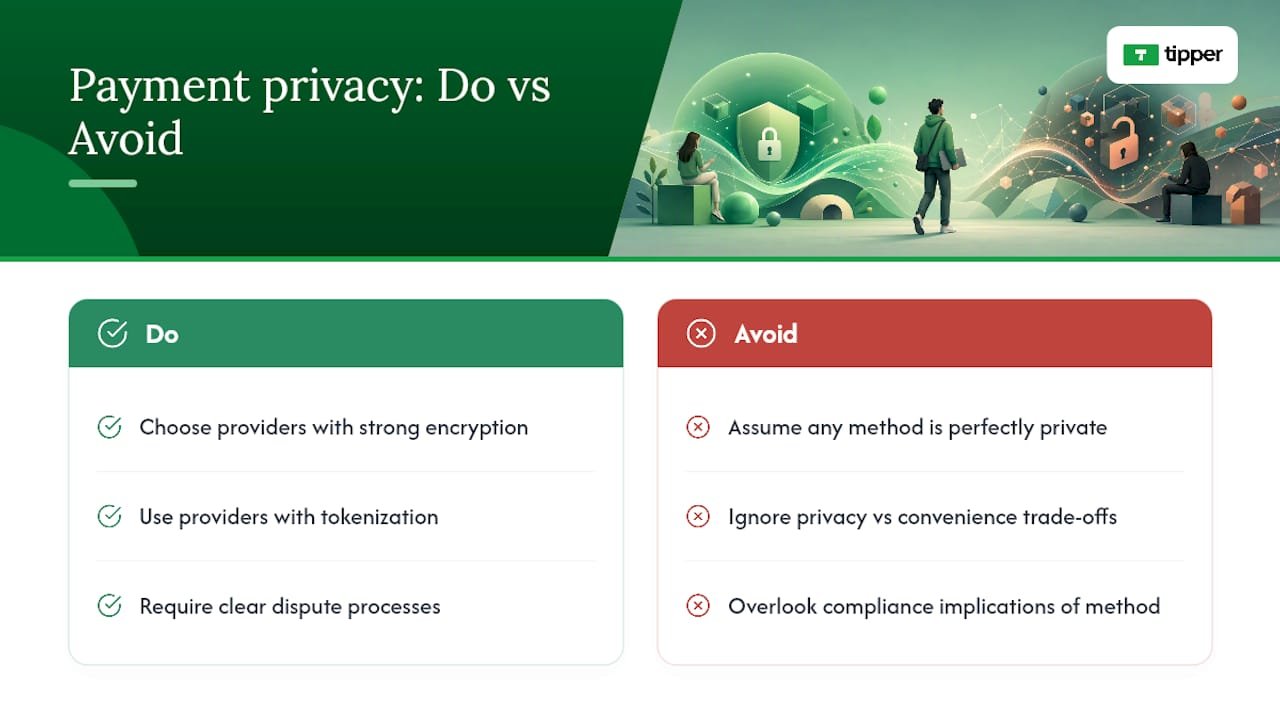
No payment method is perfect. Each one trades privacy against convenience, speed, and compliance in different ways. Choosing providers with strong encryption, tokenization, and clear dispute processes is a baseline, but the underlying method still shapes your exposure.
Card payments via PSPs
High convenience, high data exposure. When a client pays you through a card-accepting PSP, the card network (Visa or Mastercard) sees the transaction at the network level regardless of which PSP processes it. Tokenization limits some exposure for the payer, but it does not reduce what the network or the PSP retains about you as the payee. For recurring, high-value client relationships, this is often an acceptable trade-off. For one-off or sensitive work, it is worth considering alternatives.
ACH and direct deposit
Fewer intermediaries than cards, which is a genuine privacy advantage. ACH transfers run through the banking system directly, so the data stays primarily with your bank and your client’s bank rather than flowing through a card network. The downside: your bank sees your full transaction history and can share it under its terms of service or in response to legal process. For recurring payroll-style arrangements with established clients, ACH is often the right call.
Platform wallets and marketplace payments
Platforms that hold your balance and link payments to your profile offer good dispute resolution but poor privacy. The platform operator can see every transaction, link it to your activity history, and use that data for its own purposes. If you work through a marketplace, assume the platform knows your income patterns in detail.
Tipping links and accountless payment pages
This is where the privacy calculus shifts in your favor. A well-designed tipping link lets a sender pay without creating an account, which means no persistent profile is built on the sender’s side. When the link also supports Apple Pay or Google Pay, the actual card number is never transmitted; a device-specific token is used instead. The result is a shorter data chain than almost any other method. For one-off appreciation payments, public-facing tip pages, or situations where you do not want to share banking details with a new contact, this approach minimizes unnecessary data linkage.
Cryptocurrency
Crypto offers pseudonymity, not anonymity. On-chain transactions are publicly visible, and the on-ramp and off-ramp points (exchanges where you convert to or from dollars) require KYC verification that can re-identify you. Privacy-preserving protocols exist and are gaining attention, as zero-knowledge proof designs demonstrate, but they add complexity and are not yet mainstream for everyday freelance payments. Use crypto with clear eyes about what it does and does not hide.
What practical steps can you take to protect your payment info?
Operational habits deliver more privacy protection than most technical tools, and they cost nothing. Here is a prioritized checklist for freelancers in the U.S.
Immediate actions:
- Open a dedicated business bank account and use a separate email address for all payment-related accounts. Mixing personal and business finances is the single fastest way to expose both.
- Use payment links that minimize metadata for one-off or public-facing payments instead of sharing your bank details directly.
- Enable two-factor authentication (2FA) on every payment account. An authenticator app (Google Authenticator, Authy) is stronger than SMS-based 2FA.
- Prefer platforms that limit unnecessary data retention and have clear, readable privacy policies.
Technical controls:
- Use a VPN on public Wi-Fi whenever you access payment accounts or send invoices.
- Keep payment apps isolated: a dedicated browser profile or a separate device for financial tasks limits cross-site tracking.
- Turn off autofill for financial details in your browser. Autofill data can be harvested by malicious scripts on compromised pages.
- Tokenization (built into Apple Pay and Google Pay) replaces your actual card number with a device-specific token, reducing exposure if a merchant is breached.
Operational controls:
- Keep invoice notes minimal. Standardize your invoice metadata so it reveals the least possible about client identity or project nature.
- Ask clients to use discrete payment descriptions. “Services rendered” is better than a description that names a sensitive project.
- Never attach sensitive personal information to public receipts or payment confirmations.
Financial controls:
- Use direct deposit for recurring clients, a privacy-friendly link for one-off tips, and approach crypto with awareness of its on-chain transparency.
- Keep proper records for taxes. The IRS requires income reporting regardless of payment method, and good records protect you in an audit. A tax professional can advise on the right recordkeeping system for your situation.
Pro Tip: For high-risk clients or public-facing pages, use a single-use or ephemeral payment link rather than a permanent one tied to your main profile. If that link is scraped or shared beyond its intended audience, it limits the damage.
When should you prioritize privacy, and when does convenience win?
Not every transaction needs the same level of protection. Spending effort on privacy controls where the risk is low wastes time you could spend on actual work.
Prioritize privacy when:
- You work in politically sensitive, journalistic, or legally adjacent fields where client relationships must stay confidential.
- A payment reveals a pattern, such as recurring income from a specific source, that you would not want a data broker, future client, or adversary to infer.
- You are receiving a large or irregular payment that could trigger algorithmic scrutiny.
- You are sharing payment details with someone you have not worked with before.
Standard convenience is fine when:
- A client requires a specific invoicing format for expense reimbursement, and full visibility is part of their compliance process.
- You are using a platform that requires transaction visibility for dispute resolution, and the dispute protection is worth the trade-off.
- The transaction is low-value and one-directional with no sensitive context attached.
A simple decision rule: if the payment reveals something about you or your client that you would not want made public, treat it as high-privacy. If it is routine and the data exposure is already baked into the platform you are using, focus your effort elsewhere.
What do central banks and policy researchers say about payment privacy?
The policy community has been debating payment privacy seriously for years, and the conclusions are more pointed than most freelancers realize.
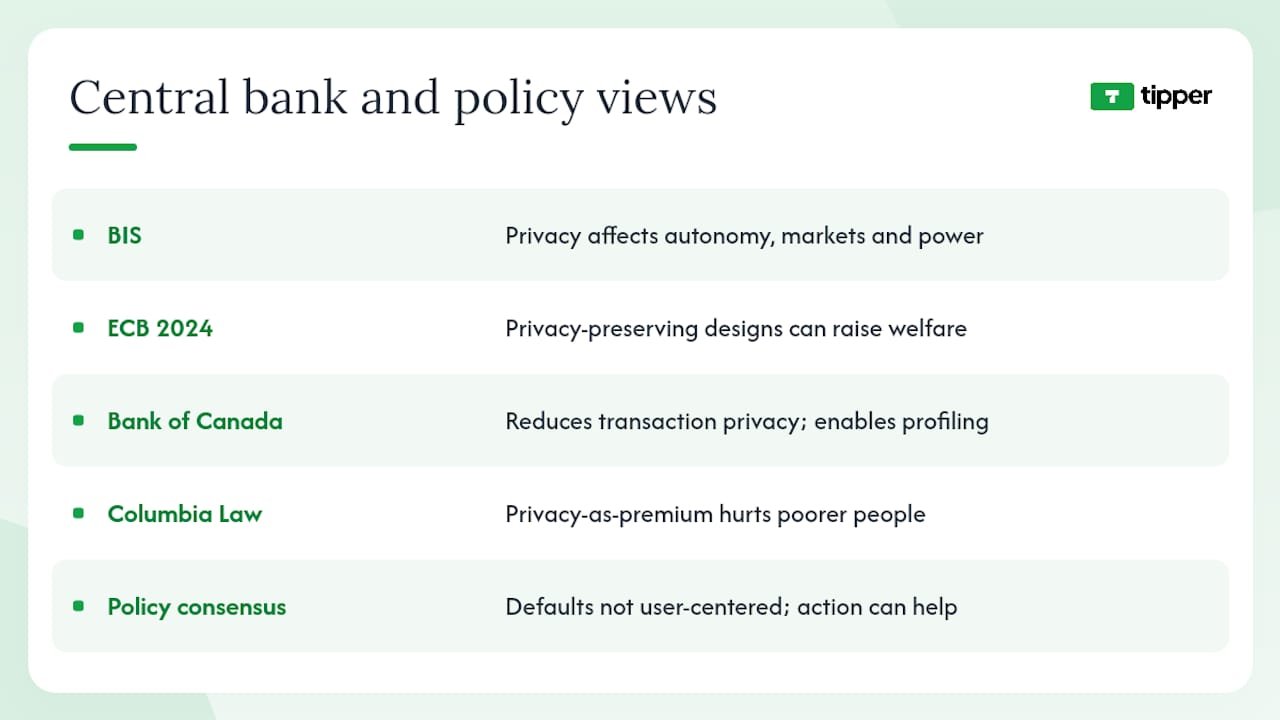
The BIS working paper on payment privacy argues that privacy in payments extends well beyond concealing illicit activity. It affects individual autonomy, market outcomes, and the distribution of economic power. Privacy must be intentionally designed into payment systems, not treated as an optional feature.
The ECB’s 2024 blog post acknowledges that digital payments create traceable footprints and signals the industry’s shift toward privacy-preserving models that balance instant settlement with reduced data exposure. The ECB Working Paper No. 2662 goes further, modeling how privacy-preserving digital payment designs can increase welfare by enabling online commerce without exposing user data to lenders or third parties.
Research callout: The Bank of Canada’s public policy research concludes that declining cash use reduces transaction privacy and enables firms to use payment data for profiling and price discrimination, a systemic risk that individual freelancers cannot easily avoid without deliberate effort.
The Columbia Law Review’s analysis of the personal data economy raises a harder point: when privacy becomes a paid premium feature, people with fewer resources end up with less protection. That dynamic is especially relevant for freelancers, who often lack the institutional leverage that larger businesses use to negotiate better data terms with platforms.
The policy consensus is not that privacy is impossible in digital payments. It is that the default systems were not built with your interests as the priority, and that individual action, combined with better-designed tools, can close a meaningful part of the gap.
Key Takeaways
Payment privacy is a concrete, manageable risk for U.S. freelancers, and the most effective protections combine account separation, minimal metadata, and payment methods matched to the sensitivity of each transaction.
| Point | Details |
|---|---|
| Separate accounts immediately | A dedicated business bank account and email address is the single highest-impact privacy step for any freelancer. |
| Match method to risk level | Use ACH for recurring clients, privacy-friendly tipping links for one-off payments, and avoid sharing banking details with new contacts. |
| Minimize invoice metadata | Keep memo lines and payment descriptions generic; free-form fields are a primary data leakage point. |
| Enable strong authentication | Two-factor authentication via an authenticator app protects payment accounts better than SMS-based verification. |
| Tipper for one-off tips | Tipper’s accountless tipping links with Apple Pay and Google Pay support reduce the data chain for ad-hoc payments. |
The privacy gap most freelancers don’t see
The conventional advice on freelancer payment security focuses almost entirely on fraud prevention: use strong passwords, watch for phishing, don’t click suspicious links. That advice is correct but incomplete. The larger, quieter risk is the routine, legal collection of your payment data by parties you have agreed to share it with, often without reading the fine print.
Every time you accept a platform’s terms of service, you are granting data rights that can be exercised for years. The profiling that results is not a breach. It is the intended function of the system. Central banks and academic researchers have documented this clearly, yet the freelance community largely treats payment privacy as a niche concern for people with something to hide.
The more useful frame is this: payment data is a form of financial biography. It records who you work with, how much they pay you, when your income peaks and dips, and what you spend money on. Handing that biography to every platform and processor you touch is not neutral. It shapes your credit access, your negotiating position, and in some cases your physical safety.
Tipper’s approach, building tipping flows that require minimal sender data and support accountless payments, reflects a belief that the default should be less exposure, not more. That is not a radical position. It is what the BIS and ECB have been arguing for in policy terms for years. The difference is that you can act on it today, without waiting for regulators to catch up.
Tipper keeps your tips private by default
Most payment tools were built for volume, not privacy. Tipper was built for creators and freelancers who want to get paid without handing over a financial biography to every platform in the chain.
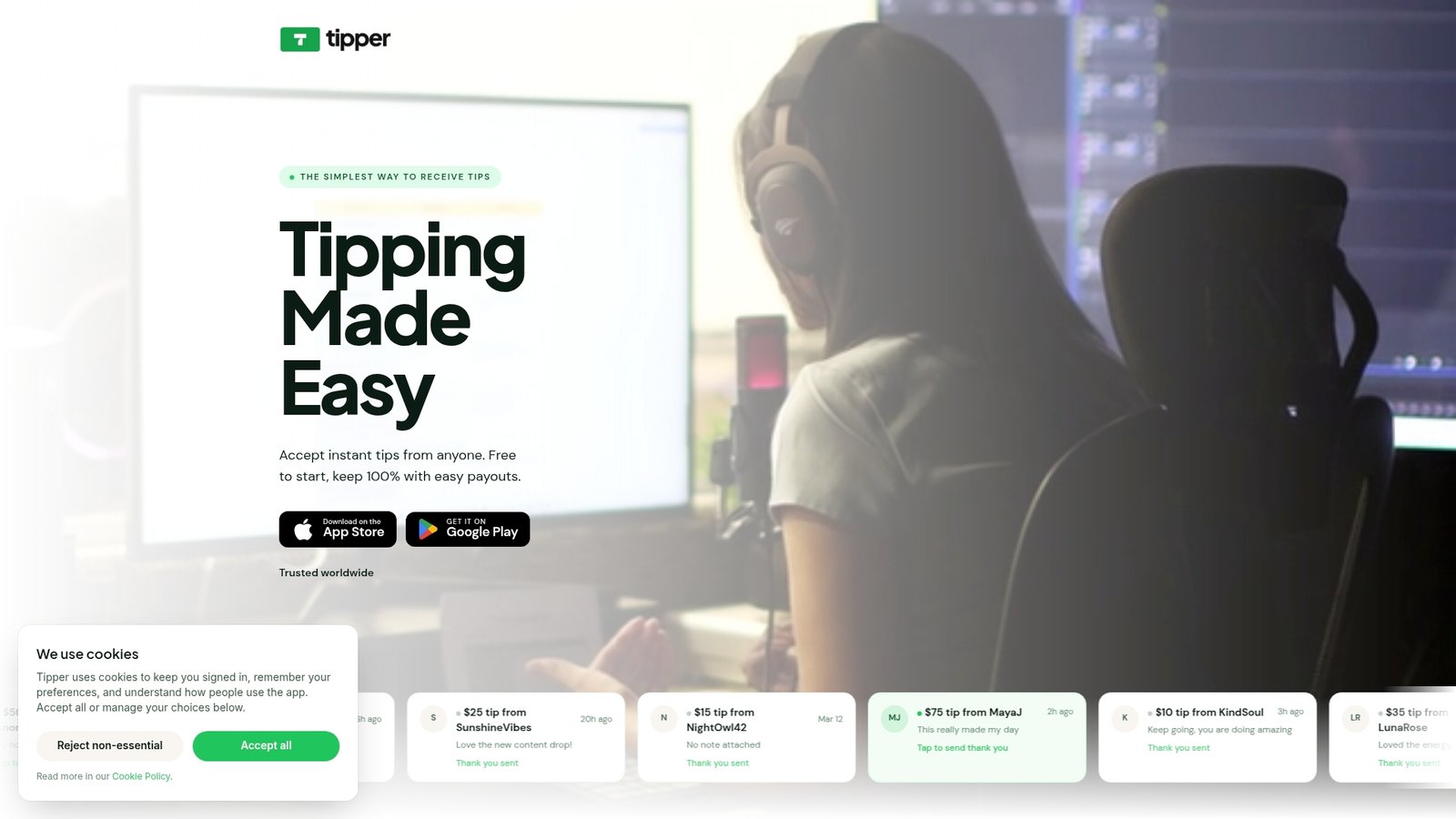
With Tipper, your supporters send tips through a personalized link using Apple Pay, Google Pay, or a card. No account required on their end, which means no persistent sender profile is built. You keep 100% of your tips (a small processing fee applies at checkout), and payouts go directly to you. For freelancers who want a one-off payment option that does not require sharing bank details or creating a paper trail tied to a marketplace profile, Tipper’s tipping link is a practical fit.
You can also send a thank-you note, photo, or video after each tip, which keeps the relationship personal without adding data overhead. For a step-by-step look at building a privacy-friendly tipping workflow, Tipper’s blog covers the setup in detail. Keep your tax records regardless of which payment method you use; Tipper does not replace your recordkeeping obligations, and a tax professional can help you structure reporting correctly.
Useful sources and further reading
- Bank for International Settlements working paper (work1242)
- European Central Bank blog — 2024-06-13
- ECB Working Paper Series No 2662
- Privacy as a Public Good: A Case for Electronic Cash (Bank of Canada/Canadian publication)
- PAYING FOR PRIVACY AND THE PERSONAL DATA ECONOMY — Columbia Law Review
- Privacy guide for gig workers and freelancers — PrivacyOn
- How Zero Knowledge Tech Protects Your Freelance Finances — Zerocrat
- How to get paid securely as a freelancer — Skrill
This article is general information, not legal, financial, or tax advice. Confirm your specific obligations with a qualified tax professional or the IRS.
FAQ
What is the best payment method for freelancers who want privacy?
ACH or direct deposit works well for recurring clients because it involves fewer intermediaries than card networks. For one-off or public-facing payments, an accountless tipping link that supports Apple Pay or Google Pay minimizes the data chain further.
What is a typical financial risk freelancers face from poor payment privacy?
Account holds triggered by unusual transaction patterns are among the most common, alongside targeted phishing attacks that use exposed payment details to impersonate clients or platforms.
How should freelancers handle payments to stay both private and compliant?
Use a dedicated business bank account, keep invoice metadata minimal, and report all income to the IRS regardless of payment method. A tax professional can help structure recordkeeping so privacy practices do not create compliance gaps.
What happens when a freelancer requests an upfront payment?
Requesting a deposit is standard practice and does not create privacy problems on its own. The risk is in how the payment is collected: sharing bank routing numbers or personal PayPal handles with a new client exposes more data than a payment link that requires no account from the sender.
Does using crypto make freelance payments private?
Crypto offers pseudonymity, not full anonymity. On-chain transactions are publicly visible, and exchange-based on-ramps require identity verification that can re-identify you. Privacy-preserving cryptographic designs exist but add complexity and are not yet standard for everyday freelance use.


[…] a deeper look at privacy trade-offs across payment tools, the payment privacy guide for U.S. freelancers is worth reading before you commit to a […]
[…] Why Payment Privacy Matters for Freelancers in the U.S. […]