

The fastest way to earn reliable freelance extra income is to package skills you already have into short, high-value services and use a three-month action plan to land paying clients. Certified financial planners consistently recommend starting with existing skills rather than learning something new, because the path from “idea” to “first payment” shrinks from months to days.
Here are the five strategies with the fastest time to first dollar:
- Value-based micro-services (copywriting, design, dev audits): Post a single, specific offer on Upwork or Fiverr today. First step: write one 150-word service description with a fixed price.
- Retainer arrangements: Pitch one existing contact for a monthly package (social posts, bookkeeping, SEO reports). First step: send a three-sentence email this week.
- Digital products (templates, printables, mini-courses): List one product on Etsy or Gumroad. First step: create a single Canva template and price it at $9–$19.
- Creator tip flows: Share a tip link after every piece of content you publish. First step: set up a Tipper page in under ten minutes and paste the link in your bio.
- Marketplace gigs (DoorDash, Rover, Turo): Sign up and complete onboarding. First step: submit your application today; most platforms approve within 48–72 hours.
Each of these works because setup cost is near zero, the first transaction can happen within a week, and all five can run alongside a full-time job.
Key Takeaways
| Point | Details |
|---|---|
| Start with existing skills | Packaging skills you already have gets you to a first payment faster than learning something new. |
| Set a specific earnings target | A concrete goal (e.g., $600/month) determines which gig category and pricing model makes sense. |
| Set aside 25–30% for taxes | Route that percentage to a separate savings account immediately on every payment received. |
| Move to retainers early | One retainer client at $500–$2,000/month stabilizes income and breaks the hourly-rate ceiling. |
| Tipper for instant tips | Creators can add a tip link to any deliverable or bio and accept Apple Pay or Google Pay with no sender account required. |
Table of Contents
- Freelance extra income strategies: a prioritized list by effort and reward
- How to choose the right side hustle for your skills and schedule
- Best practices to keep your side income growing and sustainable
- U.S. tax and payment basics every freelancer needs to know
- Platforms and payment tools to find work and get paid quickly
- Your 30/60/90 day plan to earn your first $500–$2,000
- What actually works (and what usually doesn’t)
- Tipper makes it easy to collect tips and small payments instantly
- Sources
- FAQ
Freelance extra income strategies: a prioritized list by effort and reward
Fidelity’s guide to side hustles notes that even modest supplemental income of $100+ per month adds up fast, and that matching the work to your schedule and skills is what keeps it going past the first month. The ideas below are grouped by how quickly they pay and how much skill they require.
Quick marketplace gigs
These are the lowest-friction entry points. You trade time for money directly, with no portfolio required.
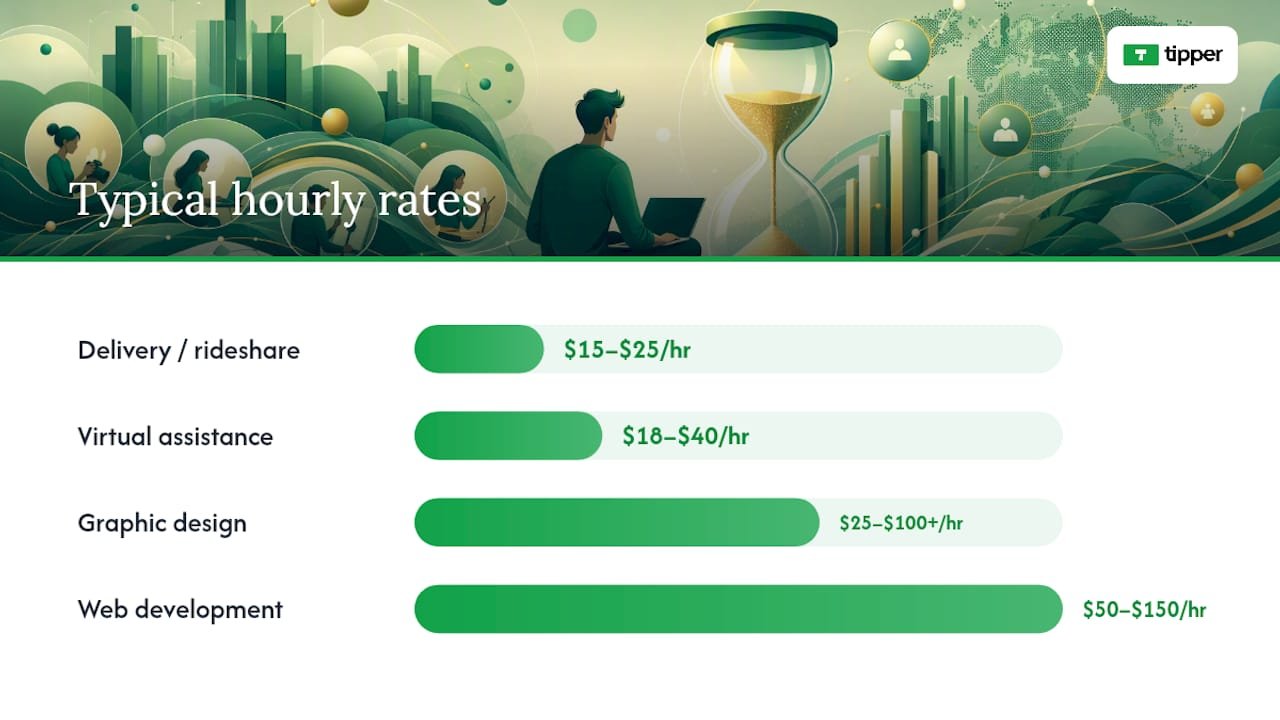
DoorDash / Uber Eats / Instacart: Food and grocery delivery pays $15–$25 per hour on average, depending on your market and tip rates. You set your own hours, which makes it genuinely compatible with a day job. Sign up, pass a background check, and you can be delivering within a week.

Uber / Lyft: Rideshare driving pays similarly, with surge pricing pushing earnings higher during peak hours. The main startup cost is a qualifying vehicle and a clean driving record.
Rover: Dog walking and pet sitting through Rover typically earns $15–$30 per visit or walk. Pet owners book recurring services, so one good client can turn into a steady weekly income. Create a profile, get a few five-star reviews from neighbors, and the bookings compound.
Turo: If you own a car you don’t drive every day, listing it on Turo can generate $300–$700 per month depending on your vehicle and location. It’s passive once the listing is live.
Skill-based freelance services
These take slightly longer to set up but pay significantly more per hour.
Freelance writing and copywriting: Blog posts, email sequences, and product descriptions are in constant demand. Rates range from $50 per article for beginners to $150–$500+ for experienced writers with a niche. Upwork and direct outreach to small businesses are both viable starting points.
Graphic design: Logos, social media graphics, and pitch decks sell well on Fiverr and through direct client work. A beginner designer can earn $25–$75 per hour; a specialist with a strong portfolio can charge $100+.
Web development and tech support: Even basic WordPress setup or Shopify customization commands $50–$150 per hour. If you have any coding background, this is one of the highest-return skills to package.
Virtual assistance: Scheduling, inbox management, research, and data entry. Rates run $18–$40 per hour. The barrier to entry is low, and many clients want ongoing help, which creates natural retainer opportunities.
Recurring and retainer services
One retainer client at $500–$1,500 per month changes the math on side income entirely. Monthly social media management, SEO reporting, bookkeeping, or email newsletter writing all lend themselves to retainer pricing. The pitch is simple: instead of quoting per project, offer a fixed monthly scope at a slight discount in exchange for commitment.
Digital products
Templates, Notion dashboards, Lightroom presets, printable planners, and short e-books sell on Etsy, Gumroad, and Creative Market. The upfront work is real, but each sale after that costs you nothing. A single well-designed resume template on Etsy can sell dozens of times per month.
Creator tip-based income
If you publish content, teach, or coach, a tip link is the simplest way to monetize appreciation directly. Share it after tutorials, at the end of newsletters, or in your link-in-bio. Tips are small individually but accumulate, and they require zero ongoing work once the link is live.

Pro Tip: Before you list on a marketplace, search for the top three sellers in your category and note exactly how they title their gigs, what they include in each tier, and what their reviews praise most. Model your offer on what’s already working, then differentiate on one specific thing.
Earnings estimates by category
| Category | Typical hourly or project range | Startup friction | Time to first payment |
|---|---|---|---|
| Delivery / rideshare (DoorDash, Uber, Lyft) | $15–$25/hr | Low (background check, vehicle) | 3–7 days |
| Pet care (Rover) | $15–$30/visit | Low (profile + reviews) | 1–2 weeks |
| Car rental (Turo) | $300–$700/month | Low (vehicle listing) | 1–2 weeks |
| Freelance writing | $50–$500/project | Medium (portfolio sample) | 1–3 weeks |
| Graphic design | $25–$100+/hr | Medium (portfolio) | 1–3 weeks |
| Virtual assistance | $18–$40/hr | Low (profile + outreach) | 1–2 weeks |
| Web development | $50–$150/hr | Medium (skills + portfolio) | 2–4 weeks |
| Digital products (Etsy, Gumroad) | $9–$19/unit | Medium (creation time) | 2–6 weeks |
| Retainer services | $500–$2,000/month | Medium (existing relationship) | 2–4 weeks |
| Creator tips | Varies (micro-payments) | Very low (tip link setup) | Same day |
How to choose the right side hustle for your skills and schedule
Most people stall here. They read a list of ideas, feel excited, and then do nothing because they can’t decide. This checklist cuts through that.
Step 1: Run a quick skill inventory
Write down every skill you use at work or have used in the past five years. Include software, writing, communication, design, analysis, teaching, and physical skills. Don’t filter yet. You’re looking for anything someone would pay for.
Step 2: Do a time audit
How many hours per week can you realistically commit without burning out or jeopardizing your primary job? Be honest. Ten hours per week is a solid starting point. Five hours is enough for digital products or a single retainer client.
Step 3: Set a specific earnings target
“Make more money” is not a target. “Earn $600 per month within 90 days” is. Your target determines which category of side hustle makes sense. At $18/hr for virtual assistance, $600/month requires about 33 hours of paid work. At $500 per retainer, it requires one client.
Step 4: Apply a startup cost filter
Most of the best freelance extra income strategies cost nothing to start. If an idea requires buying equipment, inventory, or expensive software before you earn a dollar, deprioritize it until you’ve validated demand with something cheaper.
Step 5: Apply a risk and commitment filter
Some platforms (Turo, Rover) require physical assets or ongoing availability. Others (Upwork, Fiverr, Etsy) are fully asynchronous. Match the commitment level to your lifestyle, not just your income goal.
Step 6: Pick your top three candidates and test the smallest version
Don’t launch three side hustles at once. Pick the one with the fastest time to first dollar and run a micro-offer: one service, one price, one outreach message. If you get a response within a week, you have signal. If not, adjust the offer before scaling.
Pro Tip: Treat your first offer as an experiment, not a business. Write one sentence describing what you do, who it’s for, and what they get. Send it to five people. The feedback from those five conversations is worth more than a month of planning.
For readers exploring multiple income streams simultaneously, this guide to income streams you can start with a full-time job covers the model-selection logic in more depth.
Best practices to keep your side income growing and sustainable
Getting the first client is the easy part. Keeping income stable and growing it without burning out is where most people struggle.
Pricing: move away from hourly as fast as you can
Hourly pricing caps your income at your hours. Project pricing and retainers break that ceiling. Once you’ve completed two or three projects, you have enough data to quote a fixed price based on the outcome, not the time. A client who pays $300 for “five blog posts” doesn’t care if you write them in three hours or eight.
Scaling to $5,000–$10,000 per month typically requires value-based pricing, retainer or outcome-based contracts, and simple repeatable systems. That level usually takes 6–18 months of consistent work, but the pricing shift is what makes it possible at all.
Client acquisition: make it a weekly habit
- Block 90 minutes every week specifically for outreach. Treat it like a meeting you can’t cancel.
- Send five personalized messages per week: two to warm contacts, three to cold prospects in your niche.
- After every completed project, ask for one referral and one testimonial. Most clients will say yes if you ask directly.
- Follow up once, seven days after any unanswered pitch. A single follow-up roughly doubles response rates.
Time management: protect your primary job
Set hard rules: no client calls before 7 AM or after 9 PM on weekdays. Batch similar tasks (all writing on Tuesday evenings, all client emails on Sunday mornings). Use a shared calendar block labeled “unavailable” to prevent scope creep into your personal time.
Quality controls that prevent late payments
Write a one-page scope statement for every project, even small ones. Include deliverables, revision limits, and payment terms. Invoice on delivery, not after. These three habits eliminate most payment disputes before they start.
Scaling moves
Once you’re earning consistently, you have three options: productize (turn your service into a fixed package), outsource (subcontract overflow to another freelancer), or swap time for recurring revenue (convert one-off clients to monthly retainers). Income smoothing through retainers and pipeline discipline is the most reliable way to convert irregular gig income into something that feels like a salary.
Pro Tip: When you land your third client in the same niche, you’ve found a market. Existing clients stay at their rate; new clients pay the new one.
U.S. tax and payment basics every freelancer needs to know
Taxes are the part most new freelancers ignore until they get a surprise bill in April. Don’t do that.
The essential steps, up front
- File if you earn $400 or more in net self-employment income in a year. That’s the IRS threshold.
- Pay quarterly estimated taxes using Form 1040-ES. Due dates fall in April, June, September, and January.
- File Schedule C (profit or loss from business) and Schedule SE (self-employment tax) with your annual return.
The IRS Self-Employed Individuals Tax Center is the authoritative source for all of this.
How much to set aside
A common starting rule of thumb is to set aside 25–30% of every payment into a separate savings account the moment it lands. That buffer covers both self-employment tax and federal income tax for most earners in the $30,000–$80,000 range. Don’t touch it.
Khan Academy’s money tips for freelancers recommend simple tracking and savings habits as the single most effective way to avoid year-end surprises.
Recordkeeping checklist
- Save every invoice you send and every receipt for a business expense.
- Track mileage if you drive for work (delivery, client visits).
- Keep records for at least three years from the date you file the return they relate to.
- Use a free spreadsheet or a low-cost app like Wave to log income and expenses monthly, not annually.
1099s and platform income
Any client or platform that pays you $600 or more in a calendar year is required to send you a Form 1099-NEC. You must report all self-employment income on your return regardless of whether you receive a 1099. Platforms like Upwork, Fiverr, DoorDash, and Rover all report payments to the IRS.
Tax note: The figures above are general guidance. Tax rules change, and your situation may differ. Confirm current thresholds and deadlines directly with the IRS or a qualified tax professional.
Platforms and payment tools to find work and get paid quickly
Finding work: marketplace vs. direct outreach
| Approach | Best for | Time to first client | Control over rates |
|---|---|---|---|
| Upwork | Skilled services (writing, dev, design, VA) | 1–3 weeks | Medium (platform fees apply) |
| Fiverr | Packaged micro-services, creative work | 1–4 weeks | Medium (platform fees apply) |
| Etsy | Digital products, printables, templates | 2–6 weeks | High |
| DoorDash / Uber / Lyft | Delivery and rideshare gigs | 3–7 days | Low (platform sets rates) |
| Rover | Pet care services | 1–2 weeks | Medium |
| Turo | Vehicle rental | 1–2 weeks | High |
| Direct outreach (email, LinkedIn) | Retainer clients, specialized services | 2–6 weeks | High |
Upwork and Fiverr are the fastest paths to a first client for skill-based work. Direct outreach takes longer but produces higher-value, longer-term relationships. For most new freelancers, the right answer is both: use a marketplace to build reviews and cash flow while simultaneously pitching direct clients.
Accepting payments
For invoiced work, tools like Wave (free), PayPal Business, and Stripe let you send professional invoices and accept card payments. For recurring retainer clients, set up automatic billing through Stripe or a similar processor so you’re not chasing payments every month.
For creators and freelancers who want to accept small, spontaneous payments without the overhead of invoicing, a tip link is the most frictionless option. You share a link or QR code, and supporters pay instantly via Apple Pay, Google Pay, or card. No account required on their end. The instant payment tools guide for freelancers covers the full range of options worth considering.
Privacy and security when choosing a payment tool
Check that any payment tool you use doesn’t expose your personal bank account details to clients. Stripe and PayPal Business both keep your banking information private. For tip-based flows, look for platforms that don’t require senders to create an account, since friction on the sender’s side directly reduces conversion.
Pro Tip: Set up a dedicated business checking account before you earn your first dollar. It takes 15 minutes at most banks and makes tax time dramatically simpler. Every dollar in, every dollar out, in one place.
For a deeper look at privacy trade-offs across payment tools, the payment privacy guide for U.S. freelancers is worth reading before you commit to a platform.
Your 30/60/90 day plan to earn your first $500–$2,000
This plan assumes 5–10 hours per week of available time. Adjust the targets if you have more.
Days 1–30: set up and land your first client
- Complete your skill inventory and pick one primary offer.
- Create profiles on two platforms (one marketplace, one direct-outreach channel like LinkedIn).
- Write your one-sentence offer: “I help [audience] achieve [outcome] in [timeframe] for [price].”
- Send 10 outreach messages in week one, 10 more in week two.
- Complete your first paid project, however small. Deliver on time. Ask for a review.
- Open a dedicated business checking account and a tax savings account.
Month 1 target: $100–$300 and at least one five-star review or testimonial.
Days 31–60: build consistency and raise your rate
- Raise your rate by 15–20% for all new inquiries.
- Pitch one existing client on a monthly retainer arrangement.
- Add a second platform or outreach channel.
- Start making quarterly estimated tax payments if your income is on track to exceed $400 for the year.
- Track time spent vs. income earned to identify your most profitable activity.
Month 2 target: $300–$800 and one recurring client or retainer.
Days 61–90: scale what’s working
- Double down on the one offer that generated the most revenue in months 1–2.
- Create one digital product (template, guide, checklist) that packages your knowledge.
- Ask every satisfied client for one referral.
- Add a tip link to every deliverable, email signature, and social profile.
- Review your 90-day numbers: income, hours worked, effective hourly rate. If any offer earns below $20/hr effective, reprice or drop it.
Month 3 target: $500–$2,000 total, with at least one repeating revenue source.
If an idea produces zero responses after 30 days of consistent outreach, that’s a signal to change the offer, the channel, or the price, not to give up on freelancing entirely.
What actually works (and what usually doesn’t)
Most side-hustle advice focuses on the launch. Very little of it addresses what separates people who earn $200 in month one and quit from those who hit $2,000 by month three and keep going.
The pattern that scales is almost always the same: a specific offer for a specific audience, priced on outcomes rather than hours, with a simple system for finding new clients every week. Retainers, productized services, and digital goods all share one trait: the work you do once keeps paying. A retainer client you land in month two is still paying in month eight. A template you build on a Tuesday evening can sell on a Saturday morning while you’re asleep.
What usually fails is the opposite: vague offers (“I do social media stuff”), hourly pricing with no floor, and relying entirely on a marketplace without any direct outreach. Undifferentiated low-rate marketplace work can generate cash in the short term, but it’s a ceiling, not a ladder. The freelancers who break through it are the ones who pick a niche, raise their rates after every three projects, and treat client acquisition as a non-negotiable weekly habit rather than something they do when they’re desperate.
One thing most guides underestimate: the behavioral side matters as much as the strategy. Showing up consistently for 90 days, even when early results are slow, is the actual competitive advantage. Most people quit before the compounding starts.
Tipper makes it easy to collect tips and small payments instantly
Creators and freelancers who publish content, teach, or deliver services often leave money on the table simply because there’s no easy way for supporters to say “thank you” with a dollar amount attached. Tipper solves that with a personalized tip link and QR code you can share anywhere: your email signature, a social bio, the footer of a deliverable, or a printed card at an in-person event.
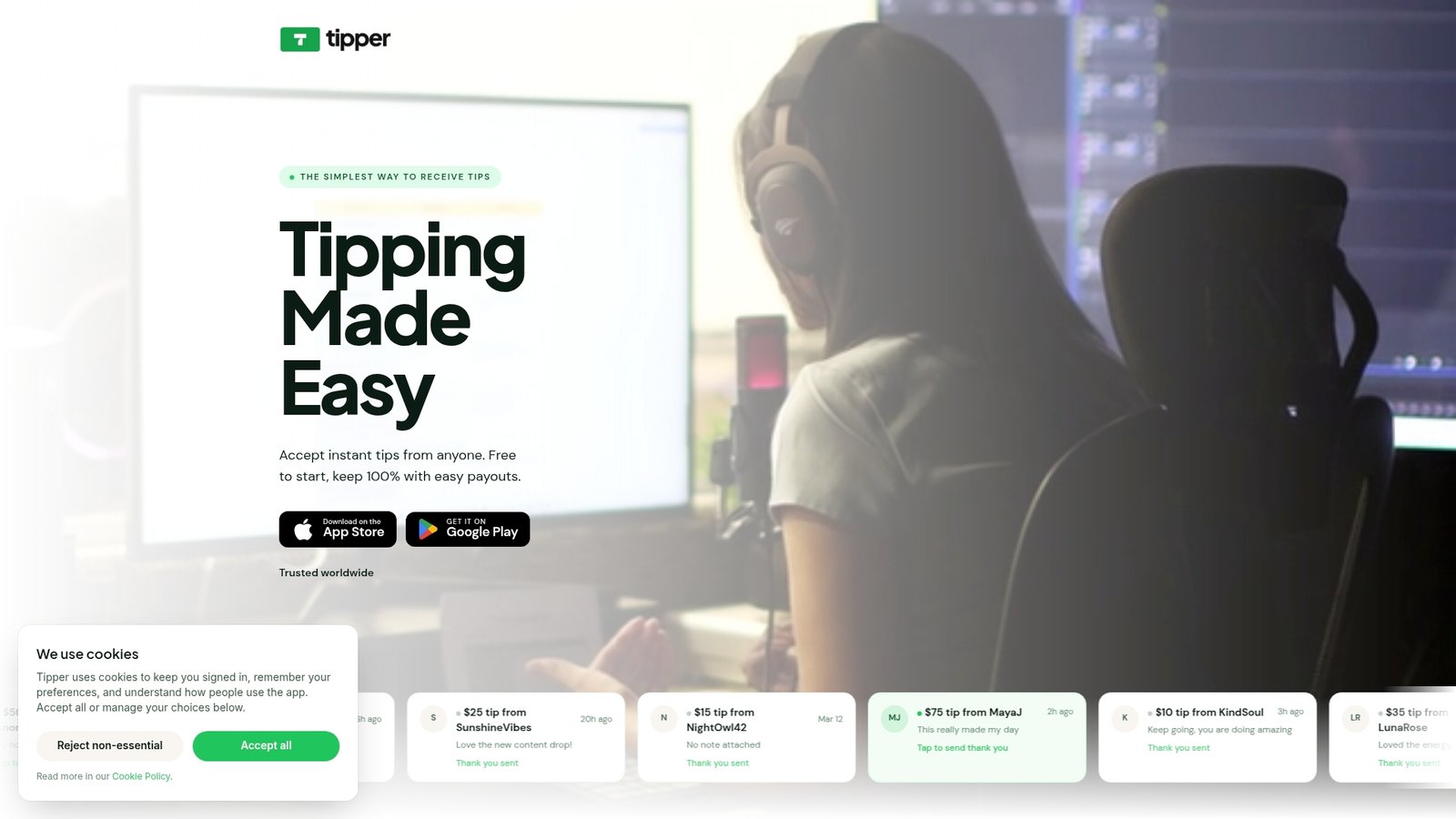
Senders don’t need an account. They tap Apple Pay, Google Pay, or enter a card, and the tip lands. There’s no subscription, no monthly fee, and no complicated setup. You can customize your tip page, add a thank-you message (text, photo, or video), and start receiving payments the same day you sign up.
For freelancers building a tip-based revenue stream alongside invoiced work, Tipper fits naturally as the “instant appreciation” layer: share your link after every tutorial, workshop, or delivered project and let supporters pay what feels right to them. It’s a low-effort extra revenue stream that complements every other strategy in this article.
Ready to add a tip link to your workflow? Set up your Tipper page in under ten minutes.
Sources
- Self-Employed Individuals Tax Center — IRS
- 20 Realistic Side Hustles for 2026 – NerdWallet
- 20 side-hustle ideas to help you make money | Fidelity
- How to Make $5,000-$10,000/Month as a Freelancer Without Leaving Your House – Escribr
This article is general information, not a substitute for advice from a qualified financial advisor. Consult a qualified financial professional about your own circumstances before acting on anything here.
FAQ
How do I make an extra $1,000 a month freelancing?
Pick one skill-based service (writing, design, virtual assistance, or web work), price it at $200–$500 per project, and land two to five clients per month. A single retainer client at $500–$1,500 per month can get you there with one relationship.
What side hustle can realistically earn $2,000 a month?
Specialized freelance services (copywriting, web development, social media management) and retainer arrangements are the most reliable paths to $2,000/month. Most freelancers reach that level within three to six months of consistent outreach and one or two anchor clients.
How do I make extra money freelancing with no portfolio?
Start with one free or deeply discounted project for a nonprofit, a friend’s business, or a personal project you can show. Three solid samples are enough to pitch paid work on Upwork or Fiverr. Platforms like Rover and DoorDash require no portfolio at all.
Do I have to pay taxes on freelance side income?
Yes. If your net self-employment earnings reach $400 or more in a year, you must file and pay self-employment tax. The IRS Self-Employed Individuals Tax Center covers the exact forms and thresholds.
Can creators accept tips without setting up a full payment system?
Yes. A tip link through a platform like Tipper lets supporters pay instantly via Apple Pay, Google Pay, or card with no account required on their end. It takes under ten minutes to set up and works as a standalone income layer alongside any other freelance work.




Leave A Comment