

TL;DR:
- Peer tips significantly boost content output, equaling about six likes in impact according to research.
- Implementing frictionless tip links and real-time support signals encourages more frequent, positive creator engagement.
Instant tips increase posting frequency and can raise post length when they come from peers rather than platforms. The single most useful thing you can do right now: set up a frictionless tip link, enable Apple Pay and Google Pay, and add a short thank-you message so supporters feel the exchange. Research from UCLA Anderson shows that receiving one peer tip produces roughly the same lift in content output as receiving six likes. That ratio alone makes the case for prioritizing tips over chasing algorithmic engagement.
The role of immediate income motivation here is specific: it is not about salary or platform ad revenue. It is about the moment a supporter sends $3 after your live Q&A and you see it land in real time. That signal changes what you create next.
Table of Contents
- What does the research say about tips vs. other rewards?
- When do instant tips work best for your content?
- What risks should you watch for with instant tips?
- How do you set up instant tipping step by step?
- How do you measure whether tips are actually working?
- What benchmarks can creators realistically expect?
- What U.S. creators need to know about taxes on tips
- How Tipper puts these practices into one place
- Key Takeaways
- Tipper makes instant tipping the easiest part of your workflow
- Further reading and sources
- FAQ
What does the research say about tips vs. other rewards?
The evidence on how different reward types affect creator behavior is clearer than most guides admit.
UCLA Anderson’s BGG panel study tracked ten years of content on a board game platform and found that peer monetary rewards (tips) increase both the volume and length of posts. Platform compensation, by contrast, increases post length but tends to reduce posting frequency. The mechanism matters: peer tips feel like appreciation; platform pay feels like a job. One makes you want to post more. The other can make you post less, but more carefully.
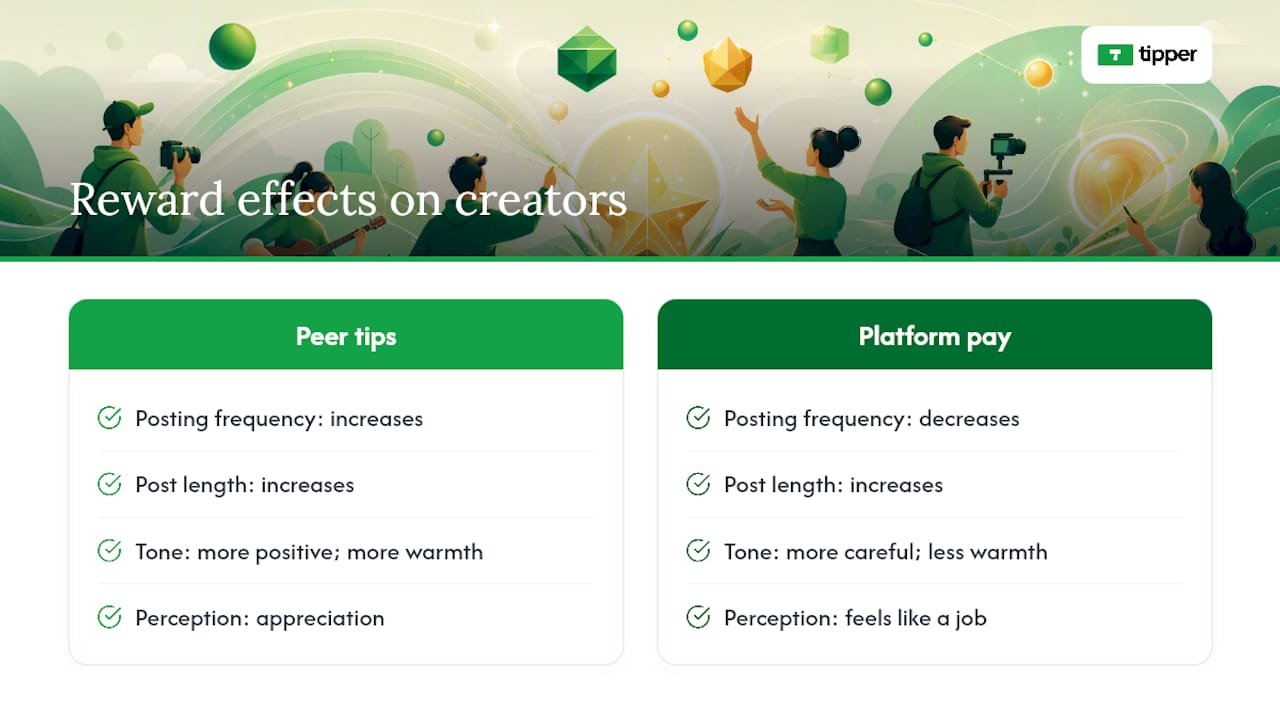
A randomized field experiment on Stack Overflow added a direct test. When contributors received peer tips, they posted more frequently and with more positive tone. Readability did not improve, and specialized jargon sometimes increased. Tips motivate volume and warmth, not necessarily clarity.
Non-monetary rewards follow a different curve. The BGG platform reward analysis found that likes and badges produce timelier responses but fewer total posts. Peer rewards generate more content; platform rewards generate faster content.
Statistic to anchor your model: one tip equals roughly six likes in terms of effect on posting output. Average tips in the BGG sample were typically small amounts, and posts received several likes on average. Small numbers, large behavioral signal.
The benefits of tip-based revenue models extend beyond the behavioral data: tips also diversify income away from ad CPMs and platform algorithm shifts.
When do instant tips work best for your content?
Not every creator or format benefits equally. Tips tend to produce the strongest immediate income impacts in these scenarios:
- Live streamers and Q&A hosts: real-time tipping during a session creates a feedback loop. A tip mid-stream signals which content is landing.
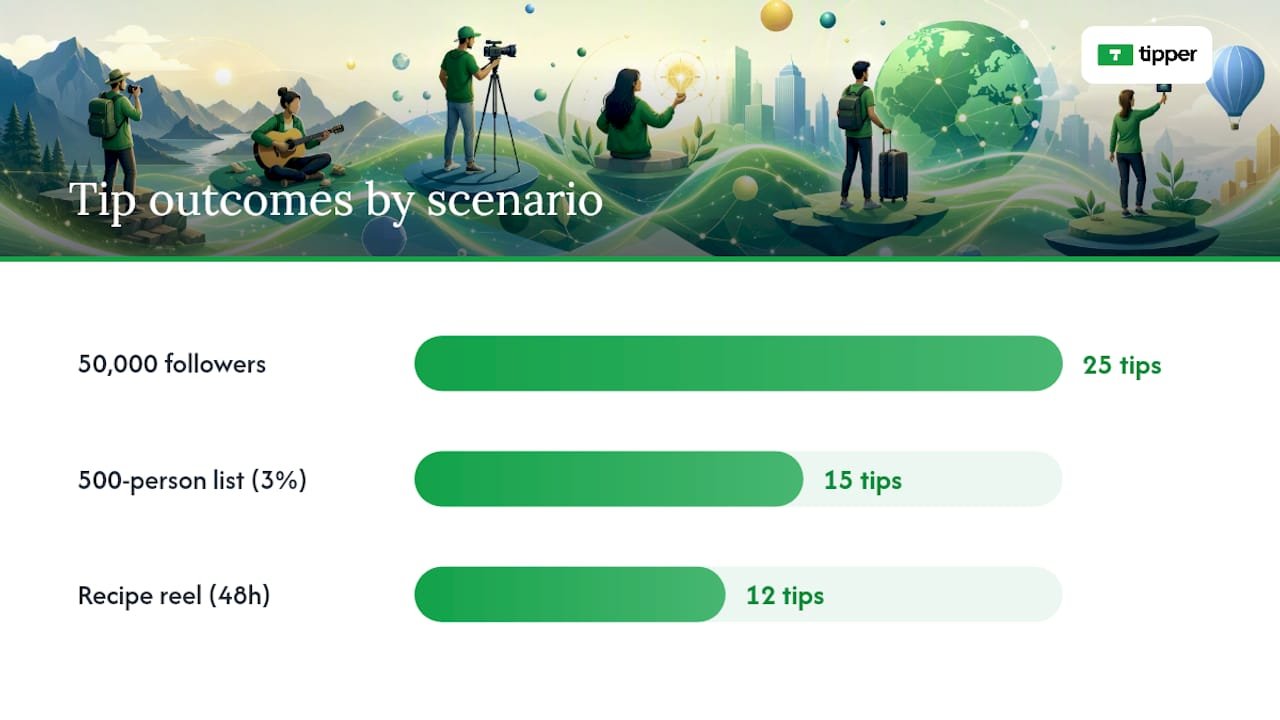
- Niche podcasters and newsletter writers: small, loyal audiences tip at higher rates than large passive ones. A 500-person list with a 3% tip conversion rate outperforms a 50,000-follower account with 0.05%.
- Micro-creators with exclusive drops: limited content (a behind-the-scenes clip, a one-time template) paired with a tip prompt converts well because the value is concrete and time-bound.
- Freelancers with repeat clients: a tip link in an invoice or email footer captures appreciation that would otherwise go unacknowledged.
Three quick scenarios:
- A food creator posts a 90-second recipe reel, pins a tip link in the caption, and sees 12 tips in 48 hours. Goal: cashflow between brand deals.
- A podcast host adds a tip QR to show notes and mentions it once per episode. Goal: community signal and partial production cost recovery.
- A freelance designer adds a tip link to project delivery emails. Goal: capturing goodwill that previously had nowhere to go.
Understanding how platform algorithm changes affect distribution makes the case even stronger: when reach becomes unpredictable, direct audience revenue is the hedge.
Pro Tip: Frame your tip link as “buy me a coffee” or “support this work” rather than “pay per post.” The voluntary framing keeps the exchange feeling like appreciation, not a transaction.
What risks should you watch for with instant tips?
The same research that shows tips increase output also flags predictable downsides.
Crowding out happens when external rewards replace internal ones. Platform pay is the bigger culprit here. The BGG data shows platform compensation can reduce frequency, likely because creators start treating posting as work rather than expression. Peer tips carry less of this risk precisely because they feel voluntary.
Perverse incentives to watch:
- Posting shorter, more frequent content just to trigger tip prompts (churn for tips)
- Using dense jargon to signal expertise and attract tips from power users, at the cost of broader readability
- Letting tip volume dictate topic choices rather than genuine interest or audience need
Timeliness trade-offs are real too. The BGG platform reward analysis found peer rewards slow response times. If your content model depends on fast replies (community management, live support), tips may not be the right primary incentive.
Mitigation checklist:
- Set a tip prompt cadence (once per post, not every paragraph)
- Keep tip amounts optional and visible, not required
- Monitor readability scores alongside tip counts
- Review topic mix monthly to confirm tips are not narrowing your content
Pro Tip: Run a 30-day test where you track which posts earn tips vs. which posts earn comments. If they diverge sharply, your tip framing may be pulling content in the wrong direction.
How do you set up instant tipping step by step?
A practical setup takes under an hour.
- Create your tip link or QR code (Tipper generates both from one account setup)
- Enable Apple Pay, Google Pay, and card payments so supporters face zero friction
- Set 3 default tip amounts ($3, $5, $10 works well for most creators; adjust based on your content’s perceived value)
- Write a short thank-you message (text, photo, or video) that triggers automatically after a tip
- Test the full flow yourself before publishing, including payout confirmation
Technical notes worth knowing: Stripe’s micropayment guidance covers settlement models and Instant Payout mechanics. Instant Payouts typically carry a small surcharge, so model that into your net revenue expectations before committing to collaborator splits that depend on same-day funds.
For collaborator splits, instant payouts change the cashflow math: small, frequent receipts become usable working capital rather than a monthly lump sum you wait on.
30-day launch checklist:
- Week 1: publish tip link, announce once per channel
- Week 2: add tip QR to any in-person or live touchpoints
- Week 3: send one email or post specifically about how tips support your work
- Week 4: review conversion data and adjust default amounts if needed
Pro Tip: Add your tip link to your email signature and bio on every platform. Passive placement converts without requiring a dedicated ask.
How do you measure whether tips are actually working?
Define your metrics before you launch, not after.
Core metrics:
- Tips per view (or per post)
- Tip conversion rate (tippers / unique visitors to tip page)
- Average tip amount
- ARPU (average revenue per supporter per month)
- Posting frequency before and after enabling tips
- Post length trend
- Audience retention rate
Two A/B test templates:
| Test | Variable | Timeline | Success Criteria |
|---|---|---|---|
| CTA vs. no CTA | Tip prompt in caption vs. none | 4 weeks, 8+ posts | 20%+ lift in tip conversion rate |
| Visible amounts vs. open tip | Default amounts shown vs. free-entry | 4 weeks, equal traffic | Higher average tip with visible amounts |
Short-term (weeks 1–4): expect noisy data. Tip counts will spike after announcements and drop back. Do not optimize yet.
Medium-term (weeks 5–12): frequency and average tip stabilize. This is when tipping frequency as a content signal becomes readable. Compare tip-per-view across content types to find what your audience actually values.
For statistical significance on small samples, wait until each test variant has at least 100 tip-page visits before drawing conclusions.
What benchmarks can creators realistically expect?
The peer-tipping field experiment found that tips reliably increase contribution frequency. The BGG study puts the effect-size ratio at roughly 1 tip to 6 likes for posting output. Average tip in that sample was 0.09 GG tokens, which in dollar terms for most U.S. creators translates to a small but psychologically meaningful amount per supporter.
Realistic benchmarks for new tip setups:
- Tip conversion rates of 1–3% of tip-page visitors are a reasonable baseline in the first 90 days.
- Average tip amounts for most content categories tend to be modest, with some higher values in niche technical areas.
- Frequency lift: expect a modest increase in posting cadence within 4–8 weeks of consistent tip receipt
Top contributors see larger effects than casual creators. If you post consistently and already have an engaged audience, the frequency lift will be more pronounced. If you post sporadically, tips alone will not fix the underlying cadence problem.
Statistic callout: one peer tip produces roughly the same output lift as six likes. That ratio holds across content types in the BGG ten-year panel.
Micropayments under $1 can also work for high-volume, low-friction interactions. The nano-payments model used by platforms like Brave (BAT) and Wavlake shows that even tiny per-interaction amounts aggregate into meaningful creator revenue at scale.
What U.S. creators need to know about taxes on tips
Tips are taxable income in the United States. This is general information, not tax advice. Consult a CPA or tax professional for your specific situation.
Basic recordkeeping checklist:
- Track gross tips received (date, amount, platform)
- Record platform or processing fees separately
- Note payout dates and amounts deposited
- Prepare for a 1099-K if your tips through a payment processor exceed IRS reporting thresholds (thresholds have changed in recent years; confirm the current figure with the IRS or your tax pro)
- Use a dedicated business bank account to keep tip income separate from personal funds
Tips are generally treated as ordinary income, not sales revenue, so sales tax typically does not apply. If you sell digital products alongside tips, those may have different tax treatment depending on your state.
Pro Tip: Set aside 25–30% of each tip payout in a separate savings account as a tax reserve. It is easier to return money you did not need than to find it at filing time.
How Tipper puts these practices into one place
Tipper maps directly to the setup steps above. The product gives you a personalized tip link and QR code from a single account, with no requirement for supporters to create an account before sending a tip.
Core features that match the implementation checklist:
- Apple Pay, Google Pay, and card support out of the box
- Customizable tip pages with default amount options
- Thank-you messages via text, photo, or video
- Direct payouts to your connected account
- QR code generation for in-person or live-event use
Getting started on Tipper:
- Create your account at tipper.app
- Customize your tip page (amounts, bio, photo)
- Enable your preferred payout method
- Copy your tip link and QR code
- Announce to your audience using the copy templates above
Two example use cases: a freelance video editor added a Tipper QR to project delivery emails and captured tips from three repeat clients in the first month. A live podcast host displayed the QR on-screen during recordings and saw tips come in during the session itself, giving real-time signal on which segments landed.
Key Takeaways
Instant peer tips increase posting frequency more reliably than likes or platform compensation, and the 1-tip-to-6-likes effect-size ratio makes them the highest-leverage reward type for most creators.
| Point | Details |
|---|---|
| Tips beat likes for output | One peer tip produces roughly the same posting-frequency lift as six likes, per the BGG ten-year panel. |
| Platform pay cuts frequency | Platform compensation increases post length but tends to reduce how often creators post. |
| Frame tips as appreciation | Voluntary framing preserves intrinsic motivation; transactional framing risks crowding it out. |
| Measure before optimizing | Track tips per view, conversion rate, and posting frequency for at least 8 weeks before changing strategy. |
| Tipper for frictionless setup | Tipper provides personalized links, QR codes, Apple/Google Pay, and thank-you flows with no supporter account required. |
Tipper makes instant tipping the easiest part of your workflow
Creators who want direct audience revenue without platform dependency need one thing: a tip link that works the first time, every time. Tipper delivers that. Supporters send tips with Apple Pay or Google Pay in seconds, no account required on their end. You keep 100% of your earnings, with a small processing fee added at checkout.
Setup takes minutes. You get a personalized link, a QR code for live or in-person use, customizable tip amounts, and automatic thank-you messages. Whether you are a freelancer adding a tip link to client emails or a live streamer putting a QR on screen, the instant tip payment flow is the same: fast, private, and direct.
Create your free Tipper account at tipper.app and have your tip link live before your next post goes out.
Further reading and sources
- Monetary and non-monetary rewards and user-generated content (BGG study) — UCLA Anderson
- How Does Peer Tipping Affect Knowledge Contributions? Evidence from a Field Experiment on Stack Overflow
- Beyond ads: Why CX leaders should care about nano-payments (CMSWire)
- A guide to micropayments for businesses | Stripe
- How creators can turn instant payouts & payment infrastructure into predictable cash flow — All About Making Money Online
- Micropayments for Content Creators: Complete Guide 2024 | ScoreDetect Blog
- Tipper
FAQ
How does immediate income motivation affect what creators post?
Peer tips increase posting frequency and tend to produce longer, more positive-toned content. Platform compensation increases length but can reduce how often creators post, per the UCLA Anderson BGG study.
Do tips improve content quality?
Tips raise volume and sentiment but do not reliably improve readability. The Stack Overflow field experiment found that tipped contributors sometimes used more specialized jargon, which can reduce accessibility for general audiences.
How much can a creator realistically earn from tips?
Tip conversion rates of 1–3% of tip-page visitors are a reasonable baseline in the first 90 days. Average tips in most U.S. creator categories fall in the $3–$10 range, with niche technical content trending higher.
Does Tipper require supporters to create an account?
No. Tipper lets supporters send tips via Apple Pay, Google Pay, or card without creating an account, which removes the single biggest friction point in most tipping flows.
Are creator tips taxable in the United States?
Yes. Tips are ordinary income and must be reported. Track gross tips, processing fees, and payout dates, and consult a tax professional about current 1099-K thresholds and your specific filing situation.




Leave A Comment