

The most effective ways to strengthen audience connection come down to five core moves, according to INMA: habit formation, serving user needs (educate, inspire, decide), building journalist–audience connections, personalization, and two-way conversation. These can be expressed through strategies like speaking in a consistent voice, inviting audience interaction, running recurring series, mapping content to user needs, and direct acknowledgment. Start with three of these this week.
Quick-win checklist (do these in the next 72 hours):
- Pull your top five content pieces by time-on-page and note what they share
- Post one opinion prompt asking your audience to reply with a single word or sentence
- Write a personal thank-you to your three most engaged followers or recent supporters
Key Takeaways
The strongest audience connections come from combining consistent voice, two-way conversation, and direct acknowledgment into a repeatable weekly habit.
| Point | Details |
|---|---|
| Research before publishing | Pull top pages, run a three-question survey, and mine comments before creating new content. |
| Prioritize depth over volume | Comments, replies, and repeat visits signal real connection better than likes or follower counts. |
| Map content to audience need | Match every piece to educate, inspire, or decide intent, then set a publishing frequency for each. |
| Close the loop publicly | When audience input changes something you publish, say so explicitly to build trust and repeat participation. |
| Acknowledge supporters directly | A personal thank-you after a tip or contribution increases the likelihood of repeat engagement. |
Table of Contents
- How do you research and segment your audience effectively?
- Does your voice make your audience feel seen?
- How should you design content your audience actually wants?
- What conversation tactics actually get your audience to respond?
- Which interactive formats produce the strongest engagement?
- How do you build a community that keeps coming back?
- How do you personalize messages without overwhelming your audience?
- What metrics actually tell you if your audience connection is improving?
- How do you win back an audience that has gone quiet?
- How does direct appreciation deepen audience loyalty?
- A recommended first 30-day experiment to strengthen connection
- Turn appreciation into a revenue stream with Tipper
- Sources
- FAQ
How do you research and segment your audience effectively?
Most creators skip audience research because it feels slow. It isn’t, if you keep it tight. Pull three signals from your analytics right now: top pages by time-on-page, top referral sources, and your highest-comment posts. Those three tell you what your audience values, where they come from, and what makes them speak up.
For faster qualitative data, run a three-question micro-survey in your next email or story:
- What’s your biggest challenge with [your topic]?
- What format do you prefer: short tips, deep dives, or video?
- What almost stopped you from following me?
Mine your comments and DMs for recurring phrases. When three different people use the same word to describe a problem, that word belongs in your next headline.
Mini-persona template (copy and fill in):
- Name: [Fictional first name]
- Top need: [One sentence: what they’re trying to solve or become]
- Preferred format: [Video / newsletter / short posts]
- Intent signal: [What they do right before they need your content]
Segment by intent, not demographics. Someone who reads your “how-to” posts is in educate mode. Someone comparing options is in decide mode. Someone sharing your posts is in inspire mode. Prioritize the segment that maps to your business goal this quarter.
Pro Tip: Post a poll on your story or in your newsletter asking one binary question, then follow up with a three-question form for people who answer. You’ll confirm assumptions in 48 hours with almost no effort, and audience analysis techniques like this consistently improve how well your content lands.
Does your voice make your audience feel seen?
Voice is the fastest trust signal you have. Before a reader finishes your first paragraph, they’ve already decided whether you sound like someone worth listening to. Consistency across channels, not polish, is what builds recognition.
Here’s the same idea written two ways:
Generic: “Our platform helps users achieve their goals through innovative solutions.”
Relatable: “We built this because we kept losing track of who actually tipped us. Turns out, a lot of creators had the same problem.”
The second version names a real experience. That’s the difference. Specific content that names lived experiences and long-term consistency build trust more reliably than any polished marketing message.
Simple tone matrix:
- Email newsletter: warm, first-person, slightly informal
- Social captions: conversational, direct, one clear point
- Long-form posts: authoritative but approachable, use “you” and “we”
- Video scripts: natural speech patterns, short sentences, rhetorical questions
Small signals compound: a byline photo, a first-person anecdote in your intro, a brief note when you get something wrong. Audiences trust accountable creators who explain their reasoning and correct mistakes openly.
How should you design content your audience actually wants?
Map every content idea to a need before you publish it. The framework is simple: audience need → format → frequency.
- Educate → How-to post, tutorial, explainer video → Weekly
- Inspire → Case study, behind-the-scenes story, transformation post → Bi-weekly
- Decide → Comparison, FAQ, checklist → As needed, tied to a launch or question spike
Recurring series are the fastest way to build habit. A weekly tip, a monthly AMA, or a daily micro-post gives your audience a reason to return on a schedule. INMA’s research identifies habit formation as one of the five primary levers for converting casual readers into loyal, long-term supporters.
Before publishing any new piece, check these four things:
- Does it solve a specific problem for a specific segment?
- Is the format the right fit for where it will live?
- Do you have a distribution plan beyond just posting it?
- Can it be repurposed into two other formats within a week?
Repurposing isn’t laziness. A newsletter section becomes a LinkedIn post, which becomes a short video script. Each version reaches a different slice of your audience and reinforces the same idea across touchpoints.
What conversation tactics actually get your audience to respond?
The most common mistake creators make is ending content with no ask. A post that ends with a period gets fewer replies than one that ends with a question. It’s that mechanical.
Prompts that reliably generate replies:
- “What would you do in this situation?” (opinion prompt)
- “Which of these two options fits your situation better?” (binary choice)
- “Reply with one word that describes your biggest challenge right now.” (micro-ask)
- “I changed my mind about this. Have you?” (vulnerability hook)
For email, add a P.S. that invites a reply. For social, ask a question in the caption, not the comments. For DMs, respond to story replies with a follow-up question rather than just a thank-you.
On volume: reply publicly to comments that others would benefit from seeing. Move to DMs when the conversation gets personal or requires a longer answer. When audience input actually changes something you publish, say so explicitly. “You asked about X last month, so here it is” closes the loop and proves you’re listening. Brands that respond publicly to audience input report stronger habitual use and trust than those that don’t.
Which interactive formats produce the strongest engagement?
Polls, live Q&As, short quizzes, and micro-workshops all outperform passive content on participation rate. The key is matching the format to the platform and the audience’s current energy level.
How to run a live session that actually drives participation:
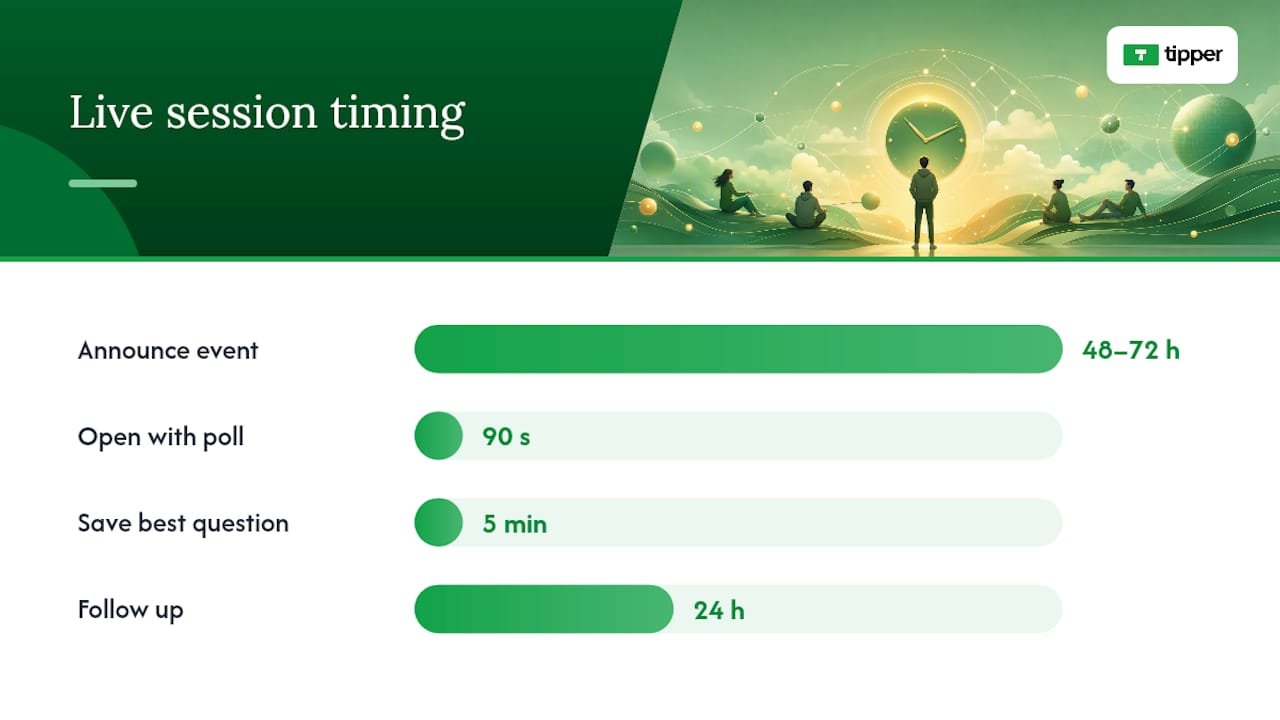
- Announce it 48–72 hours in advance with a specific topic, not just “going live.”
- Open with a poll or question in the first 90 seconds to activate lurkers.
- Call out participants by name when they contribute.
- Save the best question for the last five minutes to reward people who stay.
- Follow up within 24 hours with a summary or a resource mentioned during the session.
Interactive prompt examples to reuse across channels:
- “Drop a number 1–5 in the comments: how confident are you about [topic]?”
- “Poll: Which of these is your biggest blocker right now?”
- “Quiz: What type of [creator/business/learner] are you?”
- “Word cloud: What’s one word you’d use to describe [topic]?”
- “Hot take: agree or disagree with this?”
- “Challenge: try this for 24 hours and report back.”
Interactive formats like polls, Q&As, and word clouds both increase participation and generate data you can use to personalize follow-up content. Watch participation rate, chat message volume, and poll response rate during live events. Those three numbers tell you whether the format is working before the session ends.
How do you build a community that keeps coming back?
The platform choice matters less than the consistency of what happens inside it. A Discord server with weekly prompts beats a Facebook group with sporadic posts every time.
Platform by use-case:
- Lightweight chat: Discord or Slack for real-time conversation and quick check-ins
- Forum-style discussion: Circle or a newsletter community for longer threads
- Email-first community: A segmented newsletter with reply-to enabled
Starter prompts that generate recurring participation:
- “Weekly check-in: what are you working on this week?”
- “Challenge of the month: share your result by Friday.”
- “Spotlight: tag a member who helped you recently.”
For user-generated content, make the ask specific. “Share a screenshot of your result” gets more responses than “share your experience.” When members contribute, feature their work publicly with credit. That single act signals to everyone else that participation gets recognized.
Keep moderation rules short and visible: one rule about respect, one about staying on topic, one about self-promotion limits. Channel-specific optimizations and live events are practical ways for creators and small businesses to increase measurable audience involvement without heavy infrastructure.
How do you personalize messages without overwhelming your audience?
Personalization doesn’t require a complex tech stack. It requires knowing which segment a person belongs to and sending them something relevant to that segment.
Simple email trigger flows:
- Welcome: Send within one hour of sign-up. Include one question about their goal.
- Interest-based follow-up: Three days later, send content matched to their answer.
- Re-engagement: After 30 days of silence, send a “we noticed you’ve been quiet” email with one specific resource.
Quick segmentation rules:
- By behavior: clicked a link about topic X → tag them as interested in X
- By lifecycle: new subscriber vs. 90-day active vs. lapsed
- By interest: self-selected at sign-up or inferred from click patterns
Pro Tip: Don’t collect data you can’t act on. If you’re not going to use someone’s job title to change what you send them, don’t ask for it. Explain your personalization simply: “We send you content based on what you’ve clicked.” That transparency builds trust faster than any clever subject line.
Modular content blocks let you scale personalization without rebuilding every email. Write three versions of a section (beginner, intermediate, advanced) and swap the right one in based on the subscriber’s tag.
What metrics actually tell you if your audience connection is improving?
Engagement depth matters more than volume. A post with 12 thoughtful comments tells you more than one with 400 likes.
Metric checklist:
- Active participation: comments, replies, DM responses per post
- Retention: return visits, repeat email opens, newsletter reply rate
- Conversion: sign-ups, tip completions, resource downloads
- Qualitative signals: sentiment in comments, words people use to describe you
Simple A/B test template:
- Hypothesis: Changing [element] from [A] to [B] will increase [metric] by a meaningful amount.
- Variable: One thing only (subject line, CTA wording, or content format).
- Duration: Run for two full send cycles or two weeks, whichever is longer.
- Decision rule: If [metric] improves by more than your normal variance, adopt the winner.
Run one experiment per month. More than that and you lose track of what caused what. When an experiment reveals a preference, update your editorial calendar to reflect it within two weeks, not two months.
How do you win back an audience that has gone quiet?
Lapsed audiences don’t need more content. They need a reason to care again.
Re-engagement hooks that work:
- A surprising data point or result from your own work
- A limited-time series with a clear end date (“5 posts in 5 days on X”)
- A UGC spotlight that features community members, not just you
- A direct “we miss you” email with a single, low-friction ask
Subject lines and social hooks for win-back campaigns:
- “I was wrong about this. Here’s what I learned.”
- “The thing I stopped doing (and why I’m starting again).”
- “You asked about X six months ago. Here’s the answer.”
When a real-time event is relevant to your audience, pause your scheduled content and respond to it. That responsiveness signals you’re present, not just broadcasting. Storytelling, humor, abrupt format changes, and direct calls to action are proven attention-recovery tools for both live sessions and long-form content.
Test reactivation channels separately. An email win-back and a social win-back reach different people. Run them two weeks apart and compare which channel brings people back to active participation.
How does direct appreciation deepen audience loyalty?
Recognition compounds. A supporter who receives a personal thank-you after their first tip is far more likely to contribute again than one who gets silence. This isn’t speculation; it’s the basic psychology of acknowledgment.
Thank-you message templates:
- Short note: “Thank you for the tip, [Name]. It genuinely helps me keep making [type of content]. I’m working on [next thing] right now and your support makes that possible.”
- Video message: Record a 30-second clip addressing the supporter by name, mentioning what you’re working on next, and inviting them to reply with a question or topic request.
Tipping and direct appreciation function as a trust-and-loyalty signal when paired with a personal response. The acknowledgment closes a loop that passive content never does.
Where tips fit in the creator lifecycle:
- Surface your tip link after high-value content (end of a tutorial, post-event follow-up)
- Include it in your email footer or bio, not just in one-off posts
- Use social proof from tip activity to show others that supporters value your work
Pro Tip: Combine a personal thank-you message with a public UGC spotlight. Feature the supporter’s comment or contribution in your next post (with permission). The private acknowledgment builds the individual relationship; the public spotlight signals to your whole audience that engagement gets recognized.
A recommended first 30-day experiment to strengthen connection
If you’re starting from scratch or resetting after a quiet period, sequence matters. Here’s how to spend the first four weeks.
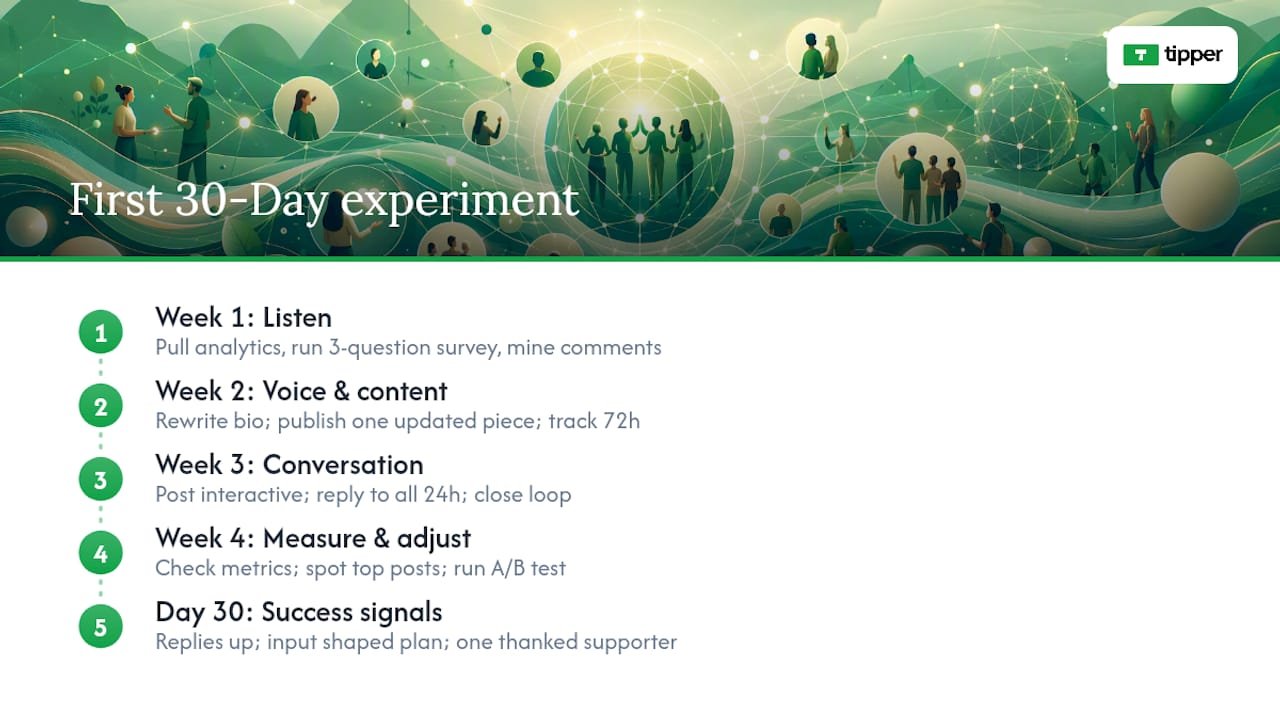
Week 1: Listen. Pull your analytics, run your three-question micro-survey, and mine your top 20 comments for recurring language. Don’t publish anything new until you’ve done this. The data will change what you write.
Week 2: Voice and content. Rewrite your bio and one piece of existing content using the relatable-voice rules above. Publish one piece mapped to your audience’s top need. Track comments and replies for 72 hours.
Week 3: Conversation. Post one interactive format (poll, opinion prompt, or live Q&A). Reply to every comment within 24 hours. Close the loop publicly on any input that shaped your next piece.
Week 4: Measure and adjust. Check your metric checklist. Which posts generated the most replies? Which format had the highest participation rate? Run one A/B test on your next email subject line.
Expected signals of success by day 30: a measurable increase in reply rate, at least one piece of audience input that directly shaped your editorial calendar, and one supporter you’ve personally acknowledged. If none of those happened, the problem is usually in Week 1. Go back and listen harder.
Turn appreciation into a revenue stream with Tipper
Every tactic in this article builds toward one outcome: an audience that trusts you enough to support you directly. Tipper makes that moment frictionless. Supporters send a tip instantly through your personalized link using Apple Pay, Google Pay, or a card. No account required on their end. You keep 100% of every tip, and you can respond with a thank-you note or video that deepens the connection further.
Set up your Tipper page in minutes and put the link where your best content lives.
Sources
- Tips & Guides – Engaging Your Audience
- 5 proven strategies to deepen audience engagement
- How brands can build stronger connections with their audience
- Miro — Audience engagement
- Audience engagement — Sprout Social
- Audience Engagement Types + Strategies To Boost Engagement (2025) – Shopify
- How to Build Trust with Your Audience
- 8 powerful ways to build trust with your audience — Gemma Gilbert Business Coach
- Strategies for Audience Connection | PDF | Nonverbal Communication
FAQ
How do you build a connection with your audience?
Start by researching what your audience actually needs, then speak to those needs in a consistent, first-person voice. Replying to comments, closing the loop on audience input, and acknowledging supporters directly are the fastest ways to move from passive following to active connection.
How do you encourage an audience to engage?
End every piece of content with a specific, low-friction ask: a binary poll, a one-word reply prompt, or a direct question. Posts that end with a question consistently generate more replies than posts that simply conclude.
How do you establish a connection with an audience quickly?
Use inclusive language, reference your audience’s present situation directly, and name a specific lived experience in your opening. Presentation techniques like these measurably improve rapport in both live and written formats.
How do you regain audience attention after a drop-off?
Lead with a surprising result, a direct “I was wrong” admission, or a limited-time series with a clear end date. Storytelling, humor, and abrupt format changes are proven attention-recovery tools for both live sessions and long-form content.




Leave A Comment