


Use client-side tokenization, virtual cards, and server-side vaulting together, and you can collect payments while keeping almost none of the payer’s raw data on your servers. That’s the whole architecture in one sentence. To build it, you need:
- A tokenization provider or gateway that handles card data client-side
- Virtual-card support so payers never expose a real card number
- A SetupIntent-style consent flow for saving payment methods for later charges
- Encryption in transit and at rest, plus a short data-retention window
Pro Tip: The most common privacy mistake isn’t a weak encryption setting. It’s collecting fields you don’t need, like billing addresses or phone numbers, just because a form template included them by default.
Key Takeaways
A privacy-first payment setup works because it keeps raw payment data off your servers entirely, relying on tokenization and virtual cards to do the exposure-reducing work for you.
| Point | Details |
|---|---|
| Choose a tokenization path first | Pick a gateway or provider that handles card fields client-side before anything reaches your backend. |
| Layer virtual cards where possible | Virtual cards hide the real funding source and add spend limits or pause controls. |
| Set a strict retention window | Store tokens and outcomes only, and delete unneeded metadata on a defined schedule. |
| Build monitoring before scale | Track baseline rates and chargeback spikes so anomalies in anonymous channels surface early. |
| Consider a done-for-you option | Tipper handles tokenized, no-signup tip collection via Apple Pay and Google Pay for creators who don’t want to build the stack themselves. |
Where to go for compliance and technical depth
- PCI Security Standards Council: the Small Merchant Guide explains how tokenization shrinks your compliance scope.
- Stripe: its guidance on anonymous payment methods covers integration patterns and trade-offs.
- FTC: the guide for business on protecting personal information sets the baseline for data-handling practices.
This article is general information, not a substitute for advice from a qualified financial advisor. Consult a qualified financial professional about your own circumstances before acting on anything here.
Table of Contents
- What Is a Privacy-First Payment Collection Setup?
- What Privacy Trade-Offs Should You Expect?
- How Do You Set Up a Privacy-First Payment Flow?
- What Are the Risks of Anonymous Payment Channels?
- How Do You Test and Monitor the Setup Before Launch?
- How Tipper Fits a Privacy-First Payment Collection Setup
- Sources
- FAQ
What Is a Privacy-First Payment Collection Setup?
A privacy-first payment collection setup means the payer’s sensitive data (card numbers, in particular) never touches your servers in raw form. Instead, a tokenization layer or virtual-card provider stands between the payer and your business, converting sensitive fields into references you can safely store. This is the standard the industry calls tokenization and data minimization, and it’s the backbone of modern secure payment processing.
Several building blocks accomplish this, each with different trade-offs:
- Virtual cards generate a temporary or merchant-locked number so the real funding source stays hidden.
- Tokenized checkout (via a gateway like Stripe) replaces card details with a one-time token before anything reaches your backend.
- Prepaid and gift cards offer near-total anonymity but work only for one-off, in-person, or low-volume transactions.
- Cryptocurrency adds pseudonymity but brings volatility and support overhead most small sellers don’t want.
- Payment links bundle tokenization and hosted checkout into a no-code option for solo creators.
| Method | Privacy level | Integration effort | Payer friction | Cost shape | PCI scope impact |
|---|---|---|---|---|---|
| Virtual cards | High | Low to moderate | Low | Standard processing fee | Minimal, funding source hidden |
| Tokenized checkout | High | Moderate | Low | Standard processing fee | Greatly reduced |
| Prepaid/gift cards | Very high | Low | Moderate to high | Often a flat markup | Minimal, no card storage |
| Cryptocurrency | High (pseudonymous) | High | High | Variable, network fees | Not applicable |
| Payment links | Moderate to high | Very low | Very low | Standard processing fee | Reduced (hosted by provider) |
For a one-time tip or donation, a payment link or virtual card is plenty. For recurring billing, you need tokenized checkout with a saved-payment flow. High-value goods call for extra fraud checks regardless of which method you pick, and anonymous payment options like prepaid cards and crypto carry the steepest trade-offs between anonymity and operational practicality.

What Privacy Trade-Offs Should You Expect?
Every privacy gain costs you something, usually in scalability, fraud coverage, or user friction. Building around a few core principles keeps that cost manageable:
- Data minimization: collect only the fields the transaction actually requires.
- Client-side handling: let the card fields live in the payment provider’s iframe or SDK, never your own form.
- Limited retention: store tokens and outcomes, not raw payment details, and delete what you don’t need after a set window.
- Encryption everywhere: in transit via TLS, at rest for anything you do keep.
The tension shows up fastest between anonymity and scale. Full anonymity (cash, gift cards) doesn’t integrate with automated systems or recurring billing. Pseudonymous methods like virtual cards or crypto give you most of the privacy benefit while staying compatible with modern checkout flows, which is why they dominate real-world implementations.
Pro Tip: For tipping and creator payments, aim for “privacy by default, verification by exception.” Keep the standard flow anonymous for the payer, and reserve identity checks for unusual patterns, like a sudden spike in high-value transactions.
How Do You Set Up a Privacy-First Payment Flow?
The short version: tokenize on the client, charge through virtual cards or a gateway token, save payment methods through a consent-based flow, and store almost nothing yourself. Here’s how that breaks down step by step.
- Pick a tokenization provider or gateway. Stripe’s Elements or a similar SDK handles the card fields inside an iframe you never touch directly.
- Implement client-side token creation. The payer’s card details get converted into a token in their browser before any network request reaches your server.
- Use virtual-card numbers where possible. Virtual cards from providers like Privacy generate single-use or merchant-locked numbers, so even your payment processor never sees the payer’s actual card. Privacy.com’s controls, including spend limits and instant pause or close, add a layer of protection most standard cards don’t offer.
- Set up a consent flow for saved payment methods. For recurring tips or subscriptions, Stripe’s SetupIntents and SCA guidance walks through how to save a method for off-session charges without storing card data yourself.
Integration choice depends on your resources. A hosted payment link takes minutes to set up and needs no code, ideal for solo creators. An embedded checkout gives you more branding control but requires front-end work. A full API-driven flow makes sense only if you’re processing volume that justifies custom logic for saved cards, refunds, and disputes.
On the server, store only what you need: a token reference, a transaction outcome, and a timestamp. Never store raw card numbers or CVVs. This is the practice the PCI Security Standards Council recommends for small merchants specifically, and it’s the single biggest lever for shrinking your PCI compliance burden.
Security checklist before launch:
- Enforce TLS and HSTS on every payment-adjacent endpoint.
- Set a Content Security Policy that restricts script sources around checkout pages.
- Rotate API keys and store secrets in a dedicated manager, not environment files in source control.
- Verify webhook signatures before trusting any payment event.
- Restrict server-side access to vaulted tokens by role.
Pro Tip: Test your saved-payment flow with a real off-session charge, not just a live checkout, since 3D Secure and SCA behave differently for user-present versus user-absent transactions. Check your provider’s documentation for the exact flow.
What Are the Risks of Anonymous Payment Channels?
Anonymous and pseudonymous methods create real regulatory exposure if you’re not careful. AML and KYC rules can apply once transaction size or volume crosses certain thresholds, and local restrictions on prepaid or crypto instruments vary by jurisdiction. Tax reporting obligations don’t disappear just because a payment method is privacy-preserving.
Practical mitigation looks like this:
- Set velocity rules that flag unusual spikes in transaction frequency or amount.
- Use device and behavioral signals to route suspicious activity to human review.
- Build a chargeback and rollback workflow before you need it, not after.
- Cap high-risk flows (crypto, prepaid top-ups) at conservative limits until you have monitoring in place.
- Keep transaction logs long enough for forensic review, but no longer than your retention policy requires.
Stripe’s guidance on anonymous payment methods recommends transaction monitoring and defined thresholds specifically because privacy-preserving channels are harder to vet after the fact.
The most common compliance trap isn’t fraud. It’s accepting large anonymous payments with no KYC gate at all, then discovering months later that a single sender exceeded a reporting threshold your business never tracked.
How Do You Test and Monitor the Setup Before Launch?
Run these checks before any real money moves through the system:
- Simulate a full client-side token flow end to end, including failure cases like an expired card.
- Test the saved-payment flow with an off-session charge to confirm SCA behaves as expected.
- Replay a webhook event to confirm your endpoint rejects unsigned or duplicate requests.
- Process a full charge-and-refund cycle and confirm your logs capture only the metadata you intended to keep.
Once live, track a baseline transaction rate so anomalies stand out, set alerts for chargeback spikes, and schedule periodic manual reviews of flagged transactions rather than relying on automation alone.
Pro Tip: Roll out privacy-preserving channels gradually. Put a new virtual-card flow behind a feature flag, send it to a small percentage of traffic first, and widen the rollout only after a week of clean monitoring data.
Why privacy-first payment collection matters for creators
From where we sit, the businesses that win long-term aren’t the ones asking for the most data. They’re the ones asking for the least. A creator who can collect a tip without demanding a payer’s name, address, or account signup builds trust faster, and tokenization means that trust doesn’t come at the cost of PCI liability piling up on your side of the ledger.
How Tipper Fits a Privacy-First Payment Collection Setup
Everything above describes the architecture. Tipper is one way to skip most of the engineering and still land in the right place. Payers tip through a personalized link or QR code using Apple Pay, Google Pay, or a card, with no account or signup required on their end, which means Tipper never asks for the personal details a traditional checkout form would.
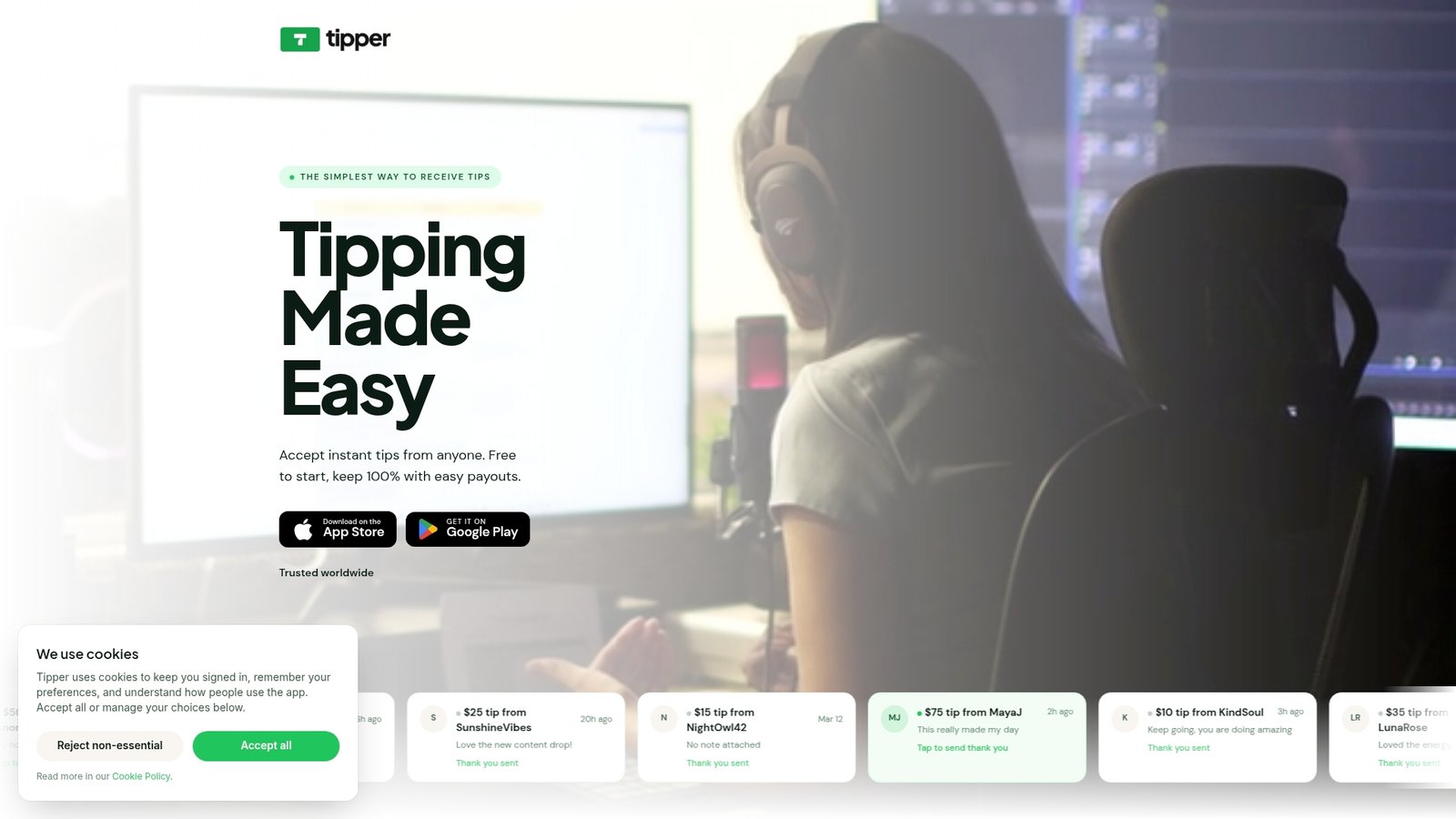
On the creator side, you get a customizable tip page, direct payouts, and the ability to send thank-you notes or videos, without building a token vault or a consent flow yourself. If you’re a freelancer or small business trying to collect tips or appreciation payments without standing up your own privacy infrastructure, set up a Tipper page and start collecting in minutes.
Sources
- Anonymous payment methods—A guide for businesses
- Anonymous Payment Methods—A Complete Guide
- Small Merchant Guide to Safe Payments (PCI Security Standards Council)
- Protecting Personal Information: A Guide for Business (FTC)
FAQ
How do I set up a privacy-first payment method?
Combine a tokenization provider for checkout with virtual cards for payment, and store only transaction tokens and outcomes on your server, never raw card data.
Is Privacy.com safe and legit?
Privacy.com is a real virtual-card provider offering single-use and merchant-locked cards with spend limits and pause controls, which reduces exposure of your actual funding source when making payments.
How can I collect payments online without exposing customer data?
Use a hosted payment link or tokenized checkout so card details never pass through your own servers, and consider a service like Tipper if you want no-signup tip collection built in.
How do I set up recurring or saved payments privately?
Use a SetupIntent-style consent flow that saves a payment token for future off-session charges instead of storing the card number yourself; consult your gateway’s SCA documentation for the exact steps.
What’s the difference between anonymous and pseudonymous payment methods?
Anonymous methods like cash or gift cards reveal no identity at all, while pseudonymous methods like virtual cards or crypto mask the funding source but can still be traced under legal or regulatory review.




[…] and compliance point the same way here. Our piece on privacy-first payment collection for creators and sellers covers the setup in more detail, and why payment privacy matters for U.S. freelancers explains the […]