

You make great content. Your audience loves it. But when it comes to getting paid for that appreciation, the sheer number of types of digital tip jar tools can make the decision feel paralyzing. Do you go with a ready-made platform that handles everything but takes a cut? A bare payment link that costs less but demands more effort? Or something newer, like a QR code flow or a crypto wallet? Each option has a different fee structure, setup time, and audience experience. This guide breaks down every major category so you can pick the one that actually fits how you work.
Table of Contents
- Key takeaways
- 1. Types of digital tip jar tools: what you need to know first
- 2. Embedded payment link and tip page tools
- 3. Creator platforms with built-in tipping features
- 4. General payment links repurposed as tip jars
- 5. QR-code based digital tip jars
- 6. Crypto-based digital tip jars
- 7. Side-by-side comparison of all tip jar types
- 8. How to choose the right digital tip jar for your situation
- My honest take on picking a digital tip jar
- Try Tipper: keep 100% of every tip you earn
- FAQ
Key takeaways
| Point | Details |
|---|---|
| Five main tool types | Digital tip jars fall into embedded links, creator platforms, payment links, QR-based tools, and crypto wallets. |
| Fees vary widely | Platform fees range from 0% to 5% plus payment processing, directly affecting your take-home earnings. |
| Audience friction matters | Tools that require app downloads or account creation reduce tip conversion rates significantly. |
| DIY costs less, demands more | Payment links like Stripe save on fees but require you to manage messaging, suggested amounts, and promotion. |
| Match tool to context | Your audience’s tech comfort, your monetization goals, and your existing platforms should drive your final choice. |
1. Types of digital tip jar tools: what you need to know first
Before picking a tool, you need a clear framework for evaluating it. The right tip jar type depends on six factors that most creators overlook until they are already frustrated with their choice.
Here is what to weigh before committing:
- Setup speed. Can you be live in under 30 minutes, or does it require developer help?
- Fee structure. Platform fees, payment processing fees, and payout fees are three separate charges. Know all three.
- Integration. Does the tool connect with your email list, social media bio links, or website?
- Payout speed. Some platforms hold funds for days. Others pay out within minutes.
- Audience friction. Does your supporter need to create an account or download an app to tip you? Every extra step kills conversions.
- Customization. Can you add your name, photo, a thank-you message, or suggested tip amounts?
Pro Tip: Before you test any tool, ask yourself one question: where does my audience already spend time online? The best tip jar is the one placed closest to where your supporters already are.
2. Embedded payment link and tip page tools
This is the most popular category for new creators. Platforms in this group give you a pre-built page with your name, a short bio, and a tip button. You share the link. Supporters click, choose an amount, and pay. No coding required.
The trade-off is cost. Buy Me a Coffee charges roughly 5% of each tip as a platform fee, on top of standard card processing fees of 2.9% plus $0.30. On a $5 tip, you could lose close to $0.60 before the money reaches your account. That adds up fast if you receive frequent small tips.
“The convenience of a ready-made tip page is real, but creators often underestimate how platform fees compound over time. A 5% cut sounds small until you calculate it across a year of consistent tipping.”
What these tools do well:
- Zero technical setup. You are live in minutes.
- Built-in social proof features like supporter counts and messages.
- Mobile-friendly by default.
- Often include membership or subscription options for future monetization.
Best for creators who want a polished, ready-made solution and are comfortable absorbing platform fees in exchange for convenience.
3. Creator platforms with built-in tipping features
Some creator platforms go beyond a simple tip page. Tools like ConvertKit (now Kit) integrate tipping directly into your email and audience management workflow. The idea is that your tip jar becomes part of a larger monetization stack rather than a standalone link you paste everywhere.
The benefits here are real. When tipping is connected to your email list, you can thank supporters automatically, segment them as high-value subscribers, or trigger follow-up sequences. That kind of personalization turns a one-time tip into a long-term relationship.
The downside is platform dependency. If you already pay for a creator platform, adding tipping may feel natural. If you do not, signing up just for tipping is overkill. Fee structures vary, but most creator platforms with tipping take a cut similar to dedicated tip page tools, sometimes layered on top of your existing subscription cost.
Key considerations for this category:
- Best for creators with established email lists of 500 or more subscribers.
- Tipping works best when embedded in content delivery, like at the end of a newsletter.
- Platform lock-in is a real risk. Migrating your audience later is painful.
- Confirm whether the platform’s tipping feature is included in your plan or costs extra.
4. General payment links repurposed as tip jars
This is the lean, low-cost approach. Tools like Stripe Payment Links let you create a payment page in minutes with no platform fee. You pay only the standard processing rate of 2.9% plus $0.30 per transaction. That is it. No percentage skimmed by a middleman platform.

The catch is that you own the entire user experience, which means you also have to build it. Stripe does not suggest tip amounts for you. It does not display your photo or a warm thank-you message by default. You need to set up the messaging, decide on suggested amounts, and distribute the link yourself across your channels.
Pro Tip: When using a payment link as a tip jar, create three separate links at different price points ($3, $7, $15) and label them clearly. Giving supporters a choice of amounts increases average tip size compared to open-ended “pay what you want” fields.
Who this works for:
- Creators who are comfortable with basic web tools and want to maximize earnings.
- Freelancers with a small but highly engaged audience who will follow a link without much hand-holding.
- Anyone already using Stripe for invoicing or product sales who wants a unified payment setup.
The tradeoff between convenience and cost is sharpest here. You save money, but you spend time.
5. QR-code based digital tip jars
QR-based tipping has moved well beyond restaurant tables. For creators who meet their audience in person, at events, at workshops, or at live performances, a QR code tip jar is one of the most frictionless options available.
Here is how it works. You display a QR code on screen, on a printed card, or on a banner. Your supporter scans it with their phone camera. They land on a payment page. They tip. No app download required. Payouts can arrive within minutes depending on the platform.
The setup is more flexible than most creators realize. URL QR codes can link to virtually any payment platform, including PayPal, Venmo, Cash App, or Stripe, and take about two minutes to generate. Dedicated platforms like eTip go further, offering branded QR flows, digital receipts via SMS, and feedback collection alongside the tip.
| Feature | Basic URL QR code | Dedicated platform (e.g., eTip) |
|---|---|---|
| Setup time | Under 5 minutes | 15 to 30 minutes |
| Branding | Minimal | Fully branded flows |
| Payout speed | Depends on linked platform | Instant to debit/bank/PayPal |
| Reporting | None | IRS-compliant automated reports |
| Feedback collection | No | Yes |
Dedicated tipping platforms like eTip also automate tip pooling and IRS-compliant reporting, which matters if you work with a team or pay collaborators from your tips. One underappreciated detail: a static QR code with no instructions dramatically reduces scan rates. Branded collateral with a short call to action (“Scan to say thanks”) consistently outperforms bare codes.
6. Crypto-based digital tip jars
Crypto tip jars occupy a specific niche. They are not for every creator, but for those with a crypto-savvy audience, they offer real advantages. No platform middleman. No KYC requirements. Low provider fees.
Setting up a crypto tip jar on WordPress or Shopify takes under 30 minutes. Platforms like Aurpay support 10 or more blockchain networks with on-chain settlements and a provider fee of around 0.8%. That is significantly cheaper than the layered fees on most traditional tip platforms.
The biggest variable is network gas fees. On Ethereum, a $3 tip could cost more in gas than the tip itself. On low-fee networks like Polygon or Solana, micro-tips become viable. Effective crypto tip-jar copy should always guide supporters toward the lowest-cost chain option.
| Factor | Crypto tip jar | Traditional tip jar |
|---|---|---|
| Platform fee | ~0.8% (Aurpay) | 0% to 5% |
| Network/gas fee | Variable (can be high) | None |
| Setup complexity | Moderate | Low |
| Audience requirement | Crypto wallet needed | Credit card or Apple Pay |
| Privacy | High | Low to moderate |
Crypto tip jars work best for creators in the Web3 space, tech podcasters, or developers with audiences who already hold crypto. For a general lifestyle or cooking creator, the audience barrier is too high.
7. Side-by-side comparison of all tip jar types
Use this table to cut through the noise and compare your options at a glance.
| Tool type | Setup ease | Typical fees | Payout speed | Best for |
|---|---|---|---|---|
| Embedded tip pages | Very easy | 5% + processing | 1 to 3 days | New creators wanting turnkey setup |
| Creator platforms | Easy (if already using) | Varies + subscription | 1 to 3 days | Email-list-driven creators |
| Payment links | Moderate | Processing only | 2 to 7 days | Fee-conscious, self-managed creators |
| QR-based tools | Easy to moderate | Varies | Minutes to hours | Live event and in-person creators |
| Crypto wallets | Moderate | ~0.8% + gas | Near-instant | Web3 and crypto-audience creators |
Key strengths and tradeoffs at a glance:
- Embedded tip pages win on simplicity but lose on fees.
- Creator platforms win on integration but create dependency.
- Payment links win on cost but require the most self-management.
- QR tools win on in-person friction reduction.
- Crypto tools win on privacy and low provider fees but require audience buy-in.
8. How to choose the right digital tip jar for your situation
The best online tip jars are not the ones with the most features. They are the ones your audience will actually use without thinking twice.
Start with your audience. If they are non-technical, any tool that requires wallet setup or app downloads will kill your conversion rate before it starts. If they are highly engaged and tech-forward, a crypto or DIY payment link might actually excite them.
Then consider your context:
- New creator with under 500 followers: Start with an embedded tip page. The setup is fast, the link is shareable, and you can always switch later.
- Established creator with an email list: Look at creator platforms with tipping built in. The integration value outweighs the fee difference.
- Live performer or event speaker: A QR-based tool is your strongest option. Scan-to-tip flows during or after a performance convert at much higher rates than links shared later.
- Freelancer or developer: A payment link through Stripe gives you full control and the lowest fees, assuming you are willing to handle the setup and promotion.
Pro Tip: Test two tip jar placements for 30 days each: one in your content itself (end of a video, bottom of a newsletter) and one in your bio link. Most creators are surprised to find that in-content placement outperforms bio links by a wide margin.
Revisit your choice every six months. Your audience grows, your platforms shift, and better tools launch regularly. Locking yourself into one solution forever is the only real mistake you can make.
My honest take on picking a digital tip jar
I’ve worked with enough creators to know that the most common mistake is choosing a tip jar based on features rather than audience fit. Someone picks a platform because it has a beautiful page builder, then wonders why tips barely trickle in. The tool looked great. The audience just never bothered to click.
What I’ve learned is that friction is the enemy. Every extra step between “I want to tip this person” and “I just tipped them” costs you real money. A supporter who has to create an account, verify an email, or download an app will close the tab 70% of the time. The best digital tipping platforms are the ones that feel invisible to the person paying.
I’ve also seen creators leave significant earnings on the table by obsessing over platform fees while ignoring payout speed. A tool that holds your money for seven days is a cash flow problem if you rely on tips as part of your monthly income. Speed matters as much as the percentage.
My honest recommendation: start simpler than you think you need to. A clean, no-account-required tip link that accepts Apple Pay or Google Pay will outperform a feature-heavy platform almost every time. Add complexity only when a specific gap in your current setup demands it.
— Steve
Try Tipper: keep 100% of every tip you earn
If you want the simplest path to getting tipped without giving up a percentage of your earnings, Tipper is worth a serious look. Unlike most digital tipping platforms that take a 5% cut, Tipper lets you keep every dollar your supporters send. There is no account required for the person tipping. They visit your personalized link, pay with Apple Pay or Google Pay, and you get paid. That is it.
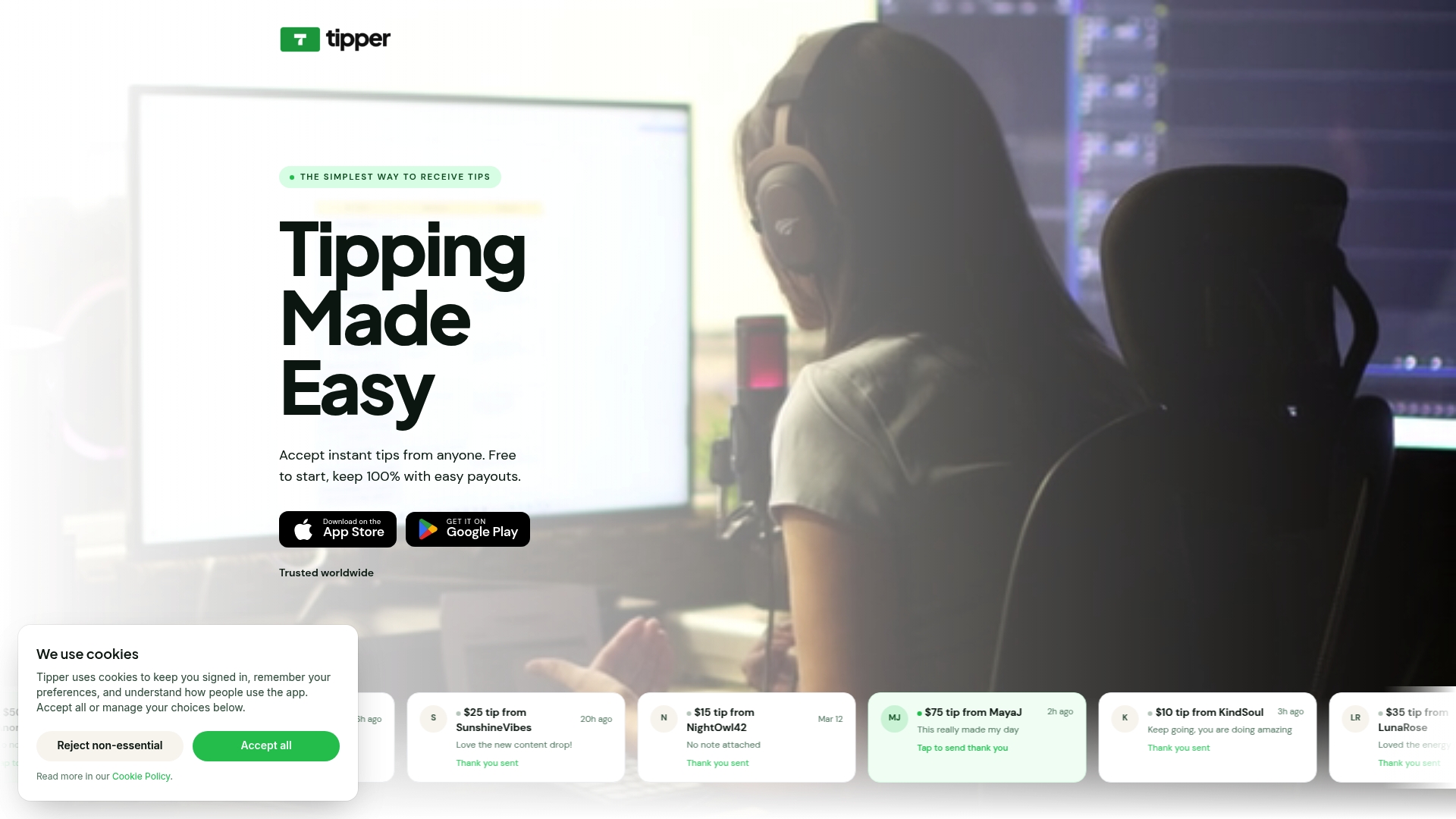
Tipper also lets you send thank-you notes or short videos back to supporters, which turns a one-time tip into a genuine moment of connection. Setup takes minutes. Your link works everywhere: in your bio, at the end of a video, or embedded in a newsletter. For creators who want effortless monetization without the fee math, Tipper removes every barrier that typically stands between your audience’s appreciation and your bank account.
FAQ
What are the main types of digital tip jar tools?
The five main types are embedded tip pages, creator platforms with tipping built in, general payment links repurposed as tip jars, QR-code based tools, and crypto wallet tip jars. Each type has different fee structures, setup requirements, and audience experience trade-offs.
Which digital tip jar has the lowest fees?
Crypto-based tip jars have the lowest provider fees at around 0.8%, but network gas fees can make small tips expensive on certain blockchains. Stripe payment links charge only standard processing fees of 2.9% plus $0.30 with no platform cut, making them the lowest-cost option for traditional payments.
Do supporters need an account to use tip jar apps?
It depends on the platform. Some tools require supporters to create an account before tipping, which significantly reduces conversion rates. Platforms like Tipper allow anyone to tip using Apple Pay or Google Pay without creating an account, removing the biggest friction point in the tipping process.
How do QR code tip jars work for live events?
You display a QR code at your event or on screen. Supporters scan it with their phone camera and land on a payment page. No app download is needed. Dedicated platforms can process payouts within minutes and include branded flows, SMS receipts, and automated reporting for team tip management.
What is the best digital tip jar for a new creator?
New creators are best served by an embedded tip page tool because setup takes minutes, the link is easy to share across social platforms, and no technical knowledge is required. As your audience grows and your monetization needs become clearer, you can evaluate whether a lower-fee or more integrated option makes sense.




Leave A Comment