

Tipping culture in business is the practice of creating conditions where customers voluntarily reward staff with gratuities, and it directly affects staff income, service quality, and customer loyalty. When you promote tipping culture business-wide, you move beyond hoping customers tip and start building systems that make tipping natural, easy, and expected. The right approach combines digital tools, written policies, and staff training. Platforms like Tipper, point-of-sale integrations, and QR code prompts have made this more achievable than ever for restaurants, freelancers, and service businesses alike.
What does your business need to build a tipping culture?
Building a tipping culture starts with infrastructure, not attitude. Without the right tools and policies in place, even well-intentioned gratuity programs fall apart under the weight of manual tracking, staff confusion, and customer friction.
The essential tools
Integrating tipping tools into your POS system is the single most important technical step. Standalone tip jars or disconnected apps create administrative overhead, reporting errors, and payroll compliance headaches. A POS-integrated solution captures tip data automatically, routes it to payroll, and generates the reports you need for tax compliance.

The table below shows the core tools and policy elements every business needs before launching a gratuity program.
| Tool or Policy Element | Purpose |
|---|---|
| POS-integrated tip tracking | Automates data capture and payroll compliance |
| Written tip pooling policy | Defines who receives tips and how they are distributed |
| Digital tipping interface | Enables cashless gratuity via QR code, NFC, or app |
| Staff training guide | Sets expectations and etiquette for tipping interactions |
| Customer-facing signage | Communicates tipping options without pressure |
Written tipping policies are non-negotiable
Transparent tipping policies covering pooling, eligibility, and distribution build trust with both staff and customers. The policy must specify which roles participate in tip pools, how tips are split, and when payouts occur. One rule stands above all others: managers must not participate in tip pools. Their inclusion destroys staff trust and, in many states, violates labor law.
Pro Tip: Post your tipping policy in your staff handbook and on your website. Customers who see transparent policies tip more generously because they trust the money reaches the right people.
How do digital tipping prompts increase tips without annoying customers?
Digital tipping prompts are the most effective lever for encouraging gratuity practices at scale. Counter-service tips averaged 16–17% with digital prompts compared to single digits without them. Some businesses reported a 28–30% increase in tips per shift within 60 days of adding prompts. That is not a marginal improvement. It is a structural change in how customers behave at checkout.
Setting the right default percentages
The default tip percentages you display shape customer behavior more than any other design choice. Moderate suggestions of 10%, 15%, and 18% yield the best results without triggering customer resentment. Defaulting aggressively to 25% or higher causes tipping fatigue and damages brand loyalty over time. Aggressive anchoring increases short-term tip amounts but reduces repeat visits. That trade-off is never worth it.
Placement and timing of prompts
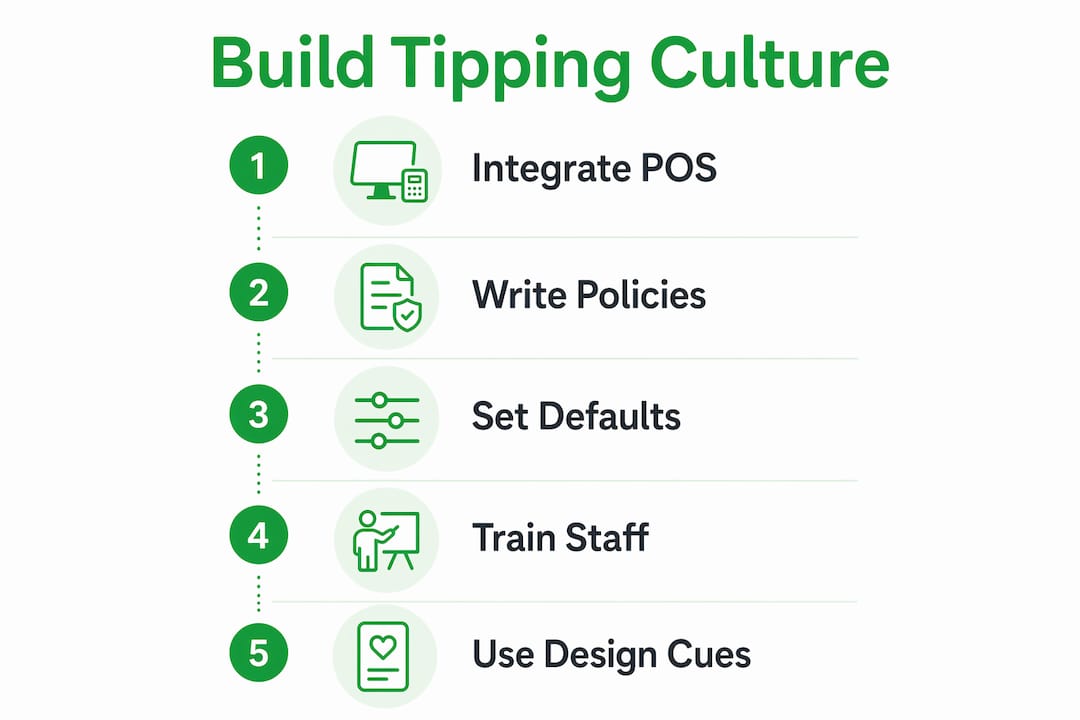
Where and when you show a tipping prompt matters as much as what it says. The most effective placements are:
- At checkout: Display the tip screen immediately after the customer confirms their order total, before payment is processed.
- QR codes on receipts or tables: Let customers tip at their own pace after the experience, which reduces social pressure.
- NFC tap points near the exit: Capture tips from customers who feel appreciation after the fact, not just in the moment.
- Mobile ordering confirmation screens: Personalized recommendations on mobile platforms boosted tips by 23% and increased check values by 20–30%.
Design cues that work
Subtle, tastefully designed tipping cues outperform aggressive signage every time. A small card on the counter with a staff photo and a simple “Thank you for your support” message creates a personal connection without pressure. Badges near the payment terminal that say “Tips go directly to your server” reduce customer anxiety about where the money goes. The goal is to replace the social awkwardness of being asked with a welcoming, voluntary choice.
Pro Tip: Link your tipping QR code to your social media follow button or Google review page. Tipping moments become engagement touchpoints that grow your audience and your staff’s income at the same time.
How to incentivize tips through staff training and customer communication
The best digital tools fail without staff who understand their role in building a tipping culture. Internal communication and customer-facing messaging work together to create an environment where tipping feels natural, not transactional.
Training staff on tipping etiquette
Staff training on gratuity etiquette covers three areas: how to present the tip screen, how to step back during payment, and how to respond to tips graciously. Train staff to turn the screen toward the customer and step away. Hovering over a customer during the tip selection creates pressure that backfires. A simple “thank you” when a customer tips, rather than a reaction that signals the amount was noticed, keeps the interaction comfortable.
- Introduce the tip interface during onboarding. New hires should practice the checkout flow before their first shift so the handoff feels natural.
- Role-play the step-back moment. Staff who physically practice stepping away during payment internalize the habit faster than those who only read about it.
- Share weekly tip totals with the team. Visibility into collective earnings motivates staff and reinforces that the system works.
- Recognize top-tipped staff publicly. A brief mention in a team meeting connects service quality to gratuity outcomes without creating unhealthy competition.
Customer messaging that builds trust
Customers tip more when they understand where the money goes and who benefits. Use these messaging strategies to communicate your tipping culture clearly:
- Place a short explanation near the payment terminal: “100% of tips go directly to your service team.”
- Add a line to your email receipts: “Did you enjoy your experience? You can still add a tip here [link].”
- Feature staff profiles on your website or menu with short personal stories. Digital tipping profiles with personal stories increase tip frequency by 24%. Customers tip people, not businesses.
- Use post-visit feedback surveys to close the loop. Instant feedback loops improve guest service scores by 14%, which correlates directly with higher tip rates on return visits.
What mistakes should you avoid when building a tipping culture?
Most tipping programs fail not because of bad intentions but because of avoidable design errors. The mistakes below are the most common, and each one has a clear fix.
- Hiding the “No Tip” option. Customers who feel trapped by a tip screen leave frustrated. A clearly visible “No Tip” button protects your brand and keeps the experience voluntary. Making tipping clearly optional increases overall guest satisfaction and loyalty.
- Setting defaults too high. Starting at 25% or 30% signals entitlement rather than appreciation. Start at 15% as the middle option and let customers choose up or down.
- Using standalone tip tools instead of POS integration. Disconnected apps require manual reconciliation at the end of every shift. That labor cost erodes the financial benefit of higher tips.
- Ignoring customer feedback on the tipping experience. Monitor your reviews for mentions of tip screens. Adjust your defaults and prompt timing based on what customers actually say.
- Letting prompts linger. A tip screen that stays active while the customer is still interacting with staff creates awkwardness. Set a timeout of 10–15 seconds so the screen moves on automatically.
“The best tipping cultures feel invisible to the customer. They tip because the experience was great and the option was easy, not because they felt watched or pressured.” — Tipping UX principle from hospitality research
Reporting compliance is another area where businesses get tripped up. Standalone tip tools often generate data that does not sync with payroll software, creating discrepancies at tax time. POS-integrated tipping eliminates this problem by capturing tip data in the same system that processes wages.
Key Takeaways
Promoting tipping culture in your business requires integrated digital tools, transparent written policies, and staff training that makes gratuity feel natural rather than forced.
| Point | Details |
|---|---|
| POS integration is the foundation | Connect tip tracking to payroll from day one to avoid compliance errors. |
| Moderate defaults outperform aggressive ones | Set 10%, 15%, and 18% as defaults to maximize tips without losing repeat customers. |
| Personal stories increase tip frequency | Staff profiles with short personal narratives increase tip frequency by 24%. |
| Visibility of “No Tip” protects your brand | A clear opt-out option keeps tipping voluntary and improves guest satisfaction. |
| Staff training drives results | Practicing the step-back moment and sharing tip totals motivates consistent performance. |
Why I think most businesses get tipping culture backwards
Most business owners treat tipping as a revenue problem. They focus on the percentage, the prompt design, and the default amount. Those things matter, but they are downstream of a more fundamental question: do your customers feel good enough about the experience to want to reward someone?
I have watched businesses install expensive digital tipping systems and see no meaningful change in gratuity rates. The technology was fine. The service was forgettable. Tipping culture is a service culture problem wearing a technology costume.
The businesses that build genuine tipping cultures do something counterintuitive. They make it easier to say no. A clear “No Tip” button, a staff member who steps back without hovering, a prompt that disappears after a few seconds. That restraint signals confidence. It tells the customer: “We are not desperate for your tip. We earned it.” That posture produces more tips than any aggressive default percentage ever will.
Cash is declining fast, and that shift is permanent. Customers who want to tip a great server or a talented freelancer have no mechanism to do so without digital tools. That gap is an opportunity. Platforms like Tipper exist precisely to fill it, letting anyone send a tip instantly through Apple Pay or Google Pay without creating an account. The businesses and creators who set up that infrastructure now will capture the goodwill that cash used to carry.
The future of tipping is not about extracting more money from customers. It is about giving people who already want to express appreciation a frictionless way to do it.
— Steve
How Tipper makes digital tipping simple for your business
Tipper is built for exactly the scenario this article describes: customers who want to tip but have no easy way to do it.
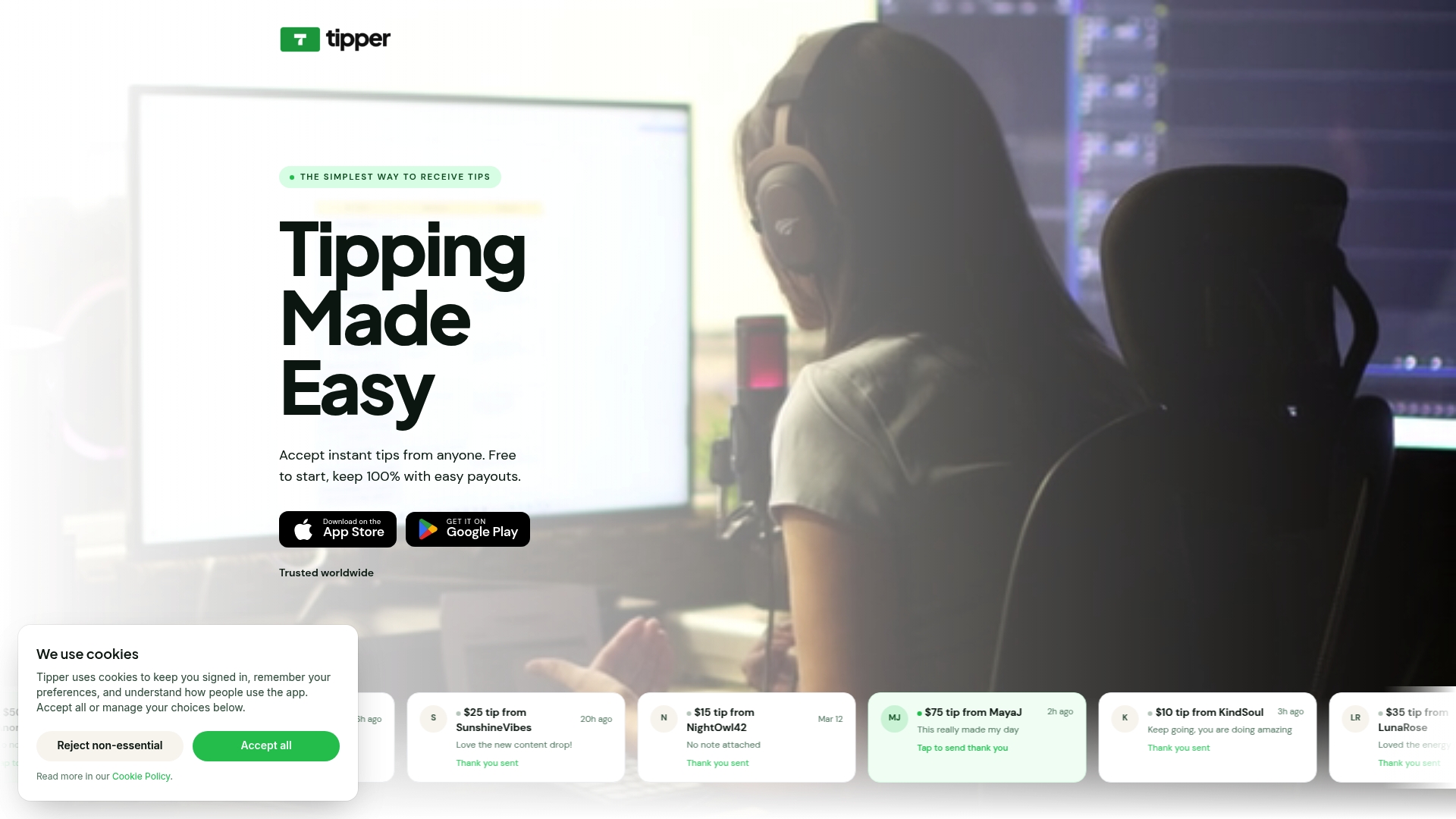
With Tipper, you create a personalized tipping link that customers access through a QR code, a text message, or a button on your website. No account required on their end. Payment goes through Apple Pay or Google Pay in seconds. Creators and business owners keep 100% of every tip, and supporters can attach a thank-you note or video to make the moment personal. If you want to understand how instant tip payments work for your specific setup, Tipper’s resources walk you through every step. Start building your tipping culture with Tipper today.
FAQ
What is tipping culture in a business context?
Tipping culture in business is the set of practices, tools, and norms that make voluntary customer gratuities a regular part of the service experience. It includes digital prompts, written policies, and staff training.
What tip percentage should I set as the default?
Set 15% as the middle default option, with 10% below and 18% above. Moderate defaults produce the best results without causing tipping fatigue or damaging repeat visit rates.
How do digital tipping profiles increase tips?
Tipping profiles that include a staff member’s photo and a short personal story increase tip frequency by 24%. Customers tip people they feel connected to, not abstract service roles.
Should I use a standalone tip app or integrate with my POS?
Always integrate with your POS. Standalone tools create manual reconciliation work and reporting gaps that create compliance problems at tax time.
How does Tipper work for creators and small businesses?
Tipper generates a personalized link that lets anyone send a tip instantly using Apple Pay or Google Pay, with no account required. Creators keep 100% of every tip received.




[…] Promoting a healthy tipping culture in your business starts with respecting customer autonomy. Supporters who feel free to choose will choose more generously over time. […]
[…] How to Promote Tipping Culture in Your Business […]