


RPI is considered moderately selective, reflecting its focus as an engineering and technology school rather than a reach-only bet. It’s test-optional for nearly every program except the combined B.S./M.D. track. Your immediate move: pick an application plan (Early Decision I, Early Action, Early Decision II, or Regular Decision), confirm its deadline, and start building your Common App or RPI application file now.
TL;DR:
- Reporting test scores is optional for most programs, but submitting strong scores can still enhance an application if available.
- The application deadlines are November 1 for Early Decision I, December 1 for Early Action, January 6 for Early Decision II, and January 15 for Regular Decision.
- Transfer applicants need a minimum of 12 college credits and a roughly 3.0 GPA, with rolling review and specific portfolio requirements for architecture.
- Optional materials like Glimpse videos or InitialView interviews should focus on specific projects or leadership examples to leave a stronger impression.
- Demonstrating initiative through recommendations, resumes, or optional content can significantly strengthen an otherwise solid application.
Table of Contents
- RPI Admissions at a Glance: Stats, Test Policy, and Deadlines
- Application Requirements: Platforms, Documents, and Fees
- Optional Materials: Glimpse Videos, InitialView, and Portfolios
- Transfer Admissions: Eligibility, GPA, and Deadlines
- How RPI Evaluates Applicants and What Strengthens Your File
- Application Checklist and Timeline: What to Do Before and After You Hit Submit
- Financial Aid Basics and Priority Filing Dates
- Campus Tours and Open House Events for Prospective Applicants
- Honors Programs and Diversity Initiatives Worth Knowing About
- International Applicants: Credentials and English Proficiency
- A Straight-Talk Perspective on Getting Into RPI
- Sources
- FAQ
RPI Admissions at a Glance: Stats, Test Policy, and Deadlines
Acceptance rates shift a bit year to year, and RPI doesn’t publish a single locked-in number for the upcoming cycle. What’s consistent is the pattern: the school reviews each applicant’s full record rather than sorting by a single cutoff score. Among admitted students who choose to report scores, mid-range SAT and ACT figures tend to land in competitive territory for a technical university, but plenty of accepted students submit no scores at all.
Rensselaer Polytechnic Institute stays test-optional for essentially every undergraduate program in the current cycle, with one notable exception: the Physician-Scientist B.S./M.D. program generally expects standardized scores given its accelerated medical track.
Here’s the plan structure that matters most for your timeline:
- Early Decision I: apply by November 1, hear back by mid-December.
- Early Action: apply by December 1, hear back by late January.
- Early Decision II: apply by January 6, hear back by mid-February.
- Regular Decision: apply by January 15, hear back by early March.
These dates come straight from RPI’s own apply page, and they’re firm. Notification timing can move a few days depending on volume, but the submission deadlines don’t budge.
Application Requirements: Platforms, Documents, and Fees
Most first-year applicants apply through the Common App, but RPI also runs its own application portal for certain programs. Architecture applicants and those applying to the Physician-Scientist B.S./M.D. program follow separate submission routes with their own supplemental steps, so check your intended major before you start filling anything out. RPI also enforces a single-program-per-term rule: you pick one major track per admission cycle rather than hedging across several.
On the academic side, RPI wants to see four years of math (through pre-calculus or beyond, ideally calculus for engineering-bound applicants), three to four years of lab science, and a solid run of English and social studies. Course rigor matters more than a padded transcript with easy electives.
Here’s the practical submission sequence:
- Choose your platform. Common App for most majors; RPI’s own application for architecture and select programs.
- Request transcripts and recommendations early. Counselors can use a free Slate.org account to send documents regardless of which platform you’re applying through.
- Submit your essay and pay the fee (or file for a fee waiver if you qualify based on documented financial need).
- Watch for your Rensselaer ID (RIN). It typically arrives within a few days of submission and unlocks your applicant portal.
- Treat the portal as your source of truth. Notifications, missing-document alerts, and decision releases all route through it first.
Pro Tip: Recommendations and transcripts don’t have to land on the deadline itself. RPI expects supplemental materials to trickle in for about two weeks after your submission date, so use that window instead of panicking if a counselor is running behind.
If something looks off in your file after submission, RPI’s own FAQ page is the best reference, and you can reach the admissions office directly at adm_updates@rpi.edu for status questions the portal doesn’t answer.
Optional Materials: Glimpse Videos, InitialView, and Portfolios
RPI gives U.S. applicants the option to submit a Glimpse video, a 60 to 90 second clip that lets you show personality and context a transcript can’t capture. Deadlines shift slightly by plan, so match your video submission to whichever round you’re applying under.
International applicants get a parallel option called InitialView, a recorded interview that serves a similar purpose to Glimpse for students outside the U.S. school system.
- Glimpse videos: optional, 60 to 90 seconds, timed to your application round’s deadline.
- InitialView: optional interview format built for international applicants.
- Architecture portfolios: submitted through Slideroom, with RPI recommending you finish at least ten days ahead of your deadline to avoid upload issues.
- An additional resume helps when your activities list doesn’t capture leadership depth or a specialized project.
Pro Tip: Skip the highlight reel approach. One focused Glimpse video about a robotics build, a research project, or a leadership role you actually drove beats three generic clips about “why I love STEM.”
Transfer Admissions: Eligibility, GPA, and Deadlines
Transfer applicants need at least 12 transferable college credits to be considered, and RPI generally looks for a GPA around 3.0, though the admissions team weighs context rather than applying a hard cutoff.
Transfer review runs on a rolling basis rather than fixed notification dates, which means earlier applications inside the window tend to get faster answers. Deadlines are June 1 for fall enrollment and November 1 for spring.
- Minimum 12 transferable credits required for consideration.
- Rolling review, so apply as early in the window as your transcript allows.
- Architecture transfer applicants still need a Slideroom portfolio.
- Confirm prerequisite coursework, especially pre-calculus and physics, before applying to protect credit transferability.
How RPI Evaluates Applicants and What Strengthens Your File
RPI’s admissions team reviews every application holistically, looking specifically for what they describe as creative, collaborative risk-takers. That phrase isn’t filler. It signals they’re reading for initiative, not just grade point averages: the student who started a maker-space club, the one who taught themselves CAD software over a summer, the one who pushed a research project further than the assignment required.
Early grades carry real weight for Early Decision and Early Action applicants specifically, since first-quarter or first-trimester senior grades often arrive during the review window and get folded into the file.
Concrete ways to strengthen what you submit:
- Choose recommenders who can speak to specific classroom moments, not just “she’s a great student.”
- Use your resume to surface leadership and initiative your activities list compresses into one line.
- If your Early Decision or Early Action grades come in strong, send an optional update through the portal rather than assuming the file is closed.
- Make your Glimpse video or essay demonstrate a specific project or problem you solved, not a general interest statement.
Strong optional content sounds like: “I redesigned our robotics team’s drivetrain after our first competition loss, cutting turn time by half.” Weak optional content sounds like: “I’ve always loved building things and solving problems.” One shows evidence. The other just states enthusiasm.
Application Checklist and Timeline: What to Do Before and After You Hit Submit
Before submission, lock down four things: finalized essays, recommendation requests sent with enough lead time, a clear decision on whether you’re submitting test scores, and a fee waiver request filed early if you qualify.
After you submit, the sequence looks like this:
- Watch your email (including spam) for your RIN. It usually arrives within a few days and is your key to the applicant portal.
- Check the portal regularly, not just your inbox. Missing-document flags and decision releases show up there first.
- Submit first-quarter or first-trimester grades if you applied Early Decision or Early Action and your school issues them during the review period.
- Confirm your recommenders and school submitted documents within roughly two weeks of your deadline, since that’s the window RPI expects supplemental materials to settle in.
- Email adm_updates@rpi.edu directly if something looks stalled in the portal for more than a couple of weeks.
Pro Tip: Bookmark your portal login instead of relying on the confirmation email. RIN based logins are the fastest way to check status once your RIN is issued, and re-finding an old email is the most common reason applicants think their file is “missing” something.
Financial Aid Basics and Priority Filing Dates
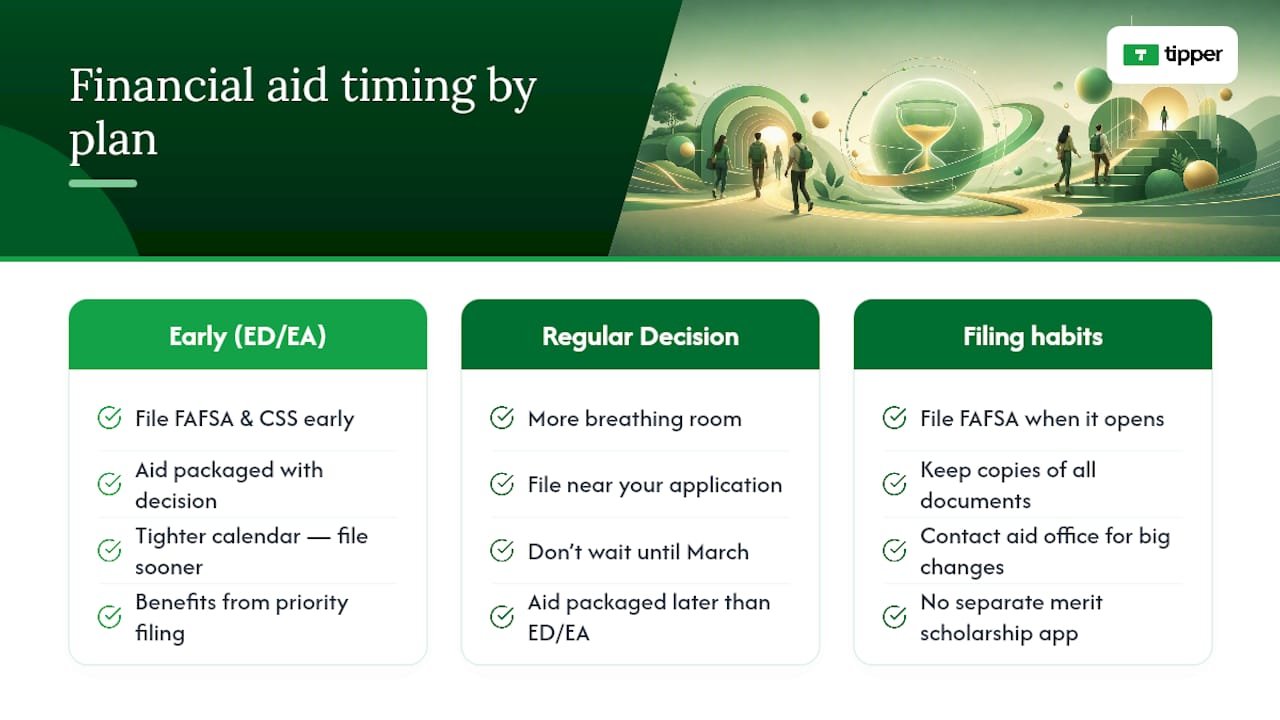
Financial aid at RPI runs on the same clock as your admission plan, so treat it as part of the application, not an afterthought. Filing your FAFSA and CSS Profile close to when you submit your application, rather than waiting for an admission decision, protects your priority filing status for need-based aid.
RPI’s admissions hub outlines how aid timing lines up with each plan: Early Decision and Early Action applicants generally benefit from filing financial forms earlier, since aid offers get packaged alongside admission decisions on a tighter calendar. Regular Decision applicants have a bit more breathing room but shouldn’t wait until March to start the paperwork.
A few practical habits make a real difference here. File the FAFSA as soon as it opens for the cycle rather than waiting for a specific deadline reminder. Keep copies of every financial document you submit, since aid offices occasionally request clarification on income or dependency status. If your family’s financial situation changed significantly since your last tax filing, contact the financial aid office directly rather than assuming the standard forms will capture it.
Merit scholarships at RPI are typically evaluated as part of the same admission review, meaning a strong application file does double duty. There’s no separate merit scholarship application to track down and submit on a different schedule.
Campus Tours and Open House Events for Prospective Applicants
Visiting campus, even virtually, changes how you write your essays and how confidently you answer “why RPI” if an interview opportunity comes up. RPI runs regular guided tours led by current students, along with larger open house events timed around fall and spring admission cycles that pack in department sessions, financial aid presentations, and campus life previews.
If a trip to Troy isn’t realistic, virtual tour options and information sessions cover most of the same ground: academic building walkthroughs, residence hall previews, and Q&A blocks with admissions staff. Attending one of these isn’t required and won’t move the needle on your admission decision by itself, but it does help you write a more specific, less generic application, especially in supplemental materials where “I visited the biomedical engineering labs and talked with a current student about their capstone project” reads a lot stronger than a vague interest statement.
Sign-ups for tours and open houses run through the admissions office’s event calendar, and spots during peak fall visiting season fill up faster than most applicants expect. If you’re weighing RPI against other technical schools, scheduling a visit early in your senior fall, before Early Decision or Early Action deadlines, gives you real material to reference in your application rather than adding it after the fact.
Honors Programs and Diversity Initiatives Worth Knowing About
High-achieving applicants have a specific track worth investigating: RPI’s honors and scholars programs offer smaller seminar classes, research opportunities earlier in your undergraduate career, and closer faculty mentorship than the standard course load provides. These programs typically factor into the same holistic review as your general application, so there’s no separate high-stakes application gate to clear on top of admissions itself, though some tracks do ask for a brief supplemental statement.
RPI also runs diversity and access initiatives aimed at broadening who ends up in its engineering and science programs, including outreach for underrepresented students in STEM and support programs that kick in once you’re enrolled, from mentorship pairings to identity-based student organizations. If financial access is part of what’s holding you back from applying, these programs are worth researching directly through the admissions office rather than assuming cost alone rules RPI out.
For students weighing whether they’re a fit for a research-heavy engineering school, these programs often matter more than the general acceptance rate. A strong honors or scholars track record signals that even within a selective applicant pool, there’s real support built for students who want to go deeper than the standard curriculum.
International Applicants: Credentials and English Proficiency
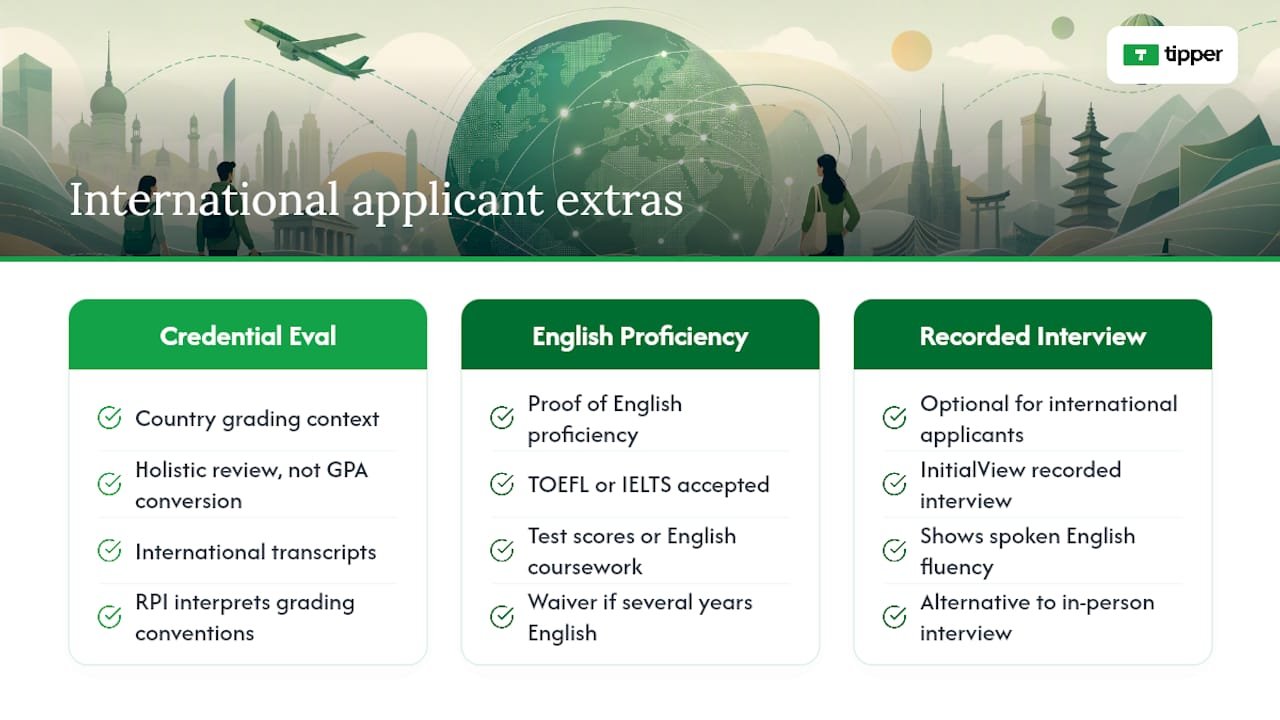
International applicants follow the same core Common App or RPI application process as domestic students, with two additional layers: credential evaluation and English proficiency documentation.
Because international transcripts don’t always translate cleanly into the U.S. grading and credit system, RPI reviews international academic records in the context of the country’s own grading conventions rather than forcing a direct GPA conversion. That’s part of why the holistic review model matters even more for applicants outside the U.S. system: context replaces a simple numeric comparison.
English proficiency documentation is required unless your coursework has been primarily in English for a sustained period, typically several years. Standard tests like TOEFL or IELTS satisfy this requirement, and RPI’s admissions office can clarify current minimum score expectations directly if you’re unsure whether your background qualifies for a waiver.
International applicants who can’t easily arrange an in-person or Common App interview should look at InitialView, the recorded interview option mentioned earlier for the optional materials section. It’s specifically built to give international applicants the same kind of personal, unscripted moment that Glimpse videos give domestic applicants, and it doubles as informal proof of spoken English fluency for admissions readers weighing a file where written English and spoken English might not match up perfectly.
A Straight-Talk Perspective on Getting Into RPI
Don’t treat test-optional as a free pass to skip strategy. If your scores are strong, submit them, since a good number still helps a file that’s otherwise solid but unremarkable. If they’re not, lean harder into your Glimpse video, your resume, and a recommender who can describe a specific moment of initiative. The RIN and portal aren’t administrative footnotes. They’re where your actual status lives, so check that before you assume silence means a problem.
FAQ
What is RPI’s acceptance rate?
RPI’s acceptance rate varies by cycle and isn’t fixed at one published figure, but it consistently sits in moderately selective territory for a technical university, with holistic review weighing course rigor and demonstrated initiative alongside grades.
What GPA do you need to get into RPI?
RPI doesn’t publish a strict minimum GPA cutoff for first-year applicants, since review is holistic, but competitive applicants typically show strong performance in math and science coursework specifically. Transfer applicants get a general guideline of around a 3.0 GPA.
Why is RPI ranked lower than some peer engineering schools?
Rankings depend heavily on the specific methodology used, including factors like class size, research funding, and selectivity metrics, and different ranking systems weigh those factors differently. A lower position in one ranking system doesn’t reflect program quality across the board, especially in specialized engineering and computer science tracks where RPI has particular strength.
Is RPI considered a “New Ivy”?
“New Ivy” is an informal media label, not an official designation, and it’s been applied inconsistently across different lists and publications over the years. RPI’s reputation rests more concretely on its engineering, computer science, and applied science programs than on any unofficial prestige label.




Leave A Comment