


Post-project tipping confuses a lot of people, and for good reason. The phrase sounds straightforward, but it sits at the intersection of service culture, creator economics, and professional etiquette in ways that aren’t always obvious. What is post-project tipping, exactly? At its core, it’s a voluntary financial gratuity given to a contractor, freelancer, or creator after they’ve completed a project. It’s not a review, not a bonus clause, and not a platform fee. Understanding the distinction matters more than ever as tipping culture expands into industries where it was never the norm.
Table of Contents
- Key takeaways
- What is post-project tipping and where did it come from
- Tips vs. reviews vs. bonuses: what’s actually different
- Etiquette, guidelines, and when to tip after a project
- Legal and tax implications of post-project tipping
- My take on what post-project tipping actually means for creators
- How Tipper makes post-project tipping effortless
- FAQ
Key takeaways
| Point | Details |
|---|---|
| Post-project tipping defined | It’s a voluntary gratuity paid after project completion, separate from contractual fees or bonuses. |
| Tips vs. reviews vs. bonuses | These three concepts serve different purposes and should never be treated as interchangeable. |
| Tipping etiquette varies | Industry, geography, and project complexity all shape whether and how much to tip. |
| Tax reporting applies | The IRS has specific rules for reporting tips, including Form W-2 codes for tax years 2025 to 2028. |
| Alternatives often work better | Referrals and positive reviews frequently deliver more long-term value to creators than cash tips. |
What is post-project tipping and where did it come from
The post-project tipping definition is simpler than most people expect. It refers to any voluntary monetary payment made by a client or audience member to a service provider or creator after a project has been completed and the agreed fee has already been paid. The key word is voluntary. No contract requires it. No invoice includes it. It’s pure discretionary appreciation.
The practice has roots in traditional service industries like hospitality and food service, where tipping compensated for wages that were legally set below living standards. Over time, the concept migrated. Gig economy platforms introduced digital tip prompts. Content creators started receiving voluntary contributions from audiences who wanted to show appreciation beyond a like or a comment. The logic shifted from “making up for low wages” to “rewarding exceptional work.”
Here’s what makes post-project gratuity practices distinct from everyday tipping:
- Timing: Tips in restaurants happen immediately. Post-project tips happen after a defined scope of work is finished, sometimes days or weeks later.
- Relationship context: The creator-client relationship in project work is usually more personal and longer-term than a single restaurant visit.
- Amount ambiguity: There’s no standard 15 to 20 percent rule. The amount is entirely up to the payer.
- Platform dependency: Many post-project tips now flow through digital platforms rather than cash envelopes.
In specialized service industries, post-project tipping has become highly structured. For example, clients may tip $300 per climber on an 8-day expedition, distributed in front of an independent monitor to prevent skimming. That level of formality shows how far the concept has evolved from dropping coins on a table.
Tips vs. reviews vs. bonuses: what’s actually different
This is where most confusion originates. People use “post-project tipping,” “post-project review,” and “performance bonus” almost interchangeably, but they describe fundamentally different things.
A post-project review is a structured evaluation conducted after a project ends. Reviews typically occur one to three months after completion and are designed to analyze performance, identify what worked, and extract lessons for future projects. They’re strategic. They’re documented. They have nothing to do with money changing hands.
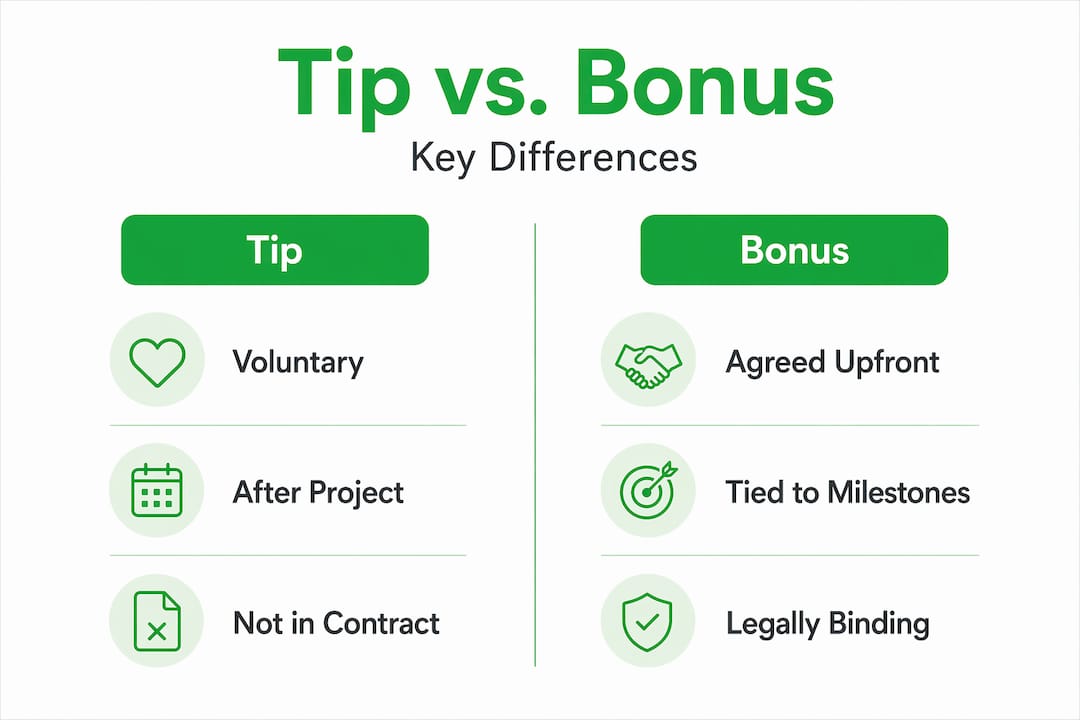
A contractual bonus is a pre-agreed payment triggered by hitting specific milestones or performance thresholds. Milestone billing secures structured extra payments far more reliably than discretionary tips, and it carries legal weight. If you promised a $500 bonus for early delivery in a contract, that’s not a tip. That’s an obligation.
A tip, by contrast, is none of those things. It’s spontaneous, personal, and entirely optional.
| Concept | Basis | Timing | Legally binding |
|---|---|---|---|
| Post-project tip | Voluntary appreciation | After project completion | No |
| Post-project review | Performance evaluation | 1 to 3 months post-completion | No (but documented) |
| Contractual bonus | Pre-agreed milestone | Triggered by contract terms | Yes |
The confusion arises most often in freelance and creator contexts, where clients sometimes treat a tip as a substitute for a proper performance review, or where creators mistake a bonus clause for a tip. Neither substitution serves anyone well.
Pro Tip: If you’re a freelancer negotiating a new project, build milestone payments into your contract rather than hoping for a tip at the end. Contractual clarity protects both parties and removes the awkwardness of post-project gratuity conversations entirely.
Etiquette, guidelines, and when to tip after a project
Knowing the post-project tipping definition is one thing. Knowing when and how to actually do it is another. The guidelines for post-project tipping are less codified than restaurant norms, which is exactly what makes them tricky.
Labor costs are built into project bids, which means tipping contractors is not always expected or even appropriate. A plumber who charges $200 for a job has already priced their time and expertise into that number. Tipping them is a nice gesture, not a social obligation. Compare that to a freelance illustrator who spent 40 hours on a passion project for a flat rate. A tip there carries a very different emotional weight.
Factors that genuinely influence whether a post-project tip makes sense:
- Project complexity: Did the creator or contractor go significantly beyond the original scope?
- Professionalism and communication: Was the experience unusually smooth, responsive, and stress-free?
- Budget context: Is the client a large company or an individual? The same tip means something very different depending on who’s giving it.
- Industry norms: Some fields have emerging tipping cultures (digital creators, voice actors, independent designers). Others don’t (architects, attorneys, accountants).
Cultural context matters too. Tip fatigue is real in professional services, and applying restaurant-style tipping logic to skilled trades creates unnecessary pressure on both sides. In some countries, tipping a professional is considered mildly offensive. In others, it’s expected.
The most overlooked alternative to tipping? A referral. Many contractors value referrals and positive reviews more than cash because they fuel sustainable business growth. If a freelance web developer built something you love, a detailed five-star review and a referral to your network is worth far more than a $50 tip.
Pro Tip: When you genuinely want to show appreciation beyond payment, ask the creator or contractor what they’d value most. Some prefer a public review. Others appreciate a tip. Asking removes the guesswork and shows respect.
Legal and tax implications of post-project tipping
This section surprises most people. Tips aren’t just social transactions. They carry tax obligations, and the IRS has gotten more specific about them in recent years.

As of May 2026, the IRS clarified rules under the One Big Beautiful Budget Act. Qualified tips must be voluntarily paid by the customer and require employer reporting with specific codes. For tax years 2025 to 2028, cash tips must be reported in Box 12 of Form W-2 using code “TP,” and a Treasury Tipped Occupation Code must appear in Box 14b.
| Tip type | Voluntary | Tax reportable | IRS form |
|---|---|---|---|
| Cash tip (employee) | Yes | Yes | Form W-2, Box 12 (code TP) |
| Digital tip (freelancer) | Yes | Yes | Schedule C or 1099 |
| Contractual bonus | No (obligated) | Yes | Form W-2 or 1099-NEC |
| Mandatory service charge | No | Yes | Treated as wages |
For freelancers and independent creators, tips received are considered self-employment income and must be reported on Schedule C. There’s no minimum threshold that makes a tip tax-free. A $20 tip from a satisfied client is still taxable income.
The distinction between a voluntary tip and a mandatory service charge matters legally. A platform that automatically adds a “tip” at checkout and routes it to the creator is not technically a tip in the IRS sense. It functions more like a service charge, which is treated as wages. Platforms that allow the payer to choose whether and how much to tip preserve the voluntary nature that qualifies the payment as a genuine gratuity.
My take on what post-project tipping actually means for creators
I’ve watched the conversation around post-project tipping shift considerably over the past few years, and I think a lot of people are drawing the wrong lessons from it.
The most common mistake I see is treating tipping as a substitute for proper compensation structures. Creators who undercharge and then hope for tips at the end are building their income on a foundation that can collapse at any moment. A tip is a gift. You can’t budget around gifts.
What I’ve found more interesting is how post-implementation reviews transform project experiences into practical knowledge for both parties. A thoughtful written review from a client does more for a creator’s career than a $30 tip. It shapes their reputation, improves their search visibility, and gives future clients the social proof they need to hire with confidence.
My honest take: post-project tipping is a meaningful gesture when it’s genuine and proportionate. But the creator-audience relationship is healthiest when appreciation takes multiple forms, not just financial ones. The creators I’ve seen thrive long-term are the ones who build real relationships with their audiences, communicate clearly about value, and don’t depend on the unpredictability of voluntary gratuities to make their numbers work.
— Steve
How Tipper makes post-project tipping effortless
If you’ve decided that tipping after a project is the right move, the mechanics of actually doing it shouldn’t get in the way. That’s the problem Tipper was built to solve.

Tipper lets creators and freelancers receive tips instantly through a personalized link, with no account required from the person sending the tip. Supporters can pay using Apple Pay or Google Pay in seconds. Creators keep 100% of what they receive, with no platform cut taken from their earnings. The platform also supports thank-you messages through notes or videos, which adds a personal layer to what might otherwise feel like a purely transactional exchange. For anyone exploring how to tip after a project in a way that feels easy and genuine, Tipper removes every friction point that typically gets in the way.
FAQ
What is the post-project tipping definition?
Post-project tipping refers to a voluntary financial gratuity paid to a contractor, freelancer, or creator after a project has been completed and the agreed fee has already been settled. It is discretionary and not legally required.
Should you tip after a project?
Tipping after a project is not universally expected. It depends on industry norms, the quality of work delivered, and whether the creator or contractor went beyond the original scope. Referrals and positive reviews are often valued just as highly.
How do you tip after a project legally?
Tips received by freelancers and creators are taxable income and must be reported to the IRS. For employees, cash tips go in Box 12 of Form W-2 with code TP. For self-employed individuals, tips are reported on Schedule C.
What is the difference between a tip and a contractual bonus?
A tip is voluntary and given at the payer’s discretion after project completion. A contractual bonus is a pre-agreed payment triggered by specific milestones or performance terms written into a contract, making it legally binding.
Are referrals better than tips for contractors?
Many contractors and freelancers find that referrals and detailed public reviews deliver more long-term business value than monetary tips, since they directly influence future client decisions and overall reputation.




Leave A Comment