
The real reason people tip has less to do with excellent service than most assume. Understanding why instant gratification motivates tipping reveals something surprising: social pressure, digital design, and dopamine responses often matter more than the quality of your meal. A quick tap on a payment screen now triggers the same reward loop that once made tip jars effective, only faster and with significantly more psychological weight behind it. If you have ever wondered why you tipped more generously at a digital checkout than you intended, the answer is buried in behavioral science.
Table of Contents
- Key Takeaways
- Why people tip: social norms and traditional motivations
- How digital payment design drives instant gratification and tipping
- The neuroscience behind instant rewards and tipping habits
- Tipflation, resentment, and the limits of digital pressure
- Practical ways to navigate tipping in a digital world
- My take on tipping psychology and where this is headed
- Make your tips count with Tipper
- FAQ
Key Takeaways
| Point | Details |
|---|---|
| Bill size drives tip amounts | The size of the bill, not service quality, explains roughly 70% of tipping variation in dining contexts. |
| Digital defaults shift behavior | Changing default tip anchors on POS systems increases average tip amounts by about 10%. |
| Dopamine reinforces quick tipping | Immediate rewards trigger dopamine responses that accelerate habit formation and repeat tipping behavior. |
| Token systems reduce spending hesitation | Digital tokens abstract real money, making tipping feel less costly and more frequent. |
| Tipflation creates consumer resentment | Escalating default tip suggestions boost short-term tips but generate psychological reactance over time. |
Why people tip: social norms and traditional motivations
Most people believe they tip because the service was good. Research tells a different story. Tipping rates in the U.S. have climbed from roughly 10% to 20% historically, not because service improved across the board, but because social conformity pushed norms upward. When generous tippers set a visible standard, others follow. This is the “appreciators pulling conformists” dynamic, and it explains why tipping expectations expand even in industries where tipping was never traditional.
Here is what actually shapes how much people leave on the table:
- Bill size. About 70% of tipping variation in dining contexts is explained by how large the bill is, not how attentive the server was.
- Social approval. People tip partly to avoid feeling judged, especially in public settings where others observe the transaction.
- Rapport with the server. Small personal gestures like eye-level contact or a personalized thank-you can increase a tip by a dollar or more per table.
- Social conformity. Tipping norms spread bottom-up through peer behavior, not top-down rules or policy.
The distinction between “appreciators” and “conformists” is especially important here. Appreciators tip because they genuinely want to reward effort. Conformists tip because it feels socially required. In any tipping environment, conformists make up the majority. That means the structure of the tipping moment, including who is watching and what the defaults suggest, carries enormous weight. It also sets the stage for understanding why digital payment systems have such a dramatic effect on tipping behavior.
How digital payment design drives instant gratification and tipping
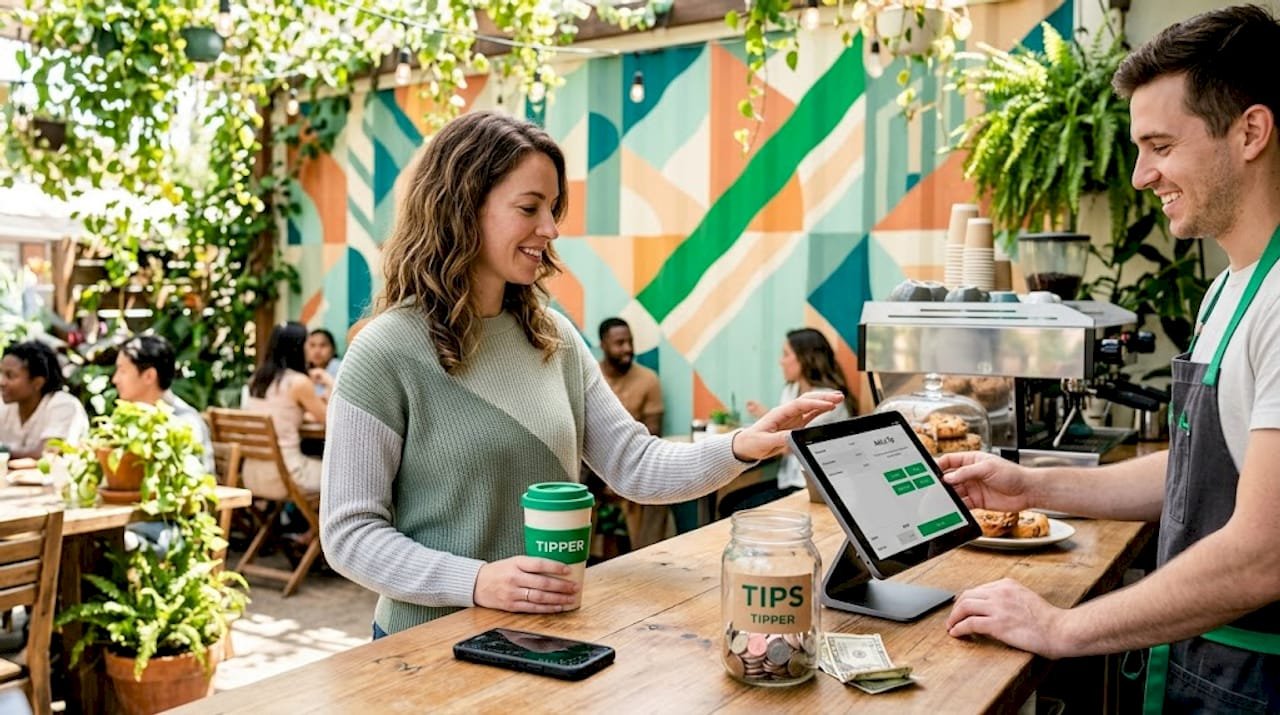
When a barista turns that tablet toward you with three tip options glowing on screen, something specific happens in your brain. You are no longer deciding whether to tip. You are deciding how much. That is a deliberate design choice, and it works.
Traditional tip jars operated on what psychologists call the “sin of omission.” You could walk past without tipping and feel mildly guilty, but the choice was invisible. Digital POS systems flipped that completely. Now, not tipping requires actively pressing “No Tip” in full view of the person serving you. That is a sin of commission. The social cost skyrockets.
Digital systems also exploit choice architecture through default anchors. When the lowest suggested tip jumps from 15% to 20%, people recalibrate their sense of “normal.” Changing default tip options increased average tip amounts by roughly 10%, a significant shift driven entirely by how choices are presented, not by changes in service.
Here is how the psychological chain unfolds in a typical digital tipping moment:
- You receive a service and feel a mild positive emotional response.
- The payment screen appears immediately, while that feeling is still fresh.
- A default tip amount is pre-selected, anchoring your reference point upward.
- Declining to tip requires a deliberate, visible action.
- You tap quickly to resolve the social tension. The transaction completes. Relief.
That final moment of relief is the instant gratification piece. The discomfort is short, the resolution is immediate, and the whole sequence is over in seconds. Tips and instant rewards are tightly linked here because the speed of digital payment compresses the emotional arc into something that feels almost reflexive.
Pro Tip: If you want to tip intentionally rather than reactively, decide your tip percentage before the payment screen appears. That small mental shift breaks the default anchor’s grip and puts you back in control of the decision.
The neuroscience behind instant rewards and tipping habits
The psychology of tipping behavior connects directly to how the brain processes rewards. Immediate rewards produce sharper dopamine spikes than delayed ones. Research on reward learning shows that larger, immediate rewards accelerate habit formation, compressing the time it takes to lock in a behavior pattern. When tipping produces instant social relief and positive emotional feedback, the brain files it as a successful behavior worth repeating.
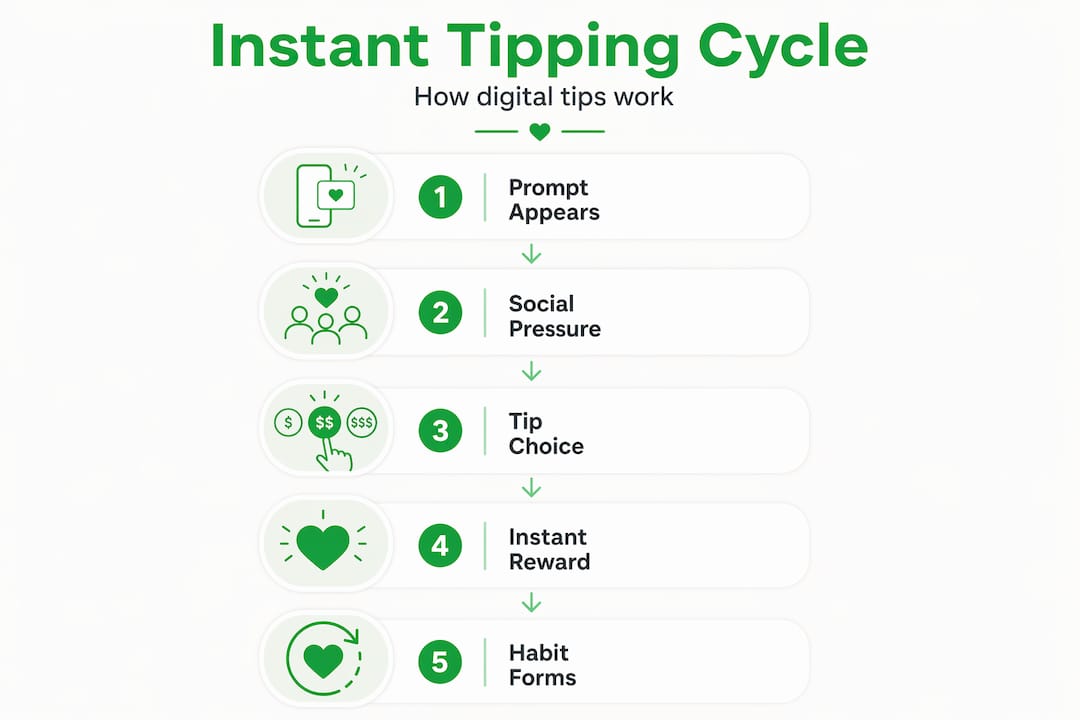
This is why digital tipping can feel habit-forming. Each quick tap followed by a completed transaction reinforces the loop: friction appears, action resolves it, relief arrives. Over time, that sequence becomes automatic.

There is a counterpoint worth understanding, though. Effortful, earned rewards produce richer dopamine responses than passive instant gratification. A tip motivated by genuine appreciation for a memorable experience carries more psychological weight for both giver and recipient than a reflexive screen tap. Instant gratification and service quality are not the same driver, even if they produce the same outcome.
The token economy layer makes this even more interesting:
- Digital currency abstraction. When you pay with a tap rather than cash, token abstraction reduces spending hesitation, making tips feel less costly than handing over actual bills.
- Gamification mechanics. Streaming platforms use leaderboards and timed tipping goals to create urgency and social visibility around generosity.
- Repeat engagement loops. Gamified tipping features like badges and recognition reduce hesitation and increase the frequency of tipping transactions.
| Tipping Context | Primary Psychological Driver | Typical Friction Level |
|---|---|---|
| Cash tip jar | Social norm, omission-based | Low |
| Digital POS screen | Default anchors, commission-based guilt | High |
| Streaming platform tokens | Gamification, social recognition | Very low |
| Creator tip links | Personal connection, direct appreciation | Moderate |
Pro Tip: Service workers who create personal moments before the payment screen appears, by using a customer’s name, making eye contact, or offering a specific thank you, convert conformist tippers into appreciator tippers. That is worth more than any default tip anchor.
Tipflation, resentment, and the limits of digital pressure
The impact of instant rewards on tipping is not entirely positive. When default tips escalate from 20% to 25% to 30% on screens for counter service and takeout, consumers start to feel coerced rather than generous. That feeling has a name: tipflation fatigue.
“Higher default tip suggestions increase tips in the short term but cause psychological reactance over time, as consumers begin resisting nudges they perceive as manipulative.” (Psychology of tipping in digital and in-person transactions)
This is the tension at the heart of digital tipping culture. The same tools that increase generosity also erode trust. When a customer feels that a screen is engineered to extract money rather than facilitate appreciation, the emotional connection between tip and service breaks down. The tip becomes a social tax, not a reward.
There is also a loss of authenticity in the digital tipping moment. In traditional settings, the face-to-face rapport between customer and server directly influenced the tip. You saw the effort, you felt the connection, and you responded. In many digital interactions, the payment screen appears before any real human exchange, decoupling the reward from the actual experience entirely. The tip no longer reflects satisfaction. It reflects social survival.
Social surveillance also works differently online. Streaming platform viewers can see who tipped and how much. That visibility drives competitive generosity among a subset of users, while making others feel excluded or pressured. The psychology of short-term rewards in tipping gets complicated fast when public recognition enters the picture.
Practical ways to navigate tipping in a digital world
For consumers, the goal is to tip intentionally without letting digital design override your judgment. A few approaches that actually work:
- Set a personal tipping framework before you pay. Decide your standard rates for different service types, such as 20% for sit-down dining and 10% for counter service, and stick to them regardless of what the screen suggests.
- Recognize the anchor effect. When you see a pre-selected 25% option, that number was chosen to shift your baseline upward. You are not being cheap if you choose 15%.
- Build in a brief pause. The instant gratification loop is most powerful when you act within the first two seconds of seeing the screen. A three-second pause disrupts the reflex.
For service workers and content creators, the dynamics are different. Your goal is to create genuine connection before the tipping moment arrives, because personal rapport increases tips more reliably than any screen design. Be specific with your appreciation. Remember a detail about a returning customer. Make the transaction feel human.
For businesses, the ethical path forward involves balancing technology’s ability to encourage tipping with the customer’s right to feel comfortable. Screens that default to 30% for a pre-packaged item are generating short-term revenue while building long-term resentment. Sustainable tipping culture requires defaults that reflect the actual labor and service involved, not just what the algorithm can extract. Mobile-first feedback systems that incorporate behavioral science can help businesses design tipping interfaces that feel supportive rather than coercive.
My take on tipping psychology and where this is headed
I have spent years watching tipping culture shift from a personal gesture into a behavioral design problem. What strikes me most is how few people realize how much of their tipping behavior is borrowed from the architecture around them. You think you are being generous. Often, you are just resolving a social discomfort that someone else engineered.
That is not cynicism. It is just worth knowing. The instant gratification mechanism that motivates tipping is genuinely powerful, and it is not inherently exploitative. A quick, frictionless tipping moment can express real appreciation efficiently. The problem comes when speed and social pressure replace genuine connection entirely.
What I have noticed is that the most sustainable tipping relationships, whether between a diner and a longtime server or a viewer and a creator, are ones where the tip carries some emotional weight. When tipping becomes purely reflexive, it loses meaning for both parties. The service worker stops feeling recognized, and the tipper stops feeling generous. Everyone just feels pressured.
My honest prediction is that digital tipping culture will fragment. High-friction, coercive default screens will generate increasing backlash, particularly in low-service contexts. Meanwhile, direct creator tipping, where a real person is on the other end of that tap, will grow because the emotional return is higher. Mindful tipping is not about tipping less. It is about tipping in ways that actually feel good.
— Steve
Make your tips count with Tipper
Understanding the psychology behind tipping changes how you think about the moment itself. Whether you are a creator, freelancer, or content producer, you deserve to receive appreciation that feels genuine, not extracted.
Tipper makes that possible. Anyone can send you a tip through your personalized link using Apple Pay or Google Pay, no account required. You keep 100% of what you earn. Supporters can add a note or video, which turns each tip into a real expression of connection rather than a reflexive screen tap. That is the kind of instant gratification that actually means something. If you want to know how Tipper handles your data, the cookie policy lays it out clearly.
FAQ
Why does instant gratification motivate tipping?
Instant gratification motivates tipping because digital payment screens create an immediate emotional loop: social pressure appears, a quick tap resolves it, and relief follows instantly. That fast cycle reinforces tipping as a habit through dopamine-driven reward responses.
Does service quality actually drive tip amounts?
Not as much as most people think. Bill size explains roughly 70% of tip variation, while service quality plays a secondary role. Social norms and payment design have a stronger measurable effect on tip amounts.
What is tipflation and why does it happen?
Tipflation refers to the gradual escalation of expected tip percentages, largely driven by digital POS systems setting higher default options. It happens because higher anchors shift social norms upward, but it tends to generate resentment when defaults feel disconnected from actual service.
How do token systems affect tipping behavior?
Token systems, used in streaming platforms and gaming, reduce the emotional cost of spending by abstracting real money into digital units. This lowers spending hesitation and makes tipping feel lighter, leading to more frequent and sometimes larger tips.
Can service workers increase tips without relying on digital design?
Yes. Personal gestures like eye contact, using a customer’s name, and specific thank-yous increase tips more reliably than screen defaults. Genuine rapport converts social-norm tippers into appreciation-driven tippers, which produces more consistent results.




Leave A Comment