

If you’ve ever wondered how tipping links work and whether setting one up requires a computer science degree, you’re not alone. Most creators assume the process is complicated, technical, or buried behind fees. The reality is that modern tipping links, sometimes called tip jars or payment links in the industry, have become genuinely simple tools that let supporters send money in seconds without creating accounts or fumbling with wallets. This guide breaks down the mechanics, the user experience, and the strategies that help creators turn casual readers into consistent supporters.
Table of Contents
- Key Takeaways
- How tipping links work: the core mechanics
- Wallet auto-creation and one-click tipping
- Crypto tipping links and non-custodial flows
- Embedded widgets vs. shareable crypto links
- Strategies for maximizing tipping revenue
- My take on where tipping links are headed
- Start earning with Tipper today
- FAQ
Key Takeaways
| Point | Details |
|---|---|
| Tipping links are instant payment gateways | Supporters click once, choose an amount, and pay with Apple Pay or Google Pay without signing up. |
| Wallet auto-creation removes friction | Modern widgets create a supporter wallet on the first tip, making every future tip a one-click action. |
| Crypto tipping links work without gas tokens | Non-custodial links let payers select their preferred chain and pay in stablecoins with no extra setup. |
| Placement and messaging drive results | Where and how you display your tipping link directly affects how often supporters actually use it. |
| Platform choice affects privacy and payouts | Custodial and non-custodial solutions differ significantly in who holds funds and how quickly creators get paid. |
How tipping links work: the core mechanics
A tipping link is exactly what it sounds like. It’s a URL, a button, or an embedded widget that takes a supporter directly to a payment screen where they can send a creator money as a thank-you. Think of it as a digital tip jar sitting at the end of your article, video, or social bio.
The confusion usually comes from lumping tipping links together with complicated donation platforms that require account creation, bank verification, and multi-step checkouts. Modern tipping links skip all of that. Research into tipping behavior shows the main motivations are gratitude and social norms, meaning supporters already want to tip. The tool just needs to get out of their way.
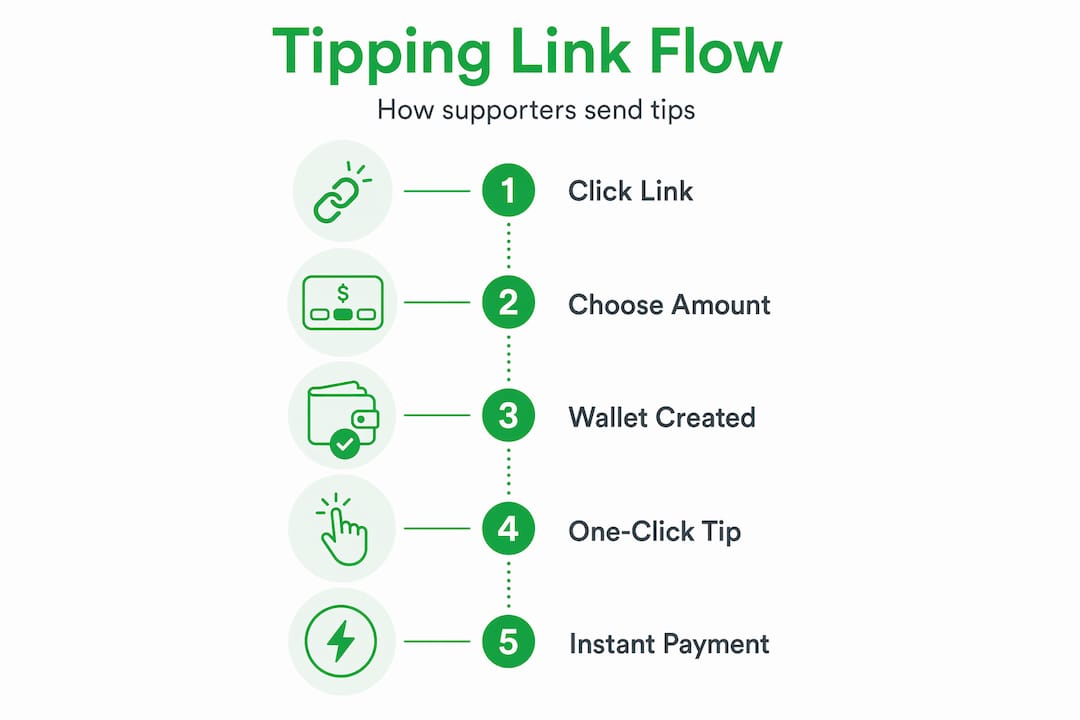
Here’s what a typical tipping link flow looks like from the supporter’s perspective:
- Step one: The supporter sees your tipping link or button at the end of your content, in your social bio, or embedded on your website.
- Step two: They click it and land on a clean payment screen showing tip amount options.
- Step three: They choose an amount and pay with Apple Pay, Google Pay, a credit card, or crypto, depending on what the platform supports.
- Step four: The payment processes and the creator receives the funds, sometimes instantly.
From the creator’s side, setup usually means copying a short code snippet or sharing a personalized URL. Tools like Tipper let anyone create a tipping link in minutes, without technical knowledge. Embedding tipping tools on sites like Substack, Ghost, or WordPress typically requires nothing more than a script tag and a custom element with your author parameters.
The distinction between an embedded widget and a shareable link matters. A shareable link works anywhere you can paste a URL, including a Twitter bio, an email signature, or a YouTube description. An embedded widget lives inside your page and lets supporters tip without ever leaving your content. Both have their place depending on where your audience is most active.
Wallet auto-creation and one-click tipping
This is where tipping link mechanics get genuinely clever, and where most creators don’t realize how much work happens behind the scenes to make their experience feel effortless.
When a supporter clicks your tipping link for the first time, some platforms automatically create an internal wallet for them during the checkout process. They don’t fill out a form or choose a password. The wallet simply exists after that first transaction.

Here’s why that matters. The SimpleTip web component demonstrates the model clearly: it auto-creates a wallet with no signup and uses a popup only for the initial funding step. Every tip after that is a single click with no checkout screen appearing at all. The supporter stays on your page, the tip sends instantly, and nobody had to create an account.
The practical steps behind this experience typically work like this:
- Supporter clicks your tipping button for the first time.
- A lightweight popup appears to collect payment details and fund the new wallet.
- The platform creates a server-side wallet linked to that session or optionally to an email address.
- On every future visit, the platform recognizes the supporter and processes the tip in one click.
- The creator receives the funds minus any platform fees, or in Tipper’s case, the full amount.
Wallet balances in these systems are stored server-side rather than in the browser, meaning supporters don’t lose access if they clear their cookies or switch devices. Optional email linking or identity verification through protocols like ATProto lets supporters recover their wallet across devices. This small detail is the difference between a one-time tip and a habitual supporter.
Some platforms take this further by allowing tip splitting. The SimpleTip widget lets readers decide what percentage of a tip goes to the author versus a subject featured in the content. If you write a profile piece on a musician, your reader can tip you both in a single transaction. That kind of flexibility turns tipping from a simple thank-you into a meaningful gesture.
Pro Tip: Ask supporters to save your page or follow you on a platform that supports persistent login so their wallet auto-link stays active. The easier it is for them to return, the more likely repeat tipping becomes.
Crypto tipping links and non-custodial flows
Crypto tipping links operate on a different philosophy entirely, and that philosophy has real advantages for creators who want to avoid intermediaries.
In a standard tipping link, the platform typically holds your funds until you request a payout. That’s a custodial model. Crypto tipping links, by contrast, can be non-custodial, meaning the payment goes directly from the supporter’s wallet to yours with no middleman holding the money in between.
The user experience for crypto tipping has improved dramatically. Consider how Hash PayLink works: a creator generates a single URL or QR code that carries multiple blockchain addresses. When a supporter opens the link, they select which chain they want to use and complete the payment in stablecoins or tokens. The creator receives the funds directly on the chosen chain.
The specific advantages of this model include:
- No app download required. Supporters open a link in any browser.
- No gas token headache. Multi-chain PayLink URLs eliminate the need for payers to hold gas tokens, which is one of the biggest friction points for crypto newcomers.
- Broader chain support. One link works across multiple networks, so you’re not forcing supporters into a specific ecosystem.
- Direct settlement. Funds arrive in the creator’s wallet without passing through a platform’s treasury.
The use cases extend well beyond the typical “donate to this creator” scenario. Hash PayLink applications include paid subscriptions, course fees, merchandise payments, and in-game purchases, making this model useful for musicians selling track downloads, educators charging for workshops, and gaming creators offering premium experiences.
Pro Tip: If your audience already engages with crypto, a non-custodial tipping link builds trust instantly because supporters can verify on-chain that their payment went directly to you. That transparency is something custodial platforms can’t offer.
Embedded widgets vs. shareable crypto links
Choosing between an embedded widget and a shareable crypto link isn’t about which is better in absolute terms. It’s about which fits your audience, your platform, and your tolerance for setup complexity.
| Feature | Embedded widget (e.g., SimpleTip) | Crypto link (e.g., Hash PayLink) |
|---|---|---|
| Custody of funds | Custodial, platform holds balance | Non-custodial, direct to creator |
| User experience | One-click after first tip | Requires chain selection each time |
| Wallet management | Auto-created, server-side | Supporter uses own crypto wallet |
| Setup complexity | Moderate, requires script embed | Low, just share a URL or QR code |
| Chain support | Single payment rails | Multi-chain out of the box |
| Tip splitting | Supported between author and subject | Not standard, depends on implementation |
| Recovery options | Email or identity-linked wallet | Supporter’s own wallet handles recovery |
| Best for | Blog, editorial, long-form content | Events, courses, social posts, global reach |
The embedded widget wins when your content lives on a page and you want the tipping experience to feel native to that page. Your supporter never leaves. The wallet remembers them. The experience feels like part of your content rather than a detour.
The shareable crypto link wins when you need portability. You’re posting on social media, speaking at an event, or reaching an audience that’s already crypto-literate. You paste one URL everywhere and it works. Non-custodial solutions simplify the payer experience while giving creators full control over their funds from the moment a transaction settles.
The practical advice here: start with whichever format your primary audience already understands. If your readers use Apple Pay and Google Pay, an embedded widget with fiat payment support gets you tipping revenue faster than asking them to set up a crypto wallet. If you’re building in Web3 communities, a non-custodial crypto link signals that you speak their language.
Strategies for maximizing tipping revenue
Understanding how tipping links generate traffic and convert supporters into tippers requires more than just placing a link somewhere on your page. Location, framing, and timing all affect results.
The creators who earn the most from tipping links treat them as part of the content experience rather than an afterthought. Here’s what actually moves the needle:
- Place your tipping link at the emotional peak. For long-form writers, that’s right after a powerful conclusion. For video creators, it’s at the end of a build-up. Supporters tip when they feel something, not when they scroll to a generic footer.
- Use specific language over generic calls to action. “Buy me a coffee” has become invisible through overuse. Telling supporters exactly what their tip supports, whether that’s your recording equipment, your research time, or your team, creates a personal connection that generic phrases don’t.
- Leverage the one-click wallet experience for repeat supporters. Once a supporter has tipped once, remind them in your next piece of content that tipping is now instant for them. That reminder converts occasional supporters into habitual ones.
- Track what works. Most tipping platforms offer basic analytics. Check which pieces of content generate the most tips and double down on that format. If your deep-dive tutorials earn more than your opinion pieces, that’s a signal worth acting on.
- Protect supporter trust above everything else. Don’t over-ask. One clear tipping prompt per piece of content is enough. Popups and aggressive overlays train readers to tune you out entirely.
Integrating your tipping link into a broader monetization strategy means treating it as complementary to subscriptions, digital products, and sponsorships, not a replacement. Tipping captures the spontaneous gratitude that other models miss. It’s the supporter who loved one specific article and wants to say so with $5. Every revenue stream captures a different supporter mindset, and tipping captures one that nothing else does.
For freelancers working with clients, placing a tipping link in your email signature or on your invoice page gives clients a frictionless way to express satisfaction beyond the agreed rate. Tools like those in the PeerFounder directory offer additional resources for freelancers building multiple income streams around their expertise.
My take on where tipping links are headed
I’ve watched tipping tools evolve from clunky PayPal buttons to the genuinely elegant experiences we have today, and my honest observation is that most creators still underestimate what a well-placed tipping link can do for their relationship with an audience.
What I’ve seen consistently is that the friction point is almost never the money. Supporters who care about your work will pay. The friction is always the process. Every extra click, every account creation screen, every “you must download our app” message cuts the conversion rate in half. Reducing supporter friction through wallet auto-creation isn’t a minor UX improvement. It’s the difference between a creator who earns $50 a month in tips and one who earns $500.
My preference has shifted toward combining both models. An embedded widget on your main content channels handles the regular readers who return weekly. A crypto link handles the global supporters, the crypto-native audience, and the use cases where you need portability. Neither one alone is the full picture.
The caution I’d offer is about privacy. Some tipping platforms collect far more supporter data than they need to process a payment. Before you embed any tool, read how it handles the people who tip you. Your supporters trust you by extension when they click your link. That trust is worth protecting. Platforms like Tipper are built around user privacy by design, and that approach earns long-term loyalty from supporters who notice those details.
— Steve
Start earning with Tipper today
If the mechanics above made sense but the setup still feels uncertain, Tipper was built specifically to solve that.
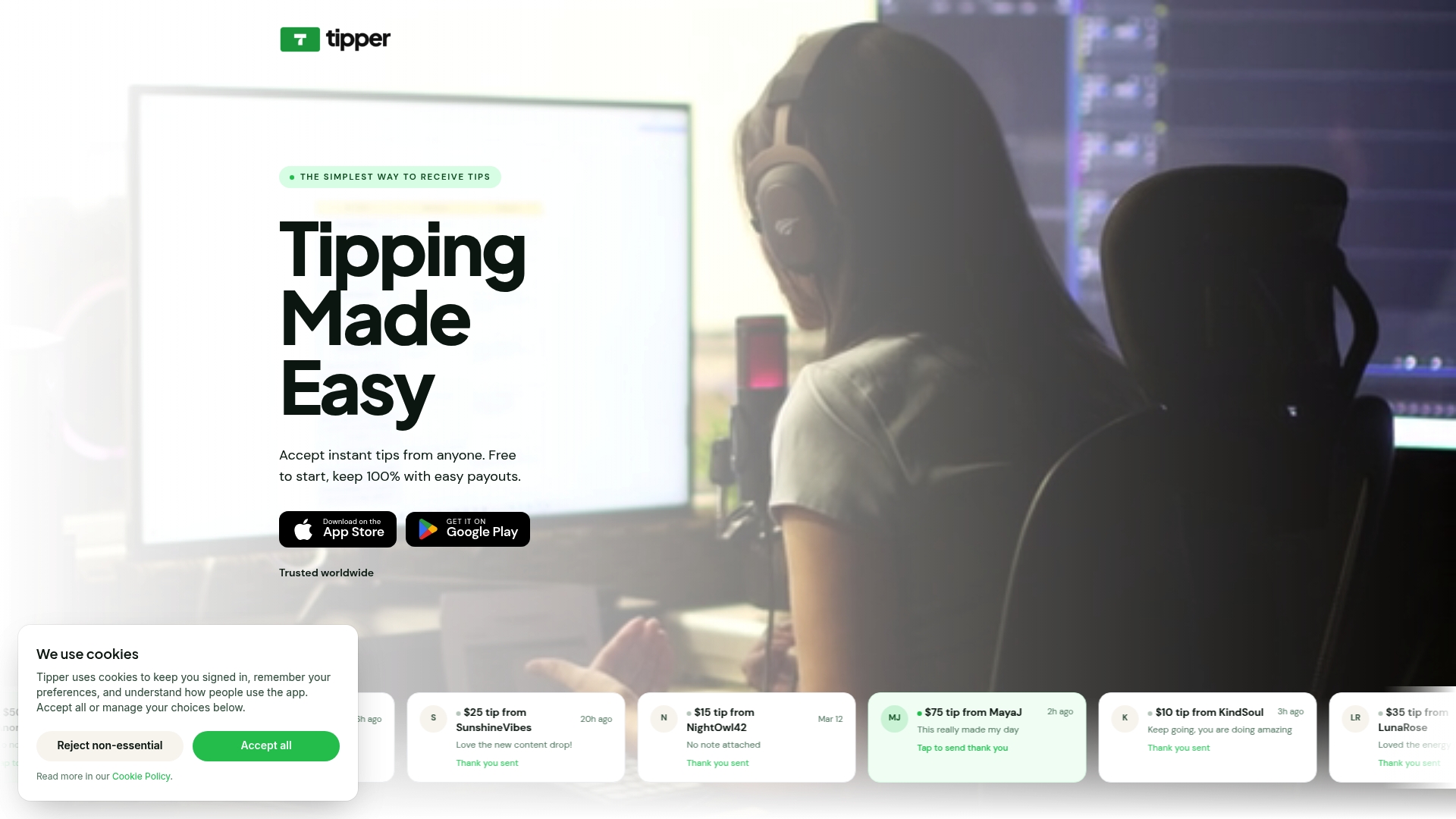
Tipper gives you a personalized tipping link in minutes. Supporters pay with Apple Pay, Google Pay, or a credit card. No account required on their end, and you keep 100% of what they send. You can embed your tipping link on your website, drop it in your social bio, or share it directly with your audience. When a supporter sends a tip, you can respond with a thank-you note or video, which creates the kind of personal connection that turns a one-time tipper into a loyal fan. Tipper handles the technical side so you can focus entirely on your content.
FAQ
What is a tipping link?
A tipping link is a URL or embedded button that lets supporters send a creator money as a thank-you, usually without creating an account or going through a multi-step checkout.
How do tipping links work without account sign-up?
Platforms like Tipper allow supporters to pay using Apple Pay or Google Pay directly from the tipping link, processing the payment without requiring the supporter to register anywhere.
What does wallet auto-creation mean for tipping?
Wallet auto-creation means the platform generates a supporter wallet during their first tip, making every future tip a one-click action with no checkout popup required.
Are crypto tipping links safe for creators?
Non-custodial crypto tipping links are generally very safe because funds go directly to the creator’s wallet rather than sitting in a third-party platform’s account.
Where should I place my tipping link for the best results?
Place your tipping link at the emotional high point of your content, right after your strongest conclusion or most impactful moment, where supporters are most motivated to express appreciation.




[…] How Tipping Links Work for Creators in 2026 […]
[…] importance of tipping links also shows up in how they deepen engagement. When a creator publicly acknowledges a tip, that […]
[…] a free account on Tipper and set your payout […]
[…] a deeper look at how tipping links are configured and tested, the technical setup is worth reviewing before you go […]
[…] link straight into your Instagram bio. If you already run a bio hub with multiple links, you can add tipping to that setup without disrupting anything else you’re linking to. Creators who also teach or sell courses can […]
[…] How Tipping Links Work for Creators in 2026 […]
[…] How Tipping Links Work for Creators in 2026 […]