

Social proof tipping is the psychological mechanism where individuals adjust how much they tip based on observing others’ behavior and the normative signals embedded in their environment. Psychologist Robert Cialdini identified social proof as one of the six core principles of persuasion, and researchers like Jamie Hyodo and Dr. Snitkovsky have since applied this framework directly to tipping behavior. The role of social proof tipping is especially powerful when norms are unclear. People look to others to determine the “correct” amount, which means the signals you display, whether a default tip amount or a visible average, carry real financial weight for creators and businesses alike.
How does social proof psychologically influence tipping behavior?
Tipping is driven by two distinct psychological forces: informational social influence and normative social influence. Informational influence kicks in when someone genuinely does not know what to tip and uses others’ behavior as a guide. Normative influence operates even when someone does know, pushing them to conform to avoid social disapproval. Both forces shape the final tip amount, often without the tipper realizing it.
Research published in 2026 identifies two core tipping motivations: appreciation and social expectation. Appreciators tip above the average because they genuinely value the service. Conformists match the average because they feel social pressure to do so. This distinction matters enormously for anyone trying to grow tip revenue, because the two groups respond to very different signals.
“Tipping levels rise where social pressure is stronger.” — ScienceDaily, 2026
The interaction between these two groups explains a counterintuitive pattern: tipping norms rise over time not because everyone becomes more generous, but because appreciators pull conformists upward. When a generous tipper sets a new visible benchmark, conformists adjust their baseline to match. This is social proof operating at a macro level, gradually reshaping what counts as “normal.”
Cialdini’s framework also clarifies why social proof reduces uncertainty, functioning through both private acceptance (genuinely changing one’s belief about the right tip) and public compliance (tipping the expected amount to avoid judgment). For content creators and businesses, this means that displaying what others typically tip is not just informative. It is persuasive.
Pro Tip: Display a “most popular tip” label next to a mid-range option. This single label triggers normative influence without requiring any additional copy.
How do digital tipping interfaces use social proof to shape outcomes?
Digital tipping has introduced a new layer of social proof: the default tip amount. Alice Fontana’s 2026 research through the Association for Cultural Economics International found that £20 defaults yield £1.20 more in average tips than £3 defaults. That gap exists not because customers are unaware they can change the amount, but because the default itself signals what is socially appropriate. The default is a normative anchor, not just a convenience feature.

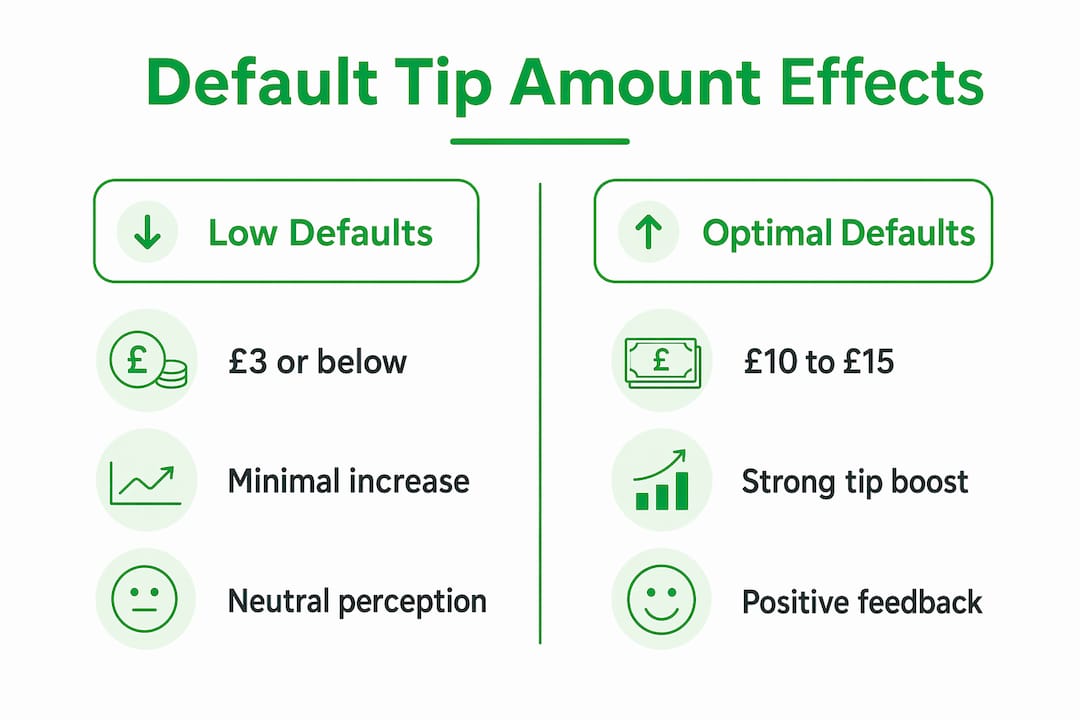
The same research identified an optimal default range of £10 to £15 for digital tipping interfaces. Below that range, the anchor is too low to shift behavior meaningfully. Above it, customers perceive the prompt as aggressive, which triggers resistance rather than generosity. The sweet spot communicates “this is what thoughtful people do” without feeling coercive.
| Default tip amount | Effect on average tip | Customer perception |
|---|---|---|
| Low (£3 or below) | Minimal uplift | Feels optional, low commitment |
| Mid-range (£10–£15) | Strongest average increase | Perceived as fair and normative |
| High (£20+) | Modest uplift, higher resistance | Can feel pushy or non-normative |
Digital tipping also introduces friction that cash tipping does not. The Edinburgh Fringe Festival research showed that multi-step digital processes and environmental factors like rain significantly reduce tipping engagement. A customer who would drop a coin into a busker’s case without thinking twice may abandon a QR code scan halfway through. Every additional tap is an opportunity for the social proof signal to lose its momentum.
The practical implication is clear: digital tipping platforms that reduce friction while preserving strong default anchors outperform those that prioritize flexibility over simplicity. For creators monetizing content through tips, the interface is not neutral. It is either working for you or against you.
Pro Tip: If you use a digital tipping link, test two default amounts with different audience segments over 30 days. The data will tell you where your audience’s normative anchor actually sits, which may differ from industry averages.
What are the benefits and pitfalls of social proof tipping for businesses?
The benefits of using social proof in tipping contexts are concrete and measurable. Clear normative signals simplify the decision for customers who would otherwise experience decision paralysis. Visible tip averages or suggested amounts reduce the cognitive load of choosing, which increases the likelihood of tipping at all. For content creators, this means that showing what your community typically contributes is not bragging. It is a service to your audience.
The core benefits break down as follows:
- Increased tip frequency: Customers who see others tipping are more likely to tip themselves, even in contexts where tipping was not previously expected.
- Higher average tip amounts: Normative anchors pull conformist tippers toward the displayed benchmark, raising the floor of what people consider acceptable.
- Reduced decision friction: Clear social proof signals eliminate the awkward uncertainty of “how much is appropriate here?”
- Stronger customer connection: When tipping feels like participation in a community norm rather than a transaction, it builds loyalty rather than resentment.
The risks, however, are equally real. Jamie Hyodo’s 2026 research found that tipping prompts in non-normative contexts generate customer reactance, reducing satisfaction and willingness to return. A coffee shop adding a tip prompt at a self-service kiosk violates the customer’s expectation of the interaction. The social proof signal backfires because it conflicts with the established norm for that setting.
“Unclear tipping norms increase negative reactions.” — The Conversation, 2026
The antidote is what researchers call social permission cues. Giving customers an easy, visible way to skip the tip, without guilt or friction, actually reduces reactance and preserves the positive effect of the social proof signal. Paradoxically, making it easier to say no increases the rate of yes.
How to apply social proof tipping strategies to grow engagement
Putting social proof tipping into practice requires more than adding a tip button to your checkout flow. The strategy has to account for context, timing, and the specific audience you are working with. Here is a structured approach that works for both businesses and individual creators:
-
Establish the norm visibly. Display what your community typically tips. A line like “Most supporters contribute $5” does more work than any persuasive copy because it tells the conformist tipper exactly where the benchmark sits. Shopify’s 2026 retail guidance confirms that effective social proof is easy to discover and presented at the moment of decision.
-
Set a mid-range default. Do not leave the tip amount blank. A blank field forces the customer to invent a number, which creates friction and often results in no tip at all. Set your default at a level that feels generous but not aggressive, based on your audience’s context.
-
Use testimonials and visible appreciation. Showing a supporter’s note or a thank-you video from a creator signals that tipping is a normal, valued part of the community. This is social proof in its most human form, and it works because it demonstrates that real people tip and feel good about it.
-
Respect autonomy explicitly. Include a clear “no tip” option that does not require explanation or justification. This is not a concession. It is a trust signal that makes the tipping prompt feel like an invitation rather than a demand.
-
Reduce friction at every step. The fewer taps between intent and completion, the higher your conversion rate. Payment methods like Apple Pay and Google Pay eliminate the friction of entering card details, which is one of the most common abandonment points in digital tipping flows. The interface design research on digital products confirms that reducing steps directly increases completion rates.
| Strategy | Best for | Key risk to avoid |
|---|---|---|
| Visible tip averages | Platforms with established communities | Displaying averages that feel aspirational rather than normative |
| Mid-range defaults | New creators and businesses | Setting defaults too high and triggering resistance |
| Social permission cues | High-friction or non-normative contexts | Making the “skip” option harder to find than the tip option |
| Testimonials and thank-you notes | Content creators and freelancers | Generic messages that feel automated rather than personal |
Pro Tip: Rotate your social proof signals. A single “most people tip $5” message loses impact over time. Pair it with a recent supporter note or a creator thank-you video to keep the normative signal feeling alive and genuine.
Key takeaways
Social proof tipping works because normative signals, whether defaults, visible averages, or community behavior, directly shape what individuals perceive as the appropriate tip amount, making interface design and context as important as the quality of service itself.
| Point | Details |
|---|---|
| Dual tipping motivations | Appreciators and conformists respond to different signals; target both with visible norms and mid-range defaults. |
| Default amounts are normative anchors | Research shows £10–£15 defaults maximize tips without triggering customer resistance. |
| Friction kills digital tipping | Multi-step processes and environmental barriers reduce engagement; minimize taps to maximize conversions. |
| Reactance is a real risk | Tipping prompts in non-normative contexts reduce satisfaction; always include a visible, easy skip option. |
| Permission cues preserve goodwill | Letting customers opt out freely increases trust and maintains the positive effect of social proof signals. |
Why I think most creators are leaving social proof on the table
After years of watching creators and small businesses set up tipping flows, the most common mistake I see is treating the tip prompt as an afterthought. They add a button, set no default, write no context, and then wonder why tips are sporadic. The psychology is clear: without a normative signal, you are asking every customer to invent a social norm from scratch. Most of them will not bother.
The subtler mistake is overreach. I have seen businesses set aggressive defaults or remove the skip option entirely, convinced that friction in the other direction will force generosity. It does not. It generates resentment, and resentment is the one thing that kills repeat engagement faster than anything else. The research on tipping norm backlash is unambiguous on this point.
What actually works is consistency. A creator who shows the same community norm repeatedly, through visible averages, genuine thank-you notes, and a clean interface, builds a tipping culture rather than a one-time transaction. The conformist in your audience needs to see the norm more than once before it feels real. Give them that repetition, and the appreciators in your community will do the rest of the work for you.
The platforms that get this right are the ones that treat social proof as a design principle, not a marketing tactic. That distinction is everything.
— Steve
Start collecting tips the way the research says works
Tipper is built around the exact principles this article covers. You get a personalized tipping link that works instantly, with no account required from your supporters. Payment through Apple Pay or Google Pay removes the friction that research identifies as the biggest barrier to digital tipping. Creators keep 100% of every tip, and supporters can attach a note or video message, creating the kind of personal connection that turns a one-time tipper into a loyal community member. If you are ready to put social proof tipping to work, start with Tipper and see how a well-designed tipping flow changes the numbers.
FAQ
What is social proof tipping?
Social proof tipping is the behavioral pattern where individuals adjust their tip amounts based on observing others’ tipping behavior or normative signals like default amounts and visible averages. It operates through both informational and normative social influence, as defined in Robert Cialdini’s foundational research on persuasion.
How does social proof influence how much people tip?
Social proof sets a perceived benchmark for what is “normal” to tip, which conformist tippers match and appreciators exceed. Research from 2026 shows that tipping levels rise in environments where social pressure and visible norms are stronger.
What is the best default tip amount for digital platforms?
Alice Fontana’s 2026 ACEI research found that £10–£15 defaults produce the strongest average tip increases without triggering customer resistance. Defaults below this range anchor too low; defaults above it feel coercive.
Why do tipping prompts sometimes backfire?
Tipping prompts backfire when they appear in contexts where tipping is not an established norm, generating customer reactance. Jamie Hyodo’s 2026 research found that non-normative tipping prompts reduce satisfaction and return intent, particularly when customers cannot easily skip the prompt.
How can content creators use social proof to increase tips?
Creators can display what their community typically contributes, use mid-range defaults, and share genuine supporter messages as social proof signals. Platforms like Tipper that support frictionless tipping through Apple Pay and Google Pay remove the technical barriers that prevent social proof from converting into actual tips.




[…] from a customer who tipped, or mentioning that tips help fund a specific goal, builds trust. Social proof influences tip amounts and lowers the hesitation barrier for first-time […]
[…] way. When audiences see that others have tipped, they are more likely to tip themselves. Social proof tipping influences future tip behavior by establishing a norm. If your comment section shows multiple tip acknowledgments, new viewers […]