


TL;DR:
- Tipping culture functions as a revenue and retention tool for small businesses by rewarding service quality and reducing turnover.
- Recent tax changes and digital tipping platforms enhance benefits, making tips more attractive for employees and easier to track for owners.
Tipping culture is a direct revenue and retention tool for small businesses, not just a social custom. When customers leave gratuity, they reward service quality, increase employee earnings, and create a feedback loop that keeps staff motivated and customers coming back. For small business owners in 2026, the advantages go further than the tip jar. Recent federal tax provisions, better compliance tools, and shifting tipping behaviors across industries have made understanding why tipping culture benefits small business more urgent and more profitable than ever.
Why tipping culture benefits small business employee retention
Tipping occupations face 70–80% annual turnover, a rate that costs small businesses thousands of dollars per replacement hire in recruiting, onboarding, and lost productivity. That number alone explains why smart owners treat tipping as a workforce strategy, not just a customer courtesy.
The 2025 federal tax provisions changed the math significantly. Tipped workers can now receive up to $25,000 in tax-free tip income, boosting their after-tax earnings by $1,300 to $5,500 per year. That increase makes tipped positions more attractive without requiring the employer to raise base wages.
The indirect benefits for small business owners are concrete:
- Lower recruiting costs. Tipped roles with strong earning potential attract more applicants, reducing time-to-hire.
- Reduced turnover. Employees who earn more stay longer, cutting the cycle of constant retraining.
- Workforce stability. A consistent team delivers consistent service, which drives repeat business.
- Competitive compensation. Owners can compete for labor by emphasizing tax-advantaged tip income rather than matching larger employers’ base wages alone.
Restaurant owners who prefer the tipped model often cite one specific reason: it links pay directly to customer interaction. Service quality stays high because employees have a direct financial incentive to perform. A flat wage removes that incentive and can quietly erode the service standard that keeps customers loyal.
In what ways does tipping culture increase small business revenue?
Tipping raises revenue in two ways: it increases the effective value of each transaction, and it encourages repeat visits from satisfied customers. Both effects compound over time.

The math is straightforward. A 15% tip on an $80 service yields $12, while a 20% tip on a $50 transaction yields $10. Mobile beauticians, personal trainers, and specialty tradespeople all operate at higher ticket sizes than a coffee counter. That means tipping culture has an outsized revenue impact in micro-businesses and service-based operations compared to traditional quick-service restaurants.
Tipping also expands economic participation beyond the industries where it started. Freelancers, content creators, and independent service providers now collect gratuity through digital platforms, adding a revenue stream that did not exist a decade ago. For a small business owner, this means tipping is no longer limited to the dining room.
| Service type | Average ticket | 15% tip value | Annual tip revenue (200 clients/month) |
|---|---|---|---|
| Mobile beautician | $80 | $12 | $28,800 |
| Personal trainer | $65 | $9.75 | $23,400 |
| Coffee shop | $8 | $1.20 | $2,880 |
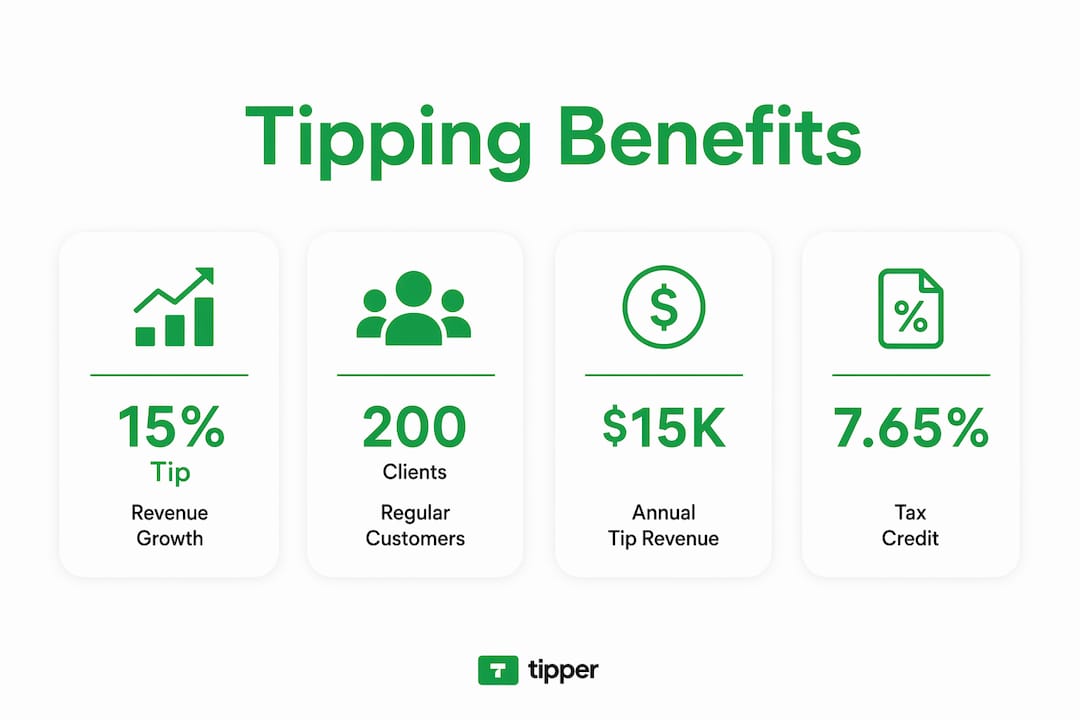
The table shows why digital tipping for local businesses matters most to service-based operators. The revenue gap between a mobile beautician and a coffee shop is not about tip percentage. It is about ticket size.
Pro Tip: Place your tip prompt immediately after the service is delivered, not at checkout. Customers tip most generously when the experience is still fresh.
What tax and operational advantages do small businesses gain from tipping?
The FICA Tip Credit is the most underused financial tool available to small business owners with tipped staff. It allows eligible employers to recoup the employer’s share of Social Security and Medicare taxes on reported tips, which equals 7.65% of tipped wages above the federal minimum wage threshold. A business with 10 tipped employees can save over $15,000 per year through this credit alone.
The credit applies to tips above the federal minimum wage, creating predictable recurring tax savings that small business owners can plan around. It also complements other available credits, including hiring and energy incentives, making it part of a broader tax planning strategy.
Beyond the credit itself, tipping culture improves financial operations in several ways:
- Reduced audit risk. The 2025 tax changes increased employee compliance in tip reporting, which means fewer under-reported tips and lower employer audit exposure.
- Better business data. Accurate tip records give owners cleaner payroll data and more reliable revenue forecasting.
- Cash flow predictability. Consistent FICA credit claims improve monthly cash flow, especially for seasonal businesses.
- Payroll efficiency. Electronic tip integration automates reporting and reduces manual reconciliation errors.
One misconception is worth addressing directly. Many owners assume the “no tax on tips” provisions are direct tax breaks for the business. They are not. The benefit flows to employees, but the indirect effect on employer audit risk, reporting accuracy, and workforce stability is real and measurable.
Pro Tip: Use payroll software with built-in tip tracking to automate FICA credit calculations. Manual tracking increases error rates and leaves money on the table.
How can small businesses avoid tipping fatigue while building loyalty?
Tipping fatigue is a real threat to customer goodwill. It arises when gratuity requests appear at low-value transactional points, such as a self-checkout kiosk or a counter where no service was performed. Customers who feel pressured to tip for nothing erode their trust in the business, not just the transaction.
The solution is selective placement and authentic service. Follow this sequence to build a tipping culture that customers respect:
- Deliver the service first. Never prompt for a tip before or during the transaction. The tip is a response to value received.
- Place the prompt at the right moment. Request gratuity immediately after service completion, when satisfaction is highest.
- Build a personal connection. Personalized customer relationships generate higher tips and repeat visits more reliably than any generic prompt.
- Limit tip requests to meaningful interactions. Reserve prompts for services where real effort and skill were involved.
- Use a frictionless payment method. Customers tip more when the process is fast and requires no account creation or extra steps.
Review your tipping etiquette practices regularly. What works in a salon may not translate to a food truck, and mismatched expectations damage the customer relationship faster than no tip prompt at all.
Pro Tip: Train your staff to thank customers by name after a service. That single personal touch increases tip frequency more than any digital prompt design.
What practical steps can small businesses take to implement tipping effectively?
Effective tipping implementation requires three things: the right technology, transparent communication with staff, and a compensation model that does not rely on tips as a substitute for fair base pay. Owners who treat tips as a bonus on top of fair wages build more stable teams than those who use tips to fill wage gaps.
Start with these steps:
- Set up electronic tip collection. Digital tip systems through platforms like Tipper let customers tip instantly via Apple Pay or Google Pay, with no account required. That frictionless experience increases tip completion rates. Learn how to get started with cashless tipping setup.
- Integrate tips into payroll. Automated tip processing is the foundation of compliance and audit readiness. Manual tracking creates gaps that trigger IRS scrutiny.
- Train staff on service standards. Employees who understand the link between service quality and tip income perform at a higher level consistently.
- Monitor tip data monthly. Tip trends reveal which services, staff members, and time slots generate the most customer satisfaction. Use that data to schedule your best performers during peak hours.
- Communicate the compensation model clearly. Employees who understand how tips affect their total income report higher job satisfaction and stay longer.
Small businesses that accept digital tips consistently outperform those relying on cash gratuity alone, because digital records create the compliance trail that protects both the owner and the employee.
Key Takeaways
Tipping culture benefits small businesses most when it is treated as a system, not an afterthought, combining tax savings, employee retention, and customer loyalty into one revenue strategy.
| Point | Details |
|---|---|
| FICA Tip Credit saves real money | Businesses with 10 tipped employees can save over $15,000 per year in payroll taxes. |
| Tax-free tips improve retention | Employees earning up to $25,000 tax-free in tips are less likely to leave, cutting turnover costs. |
| Ticket size determines tip impact | Service businesses with higher average tickets gain far more from tipping than quick-service counters. |
| Tipping fatigue hurts loyalty | Placing tip prompts at low-value moments erodes customer trust and reduces future tip rates. |
| Digital tip systems drive compliance | Automated electronic tip tracking reduces audit risk and improves payroll accuracy for small businesses. |
Tipping culture is more nuanced than most owners realize
After working with small business owners across service industries, one pattern stands out: the owners who benefit most from tipping culture are the ones who treat it as a management tool, not a windfall. They track tip data, train their teams around it, and use it to make scheduling and compensation decisions.
The 2025 tax changes created a real opportunity that most owners are still missing. The no-tax-on-tips provision does not cut your tax bill directly. What it does is make your tipped positions more attractive to quality workers, which lowers your recruiting costs and raises your service standard. That is an indirect benefit, but it is a durable one.
The owners I see struggle with tipping culture are the ones who over-prompt. A tip screen at a self-serve kiosk does not build loyalty. It builds resentment. The businesses that earn consistent, generous tips are the ones where the staff knows the customer’s name and the service feels personal.
My honest advice: stop thinking about tips as revenue and start thinking about them as a signal. High tip rates mean your service is working. Low tip rates mean something is off, and no amount of digital prompting will fix a service problem.
— Tipper
How Tipper helps small businesses collect tips without friction
Small business owners who want to grow revenue through tipping need a system that works as well as their service does.

Tipper gives you a personalized tipping link that customers can use instantly, with no account required, through Apple Pay or Google Pay. Customers complete the tip in seconds, and you keep 100% of every dollar. There are no platform fees eating into your gratuity. Tipper also supports thank-you messages via notes or video, which deepens the customer connection that drives repeat business. For owners who want to simplify tip management and improve compliance at the same time, Tipper is built for exactly that. Getting started takes minutes, and your first tip can arrive the same day.
FAQ
Does tipping culture actually help small business revenue?
Tipping directly increases per-transaction revenue and encourages repeat visits from satisfied customers. Service businesses with higher ticket sizes, such as mobile beauticians or personal trainers, see the largest revenue impact from consistent tipping.
What is the FICA Tip Credit and how does it benefit small businesses?
The FICA Tip Credit lets eligible employers recoup 7.65% of Social Security and Medicare taxes paid on reported tips above the federal minimum wage. A business with 10 tipped employees can save over $15,000 per year through this credit.
How does the no-tax-on-tips provision affect small business owners?
The provision benefits employees directly by making up to $25,000 in tip income tax-free. Small business owners benefit indirectly through better tip reporting compliance, lower audit risk, and improved employee retention.
What causes tipping fatigue and how can small businesses avoid it?
Tipping fatigue occurs when gratuity prompts appear at low-value or self-service moments where no meaningful service was performed. Small businesses avoid it by placing tip requests only after high-effort, personalized service interactions.
What is the best way to collect tips in a small business in 2026?
Electronic tip collection through a platform like Tipper is the most effective method. It removes friction for customers, automates reporting for payroll compliance, and creates a digital record that supports FICA credit claims.



Leave A Comment