
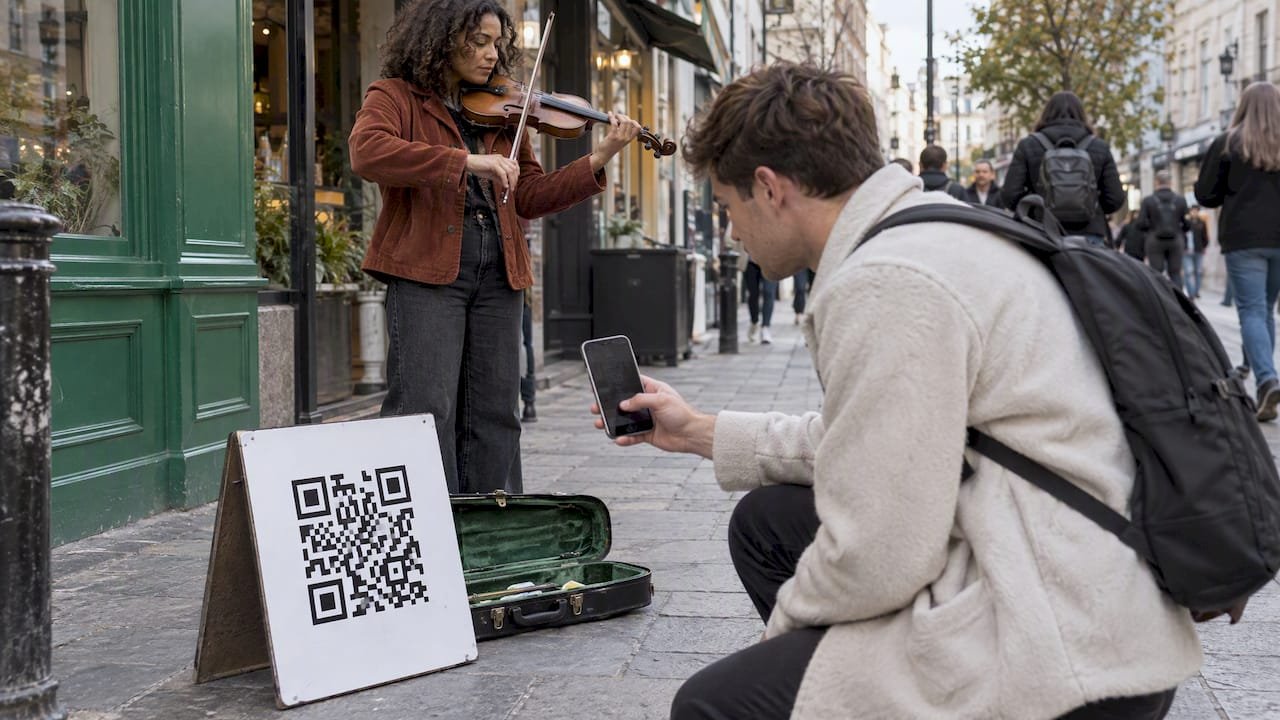
A QR code lets a passerby tip you from their phone in a few seconds, with no cash in their pocket and no app to download. The code itself is easy to make. Getting people to scan it is harder: where you put it, what the sign says, and what happens after the scan decide whether it earns anything. This guide covers the setup, the sign, the scam risks, and the tax and permit questions that come with it.
TL;DR
- Point the code at a mobile tip page that works without an account and accepts Apple Pay, Google Pay and cards. Every extra step costs you tips.
- A code alone does little. In a 2025 study of Edinburgh Fringe performers, 60% of performances got zero scans. Your spoken ask and your sign matter more than the code.
- Keep your cash bucket. It still works as social proof, and many people still prefer to pay in cash.
- Watch your sign. Scammers stick fake codes over real ones, so check yours after every break.
- Tips may be taxable income. Keep records and ask a tax professional about the new tip deduction.
Table of Contents
- Why performers are adding QR codes
- What the research says about scans
- Choose a tip page that does not ask for much
- Where and how to display the code
- Keep the cash bucket
- Protect your code from scams
- A perspective from Tipper
- Set up your tip link: a practical walkthrough
- Check the rules where you perform
- Taxes: tips are income
- What to expect: realistic earnings
- Common mistakes
- Tipper for street performers
- FAQ
- Sources
Why performers are adding QR codes
People carry less cash every year, and performers feel it. NBC News reported on subway musicians in New York who lean more on apps like Venmo because their buckets fill more slowly than they used to. One performer there had only a few dollars in her bucket halfway through a three-hour afternoon set.
A QR code answers a simple problem: someone enjoys your set, wants to give you $5, and has only a card. Without a way to pay, the moment passes. With a code on a sign, the tip takes a few taps.
A code is not a magic fix, though. Treat it as a second, quiet way to pay, set beside the way you already ask for tips.
What the research says about scans
The best data we have comes from a study by M. Elkins in the Journal of Cultural Economics on QR code tipping at the Edinburgh Fringe Festival. It looked at street acts using QR signage and found three things worth knowing:
- The average was low. Performances averaged about 3.2 scans, and 60% had none.
- The code was not the main driver. The type of act, the time and place, and the sign on display were all linked to scan activity. The “hat speech” that frames the ask also mattered.
- The tip page design counts. Clear suggested amounts reduce friction for the person paying.
The lesson is not that QR codes fail. It is that a code left on its own does not do the work for you. You have to tell the crowd it exists, make the sign readable from a distance, and make the payment page fast.
Choose a tip page that does not ask for much
The worst thing that can happen after a scan is a signup wall. Someone stands in a crowd, holds up a phone, and hits a screen asking for an email, a password or an app install. Most will leave.
What to look for in a tip page:
- No account for the tipper. They scan, pick an amount and pay.
- Apple Pay and Google Pay. One-tap payment on the phone they are already holding is the fastest option. If you want the details, our guide on Apple Pay and Google Pay tips explains how they work for small businesses.
- Preset amounts. Buttons for $3, $5 and $10, plus a custom option, mean nobody has to think about what to give.
- A page that loads fast on weak signal. Subway platforms and crowded plazas have poor reception. Test your page there, not on your home Wi-Fi.
- A personal touch. A short thank-you note, photo or video after the tip makes people feel seen, and that is what turns a one-time tipper into a fan.
- Clear payout terms. Know how and when you get paid, and what fees come out.
We built Tipper around these points, and the promo section below explains how it works.
Where and how to display the code
The study above and performers’ own reports point the same way: put the code where people already stop and look.
Placement
- At eye level, near the front. A sign on the ground gets stepped over. A sign on a stand, case or easel is seen.
- Next to your bucket or case. Seeing cash and a code together tells people both are fine.
- In your line of sight. You should be able to see the sign at all times. That matters for security, covered below.
- Facing the crowd, not the street. The code should face where the audience stands, so people can scan without moving.
Size and contrast
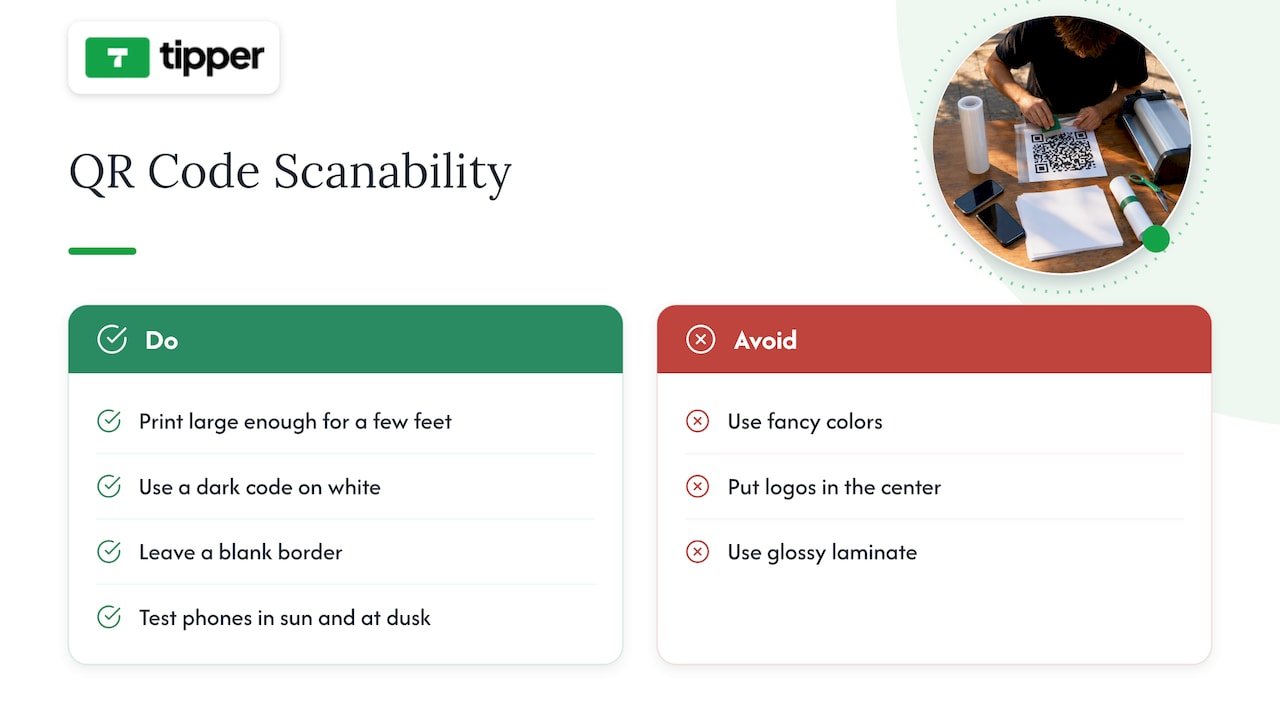
Print it big enough to scan from a few feet away. Use dark code on a white background, and leave a blank border around it. Skip fancy colors, logos in the middle and glossy laminate that reflects sun. Test the sign with two or three different phones, in sun and at dusk.
What the sign should say
A bare QR code looks like an ad. Give it a reason and an action. A short line works best, for example: “Enjoyed the show? Scan to tip. Apple Pay and Google Pay work.” Add your name or act name so people know whom they are paying, and the page they land on should show the same name.
Some performers use a screen or monitor with a looping video and a code. That can catch attention, but it adds cost, battery needs and theft risk. A printed sign on rigid board is a better start.
Your spoken ask
The research on hat lines is clear that framing matters. Say it out loud, once or twice per set, without apology: “If you don’t have cash, there’s a code on my sign. It takes ten seconds.” Point to it. Most people will not notice a sign unless you direct their eyes.
Keep the cash bucket
Going fully digital is a mistake for most street acts. The NBC reporting notes that performers who work the subway still see plenty of cash-paying listeners, and a visible bucket with some bills in it shows others that tipping is normal. Cash also needs no signal and no battery.
The approach that works for most acts is a bucket plus one digital option. We cover that in more detail in our piece on cash plus one digital option for musicians. Offering one clear code, rather than a list of Venmo, Cash App, PayPal and three more, keeps the choice simple.
Protect your code from scams
QR codes have a security problem that cash does not. The FTC has warned that scammers place their own codes over legitimate ones, which has been reported on parking meters. A sticker over your sign sends your tips to a stranger, and your audience will blame you.
Simple habits help:
- Never leave your sign unattended. Take it with you on breaks, or keep it in sight.
- Scan it yourself after every break. Check that the page shows your name and the right payee.
- Use a sign you can’t easily cover. A printed code on a board, with your name in large letters, is harder to fake convincingly than a loose sticker.
- Check the link. The FTC advises looking for misspellings or swapped letters in the URL before scanning.
- Know where to report. If you find a fake code on your sign or in your area, report it at ReportFraud.ftc.gov.
For a longer list of threats and fixes, see our guide to QR code tipping security.
A perspective from Tipper
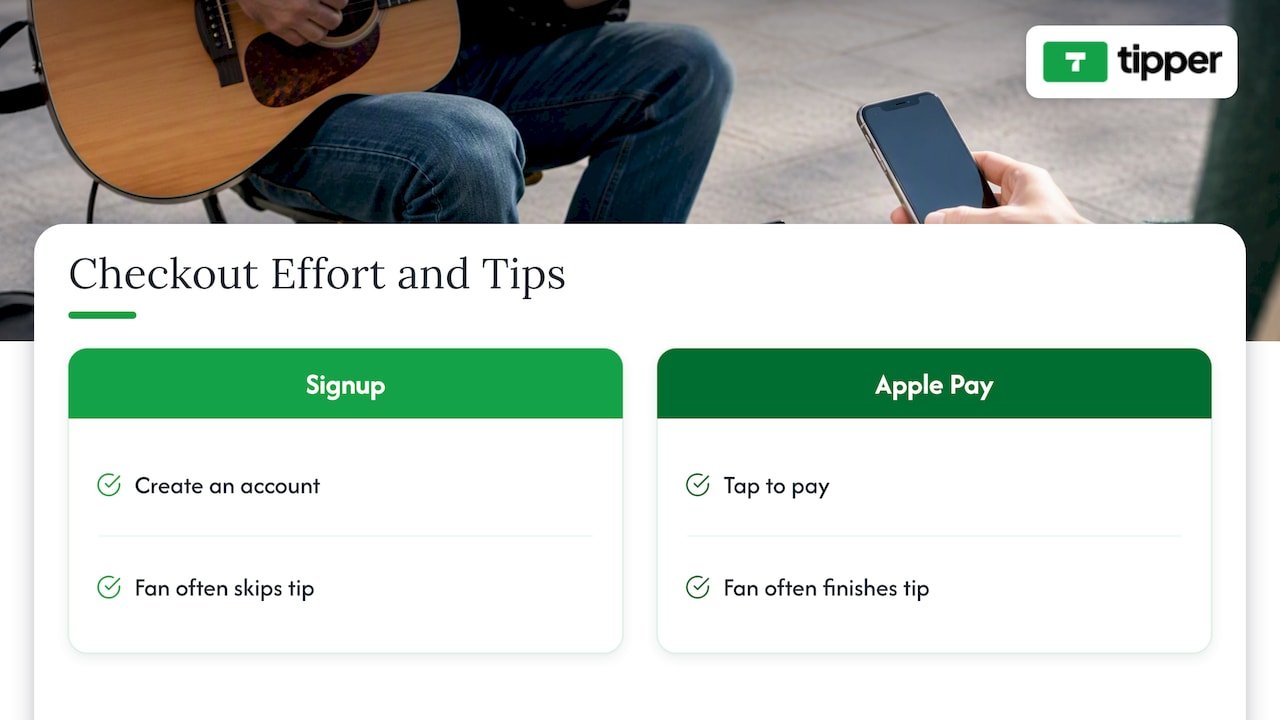
We talk with a lot of creators and small businesses about tips, and one pattern repeats. The tipper’s effort decides the outcome. A fan who has to create an account will often skip the tip, and a fan who can tap Apple Pay will often finish it.
That is why we do not require tippers to sign up. It is also why creators keep 100% of what they earn on the tip itself, with a small payment processing fee added at checkout rather than taken from the creator’s side. We would rather you spend your effort on the performance and the ask than on chasing a clunky checkout.
We also think the thank-you matters. A short note or video after a tip is cheap for you and meaningful for the person who gave. For a street performer, that is a way to turn a passerby into someone who follows you online and comes back.
One caution from experience: do the test before the big day. Scan your own code from a stranger’s point of view, on cellular data, standing where your audience stands. If anything is slow or confusing, fix it before you play.
— Tipper
Set up your tip link: a practical walkthrough
Here is a sequence that takes less than an hour.
- Create your tip page. Use your performer name, a clear photo and one sentence about what you do. Keep it short, since people read it on a small screen.
- Set suggested amounts. Three buttons is enough. Pick amounts that match your setting. A subway platform audience may tip differently than a festival crowd.
- Turn on Apple Pay and Google Pay. If you are using a business setup, our Apple Pay tipping setup guide walks through it.
- Download the QR code. Print it large on rigid board or a weatherproof sheet.
- Run a $1 test. Pay yourself from a different phone and confirm the money arrives where you expect. Our event QR tipping guide describes this test in detail.
- Add the link to your online profiles. The same page works in your Instagram bio, your YouTube description and a poster. Our guide to collecting tips with no signup covers that side.
- Note your pitch. Write the one line you will say out loud, and say it the same way each set so you can see what changes the results.
Check the rules where you perform
QR codes do not change the legal rules for busking. Those vary by city, and sometimes by block or transit system.
New York City is one example. According to a Village Sun summary of NYC busking rules, unamplified performers can generally play without a permit on most sidewalks and public spaces, while amplified performances need extra permission such as a sound device permit from a local police precinct. The same piece notes that subway performers can play in stations without a permit, with amplified sets restricted to mezzanines. Rules like these change, so confirm with the city or transit authority before you go out.
If your city has a licensing program, find out whether it limits signage, solicitation or electronic payments. Ask the permitting office directly, and keep a copy of any permit with you.
Taxes: tips are income
Every tip you receive is generally income, including digital ones. Keep a simple record of what you earn, by date and place if you can. Your tip platform’s payout history helps.
The IRS has said that, from 2025 through 2028, some workers can deduct up to $25,000 in qualified tips from taxable income each year, within limits that apply per return. Whether your busking tips qualify depends on the details of the rule, including which occupations count and your income. The IRS also has a publication on the new tip and overtime deductions that explains who may be eligible. Talk to a CPA or enrolled agent who works with self-employed or gig clients before you assume anything, especially if you busk alongside other work.
What to expect: realistic earnings
Earnings vary widely. The research summary behind this article notes that some veteran buskers in high-traffic areas can reach $100 per hour or more in good conditions, but that is the top end. Surveys of working musicians suggest many earn under $15,000 to $20,000 a year from music. Treat a QR code as one part of a broader mix: online tips, merch, private gigs and teaching.
The Edinburgh data points the same way. With 3.2 scans on average, a code adds a modest amount for most acts, and more for those who ask well and place the sign carefully. Track your own numbers for a few weeks before judging.
Common mistakes
- Sending people to a page that needs signup. Pick a no-account tip page.
- A tiny, low-contrast code. If a friend can’t scan it from three feet, resize it.
- No spoken ask. Many people will not notice the sign without a cue.
- Too many payment options. One code beats five logos.
- Skipping the test. Always pay yourself once before you perform.
- Leaving signage unattended. Fake stickers are a real risk.
- Dropping cash entirely. Keep the bucket.
Tipper for street performers
Tipper gives you a personalized tip link and QR code. Tippers pay with Apple Pay, Google Pay or a card, without creating an account. You can customize your tip page, send a thank-you as text, photo or video, and get paid directly. Creating and keeping an account is free, there is no subscription, and a payment processing fee is added at checkout. We do not publish a fee figure here, so check the current terms on the site. You can set up your tip link with Tipper and run your $1 test before your next set.
FAQ
How do I get a QR code for tips?
Sign up with a tipping service that gives you a personal link and a downloadable code, then print it on rigid board or weatherproof paper. Before you rely on it, pay yourself $1 from another phone to confirm it works. Add your name next to the code so people know whom they are paying.
Do QR codes actually increase busking income?
Sometimes, but not automatically. In the Edinburgh Fringe study, 60% of performances had no scans, and results depended on the act, the location, the sign and the way the performer asked. Acts that ask out loud and use a clear sign are in a better position than those who just leave a code out.
Should I stop using a cash bucket?
No. Reporting on New York street performers shows digital tipping growing, but cash still plays a role, and a bucket with bills in it signals to others that tipping is expected. Use both, with one clear digital option.
Can someone steal tips with a fake QR code?
Yes, it is a known scam. The FTC reports that scammers cover real codes with their own. Keep your sign in sight, scan it after every break, and report fakes at ReportFraud.ftc.gov.
Do I need to pay taxes on QR code tips?
Generally, tips are income and should be recorded. Some workers may qualify for a federal tip deduction of up to $25,000 through 2028, but eligibility depends on your occupation and income. Ask a tax professional who handles self-employment.
Sources
- QR code-enabled tips to street performers at the Edinburgh Fringe Festival, Journal of Cultural Economics
- See a QR code parked somewhere? Don’t scan it…yet!, FTC Consumer Advice
- Street performers rely more on apps like Venmo as cash fades, NBC News
- Busking in NYC: What’s legal and what isn’t?, The Village Sun
- Filing tips and updates for gig economy workers, IRS
- Publication 6133, IRS



Leave A Comment