

A coach tip link is a short personalized web address, plus a matching QR code, that lets a client, parent or athlete send you a tip from their phone in a few taps. No cash, no invoice, no app download. If you coach tennis, fitness, golf, swimming, business or life skills, it is the simplest way to turn “thanks, coach” into something you can actually bank.
This guide covers how to set one up, what to put on the page, where to share it so people really use it, and what to know about taxes. (If you landed here looking for the stagecoach robbery tips in Red Dead Redemption 2, this is a different kind of coach tip: real money, real clients.)
TL;DR
- A tip link lets anyone pay you by Apple Pay, Google Pay or card, and with Tipper the sender does not need an account.
- Put the link where clients already look: after-session texts, invoices, email signatures, and a QR code at the court, gym or studio.
- Tips are income. The IRS treats tips to self-employed workers as business income, so keep records from day one.
- Send a test tip from both an iPhone and an Android phone before you share the link.
- A short, personal thank-you after each tip is what turns a one-time tipper into a regular supporter.
Table of Contents
- Why coaches use tip links
- What a tip link actually does
- Set up your coach tip link in 10 minutes
- Where to share your tip link so it gets used
- Writing a tip page that earns more
- Thank people back, and turn tips into relationships
- Taxes and record keeping
- Our perspective: why the sender should not need an account
- Make your link live today
- Common mistakes to avoid
- FAQ
- Sources
Why coaches use tip links
Coaching is a relationship business. Clients and parents often want to say thank you beyond the session rate, especially after a breakthrough, a tournament, a season or a big personal goal. Cash tips are awkward, and many people carry none. Venmo-style handles create a different problem: you have to hand out a username, and the sender needs the right app.
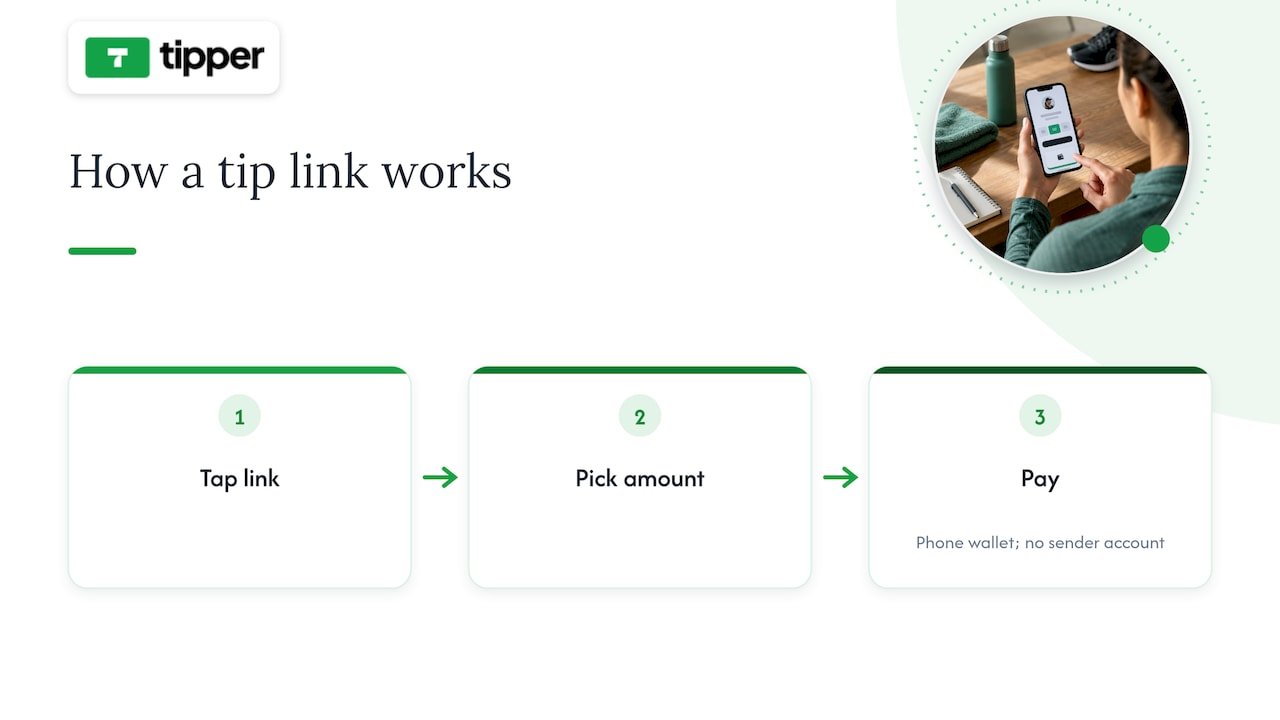
A tip link removes that friction. The client taps, picks an amount, and pays with the wallet already on their phone. Tipper’s guide to share tip links describes it as a direct route from the supporter’s wallet to the creator, with no account required on the sending side.
There is also a business reason. Research on the US creator economy suggests tipping is mainstream: in a 2025 survey covering Japan, the U.S. and China, 60% of respondents had tipped, and about 60% of single tips fell between $5 and $50. Those are small amounts, which is exactly why the checkout has to be effortless. Nobody fills out a registration form to send $10.
The same paper notes that supporting a creator is the main reason people tip, and that about a third tip for niche content. Coaching is niche by nature: a clients’ loyalty to the person who helped them is the whole point.
What a tip link actually does
A tip link is a personalized page with your name, photo and a short note, along with preset amounts and a pay button. Behind it sits a payment processor that handles the wallet handshake.
That last part matters more than it sounds. Offering Apple Pay and Google Pay on your own website needs merchant IDs and domain verification, which is developer territory. A dedicated tipping platform handles that setup, so the buttons just appear. That is the main reason a coach with a day job and a full schedule is better off with a hosted link than a DIY payment form.
With Tipper, you get:
- A personalized link and a QR code.
- Apple Pay, Google Pay and card payments for the sender.
- Customizable tip pages.
- Thank-you replies as text, photo or video.
- Direct payouts.
- Free account creation with no subscription. Creators keep 100% of their tips, and a small payment processing fee is added at checkout on top of what the supporter chooses to give.
Set up your coach tip link in 10 minutes
- Create your page. Sign up at Tipper and choose a short, recognizable link name. Your name or your business name works better than a slogan.
- Make the page about coaching. Use a real photo, ideally of you at work. Write one or two sentences: who you coach and what a tip supports (“Tips go toward court rental and new junior ball hoppers” beats “Support me”).
- Choose your amounts. Offer three presets plus a custom field. Our guide to three custom tip amounts that convert walks through how to pick them.
- Connect your payout. Complete payout onboarding early. Setup delays usually come from payment provider onboarding or domain verification, not from the page itself.
- Send test tips. Send a small test tip from an iPhone and from an Android phone to confirm Apple Pay and Google Pay both complete. Our research flags this as the most overlooked step in setting up a link.
- Download your QR code. Print it and save the image for slides, flyers and your phone’s lock screen.
- Share it. Do this only after steps 1 to 6 are done.
If you want a closer look at how a coaching page can read, see our tennis coach example.
Where to share your tip link so it gets used
The bio link alone is rarely enough. Tipper’s blog points out that conversions rise when the link is built into the workflows you already run: a line on invoices, your email signature, and a QR code at in-person events.
For coaches, that translates to specific moments.
| Moment | What to share | Why it works |
|---|---|---|
| End of a session | QR code on a small sign at the gym, court or studio | The client is happy and phone in hand |
| After a milestone or tournament | Link in a follow-up text | The gratitude is fresh |
| Monthly invoice | Optional tip line under the total | It sits where payment already happens |
| Email signature | Short link, no sales pitch | It is always there, never pushy |
| Group programs and camps | QR on the final-day handout | Parents decide as a family |
| Online coaching calls | Link in the chat or follow-up email | Remote clients have no “tip jar” otherwise |
Keep the ask soft. A single line such as “If today’s session helped, you can say thanks here” is enough. Never make a tip feel like part of the fee. Your rate is your rate, and tips stay optional.
Reaching new clients too
A tip link works best with an audience that already knows you. If you publish coaching content, such as drills, nutrition notes or game breakdowns, regular articles on your own site bring more people to the link. Tools like automated SEO article publishing can help you keep a content calendar going when you are busy running sessions.
Writing a tip page that earns more
People tip a person, not a payment form. A few rules we see working for creators of every kind:
- Say what the tip supports. Specific beats vague.
- Keep it to one screen. Photo, two sentences, amounts, button.
- Use presets in the $5 to $50 range. That is where most single tips land in the survey above. A custom field catches the generous outliers.
- Do not hide the privacy angle. Supporters who do not want to create an account or share details appreciate a page that asks for nothing extra.
If you also sell sessions or packages, keep that on a separate booking page. Mixing the two makes the tip feel like a purchase.
Thank people back, and turn tips into relationships
The reply is where a tip link becomes more than a payment tool. According to Tipper’s creator strategy resources, a personalized thank-you, whether text, photo or video, works as a retention tool that can turn a one-time supporter into a recurring one.
For a coach, that is natural. A 15-second video of you saying “Thanks, Maria, see you Thursday, keep working on that backhand” costs nothing and is remembered. Some ideas:
- Text for quick replies on busy days.
- Photo of the team or a finished drill board for group tips.
- Video for larger tips or milestones.
We have collected wording in our acknowledgment message templates, and a comparison of video thank-you platforms if you want to go further.
Taxes and record keeping
This is the part many coaches skip. Tips are income. The IRS says tips received by self-employed workers are income, generally included in gross receipts and reported as business income on Schedule C, and subject to self-employment tax. The same page describes a qualified tips deduction for certain cash tips that began in 2025, with conditions attached.
What that means in practice:
- Export or save your tip records monthly so they sit next to your session income.
- Do not assume a tip is exempt because it came through a link or an app. Whether any deduction applies to you depends on your situation.
- If you coach as an employee of a club or school, tips may follow different rules, and your employer may have its own policy on accepting them.
For your specific case, ask a CPA or enrolled agent. They can tell you how to treat tips alongside your session income and whether the deduction applies.
Our perspective: why the sender should not need an account
We built Tipper around a simple observation: the person who wants to say thanks is the one with the least patience. A parent standing at the edge of a court has about thirty seconds and one hand free. Every form field, password or app download costs you a tip.
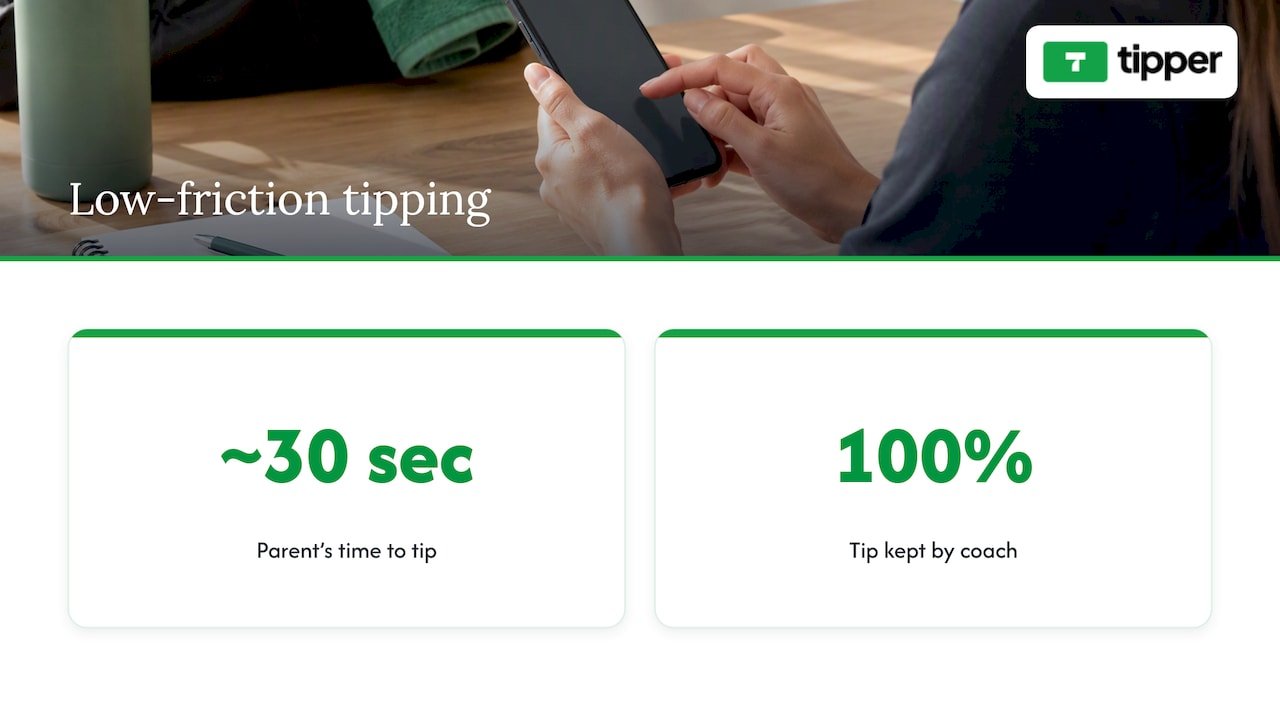
That is why we let supporters pay with Apple Pay, Google Pay or a card without signing up, and why we focus on what happens afterwards: you keep 100% of what the supporter gives, with a small payment processing fee added at checkout rather than taken out of your tip, and you can reply with a note, photo or video.
For coaches, we think the best use is modest and consistent. Do not expect a tip link to replace your rate. Treat it as a way to capture goodwill that used to evaporate, then use the thank-you reply to deepen the relationship. Over a season, small steady tips from many people tend to matter more than one big one, and the research on balancing a few large supporters against a broad base of small ones points the same way.
— Tipper
Make your link live today
If you want a tip page you can share by the end of the day, create your free Tipper page. Setup is free, there is no subscription, and a processing fee applies to each tip at checkout. For tips beyond coaching, such as invoices and in-person payments, our personalized tip link guide shows how creators get paid in minutes.
Common mistakes to avoid
- Skipping the test tip. A broken Apple Pay button on an iPhone embarrasses you in front of the very client who wanted to tip.
- Hiding the link. One buried bio link will not do the job. Use three or four touchpoints.
- Making the ask pushy. A tip is a thank-you, not a surcharge.
- Ignoring records. Tips add up, and tax season arrives anyway.
- Forgetting to reply. A reply costs seconds and drives repeat tips.
- Using the link for minors’ tips without a parent in the loop. Direct the link to parents and guardians, not to young athletes.
FAQ
Can I accept tips as a coach?
In most cases, yes, if you are self-employed and your client chooses to give. If you work for a club, school or gym, check your employer’s policy first, since some forbid tips or require them to be pooled. Report tips as income either way.
Do my clients need an account to tip me?
No. With Tipper, supporters can pay with Apple Pay, Google Pay or a card without creating an account. You create a free account to receive tips and payouts.
How much should I suggest as preset tip amounts?
Start with three presets and a custom field. In the 2025 survey cited above, about 60% of single tips fell between $5 and $50, so presets inside that range match how people tend to tip. Adjust once you see which amount your clients choose.
Are tips taxable?
Generally yes. The IRS says tips to self-employed workers count as income, typically reported on Schedule C. A tax professional can confirm how that applies to you.
What is the best way to share a coach tip link?
Use several moments rather than one: a QR code at your venue, a follow-up text after milestones, an optional line on invoices, and your email signature. Test the link on both iPhone and Android first.
Sources
- Why do audiences support creators online in the generative AI era? Survey results for Japan, the U.S. and China
- IRS: Tip recordkeeping and reporting
- Tipper Blog
- Tipper: share tip link guide




Leave A Comment