


Gig economy tipping is defined as the practice of customers paying extra money directly to gig workers, where those tips function as essential income rather than optional bonuses. Unlike a restaurant gratuity left after a satisfying meal, tipping in gig economy platforms like Uber Eats, DoorDash, and Instacart directly shapes which orders workers accept and how fast service arrives. Understanding what does gig economy tipping mean matters whether you are a customer placing a delivery order or a freelancer building income from platform work. The rules around gig economy tipping have also grown more complex in 2026, with new federal tax deductions under the One Big Beautiful Budget Act (OBBBA) and city-level regulations in places like New York City changing how tips are reported, paid out, and protected.
How does tipping in the gig economy differ from traditional tipping?
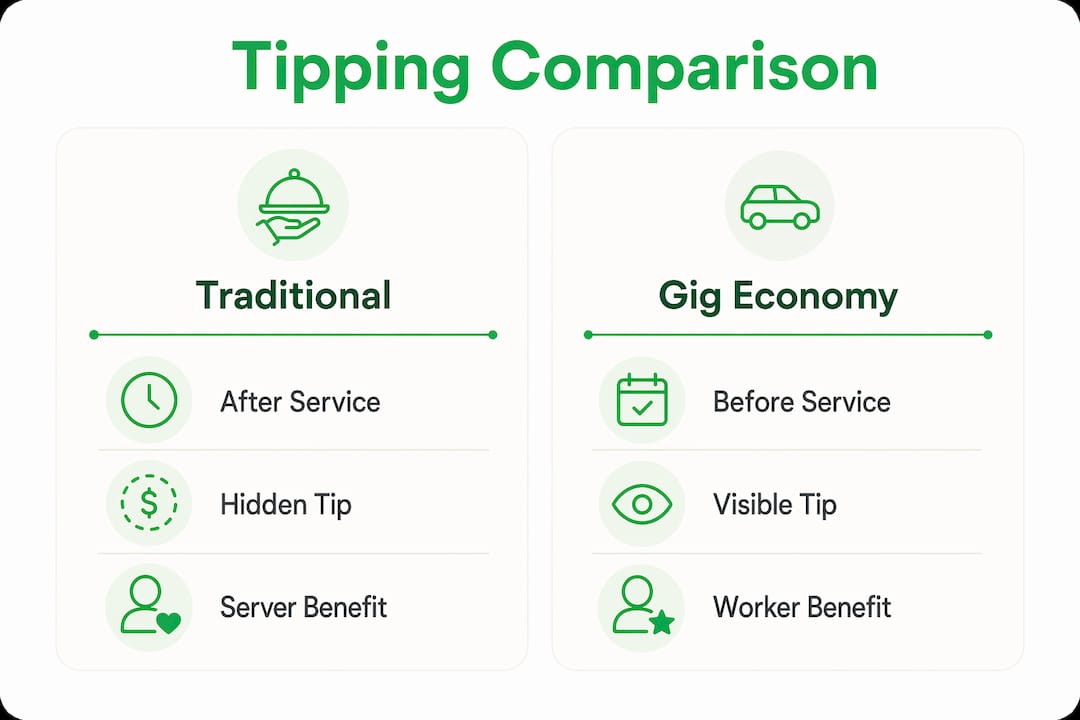
Traditional tipping and gig economy tipping share a name but operate very differently. In a restaurant, a customer tips after the service is complete. The worker has already committed to the job. In the gig economy, tips are visible before job acceptance, meaning a tip functions more like a bid than a reward.
This pre-tip visibility changes everything. A DoorDash driver scrolling through available orders sees the tip amount attached to each one. Orders with higher tips get picked first. Orders with no tip risk sitting unaccepted, which means slower delivery or none at all. Tipping in gig economy platforms is therefore a direct factor in service speed and reliability.

The table below shows the key differences between traditional and gig economy tipping:
| Feature | Traditional tipping | Gig economy tipping |
|---|---|---|
| Timing | After service is complete | Before job acceptance (pre-tip) |
| Worker visibility | Worker does not see tip in advance | Worker sees tip before accepting |
| Function | Reward for good service | Incentive to accept the job |
| Impact on service | Affects future behavior | Affects whether service happens at all |
| Platform involvement | Minimal | App controls display and payout timing |
One more critical distinction: tipping on platform fees does not benefit workers. If a delivery app charges a $5 service fee, tipping a percentage of that fee sends money to the platform, not the driver. Customers who want their tip to reach the worker should tip on the base order cost only.
Pro Tip: Always tip on the subtotal of your order, not the total including fees. Platform service fees go to the company, not the gig worker.
What are the standard tipping norms for gig services in 2026?
Tipping norms for gig services have settled into clear ranges that most workers and customers now recognize. The standard tip for delivery and rideshare services is 15–20% of the base order cost. Grocery delivery through platforms like Instacart warrants the same 15–20%, with 20–25% recommended for large or complex orders.
Several factors justify tipping above the standard range:
- Bad weather conditions. Rain, snow, or extreme heat adds physical difficulty and risk to every delivery. A higher tip acknowledges that reality.
- Large or heavy orders. A grocery run with 30 items requires more effort than a single bag. Tip accordingly.
- Long distance deliveries. Orders requiring significant travel time from the restaurant or store to your door cost the worker more in fuel and time.
- Exceptional service. Fast arrival, careful handling of fragile items, and clear communication all merit recognition above the baseline.
- Complex tasks. Gig work beyond delivery, such as TaskRabbit jobs involving assembly or moving, typically warrants tips at the higher end of the range.
Pre-tipping is now the norm on most major platforms. Uber Eats, DoorDash, and Instacart all prompt customers to tip before checkout. Skipping that prompt or entering zero is a choice that directly affects which worker takes the job and how quickly it gets done. Workers on these platforms see no-tip orders last, if at all.
What are the tax and legal implications of gig economy tipping?
Tax treatment of tips is one of the most misunderstood parts of gig economy tipping explained for new workers. Tips are taxable income. Every dollar a gig worker receives as a tip must be reported to the IRS, regardless of whether it came through the app or in cash.
The OBBBA introduced a significant change for 2025–2028. Eligible gig workers can deduct up to $25,000 of qualified tip income annually from their federal income tax. Income limits apply: $150,000 for single filers and $300,000 for joint filers. This deduction reduces federal income tax but does not reduce self-employment tax, which remains at 15.3%.
Key distinction: A voluntary tip from a customer is treated as worker income and may qualify for the OBBBA deduction. A mandatory service charge added by the platform is treated as platform revenue, not a tip, and does not qualify. Platforms must separate these two categories clearly to comply with IRS rules.
Gig workers have specific responsibilities when it comes to recordkeeping:
- Keep independent tip records. Platform 1099 forms may not capture all tips, especially cash payments. Workers should self-record tips beyond what the app reports.
- Track tip income by date and source. This supports accurate deduction claims and protects against IRS audits.
- Understand quarterly estimated taxes. Gig workers pay taxes quarterly. Tip income counts toward that estimate.
- Consult a tax professional familiar with gig work. The OBBBA rules are new, and the deduction eligibility criteria are specific.
New York City has gone further than federal law. NYC mandates that delivery platforms show tipping options before checkout, pay out tips within seven days, and maintain a minimum pay rate of $22.13 per hour separate from tips. That baseline pay requirement means tips in NYC function as earnings on top of a guaranteed floor, not as a substitute for fair wages.
How do platform design and regulations shape gig worker earnings?
App design is not neutral. The way a platform presents tipping options directly determines how much workers earn. When Uber moved its tipping prompt to after trip completion, tip rates dropped. When DoorDash made pre-tipping the default, acceptance rates for tipped orders rose. These are not coincidences. They are the predictable results of interface choices.
The financial stakes are significant. App design changes that obscure tipping have been linked to a $550 million drop in worker tips. That figure represents real income lost by real workers because a button moved on a screen. It shows how much power platforms hold over gig worker earnings.
Regulatory responses are catching up. NYC’s tipping transparency law is the most detailed in the country, but other cities are watching. The core requirements emerging from these regulations include:
- Tip visibility before checkout. Customers must see and interact with tipping options before completing a transaction.
- Payout timing limits. Tips must reach workers within a defined window, not held indefinitely by the platform.
- Separation of tips from fees. Platforms must clearly label what goes to the worker versus what stays with the company.
- Traceable tip records. App features for tipping should maintain a clear record from tip event to payout, supporting both tax compliance and dispute resolution.
These regulations protect workers, but they also benefit customers. When tipping is transparent and timely, workers trust the system more. That trust translates into better service quality and lower turnover on platforms.
Key Takeaways
Gig economy tipping is a fundamental income mechanism, not a courtesy, and its rules around timing, tax treatment, and platform design directly determine whether gig workers earn sustainable wages.
| Point | Details |
|---|---|
| Tips act as service bids | Workers see tips before accepting jobs, so higher tips get faster, more reliable service. |
| Standard tip range | Tip 15–20% on the base order cost for delivery and rideshare; up to 25% for complex orders. |
| OBBBA tax deduction | Eligible workers can deduct up to $25,000 in qualified tips from federal income tax for 2025–2028. |
| Platform design matters | Moving tipping prompts to post-checkout has been linked to a $550 million drop in worker tips. |
| Recordkeeping is required | Gig workers must track tips independently, as platform 1099 forms may miss cash or off-app payments. |
The uncomfortable truth about gig tipping most customers ignore
I have spent years watching the conversation around gig economy tipping circle the same tired debate: is it obligatory or optional? That framing misses the point entirely.
The real issue is that gig platforms were built on a wage model that depends on tips to function. When Uber Eats or DoorDash sets a base pay rate that does not cover a worker’s costs, the tip is not a bonus. It is the difference between a profitable shift and a losing one. Customers who skip the tip are not exercising a preference. They are transferring their cost onto the worker.
What I find more troubling is the platform side of this. A $550 million drop in tips from a single interface change is not an accident. It is a design decision with predictable financial consequences for workers. Regulations like NYC’s tipping transparency law exist because platforms cannot be trusted to prioritize worker earnings over engagement metrics.
My practical advice: treat the tip as part of the price. If a $25 delivery order feels expensive with a $5 tip, the real cost of that service was always $30. The platform just hid it. For gig workers, the OBBBA deduction is real money worth claiming, but only if you keep clean records. Do not rely on your 1099 alone.
— Steve
Tipper makes fair tipping straightforward for gig workers
Gig workers and freelancers deserve a tipping system that is transparent, instant, and puts earnings directly in their hands. Tipper was built for exactly that.

With Tipper, anyone can send a tip through a personalized link without creating an account. Payments arrive instantly via Apple Pay or Google Pay, and workers keep 100% of every tip. There are no platform fees skimming off the top and no waiting days for a payout. For workers who want clean, traceable tip records that support the OBBBA deduction, Tipper creates a clear payment trail from the moment a tip is sent. Explore no-fee tipping options and see how Tipper puts gig workers in control of their earnings at tipper.app.
FAQ
What does gig economy tipping mean?
Gig economy tipping is the practice of customers paying extra money to gig workers through platforms like Uber Eats or DoorDash, where tips serve as essential income and influence which jobs workers choose to accept.
Do gig workers pay taxes on tips?
Yes. All tip income is taxable. Under the OBBBA, eligible workers can deduct up to $25,000 in qualified tips from federal income tax for 2025–2028, but self-employment tax at 15.3% still applies.
How much should you tip a gig delivery worker?
The standard tip is 15–20% of the base order cost. For large, heavy, or complex orders, 20–25% is appropriate. Always tip on the subtotal, not the total including platform fees.
Why does app design affect how much gig workers earn in tips?
When platforms move tipping prompts to after checkout or make them harder to find, tip rates fall sharply. One documented case linked app design changes to a $550 million drop in total worker tips.
Are mandatory service fees the same as tips for gig workers?
No. Mandatory service charges go to the platform as revenue and do not qualify as tips under IRS rules. Only voluntary tips paid directly to the worker count as tipped income for tax purposes.




Leave A Comment