


The voluntary tip economy is an economic system where consumers choose to pay extra money directly to service workers, shifting part of the wage burden from employers to customers. This system generates over $50 billion annually in the United States alone. That figure reflects not just restaurant servers but millions of workers across hospitality, personal care, delivery, and increasingly, digital content creation. The formal industry term for this arrangement is “gratuity-based compensation,” though “voluntary tip economy” captures its defining feature: no law compels the payment. The federal tipped minimum wage has sat at $2.13 per hour since 1991, which means tips are not a bonus for most workers. They are the paycheck.
What is the voluntary tip economy and how is it defined?
The voluntary tip economy is defined as any compensation system where gratuities are paid at the customer’s discretion rather than mandated by contract or law. The word “voluntary” is the critical distinction. A service charge added automatically to a restaurant bill is not a tip in this sense. A customer choosing to tap 20% on a payment terminal after a haircut is.
This system operates across a wide range of industries. Restaurant servers, hotel housekeeping staff, taxi and rideshare drivers, salon workers, baristas, food delivery couriers, and now digital creators all participate in some form of voluntary tipping. The voluntary nature of tipping creates a power dynamic where the consumer holds direct financial influence over the worker’s income.

The scale of this system makes it economically significant. Millions of American workers depend on tips as their primary income source, not a supplement. That dependency shapes everything from how workers interact with customers to how businesses set base wages and staffing levels.
How does the voluntary tip economy operate in practice?
Standard tipping expectations at full-service restaurants run 18% to 22% of the bill. That range did not emerge from any law or industry standard. It grew from decades of social norm formation, reinforced by the stagnant federal tipped minimum wage.
Behavioral economists identify two types of tippers driving this system:
- Appreciators tip above the norm when service genuinely exceeds expectations.
- Conformists match the prevailing social expectation regardless of service quality.
Studies show that appreciators push average tip percentages upward over time, while conformists lock in those higher rates as the new baseline. This dynamic explains why the “standard” tip has crept from 15% to 20% over the past two decades.
Social pressure plays a real role. Nearly 66% of consumers feel obligated to tip when digitally prompted, even in contexts where tipping was not previously expected. That obligation is not legal. It is psychological.
Common voluntary tipping scenarios include:
- Tipping a restaurant server after a meal
- Adding a gratuity at a coffee shop counter via a tablet prompt
- Tipping a rideshare driver through an app after the ride ends
- Sending a digital tip to a content creator through a platform like Tipper
- Leaving cash for hotel housekeeping at checkout
Pro Tip: Always calculate your tip on the pre-tax subtotal. Tips based on the full bill include sales tax, which means you are tipping the government’s portion of the transaction, not just the service.
What economic impacts and challenges does the voluntary tip economy create?
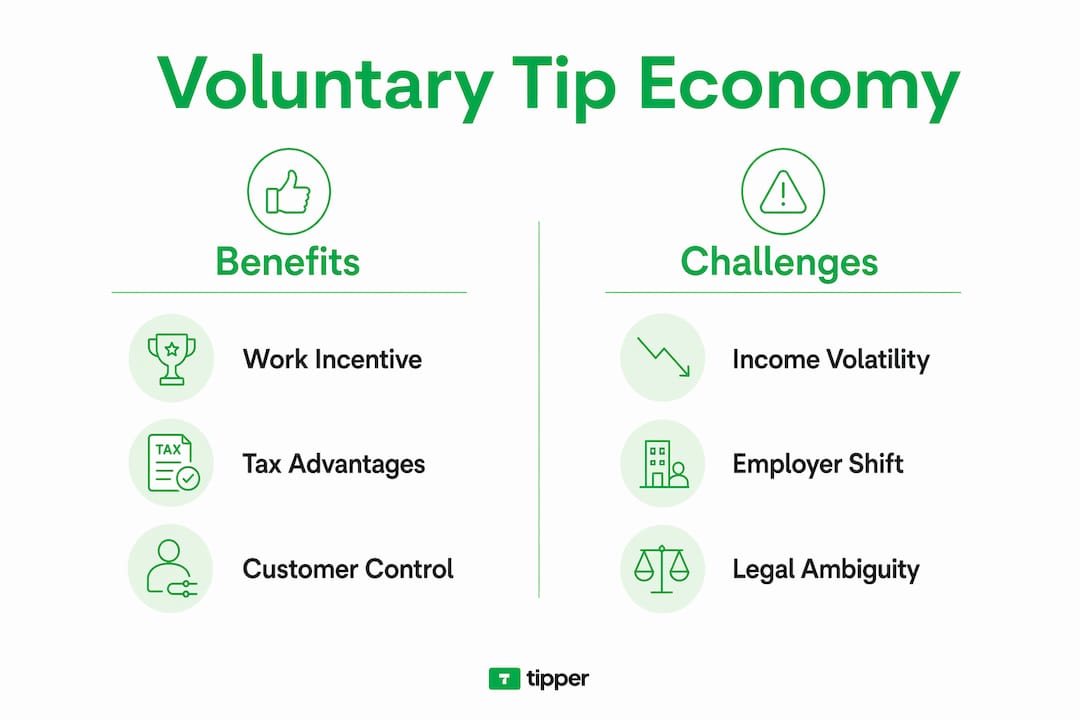
Tipping shifts the wage burden from employer to customer. That shift benefits businesses directly. Instead of raising base wages, employers rely on customer generosity to bring workers to a living wage. Behavioral economists note that this arrangement can mask higher effective prices while keeping listed wages artificially low.
The economic challenges for workers are real and underappreciated. Tip income is volatile. A slow Tuesday night, a bad weather week, or a single difficult customer can cut a worker’s income significantly. That volatility makes budgeting, saving, and qualifying for loans harder than it is for salaried workers.
| Factor | Salaried worker | Tipped worker |
|---|---|---|
| Income predictability | High | Low |
| Employer wage obligation | Full base wage | $2.13/hour (federal floor) |
| Performance incentive | Indirect | Direct but inconsistent |
| Tax reporting complexity | Standard W-2 | Requires tip documentation |
The performance incentive argument for tipping is weaker than it appears. Research shows that tip amounts correlate more strongly with bill size, time of day, and customer mood than with actual service quality. That means tipping does not reliably reward better service. It rewards circumstances.
Employers benefit from tip-based compensation through tax advantages, but those advantages come with limits and worker income preferences that complicate the picture.
Pro Tip: If you run a business that relies on tip income for worker compensation, digital tipping tools can improve income consistency by creating a reliable, trackable tip flow rather than depending on cash-only transactions.
How have digital tipping systems transformed the voluntary tip economy?
Digital tipping has changed the mechanics of how tips move from customer to worker. Payment terminals, mobile apps, QR codes, and digital checkout screens now prompt tipping at nearly every transaction. Digital tipping reduces transaction costs and increases transparency for both businesses and workers.
The tradeoff is timing. Cash tips go directly into a worker’s pocket at the end of a shift. Digital tips often process through payroll cycles, delaying access by days or even weeks. For workers living paycheck to paycheck, that delay creates real financial stress.
Digital systems also reshape tipping behavior through interface design. Point-of-sale systems often suggest inflated tip percentages as defaults, nudging customers toward higher amounts regardless of service quality. A screen showing 20%, 25%, and 30% as options makes 20% feel like the minimum, even when 15% was the norm a decade ago.
Key advantages of digital tipping for businesses and workers include:
- Automatic record-keeping for tax reporting
- Reduced risk of cash theft or loss
- Increased tip amounts through social prompting effects
- Easier tip pooling and distribution across teams
- Integration with payroll and accounting software
The role of social proof in digital tipping is significant. When customers see suggested amounts or know others are tipping, they tip more. That social signal does not exist with a cash jar on a counter.
What are the legal and taxation aspects of voluntary tip income?
Qualified tip income is defined under U.S. tax law as voluntary cash tips in traditionally tipped occupations, with deductions capped at $25,000 and specific reporting requirements attached. That definition matters because not all gratuities qualify for the same tax treatment.
Workers must report all tip income to their employer if tips exceed $20 in a calendar month. Employers then withhold federal income tax, Social Security, and Medicare on that reported amount. Failure to report tips accurately creates legal and financial risk for both parties.
Key legal points for tipped workers and employers:
- Workers must keep a daily tip record and report monthly totals to their employer.
- Employers must include reported tips in W-2 wage calculations.
- Mandatory service charges are not tips under IRS rules. They are wages.
- Independent contractors who receive tips report them directly on Schedule C.
- The $25,000 deduction cap applies to qualifying tip income under the 2025 reconciliation framework.
The distinction between employee and independent contractor matters significantly here. Employees have taxes withheld automatically. Independent contractors bear full responsibility for self-employment tax on tip income. Digital creators using platforms like Tipper typically fall into the independent contractor category and must account for this in quarterly estimated tax payments.
Pro Tip: Keep a simple daily log of tip income, even if your employer tracks digital tips. Your own records protect you in the event of a discrepancy during an IRS audit.
How can individuals and businesses engage with the voluntary tip economy?
Businesses that want to benefit from voluntary tipping without creating resentment need to make the process frictionless and pressure-free. The goal is to make tipping easy, not mandatory. Small businesses can set up cashless tipping with minimal technical overhead using QR codes or personalized tip links.
Practical strategies for businesses include:
- Display a QR code at the point of service so customers can tip on their own device.
- Avoid pre-selecting a tip amount on payment terminals. Let customers choose.
- Train staff to thank customers for tips without creating awkward expectation.
- Use tip links on receipts, email follow-ups, and social media profiles.
- Review tipping etiquette standards for 2026 to stay current with evolving norms.
For individuals, the voluntary tip economy now extends well beyond restaurants. 75% of consumers report that tipping expectations have expanded into professional and retail contexts. That expansion means navigating new situations where the right amount is unclear.
| Business type | Recommended tipping approach | Best format |
|---|---|---|
| Full-service restaurant | 18%–22% of pre-tax subtotal | Cash or card at table |
| Coffee shop or counter service | Optional, $1–$2 per order | Digital prompt or jar |
| Content creator or freelancer | Discretionary, any amount | Digital tip link |
| Personal care (salon, spa) | 15%–20% of service cost | Cash or app |
| Delivery service | $3–$5 per order minimum | In-app tip at checkout |
The local business advantages of digital tipping are clearest for small operators who lack the infrastructure of large chains. A personalized tip link costs nothing to create and can generate meaningful supplemental income with zero friction for the customer.
Key Takeaways
The voluntary tip economy functions as a customer-driven compensation system that transfers wage responsibility from employers to consumers, creating both opportunity and financial risk across service industries.
| Point | Details |
|---|---|
| Scale of the system | U.S. tipping generates over $50 billion annually, making it a core income source for millions of workers. |
| Behavioral drivers | Appreciators and conformists together push average tip rates higher over time, independent of service quality. |
| Digital tipping tradeoffs | Digital systems increase transparency and tip amounts but delay worker access to funds compared to cash. |
| Tax obligations | Workers must report tips exceeding $20 per month; qualified tip deductions are capped at $25,000 under current law. |
| Business strategy | Frictionless, pressure-free tipping systems generate more voluntary tips than aggressive prompting or mandatory pools. |
The voluntary tip economy is more complicated than it looks
I have watched the voluntary tip economy shift dramatically over the past decade, and the most important thing I have learned is this: the word “voluntary” does not mean what most people think it means.
When a payment terminal shows you three tip options and a “no tip” button in small gray text at the bottom, that is not a neutral choice. The interface is designed to make tipping feel like the default and declining feel like a social failure. That is not voluntary in any meaningful sense. It is engineered consent.
The businesses that build genuine goodwill through tipping are the ones that make it easy and never make it awkward. A QR code on a table, a tip link in an email, a simple prompt at the end of a digital transaction. No guilt, no theater. Just an honest offer.
The future of voluntary tipping is not in restaurants. It is in the creator economy, in freelance services, and in any context where one person delivers real value to another and wants a direct way to receive appreciation. That is where the model works best, because the relationship is personal and the gratitude is genuine.
— Tipper
Tipper makes voluntary tipping work for creators and businesses
Receiving tips should not require a complicated setup or force your supporters to create an account. Tipper gives creators and businesses a personalized tip link that anyone can use instantly, with Apple Pay, Google Pay, or a card, no login required.
Creators keep 100% of every tip they receive. There are no platform fees eating into earnings, and every transaction comes with the option for a thank-you note or video, so the connection between creator and supporter stays personal. Whether you run a small service business or create content online, start accepting tips through Tipper today. For businesses looking to move beyond traditional checkout prompts, point-of-sale tipping alternatives offer a better path to consistent, frictionless gratuity income.
FAQ
What is a voluntary tip economy?
The voluntary tip economy is a compensation system where customers choose to pay gratuities directly to service workers, with no legal obligation to do so. It generates over $50 billion annually in the U.S. and serves as a primary income source for millions of workers.
How does tipping work in the U.S.?
Standard tips at full-service restaurants range from 18% to 22% of the pre-tax bill, driven by a federal tipped minimum wage of $2.13 per hour. Customers tip at their discretion, though digital prompts increasingly shape the amounts they choose.
Are tips taxable income?
Yes. Workers must report all tip income exceeding $20 per month to their employer, who withholds federal income and payroll taxes. Qualified tip income deductions under current U.S. law are capped at $25,000.
What are the advantages of voluntary tipping for businesses?
Voluntary tipping reduces direct wage costs for employers and creates a tax-advantaged compensation structure. Businesses that implement frictionless digital tipping systems also see higher average gratuities compared to cash-only setups.
How has digital tipping changed the tip-based economy?
Digital tipping increases transparency and average tip amounts through interface prompts and social proof effects, but it delays worker access to funds compared to immediate cash. Nearly 66% of consumers feel obligated to tip when digitally prompted.




Leave A Comment