

TL;DR:
- Tip links are shareable URLs that allow customers to send instant digital tips without creating accounts. Promoting these links after providing value and placing them strategically increases recurring income and customer engagement. Small businesses should focus on a few high-impact channels and optimize post-tip experiences to build long-term supporter relationships.
A tip link is a shareable URL that lets customers send a digital tip to a business or creator instantly, without creating an account or handling cash. Knowing how small businesses promote tip links is the difference between a link that sits unclicked and one that generates real, recurring income. The most effective promotion strategy puts value first, places the tip option at the right moment, and removes every possible point of friction. Platforms like Tipper make this achievable by letting anyone pay via Apple Pay or Google Pay, with the business keeping 100% of earnings.
How do small businesses promote tip links in their content?
Promoting tip links works best when the tip option appears after the customer has already received value. A coffee shop owner who posts a short video tutorial on latte art, then places a tip link at the end, converts far better than one who opens with “support us here.” The tip feels like a natural response to something the customer already enjoyed.
Placement follows the logic of visual hierarchy. Human eyes scan digital content in a Z-pattern, which means bottom-right placement is the natural landing spot for a call-to-action. Putting your tip button there, rather than at the top of the page, aligns with how customers actually read. This one change alone improves click rates without any additional promotion.
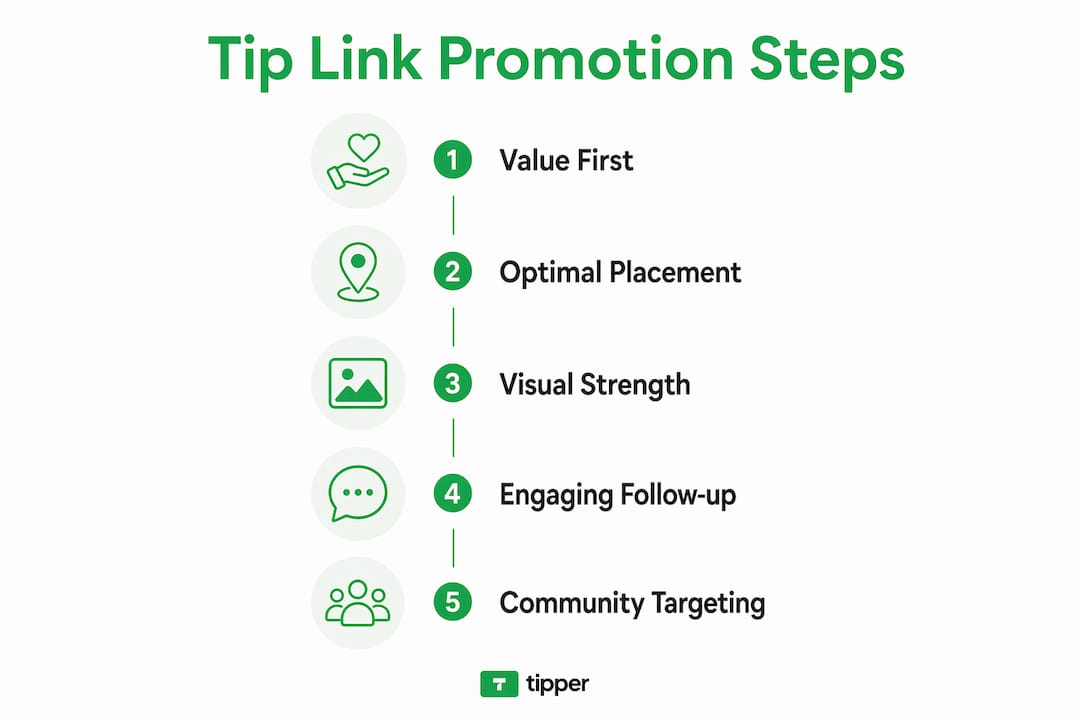
Visual content strengthens the tip page itself. Businesses with high-quality photos on profiles see a 42% increase in customer direction requests. That same principle applies to tip pages: a well-photographed page signals professionalism and builds the emotional connection that motivates tipping.

Adding a short personal video takes it further. A personalized video on a tip page can increase tip likelihood by up to 18% per transaction. A 30-second clip where you thank customers by name or explain what tips support makes the transaction feel personal, not transactional.
Word choice matters more than most small business owners realize. Framing the ask as “leave a tip” instead of “make a donation” reduces psychological pressure and frames the exchange as casual appreciation. “Donation” implies charity and creates hesitation. “Tip” implies a normal, low-stakes reward for good service.
- Place the tip button at the end of content, not the beginning
- Use high-quality photos and a short personal video on your tip page
- Write “leave a tip” instead of “donate” in all customer-facing copy
- Apply Z-pattern visual hierarchy to position your call-to-action naturally
- Lead with the story or service, then introduce the tip option
Pro Tip: Never open an email, post, or page with your tip link. Share something genuinely useful first. The tip link performs best as a quiet, natural conclusion to a moment of real value.
What marketing strategies help small businesses promote tip links?
The most common mistake in tip link promotion is spreading effort across too many platforms. Focusing on 3–5 high-impact channels produces better results than posting the same link everywhere and hoping something sticks. Pick the platforms where your customers already spend time, then commit to those fully.
Here is a practical sequence for building a tip link promotion strategy:
-
Identify your top 3 platforms. For most local businesses, this means Instagram, a Google Business Profile, and either TikTok or Facebook, depending on the customer’s age range. Choose based on where your existing audience already engages with you.
-
Lead every post with value. A hair stylist might share a quick tip on protecting color-treated hair. A personal trainer might post a 60-second mobility drill. The tip link appears at the end, after the customer has already received something useful. Value-first communication drives higher engagement than leading with the ask.
-
Balance promotional and educational content. A rough guide: for every post that mentions your tip link, publish two or three posts that ask nothing of the customer. This ratio keeps your audience engaged rather than fatigued.
-
Use social proof deliberately. Sharing a thank-you message from a customer who tipped, or mentioning that tips help fund a specific goal, builds trust. Social proof influences tip amounts and lowers the hesitation barrier for first-time tippers.
-
Write calls-to-action that are specific and honest. “If today’s tutorial helped you, a small tip means I can keep making these” outperforms “support my work” every time. Specificity creates connection. Vagueness creates distance.
Micro-communities, such as local Facebook groups, neighborhood apps, or niche subreddits, often outperform large general audiences for tip link promotion. A smaller, warmer audience converts at a higher rate than a large, cold one.
How can you optimize the post-tip experience for more leads?
The moment right after a customer tips is the highest-motivation point in the entire interaction. Most businesses waste it by showing a generic “thank you” screen and nothing else. That screen is prime real estate for building a longer relationship.
Post-tip screens are an underutilized opportunity to capture leads and offer value when customer motivation peaks. The customer has just demonstrated goodwill. They are warm, engaged, and open to the next step. Use that moment intentionally.
- Invite mailing list sign-ups immediately. Customers who have just tipped are significantly more likely to subscribe. Research shows 18% of customers join mailing lists when invited right after a positive tip transaction. That is a meaningful conversion rate from an audience you already have.
- Offer exclusive content as a reward. A recipe, a discount code, a behind-the-scenes video, or early access to a new product gives the customer a reason to stay connected beyond the tip.
- Automate the follow-up. Set up a simple email sequence that triggers after a tip interaction. The first message thanks the customer. The second shares something valuable. The third introduces your next offer or event.
- Ask for a review. Customers who tip are already satisfied. A post-tip prompt asking for a Google or Yelp review converts at a higher rate than a cold review request sent days later.
Pro Tip: Treat the post-tip screen like a landing page, not a receipt. Design it with the same care you would give any customer-facing page. One clear next step performs better than three competing options.
Common mistakes small businesses make when promoting tip links
The single biggest error is leading with the tip link before establishing any value. Sending a cold message that opens with “here’s my tip link” signals desperation and creates immediate resistance. The link should always follow content, not precede it.
Several other mistakes consistently reduce tip conversion rates:
- Using “donation” language. The word triggers a charity mindset. Customers feel pressure rather than appreciation. Stick with “tip” in every context.
- Sending customers off-site. Embedding a tips block on your page outperforms sending users to an external link. Every extra click is a chance for the customer to drop off. Keeping the tipping experience on your own page maintains trust and context.
- Setting tip amounts too high. Preset amounts between $1 and $10 keep tipping approachable. A $25 default tip amount creates hesitation. A $3 default feels easy and low-stakes.
- Spreading across too many channels. Posting your tip link on eight platforms with minimal effort on each produces worse results than owning two or three platforms deeply.
- Placing the tip button at the top of the page. Customers who have not yet consumed your content have no emotional reason to tip. Position the button at the bottom, after the value has been delivered.
For small businesses just starting out, cashless tipping setup does not require technical expertise. The key is choosing a platform that handles payment processing without adding friction for the customer.
Key Takeaways
Promoting tip links effectively requires value-first content, precise placement, and a post-tip strategy that converts satisfied customers into long-term supporters.
| Point | Details |
|---|---|
| Lead with value, not the link | Share useful content first; introduce the tip option only after the customer has received something. |
| Place the tip button strategically | Bottom-right or end-of-scroll positions align with natural visual scanning and improve click rates. |
| Use “tip” not “donation” | Casual framing reduces psychological pressure and increases willingness to complete the transaction. |
| Optimize the post-tip screen | Invite mailing list sign-ups and offer exclusive content when customer motivation is at its peak. |
| Focus on 3–5 platforms | Concentrated effort on a few high-impact channels outperforms scattered promotion across many. |
What I’ve learned about tipping psychology in small business settings
Most small business owners treat the tip link as a payment tool. It is actually a relationship signal. When a customer tips, they are saying they feel connected enough to give something back without being required to. That distinction changes how you should promote it.
The businesses I have seen succeed with tip links share one trait: they frame tipping as casual reciprocation, not a financial ask. A barista who says “tips help me keep creating content for you” lands differently than one who says “please support my work.” The first is a conversation. The second is a transaction.
Digital payment behavior has shifted significantly. Customers who pay with Apple Pay or Google Pay are already conditioned to quick, frictionless transactions. They do not want to create accounts or enter card numbers. Meeting them where they already are, with a payment method they trust, removes the last barrier between intention and action.
My honest advice: experiment with your framing, your placement, and your post-tip offers. What works for a freelance photographer will not work identically for a local bakery. The principles are consistent. The execution needs to fit your specific audience.
— Tipper
Tipper makes tip link promotion simple for small businesses
Small businesses that want to put these strategies into practice need a tipping platform that removes friction at every step. Tipper is built for exactly that.
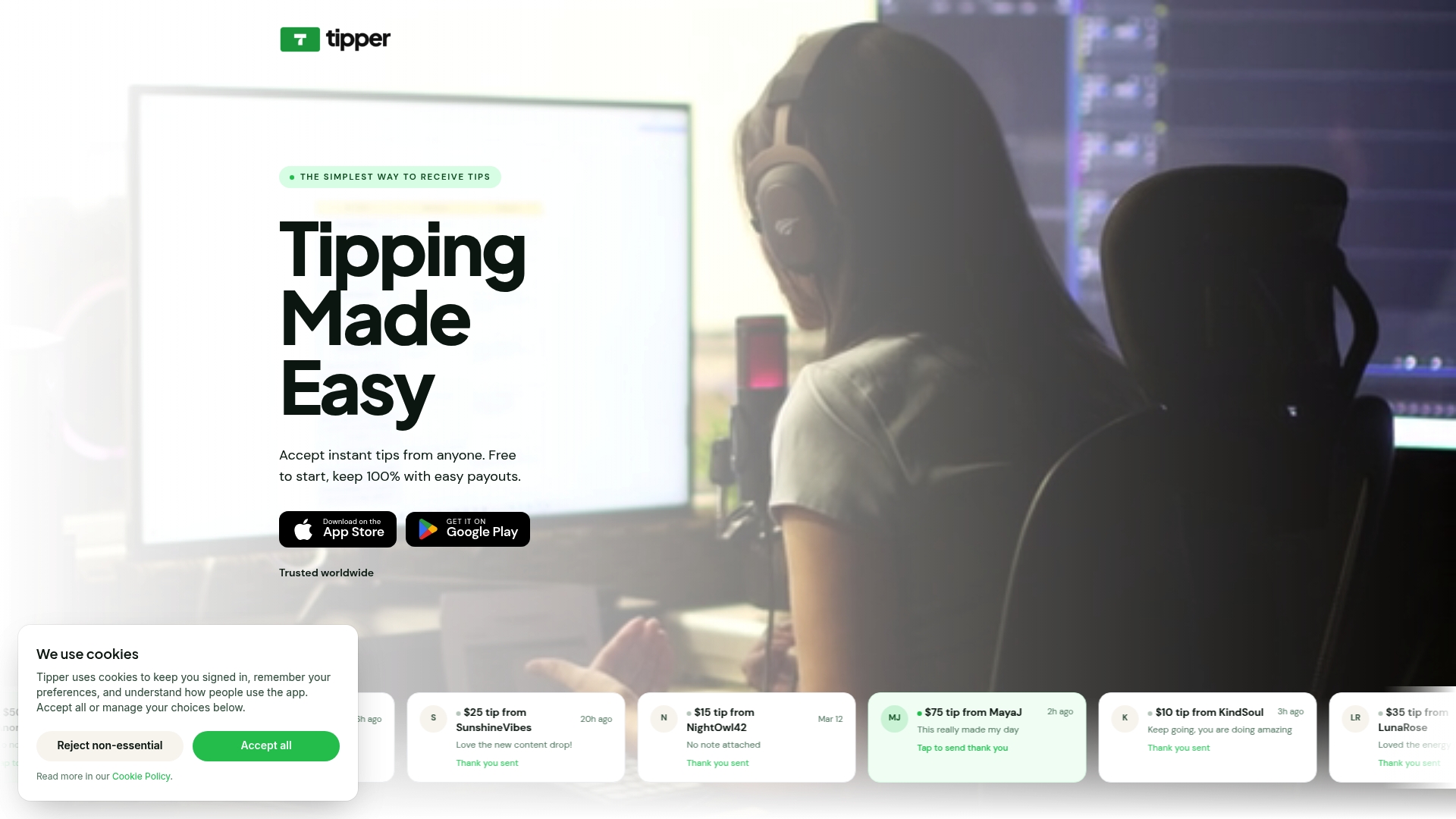
Tipper lets customers tip instantly using Apple Pay or Google Pay, with no account required on either side. The tips block feature embeds directly on your page, so customers never leave your content to complete a tip. Tipper integrates with Stripe and PayPal, keeping payment processing reliable and familiar. Businesses keep 100% of every tip, and thank-you messages via notes or video add the personal touch that turns a one-time tipper into a repeat supporter. If you are ready to put a frictionless tipping system to work for your business, Tipper is where to start.
FAQ
What is a tip link and how does it work?
A tip link is a shareable URL that lets customers send a digital payment to a business or creator instantly, without creating an account. Platforms like Tipper process the payment through Apple Pay, Google Pay, or card, and the business receives the funds directly.
Where should I place my tip link for the best results?
Place your tip link at the end of your content, after the customer has received value. Bottom-right placement on a web page aligns with natural Z-pattern visual scanning and produces the highest click rates.
How do I get customers to actually use my tip link?
Lead with useful or entertaining content, then introduce the tip link as a natural conclusion. Value-first promotion consistently outperforms cold link sharing, because customers tip in response to a positive experience, not a request.
What preset tip amounts work best for small businesses?
Preset amounts between $1 and $10 keep tipping approachable and reduce hesitation. Higher default amounts create psychological resistance and lower overall conversion rates.
How can I use the post-tip screen to grow my business?
Use the post-tip screen to invite mailing list sign-ups, offer exclusive content, or request a review. Research shows 18% of customers who have just tipped will join a mailing list when invited at that moment, making it one of the highest-converting lead capture opportunities available.




Leave A Comment