

TL;DR:
- Using a single, persistent hub URL with contextual copy and tracking UTMs maximizes tip collection across your content. Embedding the link in bios, descriptions, and signatures, and following up with thank-you messages, encourages repeat support. Tips are taxable income in the U.S., so creators should record payouts and verify payout methods regularly.
One persistent tip-collection link, placed in the right spots with clear context and a UTM parameter, is the fastest way to start collecting tips without ever breaking a historical link. Set it up once, share it everywhere, and let the link do the work.
The verdict: use a single hub URL (your collection page), embed it with contextual copy in your bios, video descriptions, and blog posts, and follow up every tip with a personalized thank-you. Tipper is a practical implementation option that handles the full flow, from Apple Pay checkout to video thank-you messages, with no subscription required. Success looks like a steady click-to-tip conversion rate and repeat supporters driven by your thank-you follow-up.
Research on AI citation behavior confirms that hub pages backed by well-linked content clusters are more likely to be discovered and cited by AI crawlers, including GPTBot and PerplexityBot. That same logic applies to your tip link: one authoritative, persistent URL beats a dozen scattered links every time.
Table of Contents
- How do you link a tip collection to your content fast?
- Where should you place your tip link for maximum visibility?
- What copy actually converts tips?
- What technical checks protect your tip link?
- What do U.S. creators need to know about taxes and payouts?
- How do you diagnose and fix a tip link that isn’t converting?
- Tipper makes the tip link setup straightforward
- Key Takeaways
- Why the “just add a link” advice misses the point
- Useful sources
- FAQ
How do you link a tip collection to your content fast?
Here is a zero-to-live checklist you can complete in 10–15 minutes.
- Create your hub link. Set up a persistent collection page with a fixed URL (e.g.,
tipper.app/yourname). This is the only URL you will ever share. - Set accepted payment methods. Enable Apple Pay, Google Pay, and card payments so tippers face no friction at checkout.
- Add branded microcopy. Write a one-line description of what tips support (your next video, your newsletter, your work). Add a suggested tip amount.
- Write a thank-you message. Draft a short text note, or record a brief video, that goes out automatically after each tip.
- Copy the link to every placement. Bio, video description, email signature, and any pinned posts.
- Add a UTM parameter. Append
?utm_source=instagram&utm_medium=bio&utm_campaign=tips(adjust per platform) so you know which placement drives conversions. - Test the full payment flow. Complete a real test transaction on mobile, including Apple Pay, before going live.
- Confirm your payout destination. Connect your bank account or preferred payout method and verify it works.
- Add a one-line income disclosure. Tips are taxable income in the U.S. A simple “Tips are appreciated and are considered income” note on your page is good practice.
Pro Tip: Never change the URL you share publicly. Update the collection page itself whenever your content changes. Every archived post, old tweet, and email signature stays working automatically, because the URL never moves.
Open your tip link in a new tab when embedding it in blog posts. That keeps readers on your page while they complete the payment.
Where should you place your tip link for maximum visibility?
Placement determines whether your tip link gets seen or ignored. A persistent hub URL lets you update your collection page without touching any of the posts that link to it, which means placement is a one-time decision per platform.
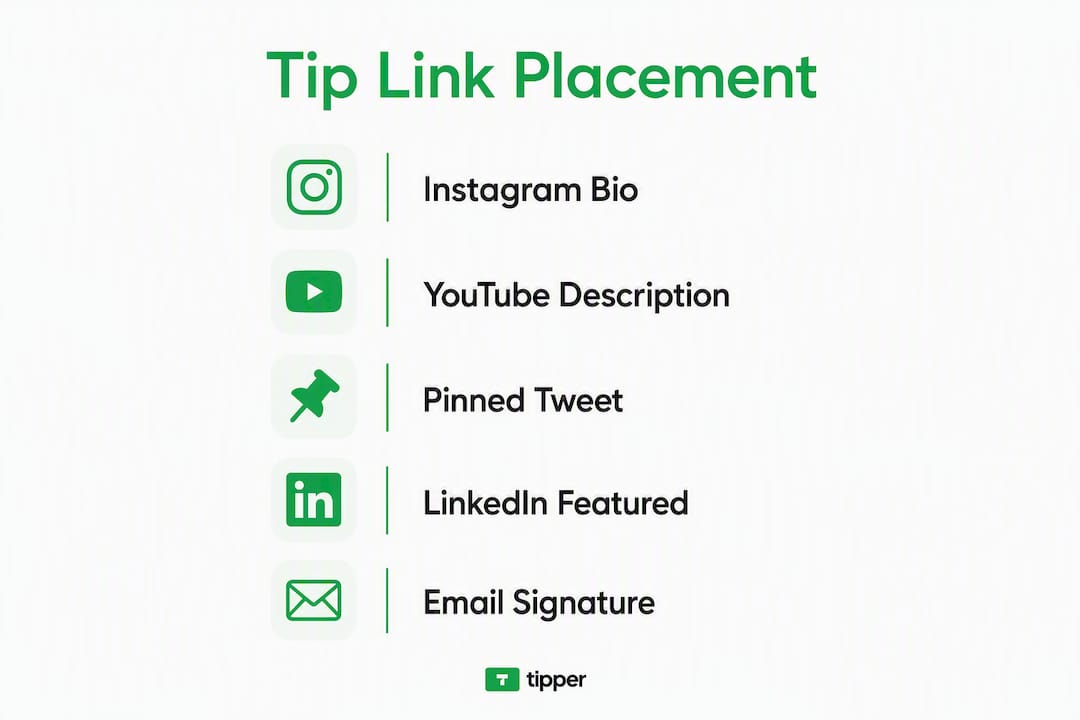
Instagram and TikTok bios: One line of context, then the link. “Support my work” followed by your hub URL. Nothing else competes with it.

YouTube descriptions: Pin the tip link at the very top, above the fold, before timestamps or affiliate links. Add a sentence tying it to the video: “If this tutorial saved you time, a tip helps me make more.”
Twitter/X pinned tweet: Write a short thread about your work, then close with the tip link. Pinned tweets get seen by every new profile visitor.
LinkedIn profile: Add the link to your “Featured” section with a short caption. Freelancers and consultants see strong results here because the audience already understands paying for expertise.
Blog post body and end-of-post CTA: Google Search Central advises giving clear context around every link and avoiding clusters of links that blur individual purpose. Embed the tip link once in the body where it fits naturally, and again at the end with a dedicated CTA. Never group it with three other links in a row.
Email signature: Four words: “Support my work: [link].” Every email you send becomes a passive placement.
QR codes for in-person events: Generate a QR code pointing to your hub URL. Print it on a card, a slide, or a table tent. The URL behind the QR never changes, so one print run lasts indefinitely.
Pro Tip: Platforms like Instagram auto-generate link previews using Open Graph tags. Make sure your tip page has a proper OG title and image set, or the preview will show a blank card, which kills click-through.
What copy actually converts tips?
Think of each tip link as a conversion bridge: the anchor text primes the action, and the destination page closes it. Vague phrases like “tip me” or “click here” underperform because they give the reader no reason to act.
Bio copy templates:
- “Enjoyed this? Buy me a coffee: [your link]”
- “Support independent content: [your link]”
- “If my work helped you, tips keep it going: [your link]”
End-of-video CTA:
- “If this video saved you hours, a small tip means I can keep making them. Link in description.”
Suggested tip amounts: Display two or three options ($3, $7, $15) rather than a blank field. A default selection reduces decision fatigue and lifts average tip size.
Thank-you message templates:
- Immediate text note: “Thank you so much, [name]. Your support genuinely helps me keep creating. More [topic] content coming soon.”
- Photo follow-up: A behind-the-scenes shot of your workspace with a handwritten “thank you” visible.
- Video note: A 15-second personal video saying their name and what their tip makes possible.
The value loop works like this: useful content earns the tip, the personalized thank-you earns the repeat tip. Skip the thank-you and you break the loop.
What technical checks protect your tip link?
A short checklist prevents the most common failures before they cost you conversions.
| Check | What to do | Why it matters |
|---|---|---|
| Persistent hub URL | Never change the public-facing URL | Archived posts stay working |
| UTM parameters | Add source/medium/campaign to every placement | Attribute tips to specific content |
target="_blank" + rel="noopener noreferrer" |
Set on all external tip links | Keeps readers on your page; blocks security exploits |
| OG tags | Set title, description, and image on your tip page | Prevents broken social previews |
| Mobile wallet test | Complete a real Apple Pay or Google Pay transaction | Catches checkout failures before launch |
| Descriptive anchor text | Use “support my work” not “click here” | Improves accessibility and trust |
When you launch a new tip-collection hub, update at least three high-traffic existing pages to link to it within the first week. That hub-and-spoke wiring helps AI crawlers and search engines discover the hub quickly.
What do U.S. creators need to know about taxes and payouts?
Tips are income in the United States. The IRS treats them as taxable regardless of the amount, so keep a record of every payout from day one. Payment platforms that process $600 or more in a calendar year are generally required to issue a 1099-K, but you owe tax on all tip income whether or not you receive a form. Consult a tax professional for your specific situation.
Payout timing varies by platform. Most digital tipping tools process payouts within one to five business days after a tip clears. Tipper supports Apple Pay, Google Pay, and card payments, with a small processing fee added at checkout. Creators keep 100% of the tip amount itself, with no monthly subscription cutting into earnings.
On privacy: never store card data on your own site. Use the tip platform’s checkout flow exclusively. Add a one-sentence disclosure on your tip page: “Payments are processed securely. We do not store card information.” That single line builds trust and reduces abandoned checkouts.
This article is general information, not tax or legal advice. Confirm current IRS rules with a qualified tax professional for your own situation.
How do you diagnose and fix a tip link that isn’t converting?
Track four numbers: clicks, tip-conversion rate (tips divided by clicks), average tip amount, and refund or chargeback rate. If clicks are high but conversion is low, the problem is almost always the destination page or the CTA copy.
- Broken link preview: Check your OG tags. A missing
og:imageproduces a blank card on every platform. Fix the tag and reshare. - Payment failing on mobile wallets: Test Apple Pay and Google Pay on an actual iPhone and Android device, not a desktop browser. Most failures are domain verification issues on the payment processor side.
- UTM missing from shared links: Build a template link with UTMs pre-filled and save it somewhere you can copy-paste. One missing parameter means a week of unattributed traffic.
- Low conversion from clear CTA: A/B test two versions of your bio copy for two weeks. Change one variable: the suggested tip amount, the action phrase, or the context sentence. UTM naming keeps the two variants separate in your analytics.
Separate bio-collection clicks from content-driven clicks by using different utm_source values: bio for profile links, blog for body embeds, email for signature links.
Tipper makes the tip link setup straightforward
Creators who want a frictionless setup without stitching together multiple tools get a concrete advantage with Tipper: one personalized link or QR code, Apple Pay and Google Pay built in, and a customizable thank-you flow (text, photo, or video) that closes the value loop automatically.
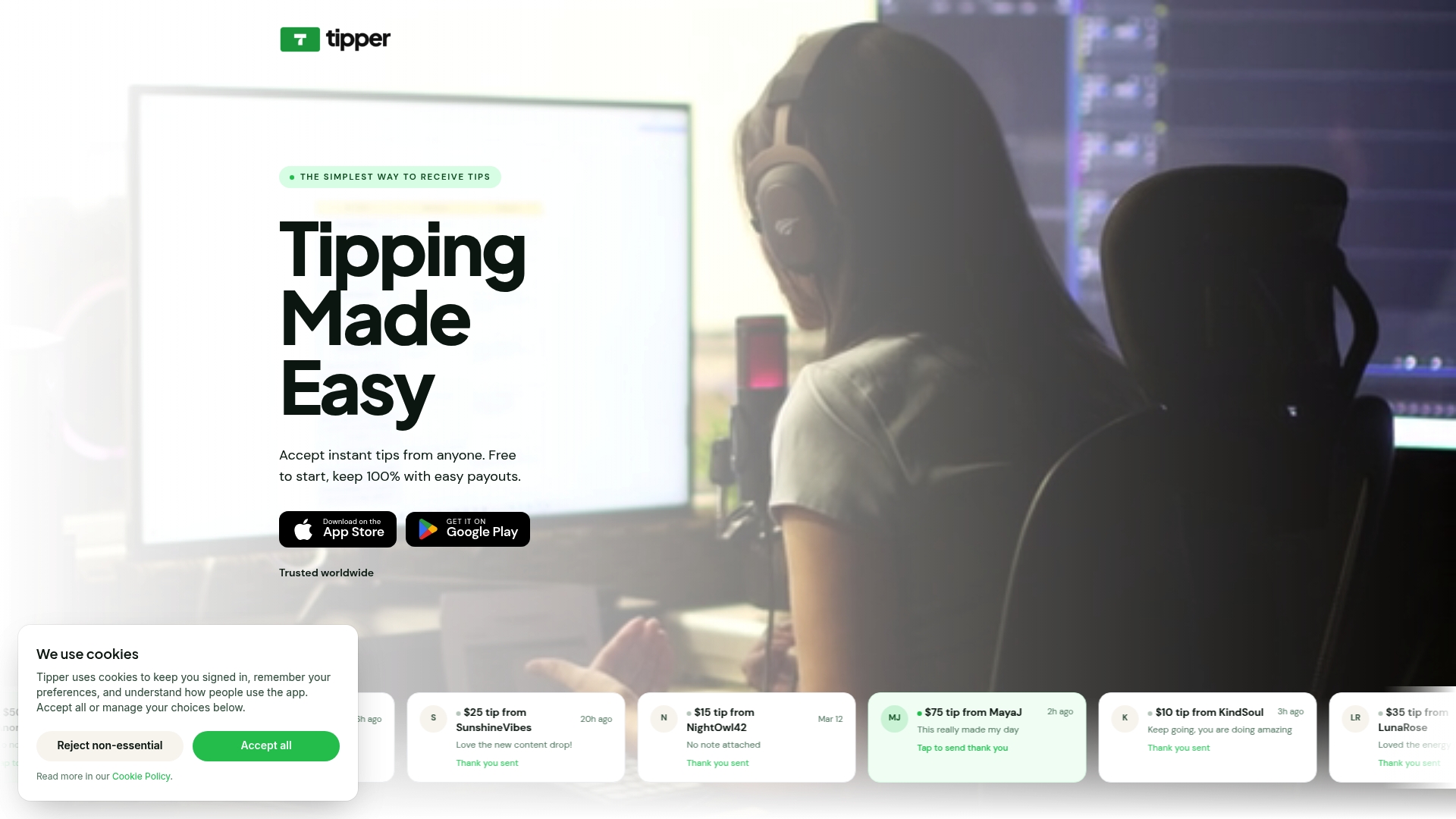
Tipper maps directly to this guide’s quick-start checklist. The hub URL is persistent by design, so archived posts never break. The checkout supports mobile wallets out of the box, which eliminates the most common payment failure. And because there is no subscription, the only cost is the small processing fee on each transaction. Creators keep 100% of every tip.
For creators ready to implement today, set up your Tipper link in minutes and start sharing it across your bios, descriptions, and email signature before the end of the day.
Key Takeaways
A single persistent hub URL, placed with contextual copy and tracked with UTMs, is the most reliable way to collect tips across all your content without ever breaking a historical link.
| Point | Details |
|---|---|
| Use one persistent URL | Never change the public link; update the collection page instead to keep archived posts working. |
| Context before and after | Write a sentence explaining the link’s purpose; avoid grouping it with other links. |
| Add UTM parameters | Tag every placement (bio, blog, email) so you can attribute tips to specific content. |
| Test payments on mobile | Verify Apple Pay and Google Pay on real devices before going live. |
| Log tips for taxes | Tips are U.S. taxable income; keep payout records and consult a tax professional. |
| Use Tipper | Tipper provides a persistent personalized link, Apple/Google Pay checkout, and thank-you messages with no subscription fee. |
Why the “just add a link” advice misses the point
Most guides tell creators to “add a tip link to your bio” and stop there. That advice treats the link as decoration. The real work is treating it as a conversion bridge: the copy before the link primes the click, the destination page reassures the tipper, and the thank-you message converts a one-time supporter into a repeat one.
The creators who see consistent tip income are not the ones with the most followers. They are the ones who close the loop. A personalized video thank-you after a $5 tip costs 30 seconds to record and routinely produces a second tip within the week. That is the mechanic most creators skip because it feels small. It is not small.
Try a 7-day experiment: share your hub link in three places you have not used before, track clicks and conversion by UTM source, and rewrite the weakest-performing CTA based on what the data shows. One iteration cycle is usually enough to see a meaningful lift.
Useful sources
- Google Search Central: Link best practices — the primary reference for contextual linking, anchor text guidance, and avoiding link clusters.
- MDN Web Docs: Creating links — authoritative technical reference for
href,target,rel, and accessibility best practices. - Rankeo: Internal linking strategy for SEO and AI visibility — covers hub-and-spoke models and how AI crawlers follow topical signals.
- Elementor: How to create a link — practical checklist for OG tags,
relattributes, and mobile wallet testing. - Zanfia: How to make something into a link — creator-focused guide on conversion bridges, UTM tracking, and anchor text strategy.
- Shelfy: All your links in one place — explains the persistent hub URL strategy and why successful creators never change their shared URL.
- Tipper blog: Why creators need tipping links — the business case for adding a tip link to your content revenue mix.
- Tipper blog: How real-time tips work for creators — technical overview of instant payments and wallet integrations.
- Tipper blog: Types of digital tip jar tools — comparison of tipping tool categories for creators who want to evaluate alternatives.
- Tipper: Set up your tip link — the Tipper landing page for creators ready to implement today.
FAQ
What is the best way to link a tip collection to your content?
Use one persistent hub URL and embed it with a contextual sentence in your bio, video descriptions, and blog posts. Add UTM parameters to each placement so you can track which content drives the most tips.
Do tips count as taxable income in the U.S.?
Yes. The IRS treats tips as taxable income regardless of amount. Keep records of every payout and consult a tax professional about your reporting obligations.
How do you prevent a tip link from breaking in old posts?
Use a persistent hub URL and update the collection page itself whenever your content changes. The shareable URL stays the same, so every archived post, email, and bio link keeps working automatically.
What payment methods should a tip link support?
Apple Pay, Google Pay, and card payments cover the vast majority of U.S. tippers. Tipper supports all three with no account required from the sender, which removes the biggest friction point at checkout.
How do you measure whether your tip link is working?
Track four metrics: total clicks, tip-conversion rate (tips divided by clicks), average tip amount, and refund rate. Low conversion with high clicks usually means the CTA copy or destination page needs revision.




[…] Link Tip Collection to Content: Creator’s 2026 Guide […]
[…] or QR code. If you want a deeper breakdown of embedding tip collection into your content workflow, Tipper’s guide on linking tips to content walks through […]
[…] Tips tend to spike around these high-engagement moments rather than in response to constant, blanket requests, so save your asks for when they’ll actually land. […]
[…] Link Tip Collection to Content: Creator’s 2026 Guide […]
[…] Link Tip Collection to Content: Creator’s 2026 Guide […]