

If you want privacy-first, no-account tips, try Tipper, since it lets fans pay instantly without signing up. If you want packaged gifting, YouPay or Amazon Wishlist handle physical items well. If you want one page for tips, merch, and content, Beacons or Ko-fi cover multiple revenue streams at once.
TL;DR:
- Tipper offers a quick, privacy-focused tipping option with no account required and support for Apple Pay, Google Pay, and cards, keeping 100% of earnings minus processing fees.
- Platforms like Ko-fi and Beacons combine multiple revenue streams, such as tips, memberships, and merch, but may involve higher fees or complex setup.
- Wishlist-based services like WishTender and Amazon Wishlist cater to physical gift fulfillment, with the latter using familiar retail checkout processes, while others focus on curated or private lists.
- The speed to first payout varies: tip links deliver support instantly, while wishlist or subscription platforms may take longer due to setup or identity verification steps.
- Platform fees often include hidden costs such as transaction fees, currency conversions, or delayed payout verification, so creators should verify payout conditions before choosing a tool.
Table of Contents
- Comparing the top Throne alternatives for creators
- How to choose the right platform for your goals
- What Tipper offers creators who want privacy and simplicity
- Fees, commission models, and payout options compared
- Security beyond privacy: fraud protection and payment safety
- Customer support quality across these platforms
- From signup to first payout: what the timeline looks like
- Total cost of ownership: fees you might not see upfront
- Why creators are rethinking their Throne setup
- Building a revenue mix instead of chasing one best tool
- Getting started with Tipper as your tipping link
- FAQ
- Sources
Comparing the top Throne alternatives for creators
Throne built its name on anonymous wishlist gifting, but App Store reviews show a mixed picture: fans like the anonymity, while creators report interface bugs and unexpected identity checks when they try to cash out. That gap is why aggregator sites list numerous substitutes. Product Hunt’s alternatives page and SaaSHub’s comparison list both group the market into several practical categories: wishlist and gift-registry apps, tipping-first platforms that skip sender accounts, and multipurpose link pages that bundle several monetization tools.
Here is what each option actually offers:
- Tipper runs on a personalized tipping link or QR code. Fans pay through Apple Pay, Google Pay, or a card with no account required, and creators keep 100% of what they earn, with a processing fee applied.
- YouPay is a mobile wishlist app built for gift-registry style sharing, with listings on the App Store marketing it directly as a Throne alternative.
- Ko-fi pairs one-off tips with optional monthly memberships on a single page, suited to creators who want both income types without juggling two tools.
- WishTender focuses on curated wishlists for creators who want to receive specific physical gifts rather than cash.
- Exclu leans toward recurring revenue, positioning itself as a low-commission option for creators who want subscriptions alongside other income.
- Snipfeed combines a link-in-bio page with tipping, content gating, and product links in one dashboard.
- Amazon Wishlist uses Amazon’s own catalog and checkout, so fans buy and ship gifts through an interface most already know.
- MyWishBoard advertises itself around private, curated wishlists rather than public gift walls.
- Giftly skips physical shipping entirely in favor of digital gift cards.
- Whisk centers on lifestyle wishlists, recipes, and home goods, and occasionally turns up in creator gifting roundups.
- Beacons stacks tipping, merch sales, and paid content into one link page.
- Loyalfans is subscription-first, with gifting features layered on top of paywalled content.
- Throne remains the anonymous wishlist platform most of this list is reacting to, known for gift-balance credits that fans load and creators redeem.
| Platform | Core model | Best for | Fees/payout | Privacy note |
|---|---|---|---|---|
| Tipper | Tipping link, no account needed | Low-friction, privacy-first tips | Processing fee only; creators keep 100% | Senders need no account; Apple Pay/Google Pay supported |
| YouPay | Mobile wishlist app | Gift-registry style wishlisting | Published on app listing | Fan identity tied to gift purchase |
| Ko-fi | Tips plus memberships | Combined one-off and recurring support | Platform fee varies by tier | Fan accounts optional for tipping |
| WishTender | Wishlist and gift fulfillment | Curated physical gifts | Shipping and platform fees apply | Gift sender visible to fulfillment process |
| Exclu | Subscriptions, diversified revenue | Recurring income creators | Positioned as low commission | Subscriber accounts required |
| Snipfeed | Link page with monetization widgets | Integrated tips and content links | Platform fee on transactions | Fan data tied to linked checkout |
| Amazon Wishlist | E-commerce wishlist | Shipped physical gifts | Standard Amazon checkout fees | Shipping address shared with Amazon |
| MyWishBoard | Private wishlist platform | Curated, private lists | Platform fee on gifts | Built around private list visibility |
| Giftly | Digital gift cards | Gift cards over physical items | Card purchase fee | No shipping data needed |
| Whisk | Lifestyle/recipe wishlist | Home goods and recipe-based lists | Retailer-dependent | Tied to linked retailer accounts |
| Beacons | Link page with tips, merch, content | One page for multiple revenue types | Tiered platform fees | Fan data varies by integrated tool |
| Loyalfans | Subscriptions with gifting | Paywalled content plus gifts | Subscription commission applies | Subscriber identity required |
| Throne | Anonymous wishlist, gift balance | Fan-funded wishlist gifting | Gift-balance system; KYC at cashout | Anonymous gifting, but payout KYC reported |
How to choose the right platform for your goals
Match the platform to how you actually get paid, not just what looks popular. Walk through these questions before committing:
- Do you want one-off tips, recurring subscriptions, or physical gifts, since that decision alone eliminates half the list?
- How much sender friction can your audience tolerate: an account-free tip link, or a wishlist checkout through a retailer?
- What does the platform actually take in fees, and is that disclosed before you sign up or buried in a help article?
- How fast and flexible is the payout, and does it route through a payment method your bank actually supports?
- Does cashing out trigger identity verification you did not expect, the way some Throne users report?
Watch for opaque fee structures, surprise KYC requirements at withdrawal, and vague language about where your payout actually lands.
Pro Tip: Create a test transaction with a small amount before promoting any new platform to your audience, so you see the fee deduction and payout timeline firsthand.
What Tipper offers creators who want privacy and simplicity
We built Tipper around removing friction for the person sending support, not just the creator receiving it:
- Fans tip through a personalized link or QR code with no account to create.
- Apple Pay, Google Pay, and card payments all work at checkout.
- Creators keep all earnings minus a processing fee.
- Thank-you messages can go back as text, photo, or video.
Tipping and wishlisting solve different problems: tips convert faster since there is no shipping or catalog browsing involved, while wishlists work better when a fan wants to give something tangible. Many creators run both.
Fees, commission models, and payout options compared
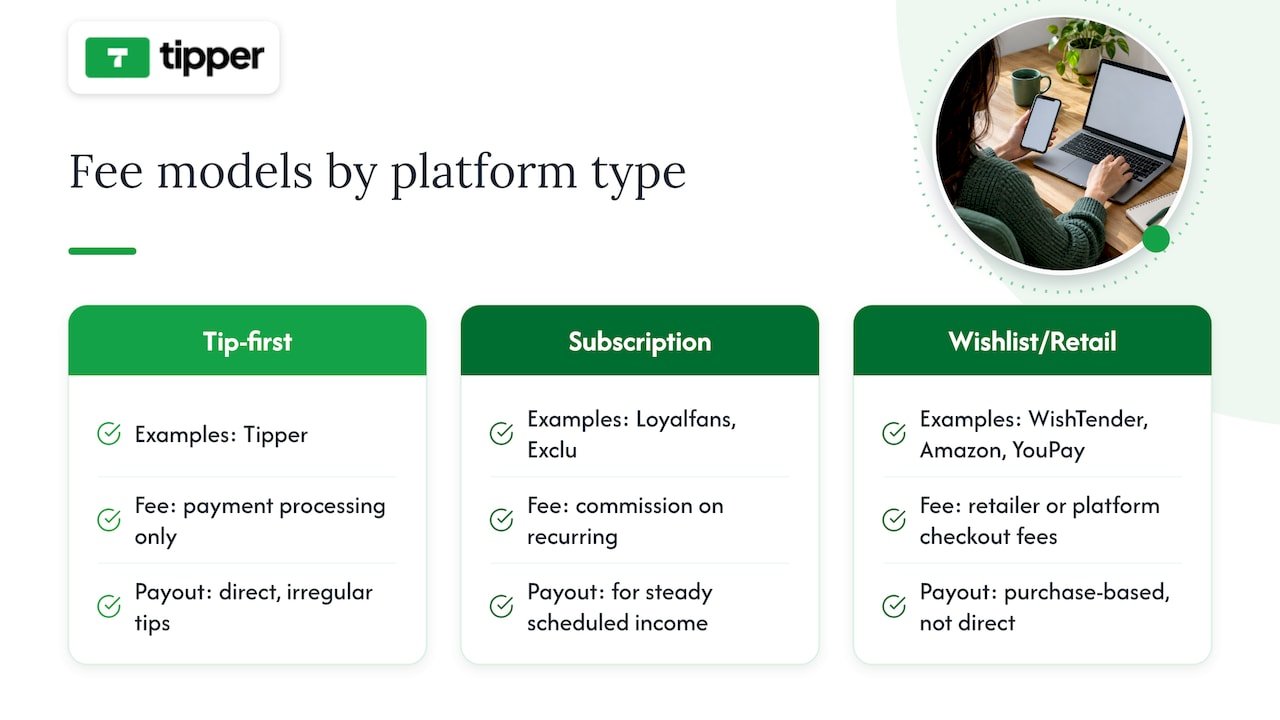
Fee structures vary more than most creators expect, and the structure itself tells you who the platform is built for. Tipper charges only a payment processing fee at the transaction level, with no subscription or platform cut, which keeps the model simple for creators doing irregular, one-off tips.
Subscription-first platforms like Loyalfans and Exclu apply a commission on recurring revenue instead, which makes sense if your income comes from steady paywalled content rather than spontaneous gifts. Ko-fi and Beacons sit in between, layering a platform fee on top of whichever monetization tool a fan uses that day, tipping, shop sales, or membership.
Wishlist-based platforms like WishTender, Amazon Wishlist, and YouPay handle fees differently since the transaction usually runs through the retailer or the platform’s own checkout rather than a direct payout to the creator. Giftly’s gift-card model and Whisk’s retailer-linked lists follow a similar pattern: the platform is a middleman for a purchase, not a direct payout.
Throne’s gift-balance system adds a layer worth flagging: fans load a balance, creators redeem it, and that redemption step is where KYC requirements often appear, sometimes without much warning ahead of time. Before picking any platform, confirm whether payout happens instantly, on a schedule, or only after you clear an identity check you did not know was coming.
Security beyond privacy: fraud protection and payment safety
Privacy covers what data a platform shares. Security covers whether your money actually arrives safely, and the two are not the same thing. Payment processors used by tipping platforms, including card networks and services like Apple Pay and Google Pay, carry their own fraud detection layers independent of the creator platform itself.
Wishlist and gift-card platforms route through established retail checkout systems, so purchase-level fraud protection tends to mirror whatever the underlying retailer or card network already provides. The weaker point tends to show up at payout, not at the point of sale: a platform that is vague about how it verifies a creator’s identity before releasing funds is a platform where fraud and fund-freezing risk overlap.
Several App Store reviews note that KYC steps appear after a creator has already built up a balance, rather than during account setup, which leaves earned funds in limbo longer than expected. A platform that asks for identity verification upfront, before you start collecting money, is generally the safer bet since you know your payout path works before you depend on it.
Customer support quality across these platforms
Support responsiveness is hard to benchmark precisely across 13 platforms, since most do not publish response-time data, but patterns show up in user reviews. Reviewers evaluating Throne frequently raise interface confusion and payout questions as recurring friction points, which suggests support demand clusters around cashout and verification issues rather than everyday browsing.
Platforms with a single, simple transaction model, a tip link with no account step, tend to generate fewer support tickets in the first place because there is less to misconfigure. Multipurpose link pages like Beacons and Snipfeed, by combining tips, merch, and content gating on one dashboard, carry more setup surface area, and more setup surface area usually means more support questions during onboarding.
Before relying on any platform for real income, check whether support is reachable through a live channel or only through a ticket queue, and look at how recently the platform’s help documentation was updated.
From signup to first payout: what the timeline looks like
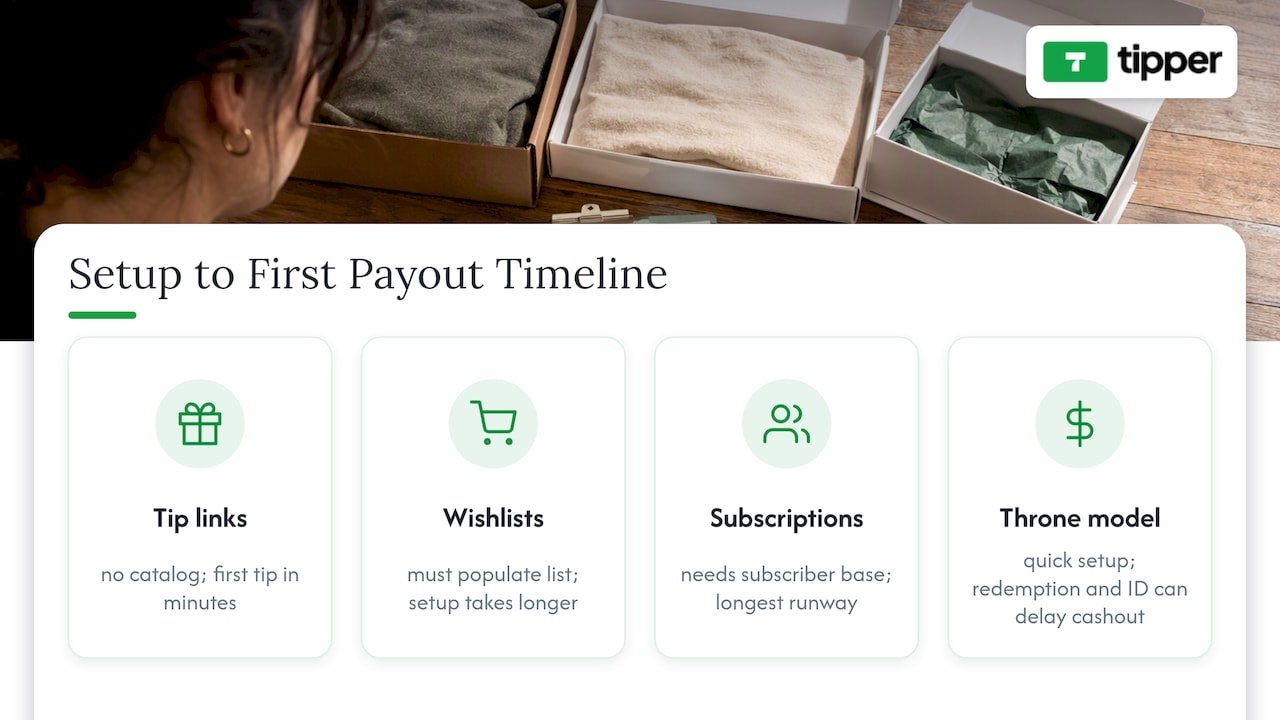
Account-free tipping links are the fastest path to a first payout, because there is no catalog to build and no wishlist items to curate. Set up a page, share the link or QR code, and the first tip can arrive within minutes of posting it.
Wishlist platforms add a setup step: you need to populate the list with items, which takes longer before a fan can act. Amazon Wishlist benefits from an interface most fans already know, which can shorten the learning curve even if the list-building step itself takes time.
Subscription and membership platforms like Loyalfans and Exclu have the longest runway to first payout, since recurring revenue depends on building an initial subscriber base rather than a single transaction. Throne’s gift-balance model sits in the middle: a wishlist is quick to set up, but the redemption and identity-check step at the back end can delay when funds actually land in your account, a pattern echoed in user reviews describing cashout as the slowest part of the experience.
Total cost of ownership: fees you might not see upfront
The sticker fee is rarely the full cost. Payment processing fees, platform commissions, and currency conversion charges can stack in ways that are not obvious from a pricing page alone. Tipper’s cost structure is limited to a processing fee at the point of tipping, with no subscription charge to maintain an account.
Subscription-based platforms carry an ongoing cost structure by design: a monthly membership fee from a fan generates recurring commission for the platform, which compounds differently than a one-time tip. Wishlist platforms route costs through the purchase itself, so a creator rarely sees a separate bill, but the fan may pay shipping or retailer markup that is invisible to the creator.
The least visible cost is time spent on compliance steps added late, such as the KYC requirements some Throne users encounter only when trying to withdraw an existing balance. A delay at cashout is a real cost even when no additional dollar amount appears on an invoice. Before adopting any platform, ask what happens at the exact moment you try to move money out, since that is where hidden friction tends to live.
Why creators are rethinking their Throne setup
Community discussions on Reddit and Twitch surface a recurring theme: creators leaving Throne usually cite data-sharing concerns or payout reliability rather than dissatisfaction with the wishlist concept itself. The shift tends to be gradual, a creator adds a tipping link alongside an existing wishlist rather than replacing one tool outright.
That pattern lines up with how Tipper’s own guidance on tipping links frames the decision: tipping and wishlisting solve different problems, so running both in parallel often beats picking a single winner. A fan who wants to send $5 right now has a different need than a fan who wants to buy a specific item later, and forcing both into one workflow adds friction neither fan wanted. For a breakdown of how different support tools fit different fan behaviors, see this overview of real-time supporter contribution tools.
Building a revenue mix instead of chasing one best tool
Tipping works best for spontaneous, one-off support. Subscriptions make more sense once you have a predictable content schedule worth paying for monthly. Privacy and discoverability pull in opposite directions, so most creators land somewhere in between rather than maximizing either one.
— Tipper
Getting started with Tipper as your tipping link
We built Tipper so you can start collecting support today, not after a lengthy setup process. Create your page, copy your personalized link or QR code, and share it anywhere your audience already is, in a bio, a stream overlay, or a caption.
- Set up a tipping page with no account required for the fans sending support.
- Accept Apple Pay, Google Pay, or card payments at checkout.
- Keep all earnings minus the payment processing fee.
- Adjust your payout settings once your page is live.
If you want the full setup walkthrough, this creator’s guide to collecting tips without requiring signup covers it step by step. Start your page at Tipper.
FAQ
Is Throne better than Amazon Wishlist?
Throne focuses on anonymous gift-balance funding, while Amazon Wishlist uses a familiar retail checkout fans already trust. Neither is strictly better: Throne suits creators who want flexible fan-funded gifting, and Amazon Wishlist suits creators comfortable with shipped physical items through an existing catalog.
Is the Throne app legit?
Throne is a real, operating platform, and App Store reviews confirm active use by creators and fans. Reviewers do flag interface bugs and unexpected identity checks at cashout, so legitimacy does not mean a friction-free experience.
Does Throne give out your name?
Throne markets itself around anonymous gifting, meaning a fan’s name is not automatically shared with the creator at the point of a gift. Creators should still confirm current data-sharing settings directly on the platform, since app behavior can change between updates.
What is the point of a wishlist-and-gifting website like Throne?
These platforms let fans fund specific items or send money without a creator needing to manage shipping or negotiate a direct payment method. The core appeal is combining fan generosity with a structured list format, something a plain tip jar does not offer on its own.
Is tipping or a wishlist better for new creators?
Tipping through a link like Tipper tends to convert faster since there is no catalog to browse and no account for the fan to create. A wishlist works better once you have specific items in mind and an audience willing to wait for shipping.




Leave A Comment