

The best approach for collecting small tips is a frictionless tipping link that lets supporters pay in one tap, with no account required and no fixed fee eating a $1 tip. Create a link, share it, and send yourself a test tip to see the full flow before you promote it.
TL;DR:
- A $0.29 fixed card fee consumes most of a $1 tip but a smaller share of a $5 tip; compare fees against your typical amount.
- Use local bank transfers where available, but keep card and wallet checkout for broader reach; Apple Pay and Google Pay let supporters pay without accounts.
- Codes at natural pauses, such as video endings, can raise tipping frequency by up to 22%; use one link or QR code per touchpoint.
- Check payout cadence and minimum balance before signing up, because weekly batches or holds can delay access to tips needed for regular expenses.
- Send yourself a test tip before sharing your link, and review IRS tax guidance as your tips approach applicable thresholds.
Table of Contents
- Why fee structure matters for micro-tips
- Payment methods that preserve micro-tip value
- How to choose a micro-donation platform: quick checklist
- Set up a tipping link quickly with Tipper
- Practical ways to increase micro-tip conversions
- How payout timing affects your cash flow
- Comparing the top approaches to micro-tipping
- Integrating tipping into your existing creator tools
- Privacy and security features that build trust
- Strategies for encouraging repeat micro-donations
- Customer support and dispute resolution processes
- Author perspective: start simple and grow tipping responsibly
- Try Tipper: frictionless tipping that preserves micro-tip value
- FAQ
- Sources
Why fee structure matters for micro-tips
Two fee models dominate digital payments: fixed fees and percentage fees. A fixed fee charges the same flat amount no matter the tip size, often around $0.29 per transaction on many card processors. A percentage fee takes a share of the tip itself, usually a few percent.
The math turns ugly fast on small tips. A $0.29 fixed fee can wipe out most of a $1 tip before any percentage fee even applies, leaving the creator with pennies. A $5 tip fares much better under the same fixed fee, since $0.29 is a smaller slice of a larger amount.
A $0.29 fixed fee consumes most of a $1 tip but only a fraction of a $5 tip, which is why fixed per-transaction fees are especially damaging for creators whose audience tips small and often.
This is why the fee structure matters more than the headline rate:
- Fixed fees punish small tips disproportionately, since the same dollar amount is a bigger bite out of a smaller total.
- Percentage-only or processing-only fee models scale with the tip, so a $1 tip and a $5 tip both lose a similar share.
- Platforms that charge no separate platform fee, only standard payment processing, preserve the most value for both the creator and the supporter’s intent.
Before signing up anywhere, run your own average tip size through the fee math. If most of your supporters send $1 to $3, a fixed-fee model will cost you more than a model built around transaction-level processing fees.
Payment methods that preserve micro-tip value
The payment rail behind a tip matters as much as the fee structure. Instant bank-to-bank transfers can be cheaper per transaction than card processing in regions where that infrastructure exists, sometimes costing just a few cents on a small transfer. Card processors are more universal but typically carry a fixed fee component that hurts micro-tips more.
Apple Pay and Google Pay solve a different problem: friction. A supporter who already has a card saved in their phone’s wallet can complete a tip in seconds, with no typing and no account creation. That one-tap experience is often the difference between a supporter who tips and one who closes the tab.
For in-person tipping, QR codes and NFC chips each have trade-offs:
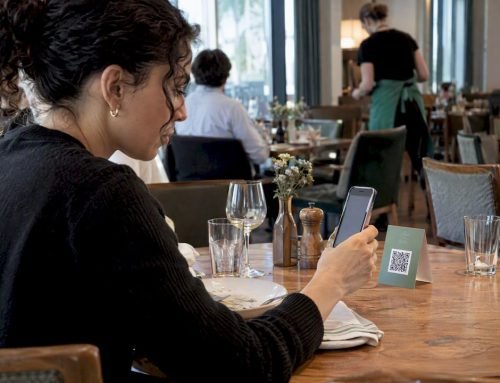
- QR codes work with any smartphone camera and need no special hardware, making them the most accessible option for events or storefronts.
- NFC taps are faster for supporters who already use tap-to-pay, but they require compatible hardware on the creator’s side.
- Combining both at live events covers supporters regardless of which method their phone supports.
Pro Tip: If your audience spans multiple countries, offer a hybrid setup: local bank-to-bank rails where available, plus global card and wallet checkout so no supporter is turned away.
How to choose a micro-donation platform: quick checklist
Picking a platform does not need to be complicated, but a few details decide whether you keep most of your tips or lose them to fees and delays.
- Calculate expected fees against your actual average tip size, not a hypothetical $20 donation.
- Check whether supporters need to create an account to tip, since every extra step reduces conversion.
- Confirm payout timing: same-day, weekly, or on request.
- Verify which payment methods are supported, especially Apple Pay, Google Pay, and card checkout.
- Look for a customizable tip page so your link matches your brand.
- Ask how the platform handles tax reporting if your tips reach IRS filing thresholds.
To estimate your net income, take your average tip size, subtract the processing fee percentage, and multiply by your expected monthly tip count. A creator averaging $2 tips with a processing-only fee structure keeps far more per transaction than one on a platform charging a flat $0.29 per tip.
When you talk to a platform directly, ask about payout cadence, whether fees are shown before checkout, and whether the platform issues any tax forms automatically.
Set up a tipping link quickly with Tipper
Getting a tipping link live takes a handful of steps, and most creators can finish setup in one sitting.
- Create an account and connect a payout method.
- Complete identity verification so payouts and any required tax reporting can process correctly.
- Build your tip page with your name, photo, and a short note to supporters.
- Set suggested tip amounts that match what your audience typically gives.
- Generate your personalized link and QR code to share across platforms or in person.
- Send yourself a test tip to confirm the full flow works end to end.
Fees are shown at the transaction level, so there are no hidden charges buried in fine print.
Pro Tip: Test your own link before sharing it publicly. A smooth test tip is the fastest way to confirm your payout method and page are both set up correctly.
On payouts, timing varies by platform and payout method, so confirm your cadence during setup rather than after your first tip arrives. On taxes, the IRS Form 1099-K instructions now include a box for cash tips and a box for Treasury Tipped Occupation Codes, which is worth knowing if your tipping income approaches reporting thresholds.
Practical ways to increase micro-tip conversions
Most of the gain in micro-tipping comes from reducing friction and reinforcing appreciation, not from aggressive asks.
- Place your tip link or QR code at natural pause points, such as the end of a video or after a service, rather than scattering it everywhere.
- Stick to one link or one QR code per touchpoint so supporters are never confused about where to tip.
- Set suggested amounts slightly above your current average tip to anchor supporters toward giving a bit more without pressure.
- Frame your copy around appreciation (“If this helped, a tip is always welcome”) rather than a direct ask, which tends to feel less transactional.
- At in-person events, offer both QR and NFC so supporters can use whichever method their phone supports.
Codes placed at natural pausing points can raise tipping frequency by up to 22%, which makes placement one of the highest-leverage changes available to any creator.
How payout timing affects your cash flow
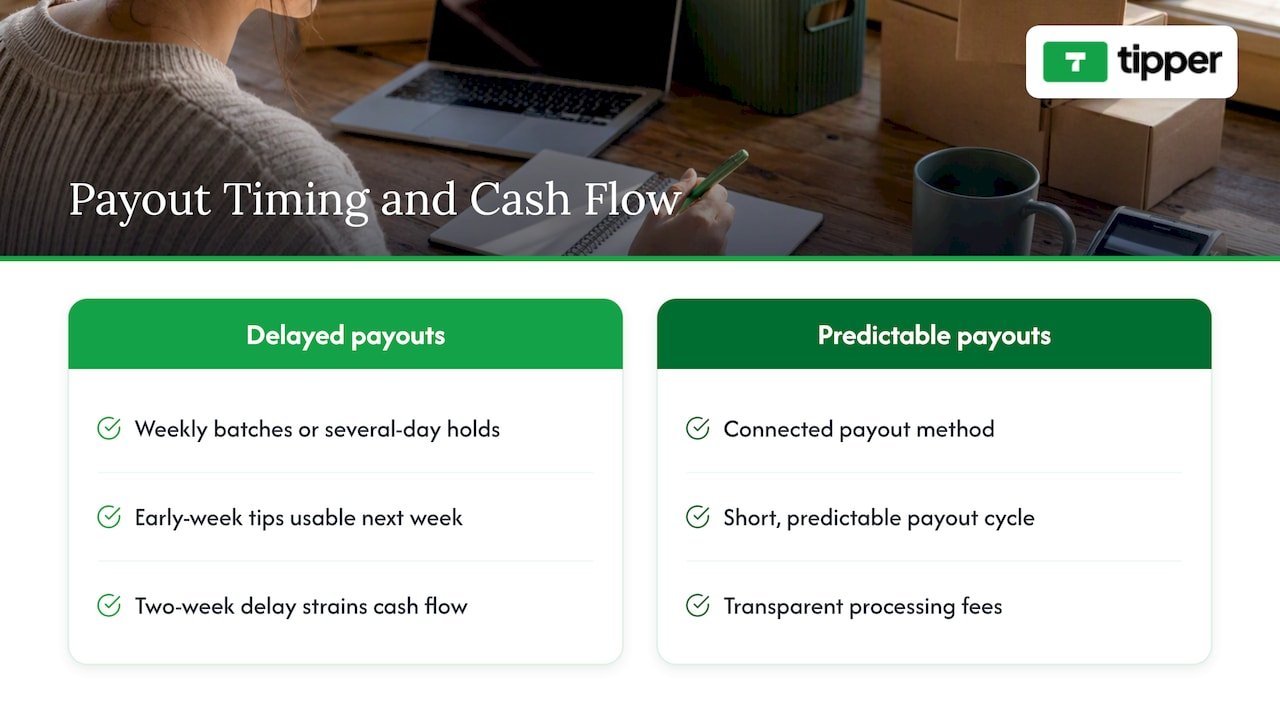
Payout timing is easy to overlook until it becomes a problem. Some platforms batch payouts weekly or hold funds for several days before releasing them, which can strain a creator who relies on tips as part of regular income. Others route funds to a connected payout method on a faster, more predictable schedule.
The difference matters most for creators and small businesses who treat tips as working income rather than occasional bonus money. A delayed payout schedule means tips earned early in the week might not actually be usable until the following week, which complicates budgeting around rent, supplies, or payroll.
Before committing to a platform, ask directly how payouts are scheduled and whether there is a minimum balance required before a payout triggers. Platforms that route funds to a connected payout method on a consistent, short cycle avoid the cash-flow friction that comes from delayed payouts, and that predictability is often as valuable as the fee structure itself.
If you are comparing multiple platforms, treat payout cadence as a core decision factor, not an afterthought you check after signing up. A platform with slightly lower fees but a two-week payout delay may be worse for your actual cash position than one with transparent processing fees and faster, predictable payouts.
Comparing the top approaches to micro-tipping
Micro-donation tools generally fall into a few categories, each with different trade-offs for small tips specifically.
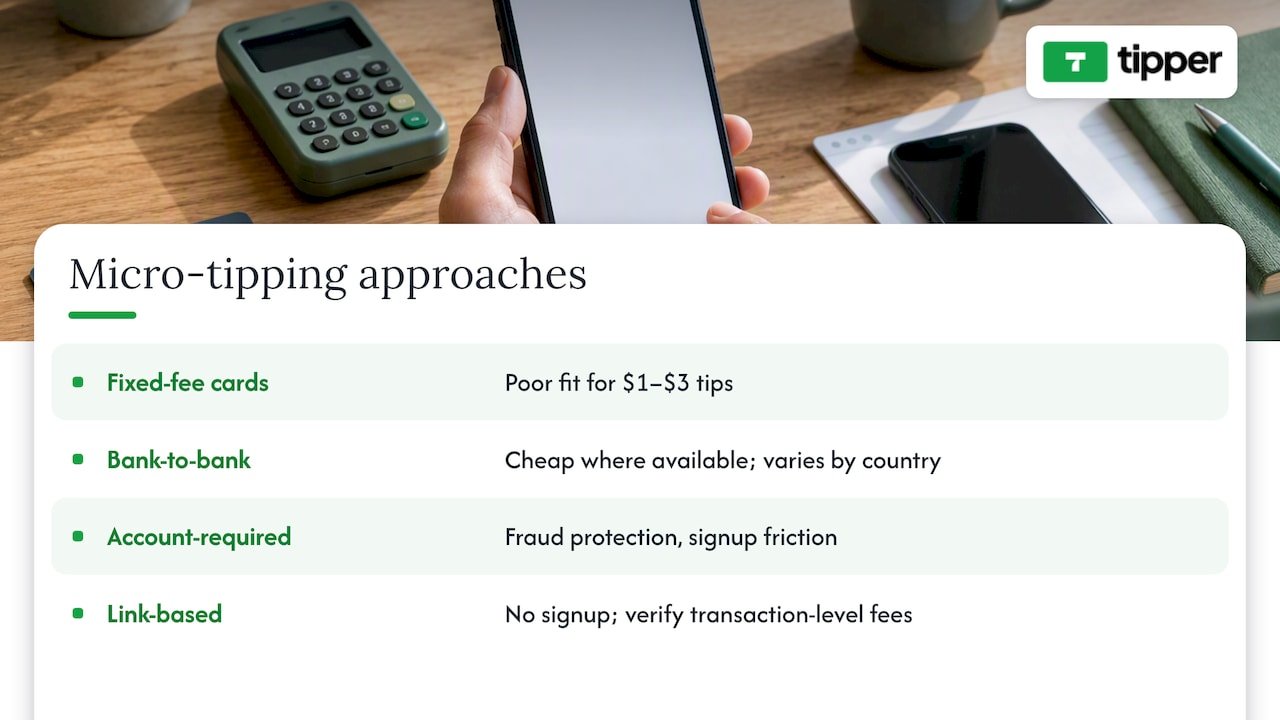
Fixed-fee card processors are widely available and easy to integrate, but their flat per-transaction fee structure makes them a poor fit for $1 to $3 tips, since the fee consumes a disproportionate share of each payment. They tend to work better for larger, less frequent donations.
Instant bank-to-bank tools can be very cheap per transaction in regions where that infrastructure is mature, but availability varies by country and by the sender’s bank, so they rarely work as a sole option for a global audience.
Account-required tipping platforms ask supporters to sign up before sending money, which adds a reliable layer of fraud protection but also adds friction that measurably reduces how many people complete a tip.
No-account, link-based platforms like the one we operate remove that signup step entirely, letting supporters pay with Apple Pay, Google Pay, or a card in one tap. The trade-off is that creators need to choose a platform with transparent, transaction-level fees up front, since the ease of use can mask fee structures that are not obvious until a payout arrives smaller than expected.
Integrating tipping into your existing creator tools
A tipping link works best when it fits naturally into tools you already use rather than existing as a separate destination supporters have to remember.
Most creators place their tipping link in a few key spots: a social media bio, a link-in-bio page, video descriptions, email signatures, and QR codes on printed materials or at physical locations. Because a tipping link is just a URL, it can sit alongside other links without requiring any special integration or plugin.
For creators running newsletters, podcasts, or livestreams, the same link can be mentioned verbally or shown on screen at the moment supporters are most engaged, which tends to outperform a link buried in a static bio. The practical goal is consistency: use the same link everywhere so supporters only ever need to recognize one destination, rather than juggling multiple payment tools across different platforms.
Privacy and security features that build trust
Trust is the quiet variable that determines whether a supporter actually completes a tip. Supporters want to know their payment information is handled securely, and creators want to know their payout details stay private.
No-account checkout flows, where a supporter pays through Apple Pay, Google Pay, or a card without creating a profile, limit how much personal data changes hands in the first place. Fewer data fields collected means less exposure if anything ever goes wrong.
On the creator side, privacy matters just as much. A tipping page should let creators share a link publicly without exposing their banking details or full legal name. Transparent, transaction-level fee display also plays a security-adjacent role: when supporters can see exactly what a platform charges before paying, there is less room for confusion that leads to disputed charges later.
Strategies for encouraging repeat micro-donations
A single tip is useful, but a supporter who tips repeatedly is worth far more over time. The strategies that work best are quiet rather than aggressive.
Sending a genuine thank-you after a tip, whether as a short text note, a photo, or a quick video message, reinforces that the tip was seen and appreciated rather than disappearing into an account balance. That personal acknowledgment is often what turns a one-time tipper into a repeat supporter.
Consistency also matters: supporters who know exactly where to find your tipping link, whether in a bio, a video description, or at a live event, are more likely to use it again without having to search for it. Keeping the same link and the same suggested amounts across appearances builds familiarity rather than asking supporters to relearn where and how to tip each time.
Finally, treat tipping as a two-way relationship rather than a transaction. A brief update shared with supporters about how tips are used, without over-explaining or asking directly, tends to encourage continued giving far more than a repeated request ever does.
Customer support and dispute resolution processes
Even with a frictionless setup, questions come up: a supporter wonders if their tip went through, or a creator needs to confirm a payout landed correctly. How a platform handles these moments matters.
Look for a platform that makes it easy to find support contact information directly from the tipping page or account dashboard, rather than burying it behind multiple menus. Clear, transaction-level records matter here too: when both the supporter and the creator can see exactly what was charged and when, resolving a question is faster and less frustrating for everyone involved.
For disputes specifically, ask how a platform handles a tip sent to the wrong recipient or a duplicate charge. A platform with transparent fee and transaction records tends to resolve these issues faster, since there is no ambiguity about what was charged or when it happened. Choosing a platform with responsive support available through a clear channel is worth checking before you rely on it for regular income.
Author perspective: start simple and grow tipping responsibly
My honest advice is to resist the urge to offer five payment methods on day one. Start with one link and one primary payment method, then watch your average tip size and conversion rate for a few weeks before adding anything else. Most creators overbuild their tipping setup before they have the data to justify it.
Keep an eye on your tip volume as it approaches IRS reporting thresholds, and review the Form 1099-K instructions early rather than scrambling at tax time.
— Tipper
Try Tipper: frictionless tipping that preserves micro-tip value
We built Tipper so supporters can send a tip with Apple Pay, Google Pay, or a card in one tap, with no account required on their end.
| What you get with Tipper | Detail |
|---|---|
| Sender account required | None |
| Creator share of each tip | beyond processing |
| Supported wallets | Apple Pay, Google Pay, card |
| Setup time | Minutes |
Create your personalized tipping link and send yourself a test tip to see the full experience before you share it with supporters. For creators building out a broader monetization stack, this creator tools guide covers additional workflows worth exploring alongside tipping.
FAQ
Do I need a platform fee on top of payment processing?
Other platforms vary, so check whether a fixed fee or percentage fee applies before you sign up.
Does the sender need an account to tip me?
No, a well-designed tipping link lets supporters pay with Apple Pay, Google Pay, or a card without creating an account. Removing that step is one of the biggest factors in whether a supporter completes a tip.
How do tips affect my taxes?
Tip income can be reportable depending on the amount and how it is processed, and the IRS Form 1099-K instructions now include separate boxes for cash tips and Treasury Tipped Occupation Codes. Review the current instructions or talk to a tax professional if your tipping income is substantial.
Should I use a QR code or NFC for in-person tips?
QR codes work with any smartphone camera and need no special hardware, making them the more accessible default. NFC is faster for supporters already using tap-to-pay, so offering both covers the widest range of devices at live events.
How do I know my tipping link actually works?
Generate your link, then send yourself a small test tip through the same flow a supporter would use. This confirms your payout method, page setup, and checkout experience all work before you share the link publicly.



Leave A Comment