

For most creators, digital tips win on reach, record-keeping and convenience, and cash wins on face-to-face moments. Digital tips reach supporters who never carry bills and arrive with a built-in paper trail. Cash has no processor in the middle, but it only works when your supporter is standing in front of you. The right answer for most creators is a mix, with digital as the default and cash as the in-person bonus.
Below we compare the two on what matters: fees, payout speed, supporter behavior, taxes and privacy. We also say where cash still earns its place.
TL;DR
- Digital tips work anywhere your audience is, online or in person, and they leave a record. Cash only works in person and leaves none unless you make one.
- Digital tips can cost you in platform and processing fees, and some platforms hold your money until you hit a minimum balance. Cash costs nothing to receive, but it costs time to count, carry and deposit.
- In the U.S., tip income is taxable whether it comes as cash or through an app, with or without a Form 1099-K.
- Cash still helps performers: visible giving nudges other people to tip.
- Pick tools that let supporters tip without creating an account, so convenience does not depend on your fans signing up for anything.
Table of Contents
- How digital tips and cash tips actually work
- Digital tips vs cash at a glance
- What digital tips cost you
- Payout timing: cash is instant, apps are not always
- How supporters behave: convenience vs connection
- Taxes: the U.S. treats cash and digital tips the same
- Privacy and safety on both sides
- When cash still makes sense
- Our perspective
- Set up digital tips in a few minutes
- A simple way to decide
- FAQ
- Sources
How digital tips and cash tips actually work
Cash is simple. A supporter hands you bills or drops them in a jar. You keep every dollar at that moment, and the exchange is personal and immediate.
Digital tips come in a few shapes:
- A hosted tip page or link you place in your bio, stream panel or video description.
- A business payment profile from a payment app.
- A tipping feature built into a live-chat or video platform.
According to a breakdown of tip jars and virtual tipping, platform fees and processing fees may apply to any of these. Livestream platforms add a gamified layer. Virtual gifts such as Twitch Bits let fans amplify a message in chat, as vidIQ explains in its guide to YouTube Super Thanks and similar tools. If you are weighing how a hosted page, a business profile and in-app payments differ, this overview of ways to monetize an app shows how payment fees enter the picture.
If you want the basics first, our guide to what digital tipping is and how it works covers the mechanics from scratch.
Digital tips vs cash at a glance
| Factor | Digital tips | Cash tips |
|---|---|---|
| Where it works | Anywhere, including online and live streams | Only in person |
| Cost to receive | Platform and/or processing fees may apply | No processing fee |
| Speed to your pocket | Depends on platform payout rules | Immediate |
| Record keeping | Automatic transaction history | You must log it yourself |
| Personal feel | Depends on the tool; notes or video can help | High, face to face |
| Visibility to others | Low unless shown on screen | High, a full jar invites more |
| Safety | No cash to lose or steal, but account and scam risks | Can be lost or stolen |
| Supporter effort | A tap with Apple Pay or Google Pay, or a few more steps elsewhere | Needs bills on hand |
What digital tips cost you
The honest drawback of digital tips is that someone processes the money, and that someone gets paid.
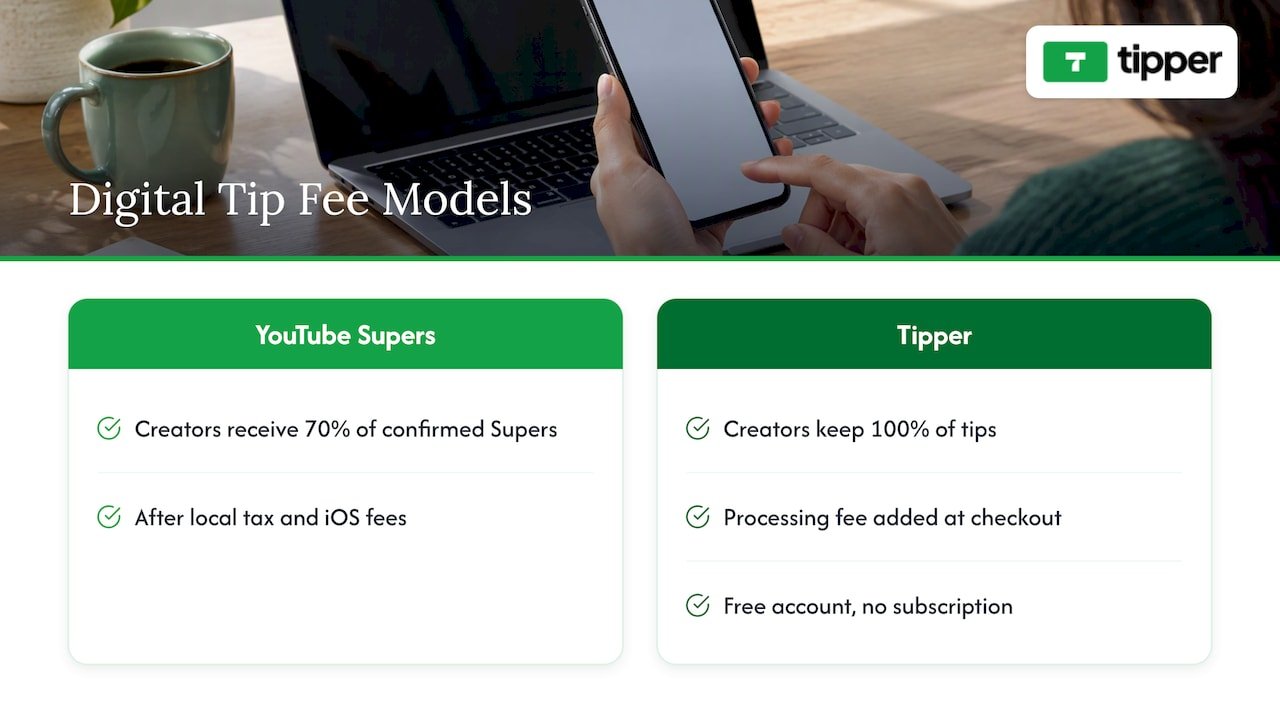
Creators can face a platform fee and a separate payment-processing fee, and rates and availability vary by country, currency, account type, payment method and platform policy. A built-in platform feature can be steeper than it looks. YouTube, for example, says creators receive 70% of confirmed Supers revenue after local sales tax and iOS App Store fees come out, according to the same source.
So the useful question is not whether digital tips cost something. It is what share of each tip reaches you and how clearly the fee is shown. Before you commit to a tool, run one test: send yourself a $5 tip and see what lands in your balance.
Tipper works on a transaction-based model: creating and keeping an account is free, there is no subscription, and a small payment-processing fee is added at checkout on each tip. Creators keep 100% of what supporters send as tips. If small tips are your bread and butter, our piece on micro donation platforms and saving more of each $1 tip shows why fee structure matters most at low amounts.
Payout timing: cash is instant, apps are not always
With cash, the money is in your hand. With digital tips, timing depends on the platform. FXC Intelligence reports that many platforms make creators build up a minimum balance before a transfer, for example $100 on YouTube, Facebook and Snapchat, then pay out on a set schedule.
That gap matters if tips are how you cover gear, rent or a bad month. Look for three things before you pick a tool:
- Whether there is a minimum balance before payout.
- How long a payout takes to reach your bank.
- Whether the fee is taken before you see the balance or at payout.
If instant access is a priority for you, read how instant tip payments work for creators.
How supporters behave: convenience vs connection
Supporters tip when it is easy and when it feels good. Both tools score differently on those two points.
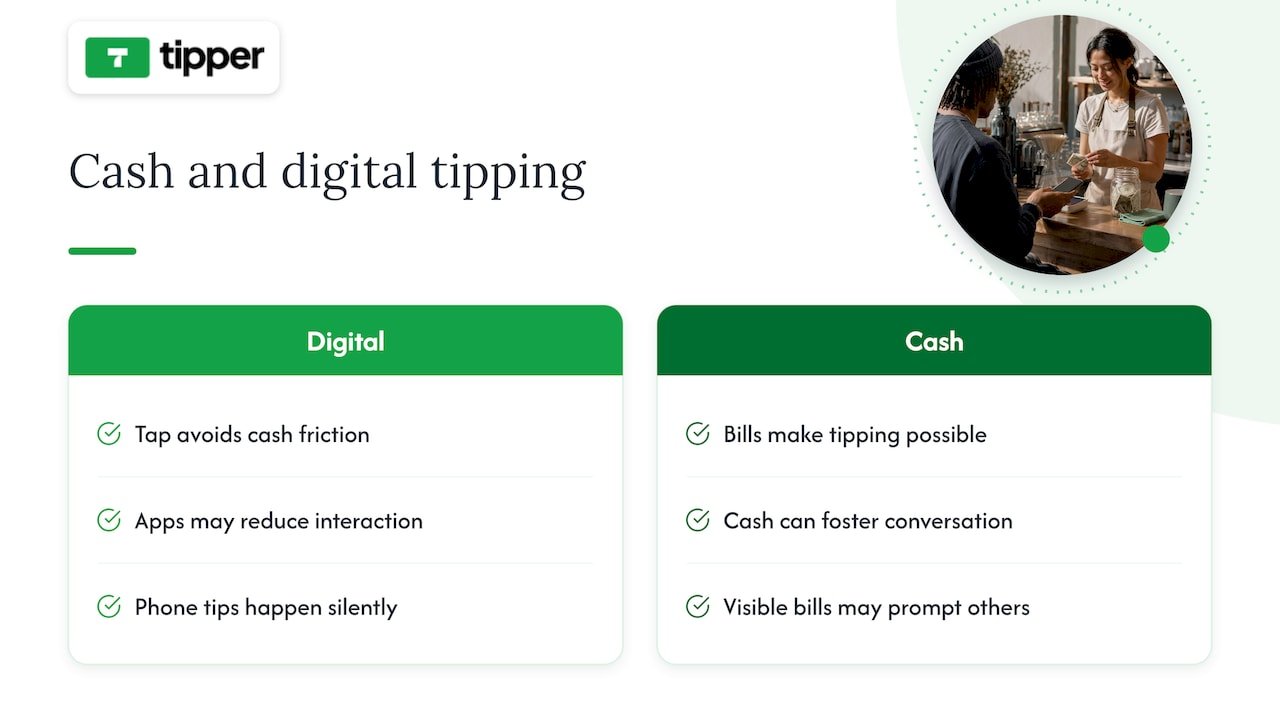
Where digital wins. Fewer people carry cash, so a tip that requires bills never happens. A tap with Apple Pay or Google Pay removes that friction. For gig workers and street performers, apps are seen as a modern necessity as cash fades, and performers are turning to them more.
Where cash wins. The same reporting notes that apps can take a cut and may reduce personal interaction, while cash can foster conversation and its visibility may encourage others to tip. Performers describe a “psychological visibility” effect: when someone drops a bill into an open case, onlookers notice, and more of them follow. That is hard to copy with a payment that happens silently on a phone.
The account problem. One more digital friction is signup. If a fan has to create an account on a platform before tipping, many will not. Tipper lets supporters tip without an account, using Apple Pay, Google Pay or a card. Our guide to collecting tips with no signup required explains how that flow works, and the livestreamer-focused comparison shows why it matters when viewers decide in seconds.
Bringing the personal touch back
The warmth of cash is mostly about being seen. Digital tools can answer that with a thank-you message. On Tipper you can reply with a note, a photo or a video, so the supporter gets a human response even if you never met in person.
Taxes: the U.S. treats cash and digital tips the same
This is where creators get caught out, so be exact.
The IRS says creator income is taxable whether it is paid in cash, property, goods or virtual currency, and whether or not you receive an information return. Its Gig Economy Tax Center applies this to income earned through digital platforms and creative or professional services. In other words, a cash tip is not invisible to the IRS just because no one reports it.
A few practical points:
- No form does not mean no tax. IRS Publication 5731-B says all income is taxable unless tax law excludes it, even without a Form 1099-K. Keep records of sales, payments and expenses, and keep business and personal transactions separate.
- Form 1099-K shows gross amounts. The IRS explains that the form reports payments without subtracting fees, refunds, credits or discounts, so you use your own records to report the right income and deductible expenses.
- Payment apps can blur personal and business. The Taxpayer Advocate Service notes that some apps let payers mark a payment as a purchase even when it goes to a personal account, which can trigger fee deductions and possible 1099-K reporting. Check each app’s current settings and FAQs.
- Gifts are different from income. Genuine personal gifts are generally not taxable, but a tip you receive for your work as a creator is business income. If you are unsure which side a payment falls on, ask a CPA or enrolled agent.
If you also earn tips in a traditional service job, IRS Publication 531 says to keep a daily tip record and report all your tips on your return. A tip diary or copies of card slips both count.
The practical upside of digital: every tip leaves a timestamped record. With cash, you need a notebook or a note on your phone, every day.
Privacy and safety on both sides
Cash is anonymous by nature, and many supporters like that. Digital tips can be private too if the tool does not force fans to hand over personal details, which is another reason account-free tipping helps.
On your side, watch for scams. The FTC warns influencers not to pay anyone who insists on gift cards, crypto, a payment app or a wire transfer, or to deposit a check and forward money. A real supporter tip never requires you to send money back.
If you promote a tool or brand you have a financial or personal connection with, the FTC says you must disclose that connection clearly, next to the endorsement and not only on a profile page.
When cash still makes sense
Cash is not dead, and creators who work in person should keep it in the mix.
- Street performers and buskers. NBC News reports that some performers still get most tips in cash, even as digital payments grow.
- Live events and meet-ups. A jar on the merch table costs nothing and invites chat.
- Backup. Apps go down and phones die.
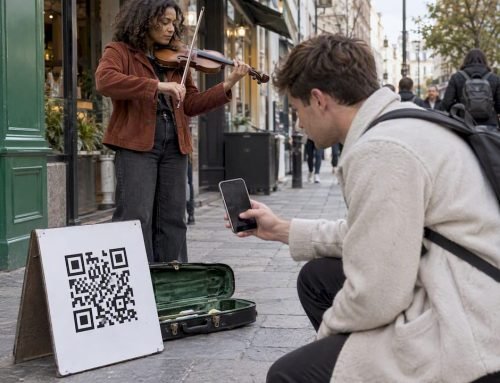
The smart setup is to put a QR code on your sign, cash jar or table. Supporters with bills can use the jar. Everyone else scans and tips in seconds. For counter and event setups, see our guide to contactless tipping with QR codes.
Our perspective
We built Tipper because we think the best tip is the one a supporter actually leaves. Most tips are lost not because fans do not care but because the process has a hurdle: no cash, no account, no time.
So we start from the supporter. Tapping Apple Pay or Google Pay on a personal link, with no signup, is closer to dropping a bill in a jar than any form we have seen. Then we try to restore what cash does best: a real thank-you, by note, photo or video.
We also think creators should see what they keep. Tipper is free to set up, there is no subscription, and creators keep 100% of the tips they earn, with a small payment-processing fee added at checkout. That is a clear trade, and it is the point of comparing digital tips against cash in the first place.
One caution we give every creator: do not rely on tips alone. Because tipping income is often uneven, some creators prioritize steadier income like subscriptions and treat tips as the extra on top. We agree. Tips are best as a way to say thank you, not as a salary.
— Tipper
Set up digital tips in a few minutes
If you are ready to accept digital tips next to cash, Tipper gives you a personal link and QR code. Fans tip with Apple Pay, Google Pay or a card, with no account needed. It is free to create and keep your page. For a deeper look at the tools on offer, compare digital tip jar tool types or read the platform comparison for creators.
A simple way to decide
Use this checklist:
- Do most of your supporters find you online? Go digital first.
- Do you perform or sell in person? Run both, with a QR code beside the jar.
- Do you need money quickly? Check payout minimums and timing before choosing a tool.
- Do you tip-sort for taxes? Prefer the option that leaves a record, and keep a log for cash.
- Do your fans hate signing up for things? Choose account-free tipping.
FAQ
Is it better to tip in cash or digitally?
For the person receiving it, it depends on fees and setting. Cash has no processing fee and is personal in person, while digital tips are easier for supporters and leave a record. Creators who work online should lean digital, and in-person performers often do best offering both.
Do I have to report cash tips on my taxes?
Yes. The IRS says income is taxable whether paid in cash or another form, and whether or not anyone sends you a Form 1099-K. Keep a daily record of what you receive, and ask a CPA or enrolled agent about your own situation.
Do digital tips cost the creator more than cash?
Usually yes, because platform and payment-processing fees may apply, and the amounts vary by platform and payment method. Cash has no processing fee, but it costs time to handle and deposit. Check what lands in your balance after a small test tip.
Do supporters need an account to leave a digital tip?
That depends on the platform. With Tipper, supporters can tip without creating an account, using Apple Pay, Google Pay or a card on your personal link or QR code.
Sources
- Tip Jars and Virtual Tipping
- YouTube Super Thanks: How to Enable Them and Make More Money
- How to monetize your mobile app
- How much do creators make from token-based social media
- Street performers rely more on apps like Venmo as cash fades
- Busking in the age of Venmo
- IRS Gig Economy Tax Center
- IRS Publication 5731-B
- What to do with Form 1099-K
- Tips for Avoiding Incorrect Forms 1099-K
- IRS Publication 531, Reporting Tip Income
- FTC: Influencers, spot a job scam
- FTC: Disclosures 101 for Social Media Influencers
- Tipping Wars



Leave A Comment