

Instant tip payment is the immediate transfer of a gratuity from a supporter to a creator, settling within seconds to minutes rather than the 1 to 5 business days typical of ACH transfers. Platforms like Uber Instant Pay, Square, and Visa Direct have normalized this technology in the gig economy, and now content creators, freelancers, and influencers are using the same infrastructure to get paid the moment their audience appreciates their work. This guide covers how the technology works, what it costs, how platforms implement it, and how it compares to traditional payout schedules so you can make a fully informed decision about adding instant tipping to your revenue mix.
How does instant tip payment technology work?
Instant tip payment runs on two primary payment rails: push-to-debit networks and real-time payment networks. Understanding the difference tells you a lot about speed, cost, and availability.

Push-to-debit networks
Push-to-debit uses Visa Direct or Mastercard Send to route funds over existing card networks directly to a recipient’s debit card. Funds reach accounts in seconds to 30 minutes, operating 24 hours a day, 365 days a year. This is the backbone behind Uber Instant Pay, DoorDash cashouts, and many creator payout tools. The trade-off is cost: the card network charges interchange fees that platforms typically pass on to users.
Real-time payment networks
The Clearing House’s RTP network and the Federal Reserve’s FedNow service are bank-to-bank rails that settle in seconds. These networks are growing fast, and their adoption is expected to push fees down significantly over the next few years. Unlike push-to-debit, RTP and FedNow do not require a debit card on file. They work directly between bank accounts, which makes them attractive for platforms building next-generation payout systems.
How it differs from ACH
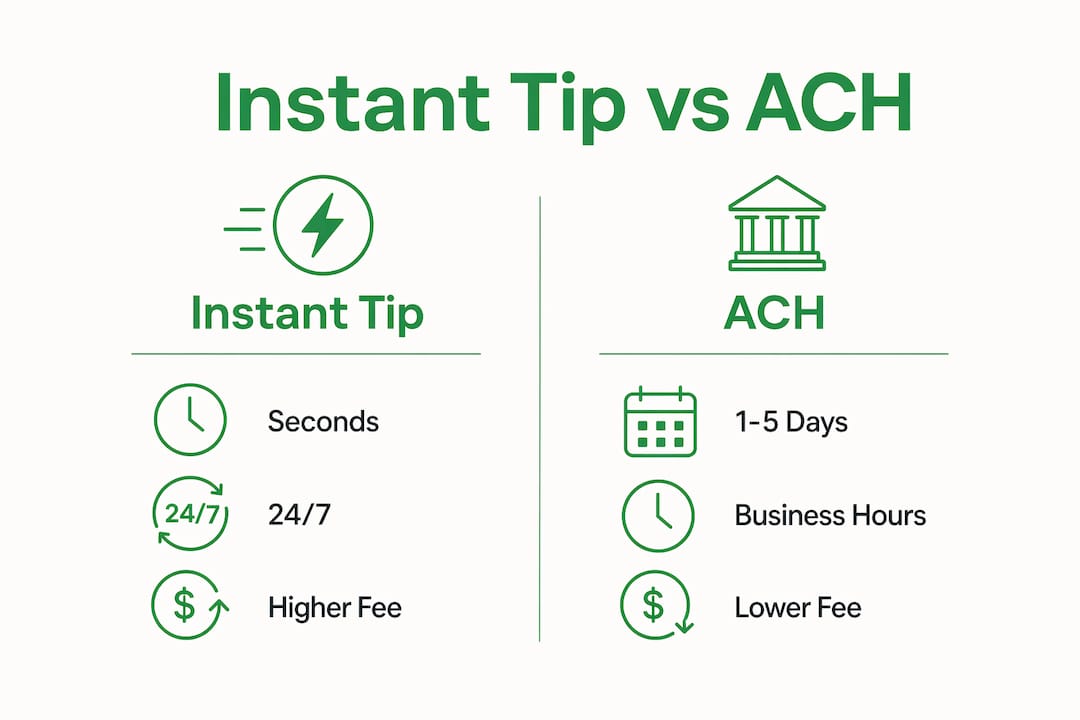
Standard ACH transfers batch transactions and settle once or twice per business day, creating delays of 1 to 5 days. Same-day ACH is faster but still limited to business hours and specific cutoff windows. Instant transfers settle in under 20 seconds for the majority of transactions, a difference that matters enormously when a creator needs to cover an expense today, not next Tuesday.
Here is a quick comparison of the three main settlement methods:
| Method | Typical settlement time | Operates 24/7 | Typical fee |
|---|---|---|---|
| Standard ACH | 1 to 5 business days | No | Low or free |
| Same-day ACH | Same business day | No | ~$0.25 to $0.75 |
| Push-to-debit (Visa Direct) | Seconds to 30 minutes | Yes | ~$0.50 to $1.99 |
Pro Tip: If your platform offers both same-day ACH and instant payout options, use instant only when you need the money immediately. Batching non-urgent payouts to ACH saves you real money over a month.
The economic model behind instant tip payments is straightforward. The platform pays the card network a per-transaction fee to guarantee speed and availability. That fee is either absorbed by the platform, charged to the sender, or deducted from the recipient’s payout. Knowing which model your platform uses is the first question to ask before you commit.
What are the benefits and costs of instant tip payments?
The core benefit of instant tip payment is financial autonomy. Instant payouts eliminate paycheck delays, giving creators immediate access to earnings they can use for daily expenses without relying on credit or short-term loans. For a freelance video editor waiting on a client invoice, or a musician who just finished a live stream, that difference is not abstract. It is rent money available now instead of Thursday.
Beyond cash flow, instant tipping creates a feedback loop between creators and their audiences. When a supporter taps a tip button and the creator can acknowledge it within seconds, the interaction feels real and reciprocal. That immediacy drives repeat tipping behavior and strengthens platform loyalty in ways that delayed payouts simply cannot replicate.
The costs, however, deserve equal attention:
- Transaction fees. Uber charges $0.85 and DoorDash charges $1.99 per instant cashout. These fees cover interchange and network costs. On small tip amounts, a $1.99 fee on a $5 tip is a 40% cut of your earnings.
- Who pays the fee. Some platforms charge the sender, some deduct from the recipient, and some split the cost. Always confirm this before choosing a platform.
- Fee negotiation. High-volume creators may negotiate lower or waived fees, but this is rare for individual creators just starting out. Standard fees apply to the vast majority of users.
- Budgeting complexity. Variable per-transaction fees make monthly income harder to forecast. Tracking net earnings after fees requires a simple but consistent system.
- Liquidity management. Platforms must maintain enough liquidity to fund instant payouts at all times. This operational cost is why fees exist and why some smaller platforms cannot offer true instant settlement.
Pro Tip: Use a fee calculator to model your actual net earnings at different tip amounts and fee structures before committing to a platform. A $0.50 flat fee is better than a 3% fee once your average tip exceeds $17.
The net result for most creators is positive. Faster access to earnings, stronger audience connection, and the ability to manage cash flow without a buffer account outweigh the per-transaction cost, provided you choose a platform with a transparent and reasonable fee structure.
How do platforms implement instant tip payments effectively?
Two distinct tip flow patterns exist in the market, and each produces different engagement outcomes. Merchant-collected tips are added at checkout by the business before the customer confirms payment. Customer-prompted tips appear inside digital wallet interfaces, with fixed or percentage suggestions presented after the transaction. Research consistently shows that customer-prompted flows generate higher engagement because the supporter feels the choice is voluntary rather than embedded.
Square’s implementation is a useful benchmark. Square sets tipping presets as fixed dollar amounts for payments under $10 and percentage-based options for payments of $10 and above. This smart preset logic reduces decision fatigue for the tipper and increases the likelihood of a tip being given at all. Creators building their own tip flows should borrow this logic: present concrete, easy choices rather than open-ended input fields.
Here is how the two main implementation approaches compare:
| Approach | When tip is requested | User experience | Engagement level |
|---|---|---|---|
| Merchant-collected | Before payment confirmation | Feels embedded in checkout | Moderate |
| Customer-prompted | After transaction, inside wallet UI | Feels voluntary and personal | Higher |
Effective implementation also requires attention to onboarding and fraud prevention. Platforms adopting instant tipping must verify payer and payee identities securely to prevent abuse. For creators, this means completing identity verification steps upfront, which protects both you and your supporters. Skipping or delaying verification is the most common reason instant payouts get blocked at the worst possible moment.
Cotton Patch Cafe offers a strong case study in combining instant tips with earned wage access. The restaurant reports improved employee experience and reduced payroll complexity after integrating both systems on a single platform. For creators managing multiple revenue streams, the same principle applies: consolidating instant tips and other earnings into one payout system reduces administrative overhead and gives you a cleaner picture of your finances.
How do instant tip payments compare with traditional tipping methods?
Traditional tipping methods fall into three categories: cash handed directly to the recipient, tips pooled and distributed through payroll, and digital tips settled via standard ACH. Each carries a different speed, cost, and operational burden.
Cash tips are instant by nature but create record-keeping problems and are increasingly rare as digital payments dominate. Payroll-distributed tips can take two weeks or more to reach workers, and the administrative process is error-prone. Standard ACH digital tips are cleaner but still subject to multi-day delays that frustrate creators who need immediate access to their earnings.
“Instant payment infrastructure is evolving fast; fees are likely to shrink as RTP and FedNow adoption increases.” — Fintek Cafe
This trajectory matters for creators making platform decisions today. Choosing a platform already built on RTP or FedNow rails positions you to benefit automatically as fees decrease. Platforms still running on legacy ACH infrastructure will struggle to compete on speed and cost as the market matures.
The competitive retention angle is also real. Creators who offer instant tipping report that their audiences perceive the experience as more personal and responsive. When a supporter knows their tip lands in your account within seconds, the act of tipping feels meaningful rather than transactional. That perception difference is a genuine competitive advantage over creators using delayed payout systems.
Key takeaways
Instant tip payments give creators real-time access to earnings through push-to-debit networks like Visa Direct, with fees of $0.50 to $1.99 per transaction that are outweighed by the cash flow and engagement benefits for most active creators.
| Point | Details |
|---|---|
| Settlement speed | Instant payments settle in seconds to 30 minutes, versus 1 to 5 days for ACH. |
| Fee awareness | Per-transaction fees range from $0.50 to $1.99; model your net earnings before choosing a platform. |
| Customer-prompted tips | Voluntary tip prompts inside digital wallet UIs generate higher engagement than merchant-collected flows. |
| Fraud and verification | Completing identity verification upfront prevents instant payout blocks at critical moments. |
| Future fee trends | RTP and FedNow adoption will likely reduce instant payment fees, rewarding creators who choose forward-looking platforms now. |
Why instant tipping is the creator economy’s most underrated revenue lever
I have spent years watching creators obsess over subscriber counts and brand deals while leaving the most direct revenue channel on the table. Instant tipping is not a tip jar. It is a real-time signal from your audience that they value what you just created, and it pays you before the algorithm decides whether to reward you.
The fee conversation trips people up more than it should. Yes, $1.99 per transaction sounds steep on a $5 tip. But the creators I see thriving with instant tipping are not optimizing for the smallest fee. They are optimizing for the highest frequency of tips, which means building a tipping experience so frictionless that supporters do it without thinking. A supporter who can tap Apple Pay or Google Pay and send a tip in three seconds will tip far more often than one who has to create an account, enter card details, and wait for a confirmation email.
The platforms that get this right share one characteristic: they remove every possible barrier between the supporter’s impulse and the creator’s payout. No account creation. No login. No friction. The technology exists today to deliver that experience, and the creators who adopt it early are building audience relationships that delayed-payout platforms simply cannot replicate.
My advice is straightforward. Evaluate platforms on three criteria: settlement speed, fee structure, and whether the tip flow is customer-prompted or buried in a checkout process. Get those three right, and instant tipping becomes one of the most reliable and emotionally resonant revenue streams you can build.
— Steve
How Tipper makes instant tip payments work for you
Tipper is built specifically for creators, freelancers, and influencers who want to receive tips without the friction that kills conversions on most platforms.

With Tipper, supporters send tips through a personalized link using Apple Pay or Google Pay, with no account creation required on their end. You keep 100% of your earnings, which means the fee model is transparent from day one. The platform supports thank-you messages via notes or video, turning each tip into a genuine moment of connection rather than a silent transaction. If you are ready to add instant tipping to your revenue mix, Tipper gives you the infrastructure to do it without the complexity. Set up your personalized link and start receiving real-time appreciation from your audience today.
FAQ
What is instant tip payment?
Instant tip payment is the real-time transfer of a gratuity from a supporter to a creator or worker, settling in seconds to 30 minutes through push-to-debit networks like Visa Direct or Mastercard Send, rather than the 1 to 5 days required by standard ACH.
How much does an instant tip payment cost?
Per-transaction fees typically range from $0.50 to $1.99. Uber charges $0.85 and DoorDash charges $1.99 per instant cashout, with costs covering card network interchange fees.
Do creators need an account to receive instant tips?
It depends on the platform. Tipper allows supporters to send tips without creating an account, using Apple Pay or Google Pay, which significantly reduces friction and increases tip frequency.
Can instant tip payment fees be negotiated?
High-volume creators may negotiate lower or waived fees, but standard rates apply to most individual users. Modeling your net earnings at current fee levels before choosing a platform is the most reliable approach.
How do instant tip payments differ from ACH transfers?
ACH transfers batch and settle over 1 to 5 business days during business hours. Instant tip payments use card network rails or real-time payment networks to settle around the clock, typically in under 30 minutes.




Leave A Comment