

The fastest way to accept gratuities is a personalized tip link or QR code that supports Apple Pay, Google Pay, and card payments, no account needed on the sender’s end. Set one up today, run a $1 test tip through it, and label every prompt “optional” or “voluntary” so it stays classified as a tip rather than payment for access or services.
Two moves matter most before you promote your link anywhere:
- Create your tip page or QR code and confirm Apple Pay/Google Pay both trigger correctly.
- Write your call-to-tip copy so it reads as clearly voluntary, not a paywall or condition of access.
On taxes: track net receipts separately from gross, since platform fees get deducted before the money reaches you, and save your monthly statements. You’ll need them whether a 1099-K arrives or you’re reporting the income yourself.
Key Takeaways
Accepting tips successfully comes down to choosing a direct payment rail, keeping the ask genuinely voluntary, and separating gross tips from net deposits for tax purposes.
| Point | Details |
|---|---|
| Choose a direct rail | Personalized links and QR codes with wallet support net more than platform-native tools after fees. |
| Keep the ask voluntary | Use “optional” phrasing and place tip prompts after content, not before, to align with IRS examples. |
| Track gross versus net | Fees get deducted before payout, so log both figures separately for accurate tax reporting. |
| Save records for three years | Export monthly statements and fee breakdowns from every rail you use. |
| Use Tipper for setup | Tipper offers no-account sending and Apple Pay/Google Pay support for creators. |
Table of Contents
- Practical Methods for Payment Processing for Tips
- How Much of a $5 Tip Do You Actually Keep?
- Setting Up a Tip Link, QR Code, and Payouts
- Wording and Placement That Keep Tips Voluntary
- Bookkeeping and Tax Steps for Tip Income
- What Creators Get Wrong About Tip Compliance
- Start Collecting Tips Without Asking Supporters to Sign Up
- Sources
- FAQ
Practical Methods for Payment Processing for Tips
Your choice of rail affects both what you keep and how easy taxes are later. Here’s how the main options stack up.
Personalized tip links work anywhere you can paste a URL: a bio, a video description, a Discord pin, an email signature. They’re the most portable option because they don’t depend on which platform the viewer is using.
QR codes solve the in-person problem: a table tent, a business card, a tip jar sticker. A customer scans, pays, and walks away in under fifteen seconds with no app download required.

Apple Pay and Google Pay buttons cut friction to almost nothing since the payment method is already saved on the phone. That one-tap flow is a big reason mobile wallet tipping converts better than manual card entry for spontaneous, low-dollar tips.

Platform-native tip tools (built into a streaming or social app) are convenient because they’re already there, but they usually take a larger cut and report the income under the platform’s own rules, not yours.
Stream overlays and in-video prompts work best as a nudge, not the mechanism itself, pointing viewers to your link or QR rather than trying to process payment inline.
- Direct links: most portable, best for cross-platform audiences
- QR codes: best for in-person, no typing required
- Wallet buttons: fastest checkout, highest completion rate
- Platform-native tools: easiest to enable, costliest long-term
How Much of a $5 Tip Do You Actually Keep?
A typical card transaction carries a processing rate around 2.9% plus a fixed fee near $0.30, on top of whatever percentage the platform itself takes before payout.
Pro Tip: Run the same $5 tip through both a direct-link rail and a platform-native tool once, side by side. The gap in what lands in your account tells you more than any fee schedule.
On a direct processing rail, a $5 tip loses roughly $0.45 to card processing, leaving you close to $4.55. Route that same $5 through a platform that also takes a revenue-share cut on top of processing, and you can lose another 5 to 20 percent depending on the platform, landing closer to $3.80 to $4.30.
- Card processor rate: typically 2.9% + a fixed per-transaction fee
- Platform take-rate: separate from processing, and stacks on top of it
- Fixed fees hurt small tips disproportionately more than large ones
The reporting side matters just as much as the math. Processors and platforms both report gross payment volume, not your net take, so reconciling gross figures against fee statements is the only way to know what you actually earned versus what shows up on paper.
Setting Up a Tip Link, QR Code, and Payouts
Here’s the sequence that gets you live in under 30 minutes.
- Pick a direct tip rail first. A rail that pays you directly, rather than pooling funds inside a platform, gives you cleaner net receipts and simpler records come tax season.
- Build your tip page. Add your name or brand, a short thank-you line, two or three preset amounts ($3, $5, $10), and a custom-amount field. Tipper’s tip page setup lets you add a text, photo, or video thank-you note that plays after the tip lands, doing more for repeat tipping than a generic receipt ever will.
- Generate your QR code. Most tip-link tools generate this automatically from your page URL. Print it or screenshot it, then scan it yourself on a second phone to confirm it opens the right page.
- Enable Apple Pay and Google Pay. These should show up automatically on supported tip pages. Run one real test transaction, even a small one, before sharing the link publicly.
- Set up payouts. Add your bank details, complete identity verification (standard KYC for any payment platform), and confirm your payout schedule so you know exactly when funds actually hit your account.
Pro Tip: Test your link on both an iPhone and an Android device before posting it anywhere. A broken wallet button on one operating system will quietly cost you tips you’ll never know you missed.
Wording and Placement That Keep Tips Voluntary
How you phrase the ask affects both conversion and your legal footing. The IRS’s recent guidance on digital creator tips makes voluntary, post-access payments more clearly classifiable as tips rather than compensation, which is exactly the distinction you want on your side.
- Use phrasing like “If you’d like to leave a tip” or “Completely optional” near every prompt.
- Place your link where it doesn’t gate content: a pinned comment, a post-stream overlay, or a printed QR on a receipt, never a wall before access.
- Offer three preset amounts plus a custom field. Round numbers convert better than odd ones, and a visible custom option signals you’re not fishing for a specific figure.
- Never preselect or pre-check a tip amount at checkout. That single UX choice is what turns a tip into something that looks compulsory.
Bookkeeping and Tax Steps for Tip Income
Tip income is taxable regardless of whether a form arrives in your mailbox, so build your bookkeeping around your own records, not just what a platform sends you.
Form 1099-K reporting covers gross payment volume, including cash tips reported in Box 1c, while 1099-NEC or 1099-MISC typically covers payments for services rather than voluntary gratuities. That distinction, voluntary tip versus paid compensation, is exactly why your on-page wording matters for how income gets classified in the first place.
- Export monthly statements from every rail you use and store them somewhere searchable.
- Log gross tips and net deposits separately; the difference is your fee history.
- Keep a running note of which platform charged what, since rates change.
- Save everything for at least three years in case of a reporting question.
Creator tax guidance generally treats tip income as self-employment earnings, which means quarterly estimated payments and, per TurboTax’s guidance for content creators, reporting through Schedule C. Many creators set aside 25 to 30 percent of net tip income for taxes and bring in a CPA once volume gets consistent month over month.
What to Verify Before You Trust a Tip Rail
Direct processors typically pay out in 1 to 7 business days; platform-native tools often run slower. Confirm the rail uses tokenized card data (never stores raw numbers) and is PCI compliant. Decide upfront whether tips stay anonymous or record sender details, since some supporters expect to send a tip without creating an account at all.
What Creators Get Wrong About Tip Compliance
Most advice on this topic treats tip collection as purely a UX problem: pick a nice-looking button, add some preset amounts, done. That’s backwards. The wording problem comes before the design problem. A gorgeous tip page with checkout copy that implies payment is expected, or worse, required, undoes any compliance benefit from choosing a “tip” rail at all.
The overlooked piece is timing. Tips requested before someone accesses your content read differently than tips requested after, and that sequencing shows up directly in how the IRS’s own examples treat voluntary payments. Ask for support after you’ve delivered value, not as a condition of it.
If you take one thing from this guide, take this: set up your link, make the ask genuinely optional in both wording and placement, and keep your fee records separate from day one. Everything else, overlays, preset amounts, wallet buttons, is optimization on top of a foundation that has to be right first.
— Tipper
Start Collecting Tips Without Asking Supporters to Sign Up
Tipper gives creators a personalized link and QR code that accepts Apple Pay, Google Pay, and card payments, and the person sending a tip never has to create an account. That removes the single biggest drop-off point in tip collection: the moment someone has to sign up just to give you money.
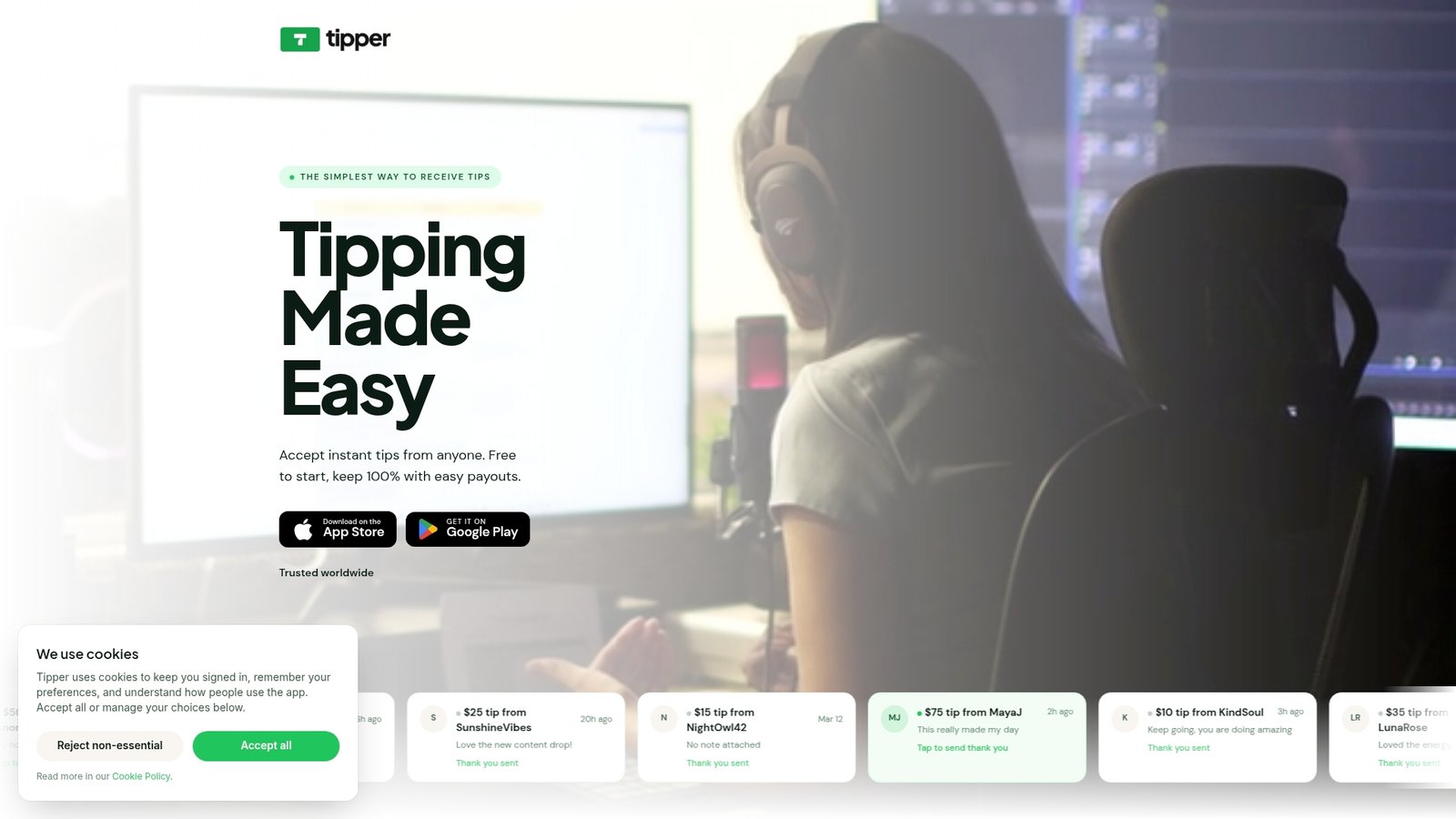
Every tip page can include a thank-you note back to the supporter, in text, a photo, or a short video, which turns a one-time tip into a reason someone comes back. Set up your personalized tip page today, generate your QR code, and send yourself a $1 test tip before you share the link anywhere public.
Sources
FAQ
Do I Have to Report Tips If I Don’t Get a 1099-K?
Yes. Tip income is taxable whether or not a form arrives, and you’re responsible for reporting it based on your own records.
What Makes a Tip “Voluntary” Instead of a Payment?
Voluntary tips are requested after access is granted, with clear optional wording and no preselected amount, which is the distinction the IRS’s guidance draws between tips and compensation.
Does Tipper Require Supporters to Create an Account?
No. Tipper lets supporters send a tip through Apple Pay, Google Pay, or a card without signing up, which removes a major source of drop-off at checkout.
How Much Should I Set Aside for Taxes on Tip Income?
Many creators set aside a substantial portion of their net tip income as a reserve for taxes, since it’s generally treated as self-employment earnings subject to quarterly estimated payments.
Which Fees Reduce a Small Tip the Most?
Fixed per-transaction fees hurt small tips disproportionately, since a $0.30 charge takes a much bigger bite out of a $5 tip than a larger one.




[…] How to Set Up Payment Processing for Tips as a Creator […]
[…] build a markup into the transaction instead of showing a line-item fee. Reading the fine print on payment processing for tips shows how the gross amount a supporter pays differs from the net amount that lands in your account, […]
[…] How to Set Up Payment Processing for Tips as a Creator […]
[…] from your payout, but the exact structure varies by provider, so check the specifics on your payment processing setup before you publish a […]