

An online tip jar is a digital link or button that lets creators, freelancers, and small businesses receive voluntary, one-time payments from their audience with no subscriptions, paywalls, or account creation required. If you’ve ever wondered what does tip jar mean online, the short answer is this: it’s the digital equivalent of the glass jar on a coffee shop counter, except it lives in your bio, your email footer, or at the end of your YouTube video. Platforms like Twitter Tips, Stripe Payment Links, and ConvertKit’s Earn feature have made this model accessible to anyone with an internet connection. Setup takes under five minutes, and transactions complete in under ten seconds with no hardware needed.
How does an online tip jar work vs. a subscription?
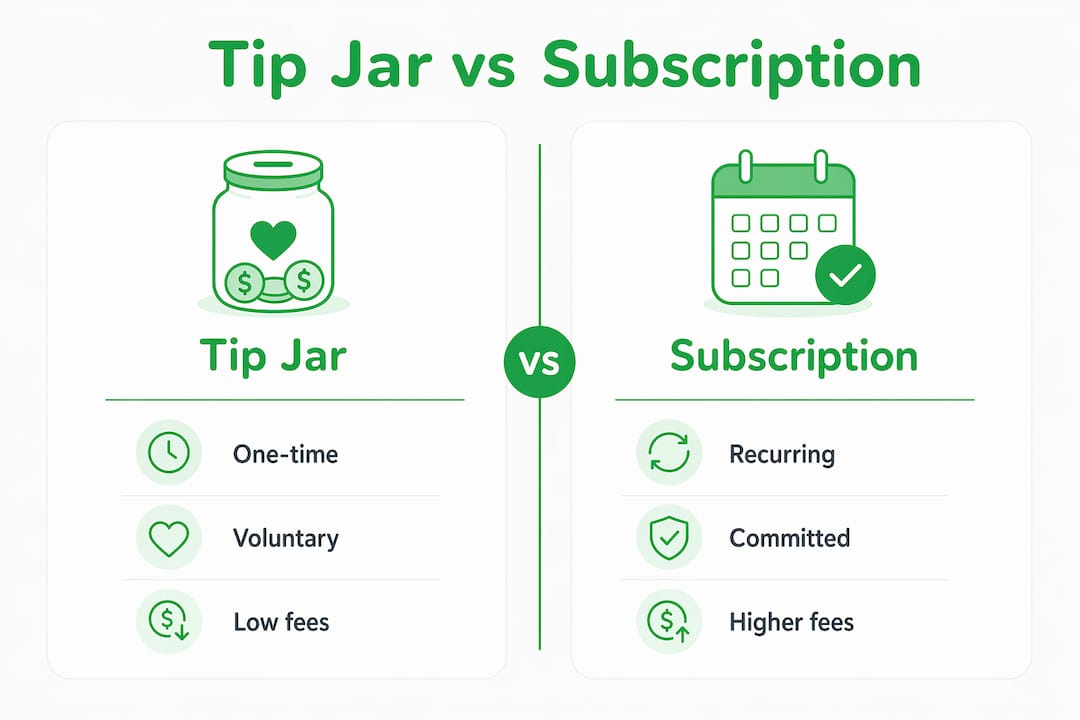
The tip jar definition comes down to one word: voluntary. A digital tip jar collects one-time contributions from people who want to show appreciation for your content, service, or personality. There is no paywall, no recurring charge, and no obligation on either side.
This is the key difference from subscription platforms like Patreon. With Patreon, supporters commit to a monthly fee in exchange for exclusive content. With a virtual tip jar, your audience gives what they want, when they want, with zero strings attached. Digital tip jars lack the obligations of memberships or recurring fees, which lowers the barrier for casual supporters who like your work but aren’t ready to commit monthly.

Payment methods and transaction costs
Most online tip jar tools support Apple Pay, Google Pay, and standard card payments. That means a supporter can tap once on their phone and send you $5 in under ten seconds. The friction is nearly zero.
Transaction fees are the main cost to understand. Stripe charges 2.9% plus $0.30 per transaction, which is cost-effective compared to subscription platforms that often take a larger platform cut on top of payment fees. On a $10 tip through Stripe, you keep roughly $9.41. On a $5 tip, you keep about $4.56. These numbers matter when you’re deciding which tool to use.
| Feature | Online Tip Jar | Subscription Platform |
|---|---|---|
| Payment type | One-time, voluntary | Recurring, committed |
| Paywall required | No | Usually yes |
| Audience friction | Very low | Medium to high |
| Creator keeps | Up to 100% | Varies (platform takes cut) |
| Best for | Casual supporters | Dedicated fans |
Pro Tip: If your audience is casual and wide, a tip jar converts better than a subscription. Save Patreon-style memberships for your most dedicated 1% of followers.
What platforms let you set up a virtual tip jar?
The online tip jar explained simply is a payment link you place wherever your audience finds you. The platform you choose depends on how much control you want, what features you need, and how technical you’re willing to get.
Stripe Payment Links are the most cost-efficient option. You create a payment link in minutes, set a suggested amount, and share it anywhere. Stripe’s standard 2.9% plus $0.30 fee is the lowest you’ll find among major processors. The tradeoff is minimal branding and no community features. DIY creators who want maximum profit favor this route.
ConvertKit’s Earn feature connects tipping directly to your email list. If you already use ConvertKit to send newsletters, you can add a tip link to every email footer. This is powerful because your email subscribers are already your warmest audience. The integration makes tipping feel natural rather than transactional.
Buy Me a Coffee offers a full creator profile, supporter messages, and a community feel. Supporters can leave notes with their tips, which adds a personal layer that pure payment links can’t replicate. The platform takes a small percentage, but the experience it creates often justifies the cost.
Twitter Tips is built directly into the platform used by over 500 million active users. Followers can tip without leaving Twitter, which removes every possible friction point. If your audience lives on Twitter or X, this is the most frictionless option available.
WordPress plugins like GiveWP or Simple Pay let you embed a tip jar directly into your website. This works well for bloggers and service providers who want tipping to feel like a natural part of their site rather than a redirect to a third-party page.
Pro Tip: Don’t overthink the platform choice. The financial processor matters less than how you present the ask. A well-worded tip jar on Stripe outperforms a poorly worded one on any premium platform.
What is the right way to present a digital tip jar?
Etiquette is where most creators get this wrong. The tip jar meaning on social media is not “please give me money.” It’s “if my work has been worth something to you, here’s a way to say so.”
Non-coercive presentation is the standard. Tipping should be framed as an option, not an expectation. Language like “if you found this helpful, you can buy me a coffee” works far better than “please support my work.” The first invites. The second pressures.
Personalized calls to action outperform generic buttons. A message that says “This newsletter takes me six hours to write every week. If it’s saved you time, a small tip means a lot” converts better than a plain “Tip Me” button. The specificity creates context. Context creates motivation.
Placement matters as much as wording. The most effective spots for a tip jar link are:
- Email signatures and newsletter footers, where readers are already engaged
- Video end screens or description boxes on YouTube
- Social media bios on Twitter, Instagram, and LinkedIn
- Blog post endings, right after the reader has consumed your best content
- Podcast show notes, where listeners who just finished an episode are most appreciative
One more thing worth knowing: digital tip jars remove the social theater of public tip screens. There’s no awkward eye contact, no barista watching you decide. That anonymity makes voluntary contributions feel more comfortable for supporters, which means you’re more likely to receive them.
What are the real benefits and challenges of online tip jars?
The uses of tip jars online go beyond simple monetization. A well-placed tip jar transforms passive viewers into active patrons. Properly presented tip jars increase engagement significantly over static links alone, because the act of tipping creates a micro-relationship between creator and supporter.
Here are the clearest benefits:
- No recurring commitment means supporters who can’t afford a monthly subscription can still contribute. This opens your monetization to a much wider audience.
- Low setup cost makes it accessible to creators at any stage. You don’t need a large following to start.
- Cashless capture lets you collect appreciation from people who don’t carry cash. Digital tip jars capture impulsive appreciation from audiences who would otherwise have no way to show support.
- No platform dependency means you can place your tip link anywhere, from your email footer to your product packaging.
The challenges are real too. A small audience means small tip volume, regardless of how well you present the ask. Transaction fees add up on small tips. A $2 tip through Stripe nets you about $1.64 after fees, which changes the math on whether it’s worth promoting heavily.
The biggest psychological challenge is the feeling of asking. Many creators avoid tip jars because they worry about looking desperate. The solution is integration, not avoidance. Integrating tip links into existing workflows like email signatures or video end screens normalizes tipping as audience appreciation rather than a transaction request.
Pro Tip: Track which placements generate the most tips. Most creators discover that one location, often the email footer or video end screen, drives 80% of their tip volume. Double down on what works and stop worrying about the rest.
Key takeaways
A digital tip jar works best when it’s integrated naturally into your content workflow and framed as an opportunity for appreciation, not a demand for payment.
| Point | Details |
|---|---|
| Core tip jar definition | A one-time, voluntary payment link with no subscriptions, paywalls, or account creation required. |
| Best platforms in 2026 | Stripe for low fees, ConvertKit for email integration, Buy Me a Coffee for community feel, Twitter Tips for social reach. |
| Presentation beats platform | Personalized, non-pushy language converts more tips than any specific payment processor. |
| Optimal placement | Email footers, video end screens, and social media bios generate the highest tip frequency. |
| Key challenge | Small audiences and transaction fees limit volume; integration into workflows reduces the psychological barrier to asking. |
Why i think most creators are using tip jars wrong
I’ve watched hundreds of creators set up tip jars and then wonder why nobody uses them. The problem is almost never the platform. It’s the framing.
Most people drop a “support me” link in their bio and call it done. That’s not a tip jar strategy. That’s a link nobody clicks. The creators I’ve seen succeed with tip jars treat them the same way a good restaurant treats its check presentation: warm, personal, and timed perfectly. They mention the tip jar at the exact moment the audience has received the most value, right after a great video, right at the end of a genuinely useful newsletter.
The other mistake I see constantly is treating the tip jar as a separate thing from the content. The best implementations I’ve come across make tipping feel like a natural extension of the relationship. A food blogger who says “this recipe took me three tries to get right, if it worked for you, a coffee tip keeps me testing” is doing it correctly. She’s not begging. She’s giving context and an invitation.
One more thing: don’t underestimate the thank-you. Platforms that let you send a personal note or video response to tippers create a feedback loop that encourages repeat support. The tip jar stops being a one-way transaction and becomes a conversation. That’s where the real audience engagement lives.
— Steve
Start your own tip jar with Tipper
If you’re ready to put a digital tip jar to work, Tipper makes the setup as simple as sharing a link. Tipper lets anyone send you a tip using Apple Pay or Google Pay, with no account creation required on either side. You keep 100% of your earnings, and supporters can attach a personal note or video to their tip, which turns every contribution into a genuine moment of connection.
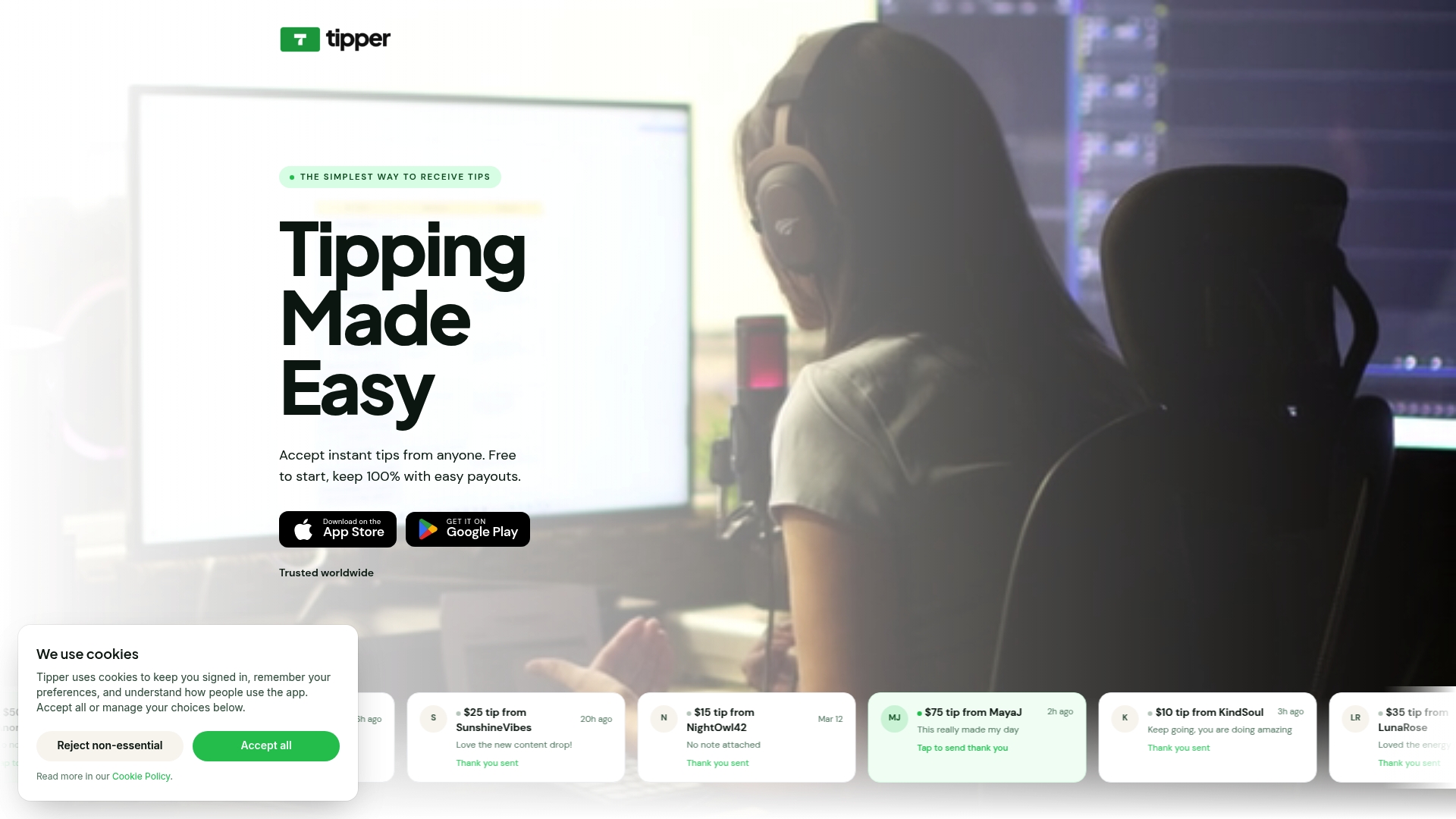
Tipper is built for creators, freelancers, and anyone who wants to receive tips easily without the complexity of traditional donation platforms. Whether you’re a podcaster, a newsletter writer, or a social media creator, Tipper fits into your existing workflow in minutes. Set up your personalized link and place it wherever your audience already finds you.
FAQ
What does tip jar mean online?
An online tip jar is a digital payment link or button that lets audiences send voluntary, one-time contributions to a creator or business. No subscription, paywall, or account creation is required from the supporter.
How does a virtual tip jar differ from patreon?
A virtual tip jar collects one-time, optional payments with no recurring commitment, while Patreon requires supporters to subscribe monthly, often in exchange for exclusive content. Tip jars have lower audience friction and work well for casual supporters.
What is the cheapest way to set up a digital tip jar?
Stripe Payment Links offer the lowest cost at 2.9% plus $0.30 per transaction, with no monthly platform fees. This makes Stripe the preferred choice for creators who want to maximize what they keep from each tip.
Where should i place my tip jar link?
The highest-converting placements are email signatures, video end screens, and social media bios. Placing the link immediately after your audience has consumed your best content produces the strongest results.
Is it rude to ask for tips online?
Non-pushy tip jar requests are considered standard and professional when framed as an option rather than an expectation. Personalized language that gives context for why tips matter converts better and feels more respectful to your audience.




Leave A Comment