

An instant payout has two halves, and creators who get paid fast fix both. The first is how easily a fan can pay you: if they must sign up for something first, many never will. The second is how quickly the money reaches your bank account or debit card after they do. Tipper handles the first half: supporters tip through your personal link or QR code with Apple Pay, Google Pay or a card, with no account needed, and the payment goes to you directly. This guide covers the second half: what “instant” really means, what it costs, and what can slow it down.
TL;DR
- An instant tip is the fan’s payment. An instant payout is you moving money you already have to your bank account or debit card. You want both.
- Depending on the payment rail, money can arrive in seconds, minutes, hours or one to three business days. “Instant” on a marketing page does not guarantee any of those.
- Instant payouts usually cost a percentage of the amount, commonly around 1% to 1.5% in the figures below, and often come with eligibility rules and waiting periods.
- Tipper lets supporters tip without creating an account, and creators keep 100% of their earnings, so the money you move is the money fans sent you.
- Before you rely on any payout, check fees, limits, holds and your tax records.
Table of Contents
- Instant tip vs. instant payout: two different things
- How fast money actually moves in the US
- What instant payouts cost
- Eligibility and what can slow a payout down
- Why speed matters to creator cash flow
- How to choose a payout setup that fits your audience
- Privacy, holds and taxes: what to check before you rely on tips
- Set up a tip link that pays you directly
- FAQ
- Sources
Instant tip vs. instant payout: two different things
The phrase “instant payouts for creators” gets used for two separate steps, and mixing them up is how creators end up disappointed.
The tip is the moment a fan pays you. It is instant when it takes a few seconds and no sign-up. That is the supporter’s experience, and it decides whether the tip happens at all.
The payout is the moment your available balance moves to your bank account or debit card. Stripe-powered documentation from FreshBooks describes it as a withdrawal of eligible funds that typically arrive within 30 minutes, including weekends and holidays. Funds you do not withdraw instantly follow the normal payout schedule.
A third idea sits between them. One creator-payments guide advises separating when earnings become available, when the payout is sent, and when funds arrive. Those can be three different moments, and a product described as “instant” may only speed up one of them.

If you want the longer background on why this matters for your income, our piece on payment immediacy for creators goes deeper, and how instant tip payments work walks through the supporter side.
How fast money actually moves in the US
Speed depends on the rail, which is the network carrying the money. Routable’s May 2026 guide lays out the main options in the US:
| Rail | Typical arrival | What it needs |
|---|---|---|
| RTP or FedNow | Seconds, 24/7/365 | A receiving bank that participates in the network |
| Push-to-card (debit) | Minutes | A supported debit card |
| Same-day ACH | Within hours | Runs during banking windows |
| Standard ACH | One to three business days | Routing and account numbers |
RTP is The Clearing House’s network and FedNow is the Federal Reserve’s service. They are the two primary US instant-payment rails, and coverage depends on whether your bank takes part.
Push-to-card is the route most creator payout features use. According to Trolley’s June 2026 industry guide, most Visa and Mastercard debit cards can receive push-to-card funds, but prepaid-card eligibility varies by issuer. If you use a prepaid card or a small digital bank, confirm that your card qualifies before you plan around it.
Person-to-person apps are a different category. Capital One’s overview says Zelle payments typically take minutes when both sides are enrolled, while ACH generally needs routing and account numbers and may take days. Those tools were built for moving money between people you know, which is why a creator-facing checkout is a better fit for strangers in your audience.
What instant payouts cost
Fast withdrawals are rarely free. The published US figures below show the usual range. They come from different products, so read them as examples of how the pricing works, not as a price list for any one platform.
- FreshBooks Payments: Instant Payouts cost 1.5% and typically land within 30 minutes. Standard scheduled payouts remain available at no additional cost.
- Hyer: its Stripe-based Instant Payout costs 1% with a $0.50 minimum, intended to arrive the same day, commonly from 30 minutes to the end of the day depending on the bank.
- Eventbrite: 3% of the requested amount, with a $2.99 minimum and a $40 maximum.
- Stripe direct and Standard connected accounts in the US: per Routable’s June 2026 comparison, 1.5% per Instant Payout with a $0.50 minimum, and a cap of $9,999 per transaction.
- Industry ranges: Routable’s May 2026 guide lists roughly $0.25 to $1.00 for same-day ACH, commonly under $1 for RTP or FedNow, and about 0.5% to 1.5% for push-to-debit, as typical figures, not universal prices.
A worked example
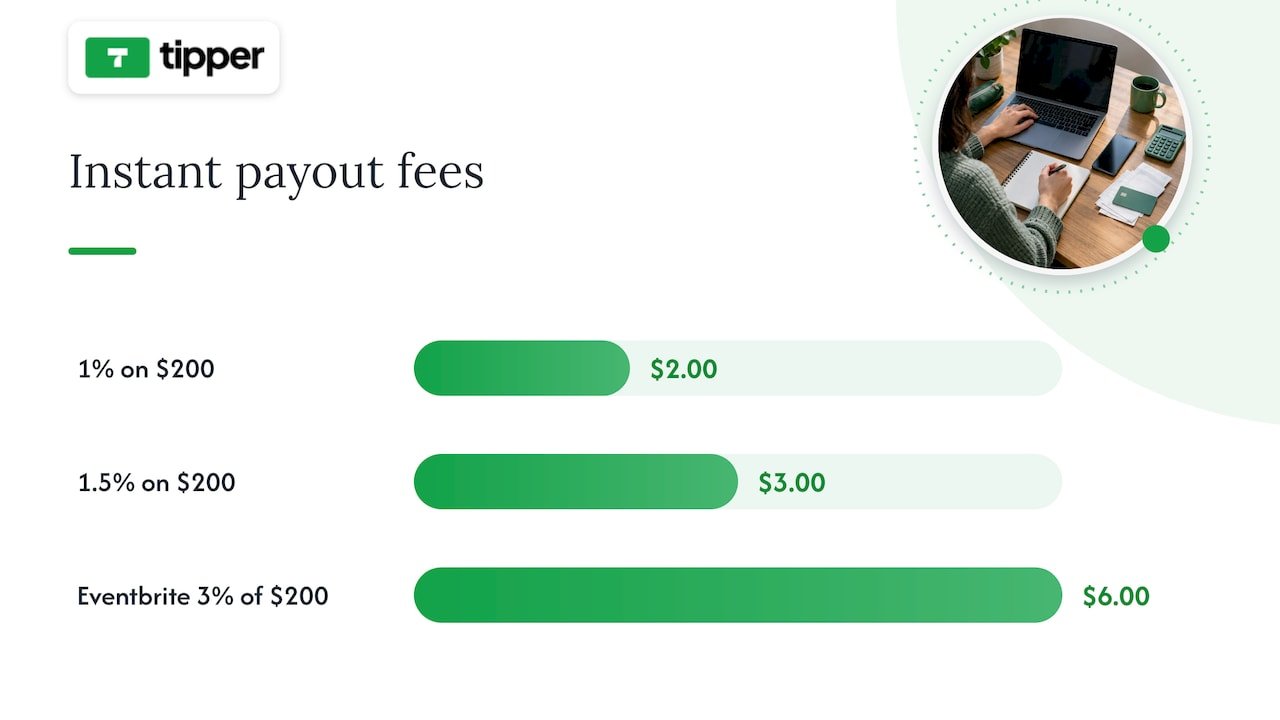
Say a stream ends and your balance holds $200 in tips. At 1% with a $0.50 minimum, an instant payout costs $2.00 and you receive $198.00. At 1.5% it costs $3.00 and you receive $197.00. At Eventbrite’s 3% it would cost $6.00. On a $20 balance, the minimums matter more than the percentage: 1% would be $0.20, but a $0.50 minimum makes the effective rate 2.5%.
The practical rule: withdraw instantly when you need the cash now, and let smaller balances follow the standard schedule. Trolley notes that platforms either deduct the instant fee from the creator’s proceeds or absorb it, and that an unclear deduction creates friction. Read where the fee shows up before you count on a payout.
Eligibility and what can slow a payout down
“Instant” often comes with conditions. The published examples show a pattern worth knowing:
- Account age and history. Eventbrite requires the account to have been on its system for over 72 hours and to have received a successful payout. FreshBooks says new users are not immediately eligible, and the initial seven-day waiting period for first transactions is not bypassed.
- Onboarding. Stripe-based features generally require you to complete identity onboarding first. Eventbrite, for example, requires Stripe onboarding and a U.S. bank account that collects U.S. dollars.
- Limits. Push-to-card limits vary by region and card issuer, according to Trolley, and Stripe’s U.S. cap in Routable’s figures is $9,999 per transaction.
- Network problems. Card-network downtime, routing problems, declines and failed payouts can delay delivery even when a product is marketed as instant.
- Bank participation. RTP and FedNow transfers need a participating receiving bank, and same-day ACH only moves during banking windows.
- Not everything is withdrawable. FreshBooks says only eligible supported payment balances can be withdrawn instantly.
The lesson for a new creator: set up your payout destination and complete verification before you need the money, not on the day a video goes viral.
Why speed matters to creator cash flow
Most creators earn from several places at once, and income arrives unevenly. Mastercard’s October 2025 article says creators may need rapid access to earnings and tips for everyday expenses, which makes payout speed a cash-flow question and not only a convenience.
Visa’s creator survey puts numbers on it: 69% of surveyed creators said waiting for payouts slows momentum, and 88% would engage more with a platform offering instant payouts. Visa also suggests that available cash lets creators act on viral moments, advertising opportunities and partnerships.
Fast access also helps with the bills that do not wait. If your income swings month to month, a practical plan for budgeting irregular income shows how to keep card payments steady between payouts. For the creator side of this, see our notes on real-time payments for freelancers and why immediate income keeps creators motivated.
How to choose a payout setup that fits your audience
Work through these questions in order.
- Where do your supporters pay? Live-stream tools tie payments to eligible live chat. YouTube Supers, for example, apply to eligible live streams or Premieres with live chat. Your fans on TikTok, Instagram or in a link in bio need something that works from a profile link, not a chat window.
- How much friction does a supporter face? Every sign-up screen loses tips. A checkout that accepts Apple Pay or Google Pay with no account is the shortest path from impulse to payment.
- Where does the money go? Separate the fan-facing payment method from your payout destination, and verify eligibility, fees, currency conversion and arrival timing for the destination.
- How urgent is your cash? Match the rail to the need: RTP or FedNow for seconds, push-to-card for debit-card payouts, same-day ACH for a lower-cost option, and scheduled payouts for predictable cycles.
- What is the real experience? Trolley recommends looking past headline speed to card coverage, limits, payout success rates, decline handling, fallback rails and uptime.
Our comparison of digital tipping platforms and the guide to instant payment tools for freelancers cover the options in more detail.
Privacy, holds and taxes: what to check before you rely on tips
The unglamorous details decide whether fast money stays fast. Open Music Business suggests this checklist for accepting tips in the US:
- Use a creator-facing checkout rather than exposing a personal handle when privacy matters.
- Confirm the account type permits commercial payments. Venmo’s US agreement distinguishes personal from authorized commercial payments, and Cash App business terms may permit delayed payouts or reserves.
- Review fees, refund and dispute rules, identity-display settings, reserves and payout holds.
- Keep transaction records and payout reports.
On taxes, the same source notes that tips for creative work can count as taxable income in the US, so keep your payout reports for filing. For how fees and tax records differ between digital tips and cash, see what creators keep from digital tips. For your own situation, a tax professional can tell you what applies to you.
What we think: make the tip as fast as the payout
We built Tipper around one observation: a fast payout is worth little if the tip never happens. Most supporters will pay when it takes seconds and will not when it takes an account, a password and a verification email. So a supporter on Tipper opens your personal link or scans your QR code, pays with Apple Pay, Google Pay or a card, and is done.
We also think the thank-you matters as much as the transfer. A short note, a photo or a video back to the supporter turns a payment into a relationship, and that is what brings people back to tip again.
And we think creators should keep what they earn. Creators keep 100% of their earnings on Tipper. Creating and keeping an account is free, with no subscription, and the cost is a platform fee plus a small payment processing fee added at checkout on each tip.
Tipper
Set up a tip link that pays you directly
Tipper gives creators, freelancers, influencers and small businesses a personalized tip link and QR code. Supporters pay with Apple Pay, Google Pay or a card without creating an account, you customize your tip page, and you can answer with a thank-you message as text, a photo or a video. Payouts go directly to you, and creating an account costs nothing.
It works wherever you can put a link: a Twitch or Kick panel, a YouTube description, a TikTok or Instagram bio, or a printed QR code at an in-person event. You can see how the setup works in our guide to getting paid in minutes with a personalized tip link, or create your tip page on Tipper.
FAQ
Is an instant tip the same as an instant payout?
No. The tip is the supporter’s payment, and it is instant when they can pay in seconds without an account. The payout is you withdrawing your available balance to a bank account or debit card, which has its own speed, fees and eligibility rules.
How fast can a creator get money in the US?
It depends on the rail. RTP and FedNow transfers generally settle in seconds, push-to-card typically takes minutes, same-day ACH takes hours, and standard ACH usually takes one to three business days. Bank participation, card eligibility and network issues can slow any of them.
Do instant payouts cost extra?
Usually, yes. The published US examples in this guide run from about 1% to 1.5% for instant card payouts, with minimums such as $0.50, while standard scheduled payouts are often free. Check how a platform charges the fee before you rely on it.
Why was my first payout delayed?
New accounts often face waiting periods, identity onboarding and eligibility checks. FreshBooks, for example, applies an initial seven-day waiting period for first transactions. Complete verification and add your payout destination before you need the money.
Do my supporters need an account to tip me on Tipper?
No. Supporters tip through your personal link or QR code using Apple Pay, Google Pay or a card, with no account required.
Sources
- What are Instant Payouts with FreshBooks Payments?
- Instant Payouts: How They Work (May 2026), Routable
- Routable vs Stripe Instant Payouts (June 2026)
- Instant Payouts to Debit Cards: What Platforms Need to Know, Trolley
- Instant Payouts: Withdraw Money Straight to Your Bank, Eventbrite
- Instant Payouts: How They Work and How to Request One, Hyer
- Tip Jars and Virtual Tipping, Open Music Business
- Ways to Transfer Money, Capital One
- Payday on demand, Mastercard
- Visa Program Unlocks New Opportunities in the Creator Economy
- Creator Payment Methods: Payments Vs. Payouts

Leave A Comment