

TL;DR:
- Tip amounts reveal how much content solves problems and provides measurable utility. Showing exact dollar figures alongside percentages increases tips by reducing cognitive load and prompting higher contributions.
Tip amounts are a direct financial signal of the perceived value content creators deliver to their audience. Understanding content valuation through tipping goes far beyond counting dollars. Tips reveal which content resonates, what problems you solved, and how strongly your audience connects with your work. Creators on platforms like YouTube can see tip revenue equal to 20–40% of their ad revenue, with educational content earning 5–10 times more in tips than entertainment. That gap is not random. It reflects a measurable difference in perceived utility, and it tells you exactly where to focus your content strategy.
How tip amounts reflect content value through utility
Content that solves a real problem earns more tips than content that simply entertains. The reason is straightforward: audiences psychologically equate content value with measurable outcomes like saving money, which leads them to tip a portion of that saved value as a form of thanks. A tutorial that walks someone through fixing a $200 plumbing issue triggers a very different tipping response than a funny video clip.

Educational and tutorial content generates the highest tip rates because the value is concrete and immediate. A viewer who learns to file their own taxes, build a website, or repair a device can calculate what they saved. That calculation drives generosity. Viewers tip portions of saved value as direct appreciation for the utility delivered, not as charity.
Timing your tip request matters as much as the content itself. Creators who ask for tips immediately after delivering measurable value see higher tip rates than generic support requests. Asking “if this saved you money, consider leaving a tip” right after the payoff moment outperforms a vague “support my channel” message at the start of a video.
Here is what drives utility-based tipping:
- Problem specificity. Content that targets a narrow, painful problem earns more than broad overviews.
- Outcome clarity. Showing the before-and-after result makes the value visible and tip-worthy.
- Request timing. Asking immediately after the value lands, not before, converts at a higher rate.
- Quantified benefit. Naming the dollar amount saved or time recovered primes the audience to tip proportionally.
Pro Tip: Frame your tip request around the specific outcome you just delivered. “If this tutorial saved you a trip to the mechanic, consider leaving a tip” outperforms any generic support ask.
Does interface design change how much people tip?
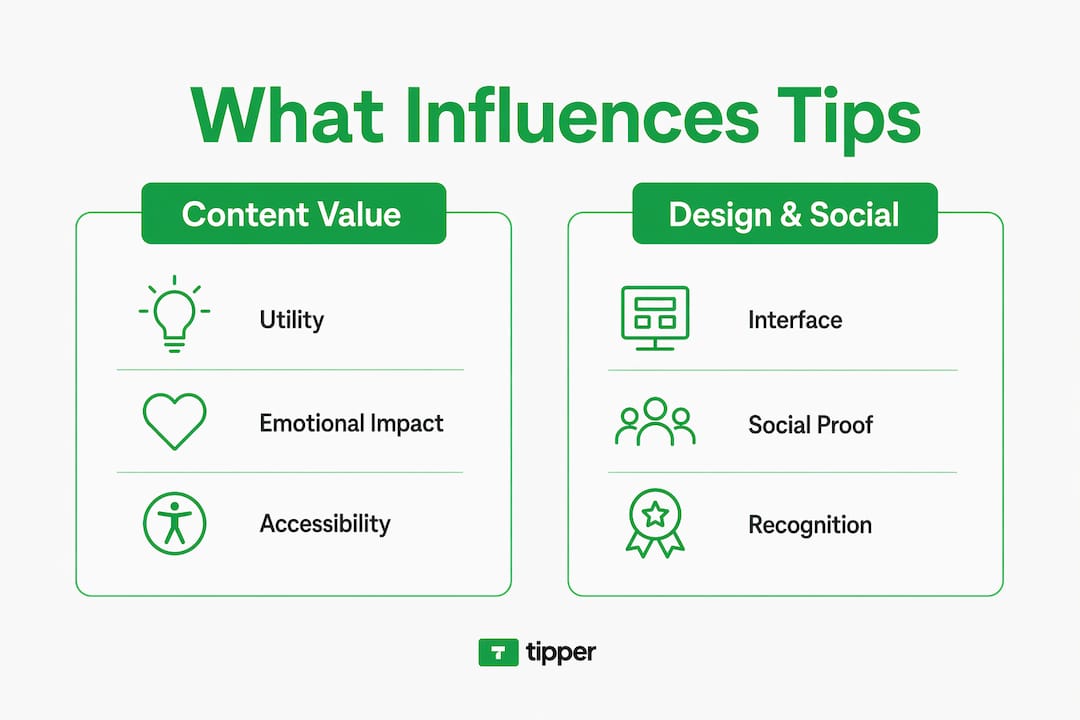
The way a tipping prompt is displayed changes how much people give. Displaying both a suggested percentage and its corresponding monetary amount leads to higher average tips compared to showing percentages alone. This finding comes from an analysis of 5,169 transactions in a natural experiment on digital tipping prompts. The effect held beyond the experimental period, meaning the behavior change was durable.
The psychology behind this is simple. A percentage is abstract. “20%” requires mental math. “$4.60” is concrete and immediate. When audiences see the exact dollar figure, they evaluate it against their perception of the content’s worth rather than calculating it from scratch. That shift in cognitive load consistently produces larger tips.
For creators, this means the tipping interface you use directly affects your earnings. Platforms that show exact dollar amounts alongside percentages give you a structural advantage. The content itself does not change. The presentation does, and the result is measurable.
Key interface factors that influence tip size:
- Concrete dollar display. Showing “$5” alongside “15%” removes friction and increases conversion.
- Preset tip options. Offering three preset amounts anchors the audience toward the middle or higher option.
- Mobile-first design. Frictionless payment methods like Apple Pay or Google Pay reduce drop-off at the moment of decision.
- Placement timing. A tip prompt that appears after content delivery, not before, aligns with the peak of perceived value.
Pro Tip: If you use a tipping platform, choose one that displays exact dollar amounts alongside percentages. That single design choice can meaningfully increase what your audience tips without any change to your content.
What social and psychological factors drive tipping behavior?
Public recognition of tips drives contribution frequency mainly through expectation of financial rewards rather than symbolic appreciation. This finding from a field experiment overturns the common assumption that people tip primarily to feel generous or seen. Financial incentive is the dominant motivator, even in community-driven platforms.
Social proof also shapes tipping behavior in a compounding way. When audiences see that others have tipped, they are more likely to tip themselves. Social proof tipping influences future tip behavior by establishing a norm. If your comment section shows multiple tip acknowledgments, new viewers interpret tipping as the expected response to good content.
Gratitude and personal connection add a second layer. Creators who respond to tips with personalized thank-you messages, whether text or video, reinforce the emotional loop that brings audiences back. The tip becomes a two-way exchange rather than a one-way transaction. That connection increases both the likelihood of repeat tipping and the size of future tips.
Understanding why audiences tip instantly also matters. The impulse to tip peaks in the moment of value delivery and drops quickly. Creators who capture that impulse with a frictionless tipping option convert at higher rates than those who redirect audiences to a separate page or require account creation.
Pro Tip: Acknowledge every tip publicly when possible. A simple “thank you” comment or shoutout signals to your wider audience that tipping is normal, valued, and reciprocated.
Do higher tips always mean better content?
Higher tip amounts do not always signal more accessible or better-written content. Data shows that tipping incentivizes technical, complex language that signals expertise, which can actually reduce readability. Audiences reward perceived expertise, and expertise is often communicated through specialized vocabulary and complex framing. The result is a tipping incentive that can push creators toward content that impresses rather than content that teaches clearly.
This creates a real tension for creators. The content that earns the most tips may not be the content that serves the broadest audience. A highly technical deep-dive on machine learning architecture may earn larger tips from a niche expert audience than a plain-language explainer that reaches ten times more people.
| Content type | Tip potential | Readability | Audience reach |
|---|---|---|---|
| Expert-level technical content | High | Lower | Narrow |
| Practical tutorial (mid-level) | High | Moderate | Broad |
| General entertainment | Low | High | Very broad |
| Beginner explainer | Moderate | High | Broad |
The table above shows that mid-level practical tutorials occupy the best position. They signal enough expertise to earn strong tips while remaining accessible to a wide audience. Pure entertainment sits at the bottom of the tip scale regardless of production quality. Pure expert content earns well but limits your reach.
Tips motivate increased creator output and frequency, but the unintended consequence is content that drifts toward complexity over clarity. Creators who recognize this pattern can make a deliberate choice: signal expertise through depth and specificity, not through jargon. That balance earns strong tips without sacrificing the audience who needs your content most.
Key Takeaways
Tip amounts are the most direct measure of perceived content value, shaped by utility, interface design, social proof, and the balance between expertise and accessibility.
| Point | Details |
|---|---|
| Utility drives tip size | Educational content that saves money or solves problems earns 5–10x more in tips than entertainment. |
| Interface design matters | Showing exact dollar amounts alongside percentages consistently increases tip frequency and size. |
| Timing your request | Asking for tips immediately after delivering value converts at a higher rate than generic support asks. |
| Social proof compounds tips | Visible tip acknowledgments establish a tipping norm that encourages future audience contributions. |
| Complexity vs. clarity | High tips can signal expertise, but content that balances depth with readability reaches more people and earns sustainably. |
What tipping data has taught me about content strategy
Tipping data is the most honest feedback loop a creator has. Likes and views measure attention. Tips measure impact. When I look at which pieces of content earn the most tips, the pattern is always the same: the creator solved something specific, delivered the result clearly, and asked at the right moment.
The mistake I see most often is treating tips as a personality contest. Creators assume their most popular content will earn the most tips. It rarely does. The content that earns the most tips is the content that made someone’s life measurably better, even in a small way. A five-minute video that saves someone $300 will out-tip a viral video with ten times the views.
The complexity trap is real and worth watching carefully. When tipping becomes a significant income source, there is a pull toward content that signals expertise through density and technical language. That content earns well from a narrow audience. But it quietly shrinks your reach over time. The creators who build durable tipping income are the ones who make complex ideas feel accessible, not the ones who make simple ideas feel complex.
Tipping frequency is also a signal worth tracking separately from tip size. A piece of content that earns many small tips from a wide audience tells you something different than one large tip from a single viewer. High frequency means broad resonance. High size means deep impact for a specific person. Both are valuable, and both point toward different content decisions.
— Tipper
Tipper makes it easy to collect and read your tip data
Creators who understand how tips signal content value need a tipping tool that keeps up with that insight. Tipper gives you a personalized tipping link that anyone can use without creating an account, paying through Apple Pay, Google Pay, or a card in seconds.
Because Tipper keeps 0% of your earnings, every tip you receive is a clean data point reflecting exactly what your audience valued. You can track which content drives tips, respond with thank-you notes or videos, and build the kind of personal connection that turns one-time tippers into repeat supporters. If you want to start collecting tips without friction or platform fees, Tipper is built for exactly that. Creators who want to go further can also explore collecting tips with no signup required to see how frictionless tipping changes audience behavior.
FAQ
How do tip amounts reflect content value?
Tip amounts reflect content value by measuring the perceived utility or emotional impact a creator delivered. Educational content that solves specific problems consistently earns higher tips than general entertainment.
Does the type of content affect how much I earn in tips?
Content type directly affects tip earnings. Educational and tutorial content earns 5–10 times more in tips than entertainment content because audiences reward measurable outcomes.
When is the best time to ask for a tip?
The best time to ask for a tip is immediately after delivering the core value of your content. Creators who time their tip requests to follow a specific result or solution see higher conversion than those who ask at the start or end generically.
Does showing a dollar amount instead of a percentage increase tips?
Showing both a percentage and its exact dollar equivalent leads to higher average tips. An analysis of 5,169 transactions confirmed that percent-and-amount prompts outperform percentage-only prompts in both tip frequency and size.
Can tipping change the style of content I create?
Tipping can shift content toward more technical, expert-level language because audiences reward perceived expertise. Creators should watch for this pattern and balance expertise with readability to maintain broad audience reach while still earning strong tips.




Leave A Comment