
Pay what you want (PWYW) is a pricing model where the buyer chooses the amount, sometimes including zero. For creators it works best as a way to lower the barrier to your work, build an audience and collect goodwill, not as a replacement for a steady price on labor-intensive products. Field research shows many buyers pay well above zero, but results depend on how you frame the ask, who your audience is and how easy payment is.
This guide explains what PWYW means, what the evidence says, how to pick a suggested amount, what platforms charge, and where a tip link fits in.
TL;DR
- PWYW lets buyers name their own price. You can add a minimum, a suggested amount, or both.
- Academic field studies found people pay significantly above zero, and revenue can even rise. Results are not guaranteed, and payments can drift over time.
- Suggested amounts, a clear story about where the money goes and social proof all pull payments up.
- Compare platform fees before you commit: percentage cuts, per-sale flat fees, payout minimums and processing charges all change what you keep.
- If you want the simplest version, a tip link with no sign-up for supporters lets fans pay what they feel your work is worth.
Table of Contents
- What pay what you want means
- Does pay what you want work?
- The relationship is the real engine
- When PWYW suits a creator
- How to set a minimum and suggested amount
- What platforms charge
- Our perspective: tips are PWYW without the store
- Start collecting voluntary payments with Tipper
- Mistakes to avoid
- A simple launch plan
- FAQ
- Sources
What pay what you want means
Under PWYW, the seller sets no fixed price. The buyer decides what to pay. Most of the time that decision comes before the purchase, for example when someone downloads a zine, a preset pack or a game. In some versions the buyer pays after using the product, which is how many street performers and some restaurants operate.
There are three common variations:
- Pure PWYW: any amount, including $0.
- PWYW with a minimum: for example, “pay at least $3, more if you like.” The minimum protects you from zero payments.
- PWYW with a suggested price: you show a recommended amount, and buyers can go above or below it.
Two phrases cause confusion. “Pay what you will” means the same thing as PWYW: the buyer picks the amount. “Pay what you can” is usually used in community settings such as theaters, classes and food co-ops, where the goal is access for people with limited budgets. It does not mean the product is free. It signals that a price exists, and that you should pay what fits your situation. If you use that wording on your own page, say clearly whether zero is allowed. Otherwise, buyers will guess.
Does pay what you want work?
The honest answer is: often better than you would expect, but not always.
In the research literature, one widely cited paper in the Journal of Marketing reports on three field studies in which prices paid were significantly above zero, and PWYW could even increase seller revenues. Many buyers do not take the free ride, because paying something feels fairer.
The same fairness instinct can backfire. Research by Gneezy and colleagues, based on three field experiments, found that identity and self-image concerns shape PWYW payments, and some people skip the purchase rather than pay less than they consider appropriate. Fewer people sometimes bought under PWYW than at a low fixed price. In one experiment, buyers who purchased under PWYW with a charity component paid on average five times more than under regular PWYW. The lesson for creators: when people understand where their money goes, they pay more.
There are limits:
- Competition matters. A study in Management Science found PWYW is less successful as a competitive strategy because a posted-price competitor can reduce buyers’ payments. If someone sells an identical thing at a fixed low price, your voluntary pricing looks weaker. Creators with a unique voice or a personal relationship with fans are less exposed.
- Payments can fade. Evidence on long-term stability is mixed. A review in Management Science Letters notes that some studies show payments decreasing over time while others report stability or increases. Treat early generosity as a launch effect until your own numbers show otherwise. For creators who want to diversify how fans can support them, accepting crypto donations is one option some choose to add alongside card and wallet payments.
- Labor-heavy products struggle. GoCardless’s guide for US businesses says PWYW can be difficult to sustain for labor-intensive products or businesses with high overhead, and may suit short-term goals like publicity, goodwill or lead generation.
The relationship is the real engine
PWYW works for creators partly because fans are not anonymous shoppers. Yochai Benkler, writing about voluntary payment models in music, describes how artist-fan engagement, trust and reciprocity can support voluntary payments. A person who has watched your streams for two years feels differently from a stranger who landed on a product page.
That has practical consequences:
- Name yourself. A face, a voice and a story beat a faceless checkout.
- Say thank you in a personal way, by note or video. Reciprocity runs in both directions.
- Be open about what the money funds: new episodes, equipment, time off from a day job.
- Do not shame people who pay little or nothing. Some of them will pay later, share your work or become paying fans another way.
When PWYW suits a creator
PWYW is a good fit when:
- Your marginal cost is near zero. Digital downloads, music, art prints in PDF, templates, fonts and short video lessons cost nothing extra to deliver again.
- You want reach first. A free-to-try entry point brings in people who would never pay a fixed price, and some of them convert later.
- You already have an audience that knows you and feels connected.
- You are testing the market. PWYW tells you what people will actually pay before you set a fixed price.
It is a poor fit when:
- Each sale means hours of custom work for you.
- You depend on predictable monthly income, such as rent money.
- Your product competes head to head with near-identical cheaper alternatives.
A common middle path is a fixed price for core products and PWYW (or tips) for everything else: free videos, open-source tools, written guides. Viewers get the free content, and those who value it can pay. Our piece on how content appreciation payments work covers that pattern in more detail.
How to set a minimum and suggested amount
The number you show matters more than most creators think. Anchoring effects are strong in voluntary pricing.
Use descriptive framing. A 2024 study in the Journal of Marketing Theory and Practice found payouts landed closer to the anchor when it described what others paid. The authors also recommend high-price anchors for radically innovative products. So “most supporters pay $8” is stronger than a bare “suggested: $8”, provided it is true. Do not invent statistics: wait until you have real data, then publish it.
Pick a minimum based on your costs and the friction you want. One indie-game revenue guide suggests a minimum of $3 to $10 for most commercial itch.io releases, depending on scope, while still letting buyers pay more. The logic carries beyond games: a small floor filters out zero payments yet keeps entry easy. Remember that card processing often takes a fixed amount per transaction, so a minimum under about a dollar can leave you with very little.
Give buyers a reason to pay more. The Gneezy findings suggest linking the payment to something meaningful, such as a cause, a goal or a community. A progress bar toward a new microphone is more compelling than a blank amount box.
Make it easy to be generous. A row of preset buttons ($3, $5, $10, custom) works better than a blank field for many people. Mobile wallets help, because tapping to pay removes the typing of card numbers.
Review after a month or two. Look at the average payment, the share of zero or minimum payments and the top amounts. Adjust the suggestion, not the whole model.

A worked example
Say you publish a 40-page illustration guide. You set a minimum of $5, a suggested $10, and a line saying that every payment funds the next guide. Over a month, 300 people download it. Suppose 200 pay the minimum, 80 pay around the suggestion and 20 pay $20. That is $1,000 + $800 + $400 = $2,200 before fees. At a fixed price of $12, you might have sold 150 copies, or $1,800. These numbers are illustrative, not a promise: the point is that a minimum plus a suggestion lets generous buyers subsidize everyone else, and it can bring in more total than a single price.

What platforms charge
Before picking a PWYW platform, compare the same few things across each: the percentage cut, any per-sale flat fee, payment processing charges on top, payout minimums and whether buyers must create an account.
Some examples of what creators see in the US, as reported by third-party pricing reviews in 2026 (check each provider’s own pricing page before you commit):
| Platform type | Reported fee structure | What to watch |
|---|---|---|
| Gumroad | 10% + $0.50 on direct sales, with a separate 30% on its marketplace sales, plus processor fees | Payout minimum reportedly raised to $100; small sellers wait longer for cash |
| Payhip | 5% on the free plan, 2% on the $29 monthly plan, 0% on the $99 monthly plan | Subscription pays off only at higher monthly revenue |
| Itch.io | Seller chooses a revenue share | Strong for games; limited outside that audience |
| Tipper | Free to create an account; a small payment processing fee is added at checkout | No account required for the person paying; creators keep 100% of the tip amount |
Fixed per-sale charges hit small PWYW payments hardest. A $0.50 fee on a $3 payment is about 17% before anything else. That is why many creators put low-value, high-volume payments through a tip link rather than a store checkout. We compare options in our digital tipping platforms comparison and show how micro-payments lose value in micro donation platforms for creators.
Our perspective: tips are PWYW without the store
We built Tipper around one idea: the moment someone feels appreciation is short, and every extra step loses money. A fan who loved your video does not want to create an account, confirm an email and enter a card number. They want to tap Apple Pay or Google Pay, pick an amount and move on.
That is pay what you want in its most direct form. There is no product to unlock and no checkout to design. You share a personal link or QR code, supporters choose the amount, and you can answer with a thank you note, a photo or a short video. We think that personal reply matters as much as the money, because it is the reciprocity Benkler describes in action.
We also think creators should keep what they earn. On Tipper, creators keep 100% of the tip amount, and the small payment processing fee is added at checkout. Accounts are free to create and maintain, with no subscription. We do not publish a fixed fee figure here, so check the site for the current processing fee before you plan around it.
And we are honest about the limits. Tips and PWYW will not replace a salary on their own for most creators. They work well alongside memberships, sponsorships or product sales, as we explain in when tipping beats subscriptions and the benefits of tip-based revenue models.
— Tipper
Start collecting voluntary payments with Tipper
If you want a pay-what-you-want option that takes minutes to set up, create your tip page on Tipper. You get a personalized link and QR code to put in your bio, video descriptions, stream panels or on printed material. Supporters pay by Apple Pay, Google Pay or card without making an account, and you can reply with a message, photo or video.
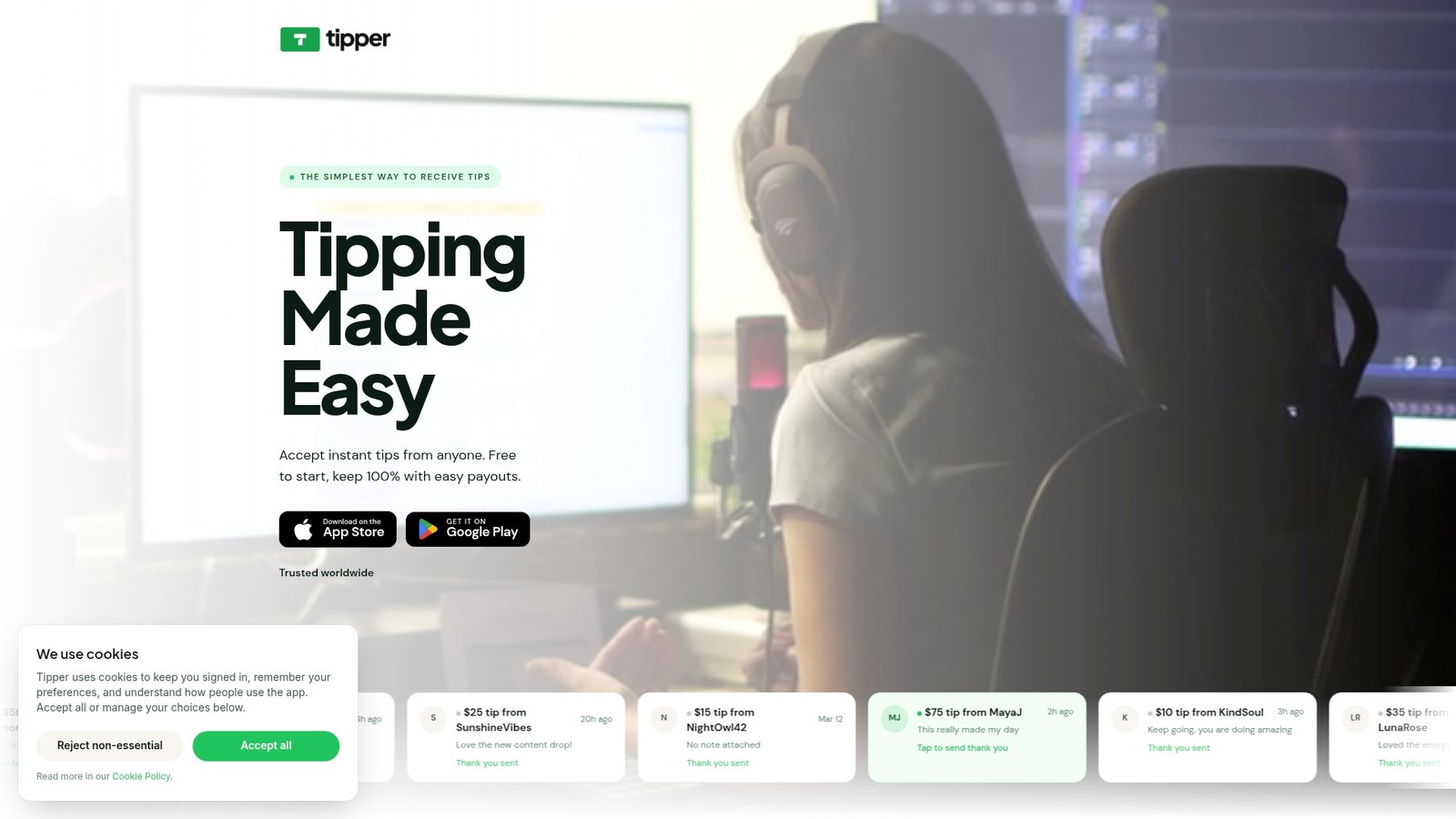
For a walkthrough, read how to collect tips with no sign-up required and our guide to setting up payment processing for tips.
Mistakes to avoid
- No explanation. If supporters do not know what happens to the money, they pay the minimum or nothing.
- Guilt trips. Pressure may work once but damages trust. Read our notes on digital tipping etiquette for tone that keeps goodwill.
- Zero minimum on costly goods. If every copy costs you time or money, set a floor.
- Hidden friction. Forced account creation and long forms undermine the benefit of voluntary payment. A link that works in two taps beats a beautiful page that takes two minutes.
- Never reviewing results. Track average payment and conversion monthly, and change your suggestion when the data says so.
- Ignoring where fans already are. Put your link in the places your audience sees it: channel descriptions, link-in-bio pages, pinned comments and stream overlays. The reasons are laid out in why creators need tipping links.
A simple launch plan
- Choose the model. Pure PWYW for goodwill, minimum for protection, suggested price for revenue.
- Write the story. One or two sentences on what the money supports.
- Set amounts. A floor you can live with, a suggestion, and two or three presets.
- Pick a payment path with low friction and clear fees.
- Thank people personally. Even a short note builds the repeat habit.
- Measure for 30 to 60 days, then adjust.
FAQ
Does pay what you can mean free?
Not necessarily. “Pay what you can” usually means a price exists, but you pay an amount that fits your budget. Some sellers do accept zero. The seller should say so clearly, so buyers know whether a free option is intended.
What does “pay what you will” mean?
It means the same as pay what you want: the buyer decides the amount. Some sellers add a minimum or a suggested amount. Without either, the buyer may choose any amount, including nothing.
Does pay what you want work for creators?
It can. Field studies have found people often pay well above zero, and revenue sometimes rises. It works best when you have a connected audience, near-zero delivery costs and a clear reason to give. It is weaker against identical fixed-price rivals or for labor-intensive products.
Should I set a minimum price?
In most cases, yes, if each sale costs you something or if payment fees would eat tiny amounts. A small floor of a few dollars screens out zero payments while keeping entry easy. If your aim is pure goodwill or reach, you can leave it at zero.
Can supporters pay me without creating an account?
On Tipper, yes. Supporters open your link or scan your QR code, then pay with Apple Pay, Google Pay or a card. Only creators who receive tips need an account.
Sources
- Pay what you Want: A New Participative Pricing Mechanism (Journal of Marketing)
- Pay What You Want as a Marketing Strategy in Monopolistic and Competitive Markets (Management Science)
- Pay-what-you-want, identity, and self-signaling in markets (PMC)
- Rethinking Music: Voluntary Payment Models (Yochai Benkler, Harvard)
- Management Science Letters, 2016
- Pay What You Want Pricing, GoCardless
- Pay what you want pricing: should marketers use it? (Journal of Marketing Theory and Practice)
- How to Make Money on Itch.io (2026 Indie Revenue Guide)
- Gumroad Pricing 2026
- Payhip Pricing 2026
- Accepting Crypto Donations for Nonprofits and Creators


Leave A Comment