
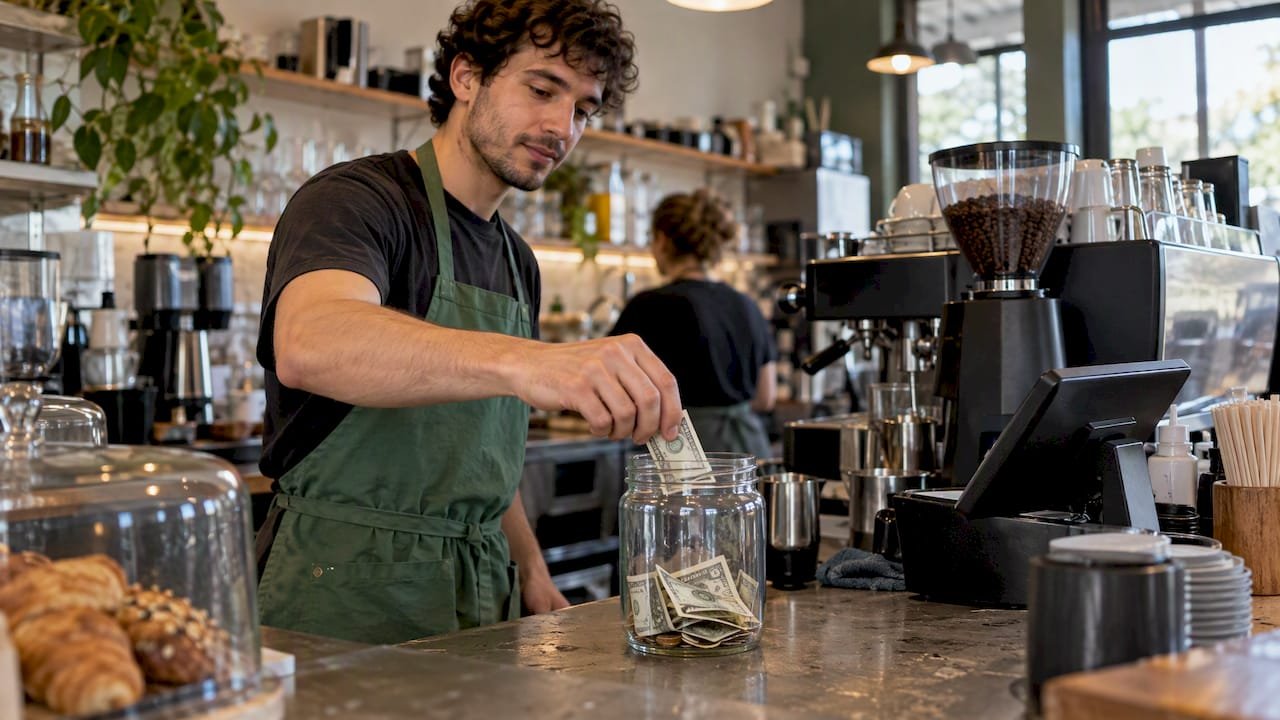
A strong cafe tip jar setup pairs an eye-catching physical jar at the register with a clearly displayed QR code that opens a no-account tipping page supporting Apple Pay and Google Pay. Put both where customers pause to pay, and ask after the drink is made, not before. Below you’ll find a menu of jar ideas, placement rules, behavioral research, and a rollout plan.
TL;DR:
- Run each theme for a week spanning weekdays and weekends, record daily tips, and keep staffing and hours steady.
- Print high contrast QR codes at least 1.5 to 2 inches square, offer two or three suggested amounts, and test scans on iPhone and Android.
- A University of Nebraska study found participants reacted more negatively to tip screens than jars, and screens did not increase tip sizes; ask after service.
- Place the jar and QR code beside the reader, use a brief, friendly sign, and empty clear glass jars often because they are less secure.
Table of Contents
- Which creative tip jar ideas work best for a cafe?
- How do you pick a jar theme that fits your cafe?
- Where should you put the jar and what should the sign say?
- How do QR code tip pages work for a cafe?
- What does the research say about getting more tips?
- What jars and signs should you buy?
- How do digital tip jars connect to your payment tools?
- How can you customize your tip link to match your brand?
- Which cafes and businesses already use digital tip jars?
- How do you keep digital tipping secure and private?
- How can you get customers to tip by phone?
- Our editorial take: test small and keep customers comfortable
- Add contactless tipping next to your jar
- FAQ
- Sources
Which creative tip jar ideas work best for a cafe?
Pick two or three of these, test them for a week each, and keep the winner. Every idea below costs very little to try.
- Pun jars: Label the jar “Coffee Fund for Our Next Latte Art Class” or “Tip Jar: Because Beans Aren’t Free.” Use a clear glass jar and a chalkboard tag so you can change the pun weekly.
- Vote or this-or-that jars: Set out two jars with two options, such as “Oat Milk vs. Whole Milk” or “Dogs vs. Cats.” Customers drop a tip in the side they back. Label each jar with a printed photo or headshot and tally the totals on a whiteboard.
- Tip-for-a-cause jars: Dedicate a week to a local shelter, school or animal rescue. Write one clear sentence about where the money goes, and post the total raised so customers see the result.
- Thank-you jars: A simple jar with a handwritten “Thank you for being here” card feels warm and low pressure. Use kraft paper tags and a twine bow.
- “Leave a story” jars: Invite customers to tip and add a note about their best cafe memory. Staff can read a few aloud on the counter board. Keep pens and small slips in a cup beside the jar.
- Seasonal jars: Swap in a pumpkin for fall, a snow globe for winter, a flower pot for spring. Rotate quarterly so regulars see something new.
- Novelty prop jars: Use a vintage espresso tin, a teapot, a retired grinder hopper or a mason jar with a painted lid. The container becomes a conversation piece.
- Milestone jars: “Help us hit a new espresso machine,” with a drawn thermometer you color in as tips grow. Keep the goal small and believable.
- Staff-pick jars: Each barista gets a mini jar with a fun fact or favorite drink. Customers tip the person who served them, which keeps credit personal.
- Trivia jars: Post a daily question and let customers tip toward the answer they pick. Reveal the answer at close.
- Gold-accent jars: Use a brass or gold-finish container or a gold lid, which fits the research on status cues covered later in this article.
- Local-landmark jars: Label two jars with neighborhood rivals, such as two parks or two sports teams, and let regulars compete.
- Minimalist glass jars: A clean, clear jar with a small sign works for upscale cafes where jokes would feel off-brand. Keep it spotless.
- Chalkboard-wrap jars: Wrap a jar in chalkboard vinyl so staff can change the message daily at no cost.
Signage matters as much as the container. Practitioner guidance notes that effective signs use humor or indirect, off-record appeals that ask for tips while keeping the exchange comfortable for staff and customers.
Pro Tip: Seed the jar with a few bills at the start of each shift so it never looks empty, and empty it into the till whenever it gets full.
How do you pick a jar theme that fits your cafe?
A joke jar that thrills a college-town spot can feel wrong in a quiet specialty roastery. Start with four simple filters: your brand voice, your typical customer, your average ticket and your foot-traffic rhythm. A cafe with fast morning lines needs a jar that reads in two seconds. A cafe where people linger can support a story or a vote.
Here are six theme buckets and when each one fits:
- Humor: Use it when your menu and staff banter are already playful.
- Cause-driven: Use it when your regulars care about the neighborhood and you can show where the money goes.
- Sentimental: Use it when your cafe is cozy and regulars know staff by name.
- Competitive or vote-based: Use it when you have a busy lunch crowd that enjoys a quick game.
- Seasonal: Use it when you want a reason to refresh the counter without redesigning it.
- Premium or minimal: Use it when your tickets run high and customers expect polish.
Test before you commit. Run one theme for a trial period, write the daily tip total on a sheet by the till, then switch to a second theme and compare. Keep other things steady, like staffing and hours, so the jar is the only variable you changed. Choose a trial period that includes both weekday and weekend traffic.
Where should you put the jar and what should the sign say?
Put the jar where customers pause: right beside the card reader or at the register edge. People tip when they are already thinking about paying, so the jar should be inside their line of sight at that moment. Keep it clear of the pastry case, the pickup shelf and anything that blocks the flow of the line.
Follow these steps when setting up:
- Place the jar within arm’s reach of the payment terminal, on the customer’s side of the counter.
- Check the sightline from the back of the queue. If the jar is hidden behind a menu stand, move it.
- Write a brief sign that a person can read while holding a wallet.
- Mount signs where customers can see them, and keep the type large enough to read from the queue.
- Reserve one short line for clarity, such as “Tips go to the whole team” or “This week: local food pantry.”
- Wipe the jar and sign daily, since a grimy jar signals neglect.
Good wording is light, never guilt-driven. “Coffee fund for the team” lands better than “Please tip.” Avoid anything that implies customers owe you something.
Pro Tip: Read your sign out loud. If it sounds like a demand, rewrite it as a joke or a thank-you.
How do QR code tip pages work for a cafe?
A QR code tip page is a link that opens in the customer’s phone browser. The guest scans, picks an amount and pays with Apple Pay, Google Pay or a card, with nothing to download and no account to create. Our own guide to contactless tipping for hospitality explains why a no-app browser page removes the hardware and app barriers that stop people from tipping.
Practical rollout notes:
- Print the code at least 1.5 to 2 inches square, with strong contrast, such as black on white, so phone cameras read it fast.
- Put one code beside the register and one on a small table tent for seated guests.
- Add the code to receipts if your system prints them.
- Show two or three suggested amounts, but never pre-select the highest, so the choice stays easy and unpressured.
- Frame the QR page as an optional alternative to the jar, with a short line like “Prefer to tip by phone? Scan here.”
- Test the code on both iPhone and Android before you print a batch.
Industry practitioners agree that digital tipping should be barrier-free, with no app and no account, because friction lowers adoption. If you want to see how others lay out their codes, our roundup of contactless tip collection examples shows practical layouts.
Why it matters: Guests had greater negative feelings toward point-of-sale tip screens than toward physical tip jars, so an optional QR code that sits quietly beside the jar avoids forcing a screen prompt on every customer.
What does the research say about getting more tips?
Three findings are worth building your setup around.
First, screens can backfire. A study from the University of Nebraska’s decision lab found that participants felt significantly more negative about tip screens than about tip jars, and the screens did not raise tip sizes. That supports keeping a physical jar in play and treating a QR code as an extra choice, not a forced prompt.
Second, timing and visibility matter. Washington State University researchers recommend making service effort visible and asking for tips after service to reduce perceptions of unfairness and tip fatigue. In a cafe, that means letting customers watch the pour, the steaming and the latte art before the jar comes into focus.
Third, color can nudge behavior. A multi-study paper found that gold-colored atmospherics increased tipping by raising status perceptions, and field experiments backed it up. Researchers at the University of South Florida reported that customers given gold-colored service props left larger tips than those given black ones.
Making service efforts visible and requesting tips after service is provided can reduce perceptions of unfairness and tip fatigue.
Here is a quick checklist to apply those findings:
- Ask for the tip after the drink is made, not at the order screen.
- Keep baristas visible while they work.
- Add a subtle gold or brass accent to the jar or sign.
- Skip tip prompts before service begins.
What jars and signs should you buy?
Choose jars and signage that match your cafe’s look and your security needs.
- Clear glass jars: Cheap and visible, and the contents show social proof. Less secure, so empty them often.
- Locking tip boxes: Better for busy shops with unattended counters, though they look more institutional.
- Novelty or repurposed containers: Teapots, tins and vintage canisters add personality at low cost.
- Custom engraved boxes: A good fit for premium cafes, with a longer lead time for custom orders.
- Signage: Laminated prints are cheap and wipe clean, small acrylic stands look polished and hold QR codes well, and chalkboard labels let you change the message daily.
Source jars from local craft stores, wholesale bar-supply vendors or online marketplaces. For custom orders, ask about minimum quantities and proof timelines before you commit.
How do digital tip jars connect to your payment tools?
A digital tip jar sits beside your existing payment setup. Customers pay for their drinks the usual way through your register and card reader, and the tip page is a separate link they open if they want to add something. Because it runs in a browser, you don’t need to replace hardware or change your point-of-sale software.
What matters is wallet support. Customers who already use their phones to pay expect Apple Pay and Google Pay, and our look at Apple Pay and Google Pay tips for small businesses covers why that matters. If your tip page asks for a card number and an email, many people will walk away.
Tipping is also a different job from checkout. Your POS processes the sale, and a tip link collects extra appreciation that goes straight to the person or team you name. Keep the two flows separate so nothing about the tip can slow down or confuse the order.
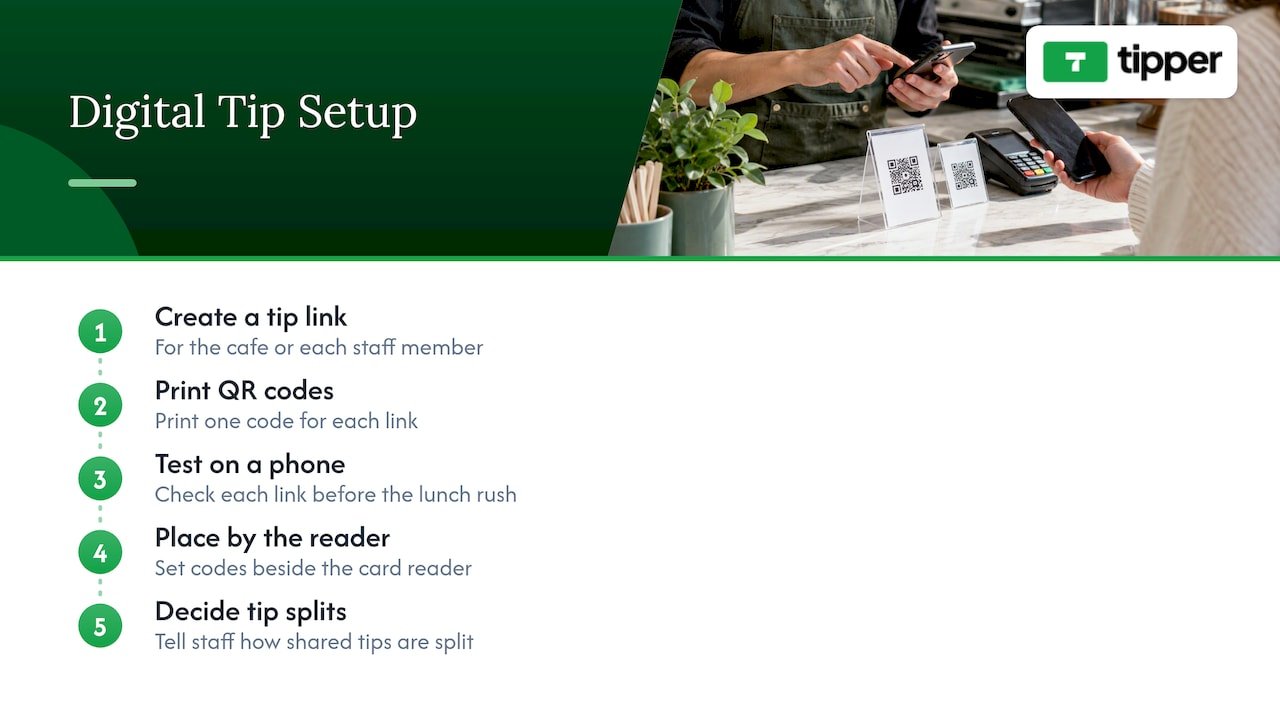
To start, create one link for your cafe or one per staff member, print a code for each, and place them beside the card reader. Check each link on a real phone before the lunch rush. If your team shares tips, decide ahead of time how payouts get split and tell staff clearly.
How can you customize your tip link to match your brand?
A tip page that looks like your cafe feels trustworthy, and customers are more likely to finish a payment on a page they recognize. With a Tipper link, you can shape the page so it reflects your shop’s personality.
Start with your name and a short, friendly line. “Thanks for starting your morning with us” sounds like a person, while “Tip the merchant” sounds like a form. Use the same wording on your jar sign so the paper and screen versions feel connected.
Add your logo or a photo of the team if the page allows it. Customers tip people, and a face makes the request feel human. Match your cafe’s tone: playful shops can add a joke, and quiet specialty shops should keep it short and warm.
Use a link people can remember, like your cafe’s name, so you can also say it out loud or put it on a menu. Then update the thank-you message for seasons or events, such as a cause week.
Finally, print the QR code in your brand colors only if contrast stays high. A pale pastel code can fail to scan, so always test it. If you want a step-by-step setup, our guide on how to collect tips with no signup required walks through it.
Which cafes and businesses already use digital tip jars?
Digital tipping has spread well beyond cafes. The common thread is a low-friction page that anyone can open on a phone.
Hospitality venues use QR codes on counters, table tents and receipts so guests can tip without handing over a card or downloading anything. Our contactless tipping guide describes this as the simplest barrier-free path for hospitality. Restaurant software providers have also built QR tipping into their tools, and one guide from RESTOBOT on QR code tipping explains how the setup works and why merchants adopt it.
Creators and freelancers use the same idea. Musicians, tour guides, hair stylists and delivery workers put a link on a card or a sign, and customers tip after the service is done. Our collection of contactless tip collection examples shows how different people lay out their codes and messages.
The lesson for a cafe is that you don’t need a big system. Many small shops start with one printed code beside the register and one line of text. Watch how many scans you get during the trial, then adjust placement or wording from there. Treat the digital page as an add-on to the jar, and keep both visible so every kind of customer has a way to say thanks.
How do you keep digital tipping secure and private?
Customers will only tip through a page they trust, so security and privacy basics matter from day one.
- Use a no-account flow: Guests shouldn’t have to create a profile or hand over personal details just to leave a few dollars.
- Rely on wallet payments: Apple Pay and Google Pay keep full card numbers off the page, since the wallet handles the payment details.
- Print codes you control: Put codes on materials inside your cafe, and check them regularly so nobody can stick a different code over yours. Replace any sticker that looks peeled or altered.
- Use a clear page address: Tell customers what link to expect, so they can tell a real page from a fake one.
- Collect only what you need: If a thank-you note needs an email, make it optional.
- Be clear about payouts: Staff should know how tips are paid out and when.
- Check local rules: Tip handling and reporting rules vary, so confirm what applies to your cafe with an accountant or your state labor department.
Train staff to answer a quick question like “Where does this go?” with one sentence. A confident answer builds more trust than any policy page.
How can you get customers to tip by phone?
Make the digital option easy to see and easy to understand. A small sign that says “Scan to tip the team” beside the card reader does more than a long explanation. Mention it once, lightly, when you hand over the drink: “You can also tip by scanning the code.”
Timing helps. As the research above suggests, the best moment is after the service is visible and complete. Let the barista finish the drink, and then point to the code.
Thank-you messages close the loop. A short note after the payment, like “Thanks, that just made our morning,” makes the exchange feel human. If your tip page supports a text, photo or video reply, use it. A quick team photo or video from the barista who made the drink can make the transaction feel more personal. Our post on promoting tipping culture in your business covers more ways to keep that going.
Keep messages specific and warm, not scripted. Rotate a few versions so regulars don’t see the same line every time. And never follow up with a second ask. One clear invitation plus one sincere thank-you is enough.
Our editorial take: test small and keep customers comfortable
Change one thing at a time and write down the tip total. Try a pun sign, then a vote jar. Small experiments can help you learn what your regulars like. Comfort matters: avoid making customers feel watched or pressured. Keep the jar, add the optional QR code, and let your service speak first.
— Tipper
Add contactless tipping next to your jar
A physical jar gives guests who carry cash an option, and a phone page gives other guests another way to tip. With Tipper, we give you a personalized tip link and QR code that customers can open with no account and pay with Apple Pay, Google Pay or a card. A low-friction page can make tipping easier, and it sits beside your jar as an optional extra, not a replacement.
- Create your tip link and print the QR code for your counter.
- Add a thank-you message in text, photo or video for guests who tip.
- Keep your jar out as usual, so every customer has a choice.
Ready to try it? Tipper and put the code beside your register this week.
FAQ
Where is the best place for a cafe tip jar?
Put it beside the card reader or at the edge of the register, where customers pause to pay. Keep it in a clear sightline from the line and make sure it doesn’t block the flow of people or the pickup area.
Do tip screens get more tips than tip jars?
Not reliably. A University of Nebraska study found customers felt more negative about tip screens than tip jars, and the screens did not increase tip sizes. A jar with an optional QR code avoids that backlash.
What should a tip jar sign say?
Keep it short, friendly and indirect. Humor or a quick note about where the money goes works better than a direct demand. Something like “Coffee fund for the team” or “This week: local food pantry” is clear without putting anyone on the spot.
How do QR code tips work for cafes?
Customers scan a printed code with their phone camera and a browser page opens. They pick an amount and pay with Apple Pay, Google Pay or a card, with no app or account. Print the code at least 1.5 to 2 inches square with strong contrast so it scans quickly.
When should you ask customers to tip?
Ask after the drink is made, not before. Washington State University researchers recommend making service effort visible and requesting tips after service, which helps reduce tip fatigue.
Sources
- Pro tip: Screen-based payment methods increase negative feelings in consumers but do not increase tip sizes
- Study: To battle tip fatigue, businesses should make their service efforts visible | WSU Insider | Washington State University
- Hey big spender! A golden (color) atmospheric effect on tipping behavior


Leave A Comment