

The best creator tip link strategy starts with an in-page tip block or a branded tip link, not a redirect to a generic donation page. Set three preset amounts, highlight the middle one, and put the link where your audience already looks: your bio, your video description, your newsletter footer. Do this today and you can collect your first tip within the hour.
Here’s the immediate playbook:
- Create your tip link or embed a tip block on your profile.
- Set three presets (a low, a highlighted middle, and a fan tier).
- Drop the link into your bio and pin it in your latest post’s link-in-bio dashboard comments.
Pro Tip: Mobile saved-payment methods like Apple Pay and Google Pay cut checkout to two taps. If your tip flow requires typing a card number on a phone, you’re losing tips before they happen.
Key Takeaways
A creator tip link strategy works best when it pairs a low-friction preset structure with a fast thank-you follow-up and consistent placement across a creator’s existing content.
| Point | Details |
|---|---|
| Pick the right category first | Validate with an external link, then upgrade to native or branded routing once repeat tippers appear. |
| Use three presets | A low, highlighted middle, and fan-tier amount converts better than a single custom field. |
| Track every placement | Add UTM tags to your bio, footer, and pinned-comment links to see which spot actually produces tips. |
| Thank supporters fast | A personal reply within 24 hours meaningfully increases the odds of a second tip. |
| Choose payout-friendly tools | Tipper lets creators keep 100% of tips beyond processing fees, with no account required for supporters. |
Table of Contents
- Choosing Your Creator Tip Link Strategy: Three Approaches Compared
- How Do You Set Up a Tip Link From Scratch?
- What Preset Amounts and Copy Convert Best?
- Where Should You Place Your Tip Link for Best Conversion?
- How Do You Turn One-Time Tippers Into Repeat Supporters?
- Which Payment Methods and Integrations Actually Matter?
- How Tipper Puts This Strategy Into Practice
- Comparing Fees, Commissions, and Payout Timing
- Keeping Tips Secure and Supporters’ Data Private
- Measuring and Improving Your Tip Link Performance
- Legal and Tax Realities of Accepting Tips as a Creator
- Does Your Tip Link Actually Work on Mobile?
- Sources
- FAQ
Choosing Your Creator Tip Link Strategy: Three Approaches Compared
Every creator tip link strategy falls into one of three buckets, and picking the wrong one for your stage costs you real money.
External hosted tip services send supporters off your page to a dedicated tipping site. They’re the fastest to set up, often live in minutes, and require zero technical work. Native or in-page tips keep the transaction on your own page or post, using a widget or block so nobody leaves your content to pay you. Branded short link routing uses a link you control (something like yourname.tip/creator) that redirects to whichever tipping destination converts best, letting you swap the backend without changing the link everywhere it’s posted.
The trade-off is speed versus control. External links win on setup speed. In-page tips win on conversion because tips blocks with quick-pick presets convert better than campaigns that require reading a goal or a tier list — supporters tap and pay without context-switching. Branded routing wins on measurement: a short link with per-platform slugs lets you re-point traffic instantly and see exactly which platform sends paying supporters.
Start where you are. If you’re testing whether your audience tips at all, validate with an external link first before investing in anything more custom. Once you see repeat tippers, upgrade to native tips or branded routing so you keep more control over the experience and the data.
- Under 1,000 followers: external link, no setup friction.
- Growing audience with repeat engagement: native in-page tip block.
- Multi-platform creator running promotions: branded short link with routing.
How Do You Set Up a Tip Link From Scratch?
Getting a working tip link live takes less time than editing your next post. Here’s the fast path.
- Pick a destination and processor. Choose a tipping platform that supports Stripe or PayPal for payouts, then connect your bank details so money actually lands somewhere.
- Set your presets. Configure three tap amounts, plus an optional custom field for outliers who want to give more.
- Write short, human button copy. Skip generic “Donate” language. Something like “Buy me a coffee” or “Tip — thanks!” performs better because it sounds like a person, not a nonprofit form.
- Place the link. Add it to your bio, embed it in a post, or paste it into your link-in-bio dashboard alongside your other links.
- Send one live test tip. Use your own card or ask a friend to send $1 so you confirm the money actually reaches your payout account before you promote it publicly.
- Add UTM tags. Tag the link by placement (bio, video description, newsletter) so you know which spot actually produces tips, not just clicks.
That last step matters more than most creators realize. Tracking from day one with UTM parameters lets you test one variable at a time, whether that’s your button copy or where the link sits on the page, instead of guessing why conversion changed.
Watch two numbers after launch: click-through rate on the link itself, and tip conversion rate once someone lands on the page. If clicks are healthy but tips are low, the friction is on your payment page, not your promotion.
What Preset Amounts and Copy Convert Best?
A structure of a small low option, a highlighted middle, and a bigger fan tier is the most common effective preset setup, and it’s not arbitrary. The middle amount anchors the decision. Most people don’t want to pick the smallest option (it feels cheap) or overthink the largest (it feels like a real financial choice), so they default to the option in the visual center.

A workable starting range looks like $2 / $5 / $10, or $1 / $3 / $5 if your audience is younger or your content is short-form. Both a low/mid/high structure with the middle highlighted show up consistently as the best-converting preset pattern. across creator tipping tools.
Button copy matters almost as much as the amount. Compare these:
- “Donate now” — reads transactional and slightly cold.
- “Buy me a coffee” — casual, low pressure, widely recognized.
- “Support my work — $5” — direct, states the ask and the amount together.
- “Tip — thank you!” — short, warm, works well on mobile where space is tight.
Should you include a custom amount field? Yes, but keep it secondary. A visible custom field next to your presets adds almost no friction and captures the rare supporter who wants to give $50 instead of $10. Making custom the default option, with no presets, does the opposite: it forces a decision instead of offering one, and decisions kill impulse tips.
Where Should You Place Your Tip Link for Best Conversion?
Placement decides whether your tip link ever gets seen, let alone clicked. The strongest spots share one trait: they show up right after someone has already gotten value from you.
- Profile bio. The first place anyone checks when they want to support you.
- End of content. A video outro, the last line of a newsletter, or a podcast sign-off, right when goodwill is highest.
- Pinned comment. On platforms where bios are buried, a pinned comment under your best-performing post keeps the link visible.
- Newsletter footer. Recurring readers see it every send, which builds familiarity without repeating the ask loudly.
- Link-in-bio dashboard. If you run a multi-link page, position the tip link above the fold, not buried under merch and socials.
Promotion rhythm matters more than promotion volume. Mention the tip link around real moments: hitting a subscriber milestone, publishing something that took unusual effort, or answering a reader’s question in depth. Thank tippers publicly when appropriate (with permission), then go quiet again. A once-weekly light mention beats a link stapled to every single post.
Pro Tip: Tag each placement with its own UTM parameter. If your newsletter footer converts three times better than your bio link, that tells you exactly where to double down next month.
How Do You Turn One-Time Tippers Into Repeat Supporters?
The first tip is nice. The second tip is the real signal, since a supporter who tips twice is far more likely to become an ongoing source of income than someone who tips once and disappears.
Respond fast and personally. A quick DM, a short thank-you video, or a shoutout (with permission) after a tip lands does more for retention than any feature you could build. Small, low-cost rewards reinforce the relationship without turning your tip page into a paywall: early access to a new video, a heads-up before you publish, or a small digital extra like a wallpaper or behind-the-scenes note.
- Send a personal thank-you within 24 hours of the tip.
- Offer one small, easy-to-deliver perk for repeat supporters.
- Track your repeat-tipper rate monthly, not just total tips collected.
A healthy early target is getting a meaningful share of first-time tippers to tip again within a couple of months. If you’re below that, your thank-you process probably needs to feel more personal, not more elaborate.
Which Payment Methods and Integrations Actually Matter?
The payment rails behind your tip link decide how many people finish the transaction they started. Saved-payment methods matter most on mobile, since a tipper who already has Apple Pay or Google Pay loaded on their phone can confirm a tip in two taps instead of typing out sixteen digits of a card number.
- Prioritize Apple Pay and Google Pay support above almost anything else on mobile.
- Expect similar percentage-based processing fees between Stripe and PayPal, with payout timing varying by provider and account history.
- Check that your billing descriptor (what shows on a supporter’s bank statement) clearly names your brand, not a generic processor string that looks unfamiliar and triggers disputes.
- Confirm your platform has a clear refund and dispute process, since even small tips occasionally get contested.
Keeping the transaction on your own page rather than redirecting off-site also preserves context and lets saved-payment methods complete the checkout faster, which is exactly why native tip blocks tend to convert better than external redirects for casual, in-the-moment tips.
How Tipper Puts This Strategy Into Practice
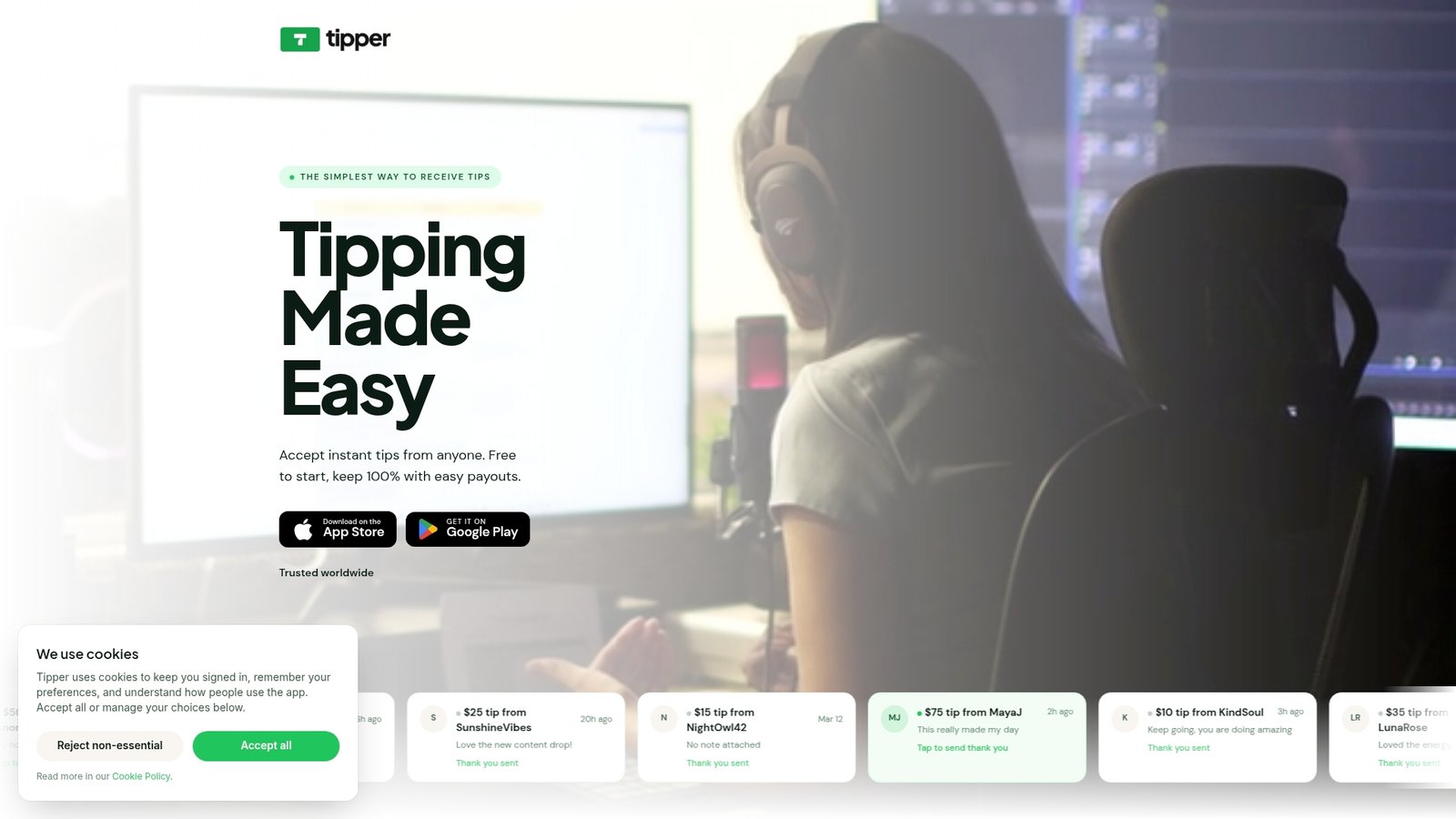
Tipper builds the entire strategy above into one flow. Creators get a personalized link or QR code, supporters pay with Apple Pay, Google Pay, or a card with no account required on their end, and creators keep 100% of what they earn minus standard payment processing.
A quick worked example:
- Create your Tipper link and set three presets, say $3, $7, and $15.
- Add the link to your bio and pin it under your most-viewed post.
- Send yourself or a friend a test tip to confirm the payout flow works end to end.
- Record a 15-second thank-you video and attach it to your tip page so first-time supporters see it immediately.
A tip page that shows a real thank-you message, not just a payment confirmation screen, turns a transaction into a moment of connection between creator and supporter.
That personal layer, thank-you notes as text, photo, or video, is what separates a tipping tool from a payment form. Try it with one friend before you promote it publicly, and see how the flow feels from the supporter’s side.
Comparing Fees, Commissions, and Payout Timing
Fee structures across tip link services generally fall into two categories: platform commission plus payment processing, or payment processing alone with no platform cut. The difference compounds fast for creators earning small, frequent tips rather than occasional large ones.
Most standard card processing runs in the 2.9% plus a small fixed fee per transaction range, industry-standard territory regardless of which tipping tool sits on top of it. What varies is whether the platform adds its own commission on top of that processing fee.
Payout schedules matter just as much as the fee itself if you’re relying on tips for regular income. Some platforms batch payouts weekly or on a fixed monthly date; others offer near-instant transfers to a linked debit card for an added fee. If you’re a freelancer covering rent with tip income, a platform that holds funds for two weeks before releasing them creates a real cash flow problem, even if its percentage fee looks competitive on paper.
Before committing to any tip link service, check three things: the platform commission (if any), the processing fee percentage plus fixed cost per transaction, and the standard payout timeline. A slightly higher processing fee with next-day payouts often beats a lower fee with a two-week hold, depending on how tight your cash flow runs.
Keeping Tips Secure and Supporters’ Data Private
Security on a tip link cuts two ways: protecting the creator’s payout information and protecting the supporter’s payment details. Neither should require either party to hand over more information than the transaction actually needs.
For supporters, the strongest privacy feature is simply not requiring an account. A tip link that lets someone pay with Apple Pay or Google Pay without creating a login, verifying an email, or saving a password reduces the amount of personal data exposed anywhere, and it removes the single biggest reason people abandon a tip halfway through.
For creators, look for a platform that uses established payment processors like Stripe or PayPal on the back end rather than handling raw card data itself. That matters because these processors carry PCI compliance and fraud protections that would take a small platform years to build independently. Ask, too, how the platform displays your payout details: your bank account number should never be visible to a supporter, only a masked reference or nothing at all.
Dispute and refund handling deserves attention before it becomes a problem, not after. A supporter who doesn’t recognize a charge on their statement, often because a billing descriptor is unclear, is far more likely to file a chargeback than contact the creator directly. Clear, brand-recognizable billing descriptors reduce that risk substantially. Creators should also know their platform’s stance on refunds for accidental tips, since a supporter who tips the wrong amount by mistake needs a straightforward path to a fix that doesn’t involve emailing customer support and waiting a week.
Measuring and Improving Your Tip Link Performance
A tip link without tracking is a guess dressed up as a strategy. The minimum setup is three data points: link clicks, tip conversions, and repeat-tipper rate, tracked separately for every placement where you share the link.
UTM parameters make this possible without any custom development. Tag your bio link, your newsletter footer link, and your pinned-comment link with different UTM codes, and your analytics will show you exactly which placement produces tips rather than just clicks. Instrumenting this funnel early also lets you run low-budget retargeting toward people who clicked but didn’t tip, which tends to recover conversions that a single visit misses.
Once you have baseline data, test one variable at a time. Change your button copy for two weeks and compare conversion against the prior two weeks before touching your preset amounts. Changing both at once tells you something moved, but not what moved it.
Beyond your own dashboard, visibility across the wider internet matters too. Consistent, diverse mentions of your tip link across communities, podcasts, and forums increasingly function as trust signals for AI-driven search, not just for human readers clicking through. A creator whose tip link shows up naturally in fan-run wikis, Reddit threads, or guest podcast show notes builds a kind of discoverability a paid ad can’t replicate.
Set a simple monthly review: total clicks, conversion rate, repeat-tipper percentage, and top-performing placement. Adjust one thing based on what the numbers show, then check again in 30 days.
Legal and Tax Realities of Accepting Tips as a Creator
Tips you receive through a personal link are taxable income in the United States, the same as freelance payment or ad revenue, regardless of which platform processes the transaction. The IRS doesn’t distinguish between a $5 tip from a stranger and a $500 invoice from a client; both count as self-employment income that you’re responsible for reporting.
Most payment processors issue a 1099-K form once you cross certain transaction thresholds, which vary by processor and have shifted in recent years, so check your specific platform’s current reporting rules rather than assuming last year’s threshold still applies. Even if you don’t receive a 1099-K because you’re under the threshold, you’re still legally required to report the income yourself.
Keep basic records as you go: total tips received per month, the platform’s processing fees (which are typically deductible as a business expense), and any related costs like equipment or software you use to create the content people are tipping for. A simple spreadsheet updated monthly saves a scramble come tax season.
One nuance creators miss: tips sent as a genuine personal gift with no expectation of content in return are treated differently under tax law than tips sent as payment for your work or access to it. In practice, nearly all creator tipping falls into the second category, since supporters are tipping because of content you produced, so treat it as income by default. If your situation is unusual, a licensed tax professional familiar with self-employment income is worth the consultation fee before your first filing season.
Does Your Tip Link Actually Work on Mobile?
Most tips happen on a phone, often seconds after someone finishes watching a video or reading a post, so a tip page that loads slowly or requires zooming to tap a button loses money you never see.
Test your tip page the way a real supporter would encounter it: from a social app’s in-app browser, not your desktop Chrome window. In-app browsers on platforms like Instagram and TikTok render pages differently, and a layout that looks perfect on your laptop can break, overlap, or force horizontal scrolling inside those environments.
Three checks matter most. First, confirm your preset buttons are large enough to tap accurately with a thumb, not sized for a mouse cursor. Second, verify Apple Pay or Google Pay appears as the default option on supported devices, since forcing a manual card entry on mobile is where most abandoned tips happen. Third, time how long the page takes to load from a tap. Anything over two or three seconds on a typical mobile connection will cost you supporters who simply move on.
Keep the page itself short. One clear thank-you line, three preset amounts, and a button are enough. A tip page with multiple sections, a long creator bio, and unrelated links buried above the actual tip button asks a mobile user to scroll past friction to reach the one thing they came to do.

Why Testing Beats Perfection in Your Tip Strategy
No tip link strategy works perfectly on the first try, and chasing a flawless setup before launching just delays real data. Keep every ask light and tied to genuine value, then revisit your presets, copy, and placement every 30 days using the click and conversion numbers you’re already tracking.
— Tipper
Start Testing Your Tip Link With Tipper Today
Everything in this article, presets, placement, thank-you follow-up, mobile-first checkout, is built directly into Tipper. Sign up, create your personalized link or QR code, set your three preset amounts, and connect payouts in a single session with no subscription fee to maintain the page.
Payout timing depends on your linked bank and payment method, and the only cost on your side is the processing fee applied at checkout, no platform commission on top. If you run a physical business alongside your content, Tipper’s point-of-sale tipping options extend the same no-signup-required model to in-person tips. The fastest way to know if this fits your audience is the smallest possible test: create your link right now and send yourself or a friend a $1 tip to see the full flow, thank-you message included, before you ever share it publicly.
Sources
- How to Use the Tips Block in UniLink (Accept Tips and Micro-Payments on Your Page)
- Creator Tips Playbook — How to Earn From Your Audience With
- Link-in-Bio Strategy for Creators: Beyond Linktree | Flyn
FAQ
What Are the Best Tips for Content Creators to Succeed With Tipping?
Keep your ask simple: three preset amounts, a highlighted middle option, and a link placed where supporters already look, then follow up with a genuine thank-you to encourage repeat tips.
What Are the Three C’s of Content Creation?
Definitions vary across sources, but a common version refers to Content, Community, and Commerce, the idea that consistent content builds a community, and that community eventually supports commerce, including tips.
Is Content Creation Still Profitable in 2026?
Content creation remains profitable for creators who diversify income beyond ad revenue, and tips through a personalized link are one of the lowest-effort additions since they require no new content, only a link and a payment method.
How Do I Know if My Tip Link Placement Is Working?
Track click-through rate on the link itself and tip conversion rate separately using UTM tags on each placement; a placement with high clicks but low conversion usually points to friction on the payment page, not the promotion itself.




[…] the kind of repeat support a one-off donation drive never does. Read more on how creators build tip link strategy around this pattern, and how payment links can boost engagement rather than just collect money […]
[…] Best Creator Tip Link Strategy: Setup, Presets, and Payouts […]
[…] For creators who want their tip link doing double duty as a monetization strategy, this guide on tip link strategy pairs well with the presets covered […]
[…] For deeper setup walkthroughs, Tipper’s own blog covers how tipping links work for creators and practical tip link strategy for setup and payouts. […]
[…] Best Creator Tip Link Strategy: Setup, Presets, and Payouts […]
[…] Best Creator Tip Link Strategy: Setup, Presets, and Payouts […]
[…] Best Creator Tip Link Strategy: Setup, Presets, and Payouts […]
[…] bios. Link straight to the tip page. Our post on a creator tip link strategy covers presets and payouts, and getting paid with a personalized tip link covers the […]