

The strongest Ko-fi alternatives for creators split into three lanes: Tipper for account-free, instant tips that let supporters pay with Apple Pay or Google Pay without signing up, Patreon or Memberful for recurring memberships, and Fourthwall, Gumroad, Payhip, or Sellfy for creators who want to sell digital products or merch. The right pick depends on whether you need one-off support, ongoing subscriptions, or a storefront.
TL;DR:
- Tip platforms like Tipper enable instant, account-free payments via Apple Pay or Google Pay, ideal for casual, high-volume audiences or in-person tipping.
- Recurring memberships are best supported by platforms like Patreon or Memberful, which provide patron management and content gating but require supporters to create accounts.
- For selling digital or physical products, Fourthwall, Gumroad, Payhip, or Sellfy offer storefronts with fulfillment or payment options tailored to digital downloads or merchandise.
- Testing and comparing platforms through quick, mobile-based transactions helps creators identify the lowest friction options aligned with their income streams.
- Combining tools, such as Tipper for tips and Patreon for memberships, allows creators to diversify income sources without forcing supporters into platforms that don’t suit specific engagement types.
Table of Contents
- How do the top Ko-fi alternatives compare at a glance?
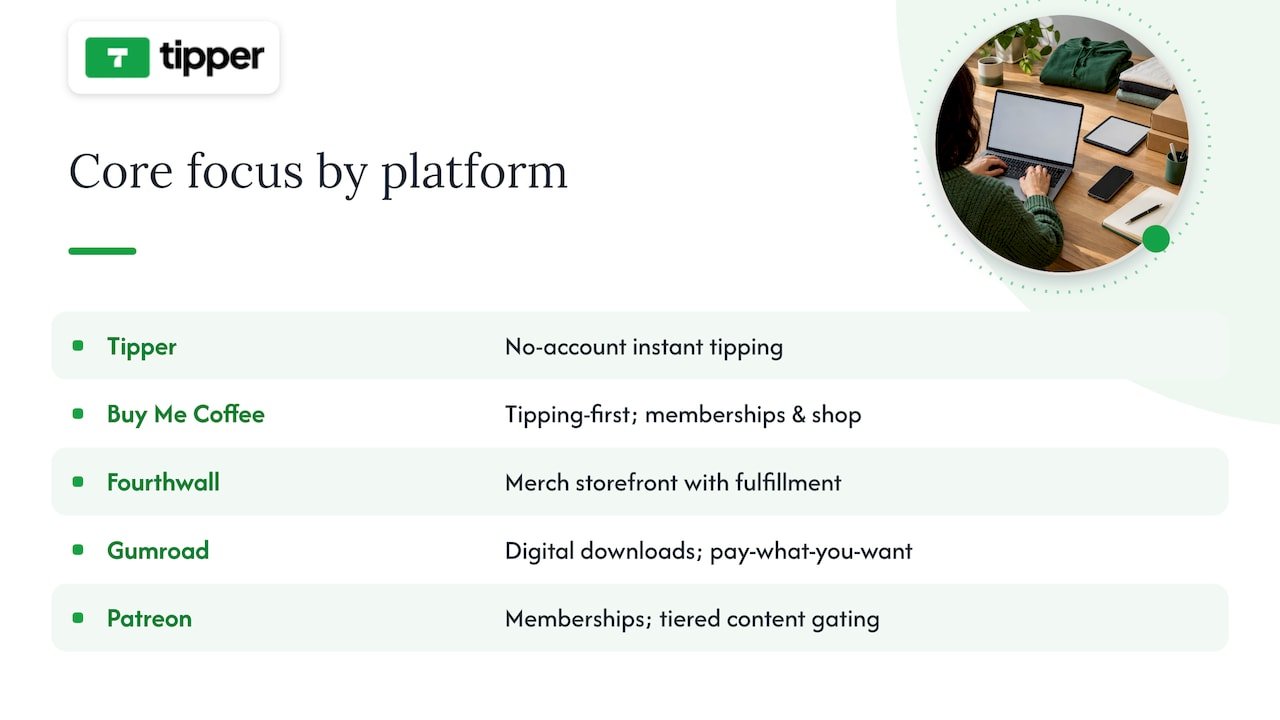
- What sets each Ko-fi alternative apart for creators?
- How should you test and choose a Ko-fi alternative?
- What does Tipper actually offer creators?
- What does 2026 tell us about how creators get paid?
- Ready to add a frictionless tip link to your page?
- Where this comparison comes from
- Sources
- FAQ
How do the top Ko-fi alternatives compare at a glance?
Before testing anything, it helps to see how these platforms differ on the things that actually affect a creator’s income: fee structure, payout speed, and whether the tool is built for one-off tips or ongoing memberships. The table below lines up all twelve options against the criteria creators ask about most.
The passage contains no spelling or grammatical errors that require correction.
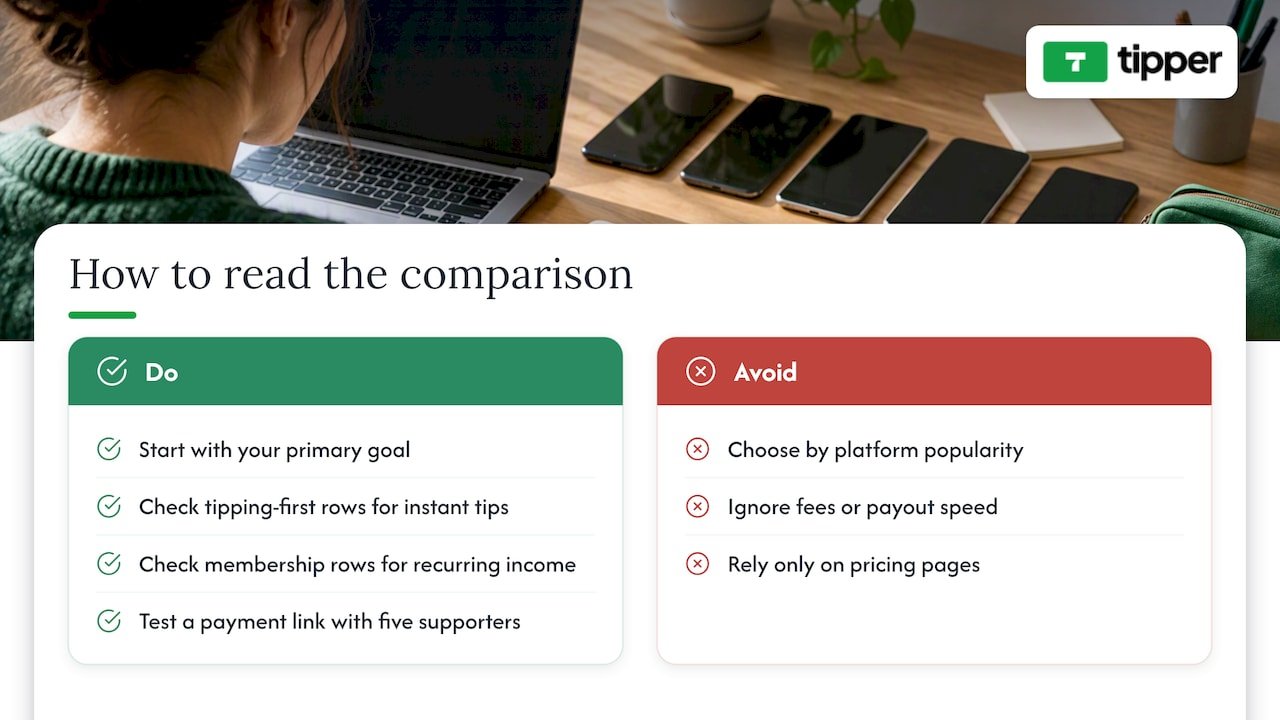
Read this table by starting with your primary goal, not the platform’s popularity. If you want a supporter to tip you in the next thirty seconds without creating an account, look at the tipping-first rows. If you’re trying to build predictable monthly income, the membership rows matter more than fees. A quick way to test any of these: set up a link, send it to five supporters, and see how many complete a payment without asking you a question first. That single test tends to reveal more about friction than any pricing page.
What sets each Ko-fi alternative apart for creators?
Tipper is built around a simple idea: supporters shouldn’t need an account to tip you. A creator shares a personalized link or QR code, and the person tipping pays instantly with Apple Pay, Google Pay, or a card, no login, no app download required on their end. Creators keep their earnings, with a payment processing fee applied at checkout, and there is no subscription cost to maintain a tipping page. The platform also supports thank-you messages back to supporters, in text, photo, or video form, which matters for creators who want tipping to feel personal rather than transactional. It’s a strong fit for in-person tipping (a QR code on a tip jar or business card), short-form video creators who need a link they can drop in a bio, and anyone tired of asking supporters to sign up just to send five dollars. To test it, generate a link and send yourself a small tip first to see the checkout flow from the supporter’s side.
Buy Me a Coffee built its reputation as a tipping-first alternative that later added membership tiers and a basic shop. Onboarding is mobile-friendly, and the one-tap support flow makes it easy for a first-time supporter to convert. Buy Me a Coffee is available as a mobile app, which matters for creators who manage their page from a phone between filming sessions. It charges a platform fee on top of payment processing, so creators give up a slightly larger share than with a pure tipping tool, but in exchange they get memberships and a shop without switching platforms.
Fourthwall is the strongest pick on this list for creators whose income already leans on merchandise. It bundles storefront tools with fulfillment, meaning a creator doesn’t need to separately manage printing, shipping, or inventory. A 2026 roundup of Ko-fi alternatives places Fourthwall specifically in the merch category, distinct from tipping or membership tools. The tradeoff is that Fourthwall isn’t designed for quick, no-friction tips: it’s a store, and it behaves like one.
Gumroad remains popular for creators selling digital downloads such as templates, presets, or ebooks, with pay-what-you-want pricing as a notable option for creators who want flexibility on price points. It charges a per-transaction fee rather than a monthly subscription, which keeps the barrier to entry low for creators testing a new product.
Patreon is the default answer for creators building a membership business. It offers patron management, tiered content gating, and tools built specifically for recurring relationships rather than one-time gestures. G2’s comparison of Patreon against Stripe Billing shows that many creators pair a membership platform like Patreon with separate billing infrastructure, which reflects a broader pattern: creators rarely rely on a single tool for their entire income. Patreon charges a tiered platform fee based on the plan, and payouts run on a monthly cycle tied to billing dates rather than on demand.
Payhip targets creators selling structured digital goods like PDFs and course materials, with built-in affiliate tools that let other people promote a creator’s products for a cut of sales. It’s a lighter-weight alternative to a full course platform for creators who just need a clean checkout page.
Substack solves a different problem: monetizing writing through paid subscriptions distributed by email. Its combination of a built-in audience feed and subscription billing makes it the practical choice for a newsletter writer, though it isn’t built for merch, tipping, or one-off digital sales.
Memberful is aimed at creators who already have a website and want membership tools embedded into it rather than sending supporters to a separate platform. Its white-label approach means a membership page can carry a creator’s own branding instead of Memberful’s, which matters for creators protective of their site’s look and feel.
Podia bundles courses, digital downloads, and memberships into one storefront, which suits creators selling a mix of products rather than a single income stream. It behaves more like a small business platform than a tipping tool.
Liberapay takes the opposite approach from most entrants on this list: an open, nonprofit-style donation model focused purely on recurring support, with no commercial storefront layered on top. It fits creators who want ongoing donations without the marketing tools or upsells that come with commercial platforms.
Sellfy offers a simple shop for both digital and physical products, with marketing tools built in. It’s a reasonable middle ground between Gumroad’s simplicity and Fourthwall’s merch focus, though it doesn’t specialize as deeply in either.
Kickstarter doesn’t compete directly with ongoing tipping tools. It’s built for project-based funding, a single campaign with reward tiers and a funding deadline, rather than continuous support. Creators raising money for a specific product run or one-time project still consider it, but it’s a poor substitute for a tip jar.
Across aggregator lists of Ko-fi competitors, the same core set of names keeps appearing, which suggests creators are converging on a fairly stable shortlist rather than constantly discovering new tools.
How should you test and choose a Ko-fi alternative?
Picking a platform on paper is easy. Confirming it actually works for your audience takes a short, deliberate test before you commit your bio link to it.
Start with a checklist of what matters most for your specific income mix:
- Fees: know the platform fee and the separate payment processing fee, since vendors often list them apart from each other.
- Payout speed: some platforms pay out on a fixed monthly cycle, others release funds faster.
- Payment methods: confirm Apple Pay, Google Pay, card, and bank transfer support match what your audience actually uses.
- Membership tools: check whether gated content, tiers, and patron communication are built in or require a third-party add-on.
- Digital or merch support: verify the platform handles delivery and fulfillment if you plan to sell products, not just accept tips.
- Customization: look at whether your page can carry your own branding or if it’s locked to a template.
Before switching, ask platform support directly (or search their pricing page) for three things: the exact percentage taken per transaction, whether there’s a minimum payout threshold, and whether supporter email addresses can be exported if you ever leave.
Then run three quick tests: set up a tip link and send yourself a small payment to feel the checkout flow, list a $1 digital file to see how delivery works, and check whether you can export your supporter list to email later.
Pro Tip: Test the checkout flow from a phone, not a desktop. Most tips and small purchases happen on mobile, and a clunky mobile checkout is the fastest way to lose a supporter mid-payment.
Watch for red flags: hidden fees not listed on the main pricing page, features that require a paid subscription tier just to unlock basic functionality like payouts, and platforms with restrictive minimum payout amounts that delay access to your own money. A tips versus subscriptions comparison breaks down how these tradeoffs play out over several months, which is worth a look before locking in a single model.
What does Tipper actually offer creators?
Tipper’s core feature is a personalized tip link or QR code that lets anyone send a payment through Apple Pay, Google Pay, or a card, with no account required on the supporter’s side. Creators keep their earnings, with only a payment processing fee applied, and can send thank-you messages back through text, photo, or video. It fits in-person tipping (a QR code at a table or event), short-form video creators who need a frictionless bio link, and anyone who wants supporters to tip in seconds rather than after creating a profile. A creator’s guide to instant tips walks through setup in more detail.
What does 2026 tell us about how creators get paid?
Payment friction is the quiet tax on every creator’s income. The platforms winning attention in 2026 are the ones that shrink the number of steps between a supporter’s intent and a completed payment, not the ones with the most features bolted onto a dashboard. At the same time, subscription fatigue is real: audiences that already pay for five newsletters and three memberships hesitate before adding a sixth.
That split suggests a practical rule. Creators with high-volume, casual audiences (short-form video, in-person events) do better with tipping-first tools. Creators with a smaller, deeply engaged audience do better with memberships. Creators selling a physical or digital product need a storefront, full stop. Test one link from each category before deciding where to put your energy.
— Tipper
Ready to add a frictionless tip link to your page?
If you’ve read this far, you already know the tradeoff: membership platforms ask for commitment, storefronts ask for inventory, and both ask supporters to slow down before they can pay you. Tipper skips that step. A supporter taps your link, pays with Apple Pay or Google Pay, and you keep your earnings, with no account required on their end and no subscription fee on yours.
Setup takes a few minutes: claim your link, personalize your page, and start sharing it anywhere your audience already is. Visit Tipper to create your tip link, or read our frictionless tipping best practices for tips on getting your first supporters to convert.
Where this comparison comes from
This comparison draws on Ecommerce-Platforms’ 2026 roundup of Ko-fi alternatives for platform groupings and pricing structure, Product Hunt’s aggregated list of Ko-fi competitors for the consensus entrant list, and G2’s comparison of Patreon and Stripe Billing for how creators combine platforms and billing tools. For podcasters weighing a monetization toolchain, this roundup of podcast hosting platforms is a useful companion read.
Sources
- Ecommerce-platforms
- Ko-fi.com Competitors & Alternatives (2026)
- Compare Patreon and Stripe Billing on G2
FAQ
Is Ko-fi or VGen better for creators?
The two serve different needs: Ko-fi is built around tipping, memberships, and a simple shop, while VGen focuses on connecting creators with brand commissions and sponsorships. Neither is universally better, since the choice depends on whether you want direct supporter tips or brand-matched work.
What is better, Ko-fi or Patreon, for ongoing income?
Patreon is built specifically for recurring memberships with patron management and content gating, while Ko-fi supports both one-off tips and lighter membership tiers. Creators focused purely on predictable monthly income from a dedicated fanbase tend to lean toward Patreon, while those who want flexible one-off support often prefer a tipping-first tool.
Which is better, Gumroad or Ko-fi, for selling digital products?
Gumroad is built specifically for selling digital downloads, with pay-what-you-want pricing and per-transaction fees, while Ko-fi combines a simple shop with tipping and membership features. Creators focused entirely on digital product sales often prefer Gumroad’s dedicated storefront tools.
Is Ko-fi similar to OnlyFans?
No, they serve different purposes: Ko-fi is a general tipping and membership platform open to any creator category, while OnlyFans is a subscription platform primarily associated with adult content creators. The two aren’t interchangeable, since their audiences, content policies, and payment structures differ significantly.
Can I use Tipper alongside a membership platform like Patreon?
Yes, many creators combine a tipping tool with a membership platform to cover both one-off support and recurring income. Using Tipper for instant, account-free tips alongside a subscription tool for ongoing memberships lets you capture both types of supporter without forcing either into the wrong format.




Leave A Comment